Sydney
11 words·1 min
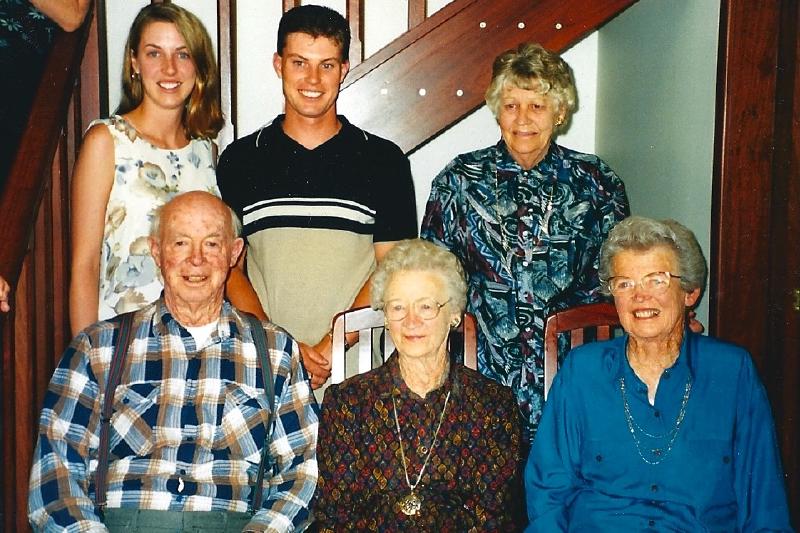
My maternal grandfather is Leslie William Atkins. Of his four grandparents, three arrived in Australia as free settlers from England. The fourth, Mary Ann Murtagh, was born in Sydney in 1821 to parents who were both transported convicts from Ireland.
Family tree: Leslie William Atkins (fullscreen)
Charles Orlando Atkins was married to Eliza Hannah Roberts on 29 January 1850, in Hobart Town, Tasmania. We have no record of him before that. He and Elisa had 12 children, of whom 8 reached maturity. He died in Hobart on 5 October 1905.
A death notice in The Mercury of 6 October 1905 tells us
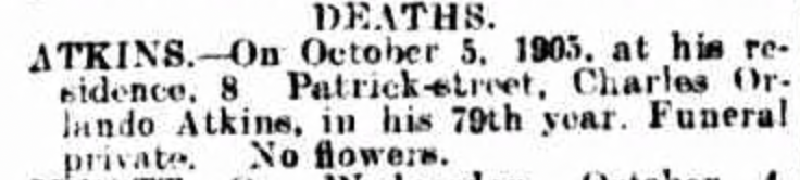
(There is a typo in the notice.) He “died in his 79th year”, which means that he was born between 6 October 1826 and 4 October 1827. His burial record tells us that he was born in England. We know no more about where he came from, nor of his coming. Ship registers are incomplete for free settlers to Hobart at that time.
He seems to use his full name wherever possible, so perhaps Orlando has some significance to him. A patron, perhaps. It is not a common English first name.
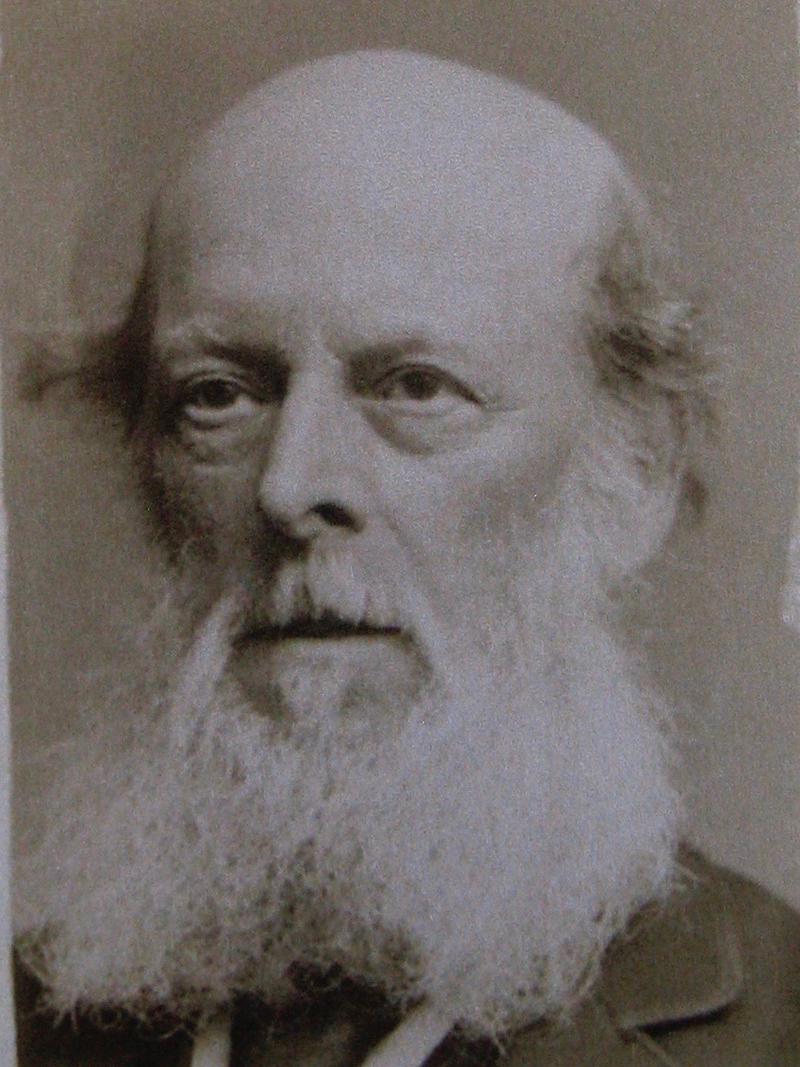
We have a photograph, from about 1894. There was an International Exhibition in Hobart in 1894-1895. A season pass cost one guinea, and required a photograph. These have survived.
At his marriage his occupation is a solicitor’s clerk. At his burial he is a law stationer. At other times, he is a bookseller, a stationer, a newspaper printer, and an accountant.
Charles seems to have taken his religion seriously. He and Eliza were married in the Brisbane Street Independent Chapel. by the Reverend Frederick Miller. He was still Independent at his burial. (Here an Independent Church means a Congregational Church). After Eliza died in 1877 he is said to have given up business and taken to his religion. He took temperance seriously, and is said to have been threatened with libel by publicans of the town.
In 1923 the Critic published a series of articles relating old Hobart. The article of 17 March 1923 included the following:
The bookshop and stationery establishment of Charles Orlando Atkins was next to O’Reilly’s. Mr. Atkins possessed high commercial ability, and after he left business devoted his attention to clerical pursuits. One of his sons is a very old civil servant, with a meritorious record, and another son has been for many years connected with the printing of a temperance paper known as the “People’s Friend.”
The first-mentioned son is Charles Richard Atkins, the second is Edwin Orlando Atkins.
Eliza arrived in Hobart (at age 1) in 1832 on the ship Thomas Laurie with her parents and her younger brother Richard (who was born on the journey).
The record is not easy to follow. There are two ships recorded on the page - we want the second. There is a list of cabin passengers, and a list of steerage passengers - we want the latter. The Roberts are the second last on the list “Mr and Mrs Roberts and 2 children”. Note that servants and children are counted but not named. Perhaps Charles Orlando arrived this way, as an indentured solicitor’s clerk.
The arrival is recorded in The Tasmanian of 16 November 1832. They are only interested in naming the the cabin passengers.
Eliza was 19 when she married. She and Charles Orlando seem to have had 12 children, of whom 8 reached maturity. She died quite early, at the age of 46. Her death certificate says she died of “asthma”, and “congestion of lungs”.
Eliza was born in Spitalfields, now an area in London but in 1831 a parish in Middlesex. Her father, Richard Lewis Roberts as born in Selattyn, Shropshire and her mother Hannah Pearson was born in Shoreditch, London. They were married in Spitalfields. They arrived in Hobart, as free settlers, in 1832. This is only two years after such immigration to Tasmania was allowed.
Richard Roberts was a well-known builder in Hobart, and took on such projects as the Hobart Hospital. He died in Hobart in 1853. His death certificate says he was 50 years of age (close enough) and the person reporting the death was his son-in-law, the trusty Charles Orlando. He was buried in the graveyard of the Congregational Church, Main Road, Hobart. So perhaps church attendance was the link between Charles Atkins and Eliza Roberts. Hannah Roberts died 20 years later, and her death certificate nominated “congestion of liver”.
Eliza was the oldest of six siblings, five of which reached maturity.
William Cooke was born in Ewhurst, Sussex in 1821, the eldest of eight siblings. The entire family (parents and all eight children) arrived in Sydney in 1838. He married Mary Anne Murtagh in 1841. He died in Blakeville, Victoria in 1883.
We have a photograph, taken from the web.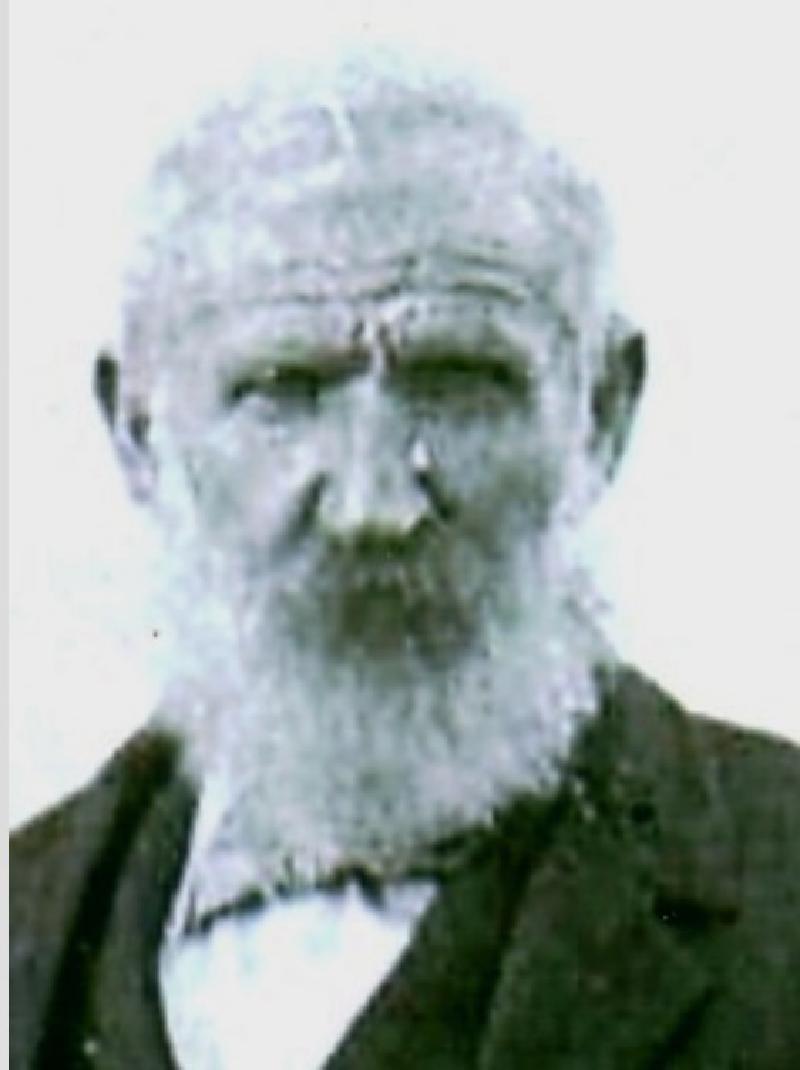
The family’s arrival is well-documented. They travelled under an assisted migration scheme whereby the cost of their passage was paid for by the Colonial Government (from the proceeds of the sale of land in the colony). They arrived on the ship Lady Nugent 0n 28 November 1839. The ship seems to have been chartered for the purpose of assisted immigration, and as government money was involved a careful passenger list was kept. The family is number 7 on the second page. Thomas Cook is said to come from “Salis” (which I take to be spelling of Salehurst in Sussex), is a “labourer”, his wife and seven children are indicated but not named (they missed one child), he is “Wesleyan”, and he unique among the 47 families on the ship in not been already engaged to work. Perhaps he was the last to be assigned to the voyage. We also find there were 4 births and 2 deaths on the voyage (one old man and one infant), and 1 birth and three deaths after arrival.
We also have the detailed immigration record for the family. Cooke family Immigration. fullscreen
With a little effort this can be read. Thomas arrived by the ship Lady Nugent and was brought by the “Government”. He is a native of “Salis, Sussex Son of Thomas Cook labourer of same place “, his calling is a “Labourer and Rough Carpenter”, his health is “Good”, his religion is “Wesleyan”, he can “Read and Write” and there have been “Not any complaints”. Mary Anne Cook is a native of “Ewhurst Sussex daughter of William Crouch shop keeper of same place”, her calling is a “farm servant”, her health is “good”, her religion is “Wesleyan”, and she can “read”. All eight children are named, with ages.
Sadly, Thomas died after little more than three months in the colony. He is buried in Cobbitty, NSW. His gravestone was erected “in memory of Thomas Cook by his affectionate son Edmund”. We have an obituary for Edmund which provides a little more detail:
Camden News (NSW : 1895 - 1954), Thursday 19 April 1900, page 4
Obituary
On the 7th inst passed away from our midst the late Edmund Cook, of The Oaks. The deceased arrived in Australia in the year 1838 with his parents who first settled at Kirkham under the employment of the late Mr. John Tooth, (Tooth and Co.) near the year 1842. The management of the farm was then under that of Mr. Sergeant, the deceased father died at Cobbitty and was buried in that old cemetery. Mr. Edmund Cook, blacksmith, was employed for many years by Mr. John Grundy of The Oaks. The deceased some 40 years ago was a blacksmith at Cawdor, near where the road turns off, subsequently occupying the blacksmithery premises now occupied by Mr. Liggins. Mr. Cook only survived his wife who died about a year ago. The funeral took place on Sunday the 8th inst and was largely attended.
The mother, Mary Anne, was left with eight children (with five under the age of 10). She married again, in 1843, to George Simpson and had one further child.
William seems to have been a carpenter, like his father. At age 20, he married Mary Anne Murtagh, the daughter of convicts. They had 11 children, of whom 10 reached adulthood. At some stage they moved to Victoria and clearly lived in Buninyong. He died in Blakeville, aged 72.
We have his will. He left an estate of less than 70 pounds. William Cooke Will. fullscreen
Mary Anne Murtagh was born in Sydney in 1821, to Charles Murtagh and Mary Regan, both convicts. By 1829 both parents were dead. She spent the years 1828-1839 in the Female Orphans School in Parramatta. She married William Cooke in 1841. She died in 1891.
Being genuine, gold-plated convicts there is a considerable amount of documentation available. It has been digitised and is available on-line.
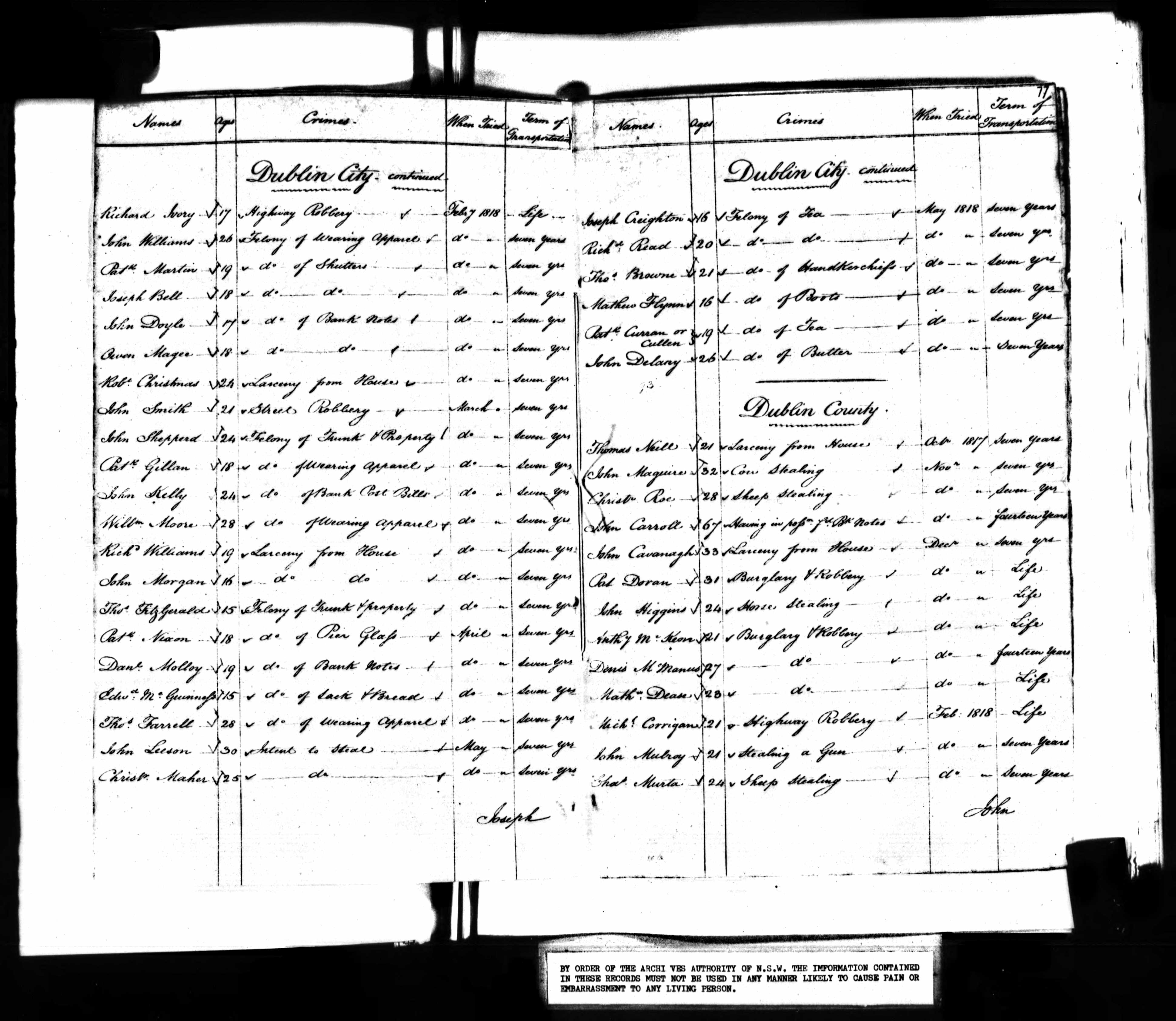
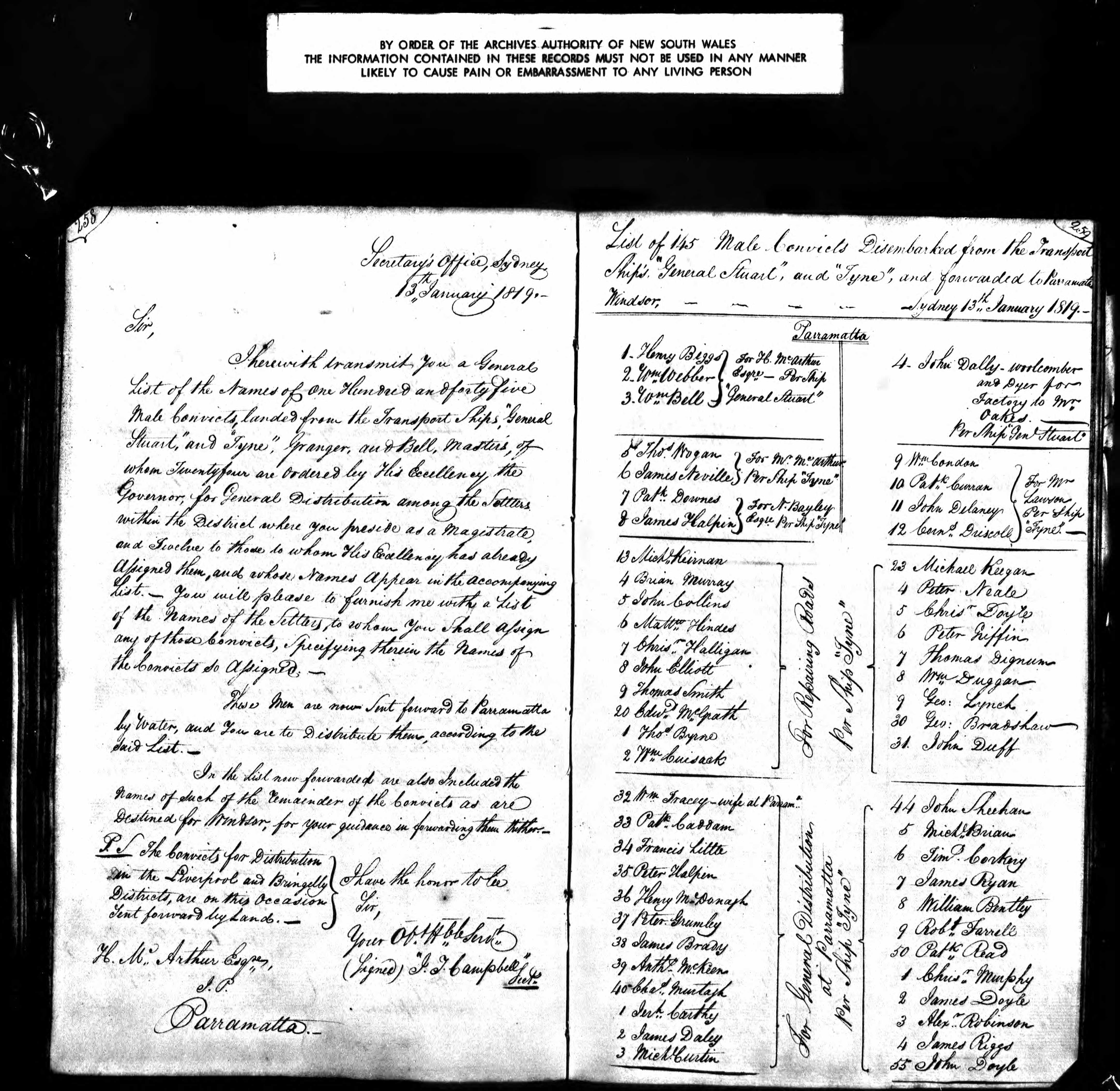
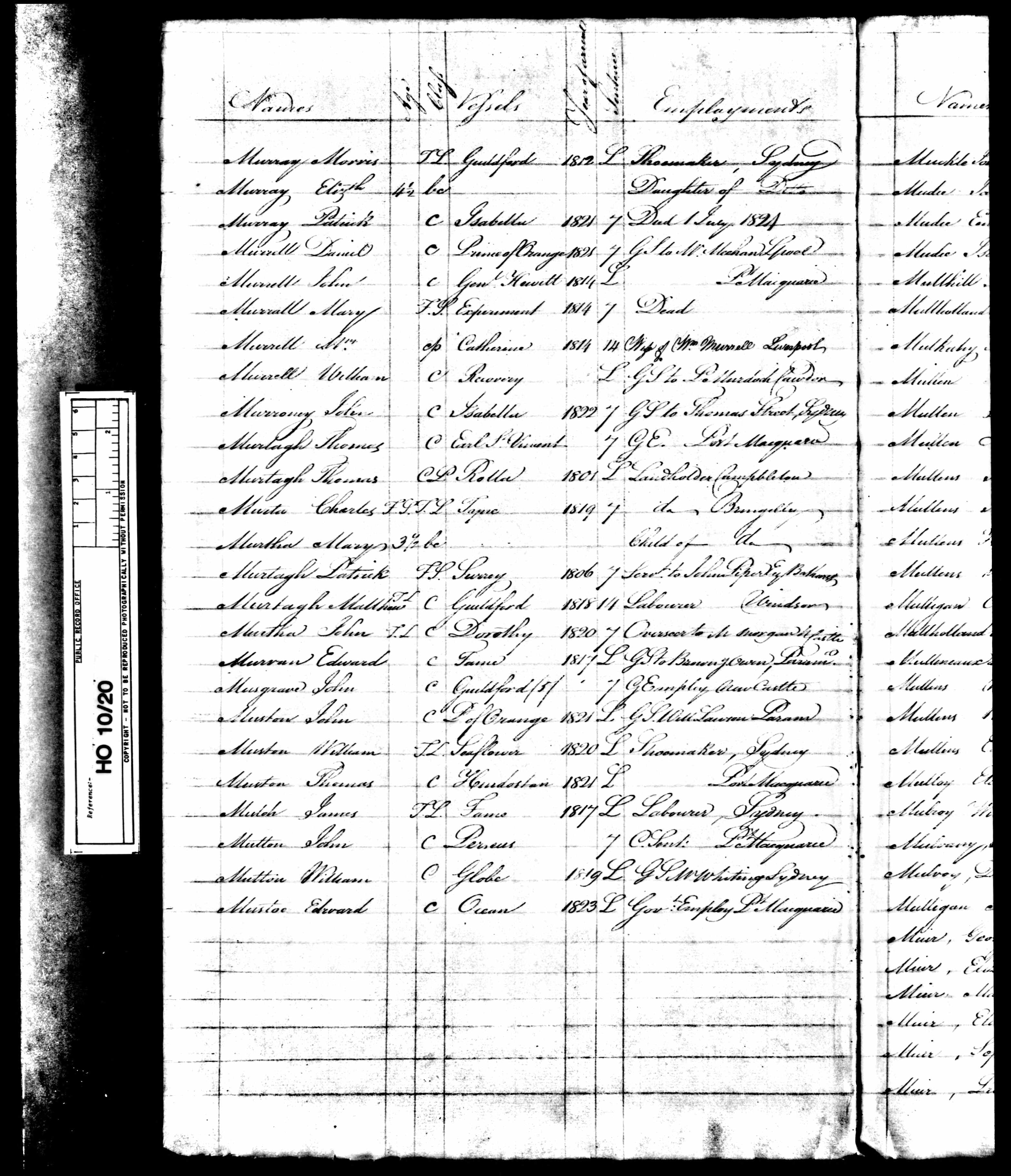
Charles Murtagh (also Murta, Murtah) is listed in the convictrecords.com.au database. From the New South Wales, Australia Convict Ship Muster Rolls and Related Records, 1790-1849 we have the ships list for the convict ship Tyne which arrived January 1819. Charles (Chas. Murta) is the last on the page. He was convicted of sheep stealing in the Dublin County Court in February 1818, and transported for 7 years. Once the convicts arrived in Sydney they were moved by water to Parramatta for assigning. A letter of 13 January 1819 from New South Wales, Australia, Colonial Secretary’s Papers, 1788-1825 lists convicts from two ships. Charles Murtagh is no 40, and is listed as being available for “general distribution”. Other convicts are down for “Repairing Roads”.
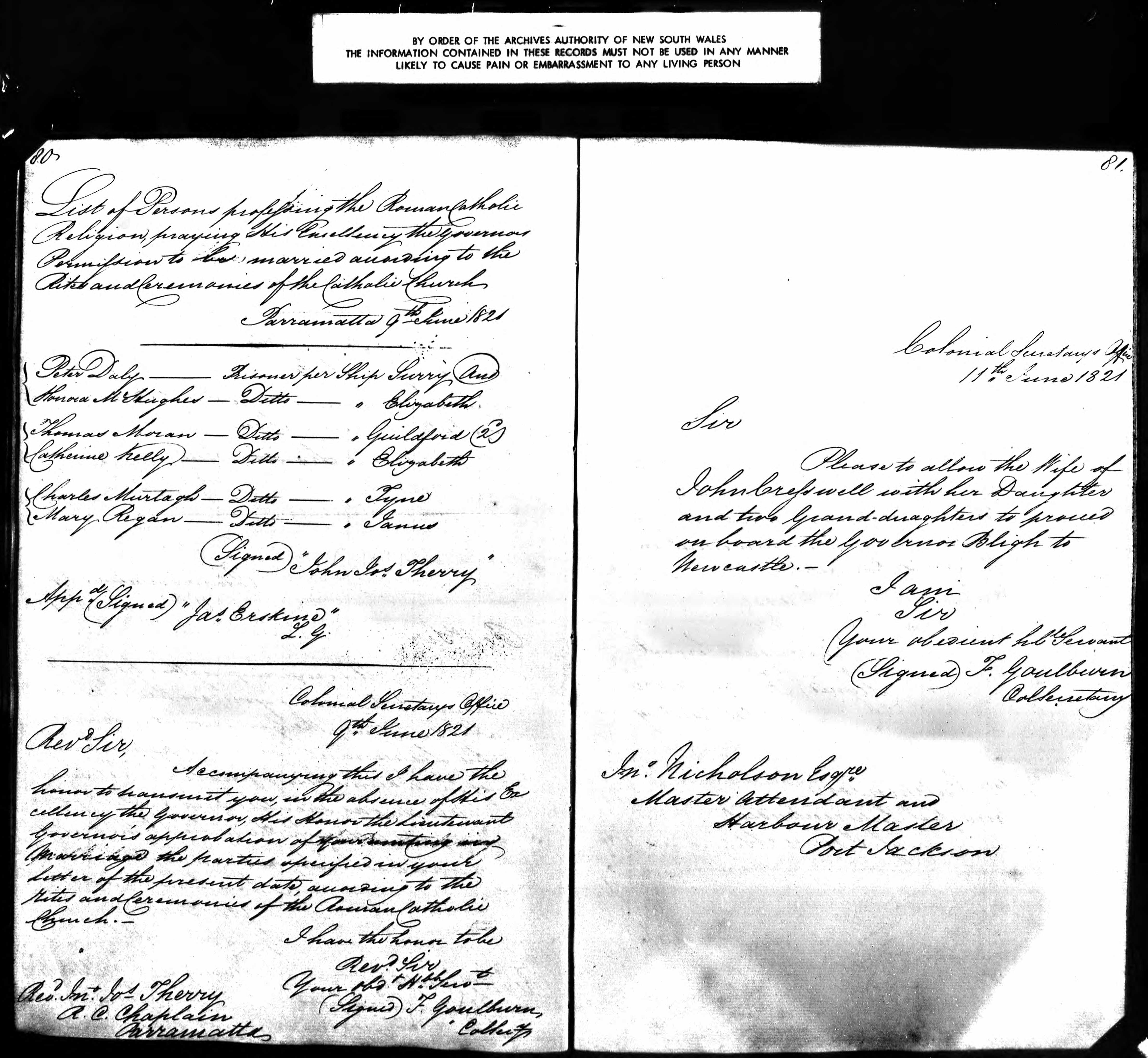
It would seem that he was assigned in Parramatta. In June 1821 he was granted permission to marry Mary Regan (in a list of three couples).
List of Persons professing the Roman Catholic
Religion praying His Excellency the Governor
Permission to be married according to the
Rites and Ceremonies of the Catholic Church
Parramatta 9 June 1821
..
Charles Murtagh Prisoner Tyne
Mary Regan Prisoner Janus
(signed) John Joseph Therry
Approved (signed) James Erskine L.G.
Here John Joseph Therry was one of the first Catholic chaplains granted permission to work in Australia. He arrived on the Janus in 1820 along with over 100 convicts (including Mary Regan).
In 1822 we have a petition for Ticket of Leave. It says in part
The Humble petition of Charles Murtoch
Most Humbly sheweth
That Petitioner was tried at Dublin
in March 1818 and arrived in this Colony on
the transport ship Tyne 1819 under sentence
of banishment for the term of Seven Years ;
That Petitioner has been upwards of three
years in the service on Mrs Shelly, and has
been principally employed in the attendance of
the native Institution, under that lady’s
management, and has most humbly to hope
that from his general line of conduct while
in the service of Mrs Shelly; for honesty, sobriety
and attention; your Excellency may be graciously
pleased to allow him to employ himself off
His Majesties stores, for the better support (?)
of his wife; by honest industry which shall be
acknowledged with gratitude and prayer by your
Excellency’s Petitioner
It is supported by Elizabeth Shelley (the teacher in charge of the Parramatta Native Institution), and one M. Laury. It would seem to have been granted. The kicker argument was the removal from the Government stores. Feeding convicts was an expensive business.
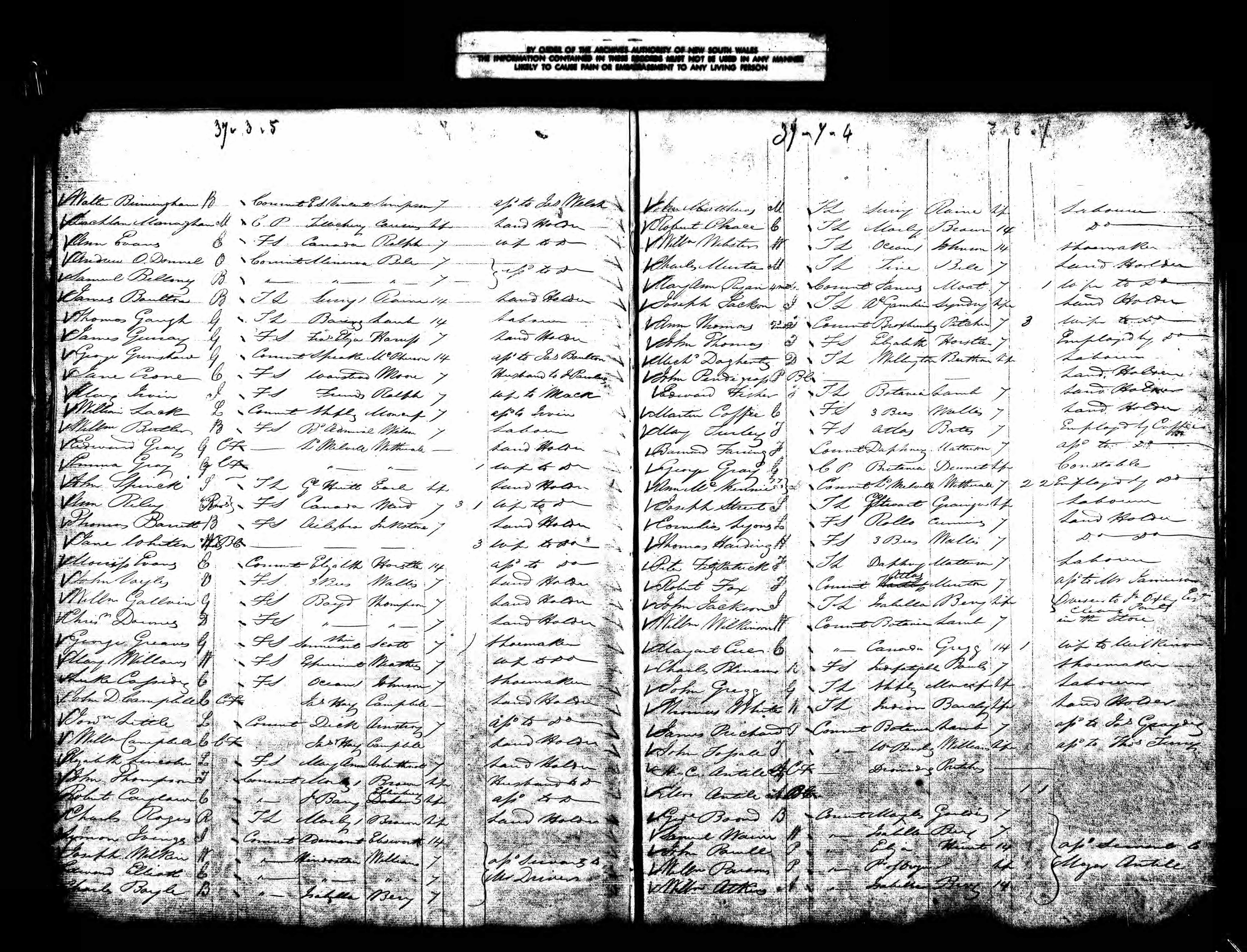
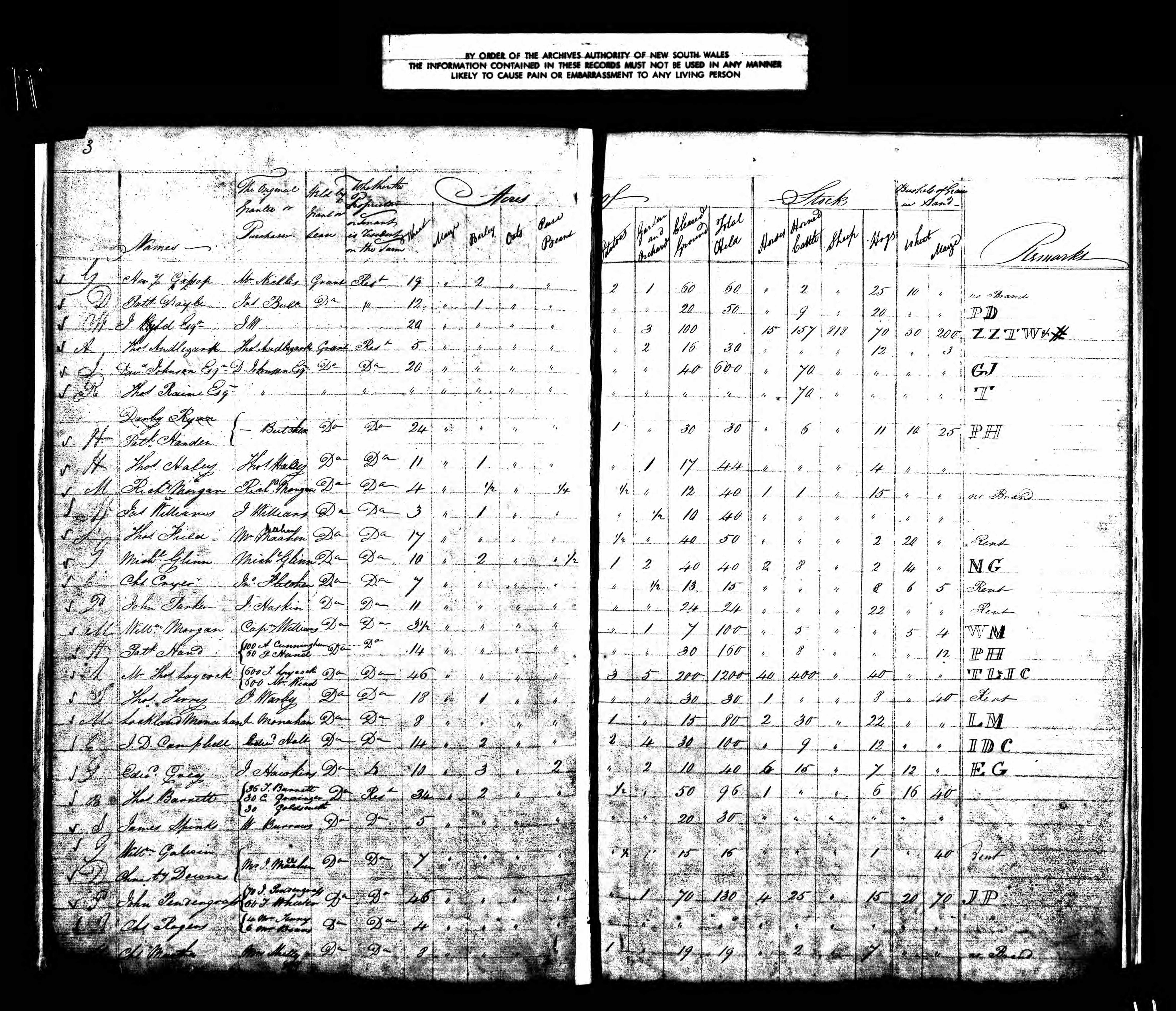
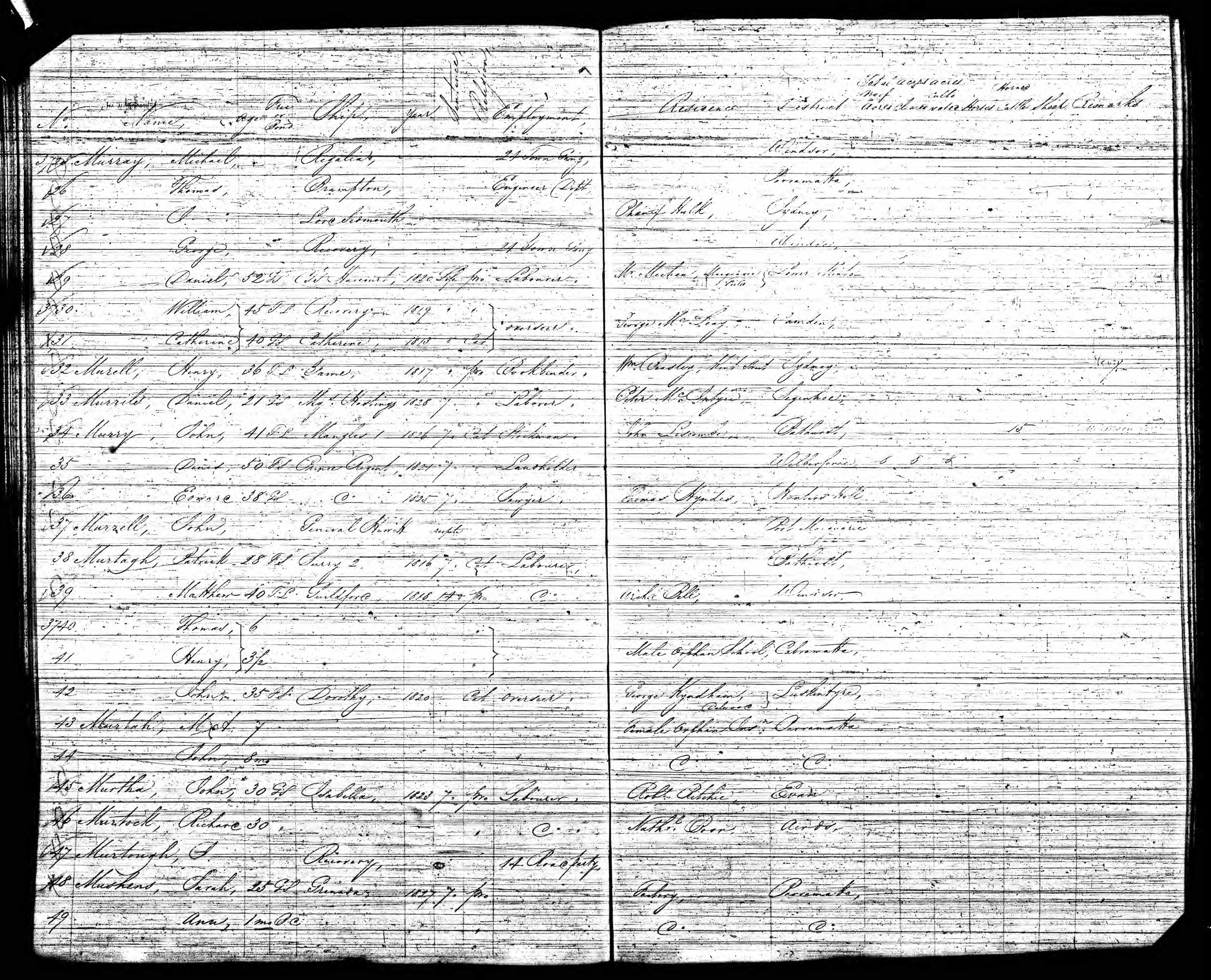
The 1822 muster gives us some information. Charles appears in the general muster (he is number 8). He also appears in two returns for the Liverpool district. He is listed in the population return (he is no 4 on the second page. He is T.L. (ticket of leave) and is a landholder). Mary Ann Regan is listed after him. She is a “convict” from the ship Janus, but is specified as the wife of Charles. maybe this was the system’s way of keeping track of her. She seems to have 1 female child (which is correct). He is listed in the land and stock return. This is hard to read as he is last on the list. He occupies land originally granted to Mrs Shelly. He is resident on the farm. He appears to have 8 acres of wheat and one of potatoes, with 19 acres in all (all cleared). He has 2 horned cattle and 7 hogs. He doesn’t have a registered brand for his cattle.
The 1825 muster provides a little more information. He is listed in the general muster (he is no 12 on the page). He is now a landholder in Bringelly. This is somewhat further out, but presumably it meant he could have more land. I haven’t managed to find out any details of the land he held (for example, whether it was land granted to him). His daughter Mary is next on the list but wife Mary is not there. Passing strange.
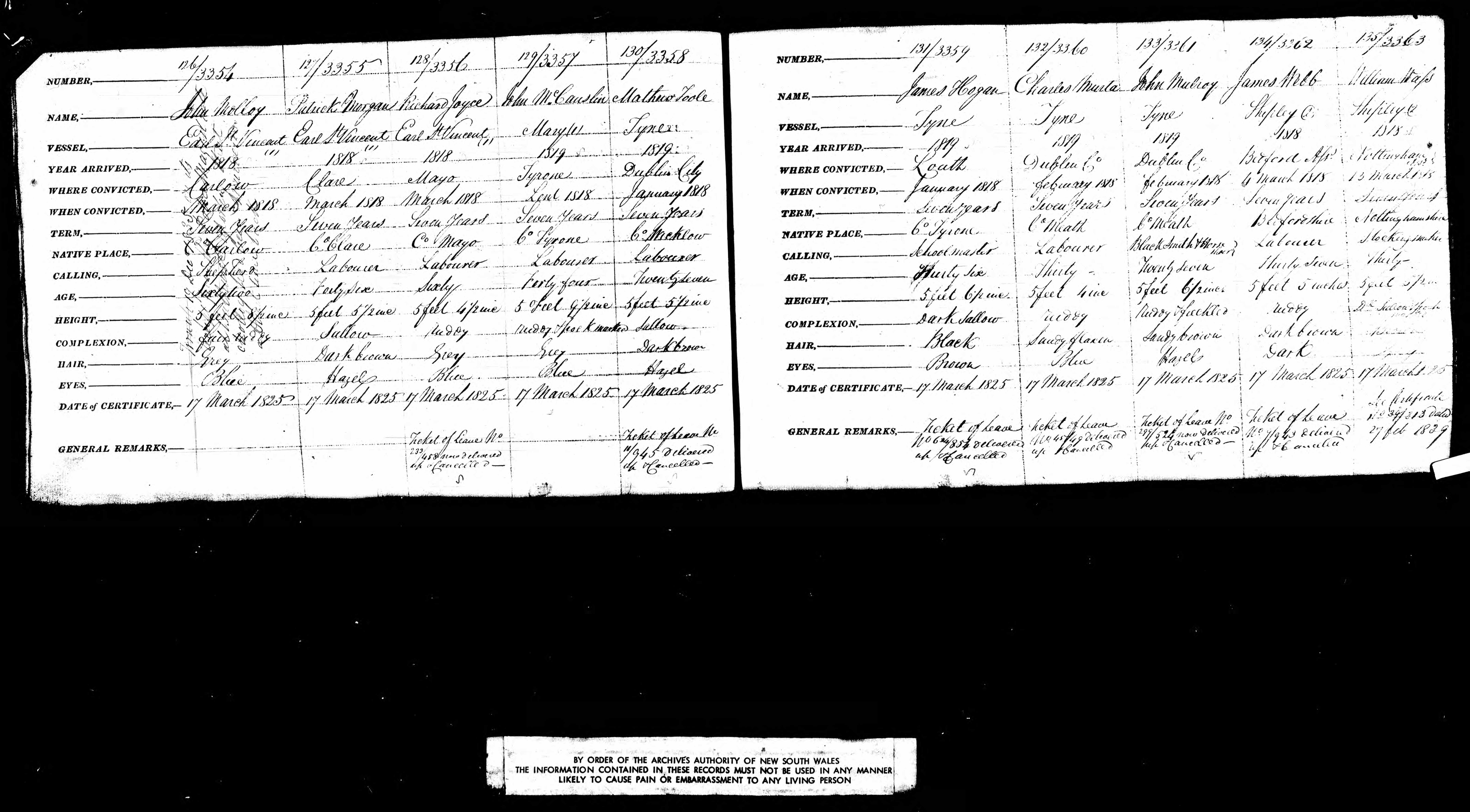
We have his pardon which he obtained once his seven years were up. We find out he is quite short (5ft 4in), is of ruddy complexion, has sandy flaxen hair and blue eyes. On receiving his pardon he had to surrender his ticket of leave. He now drops out of the official records.
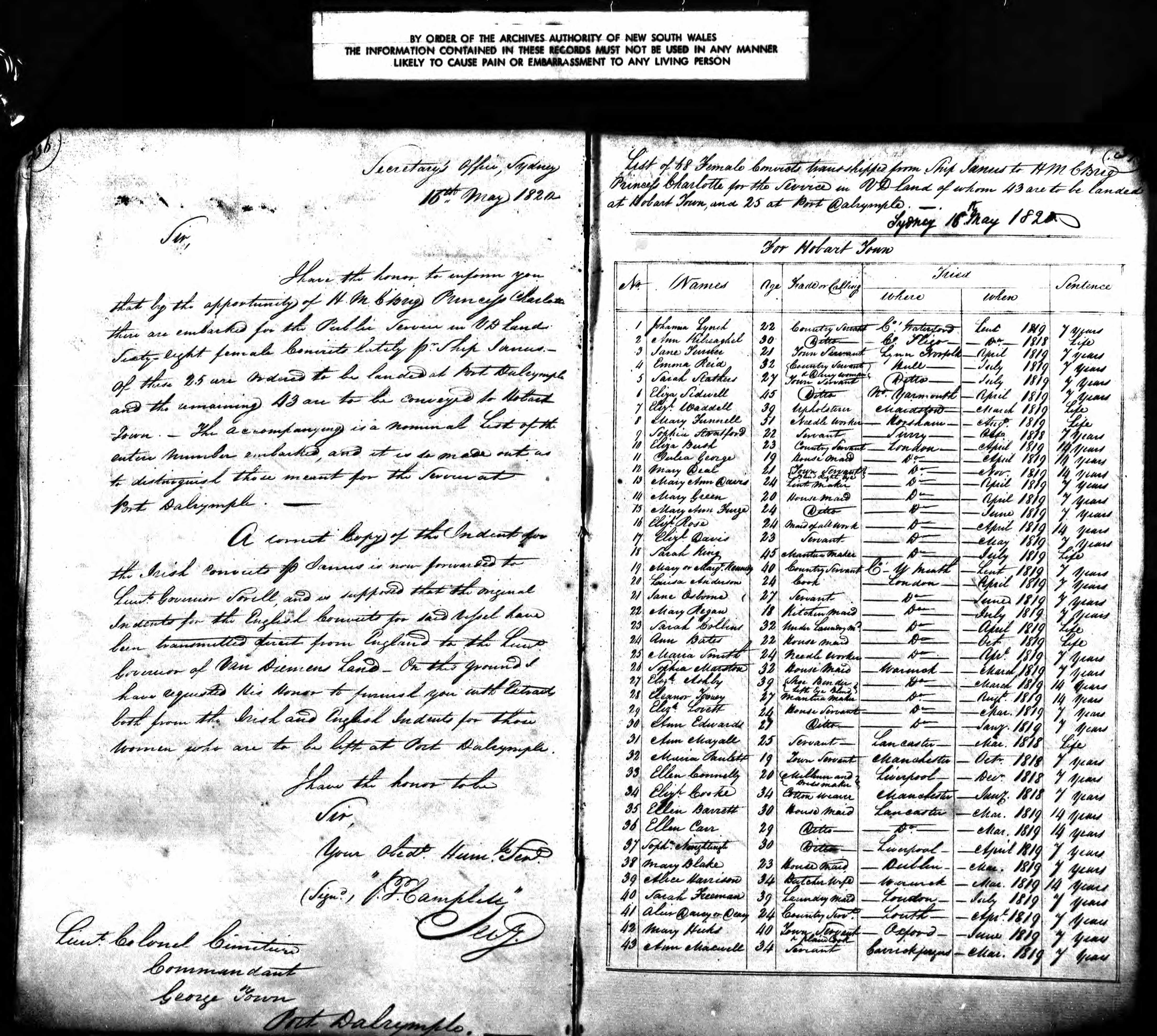
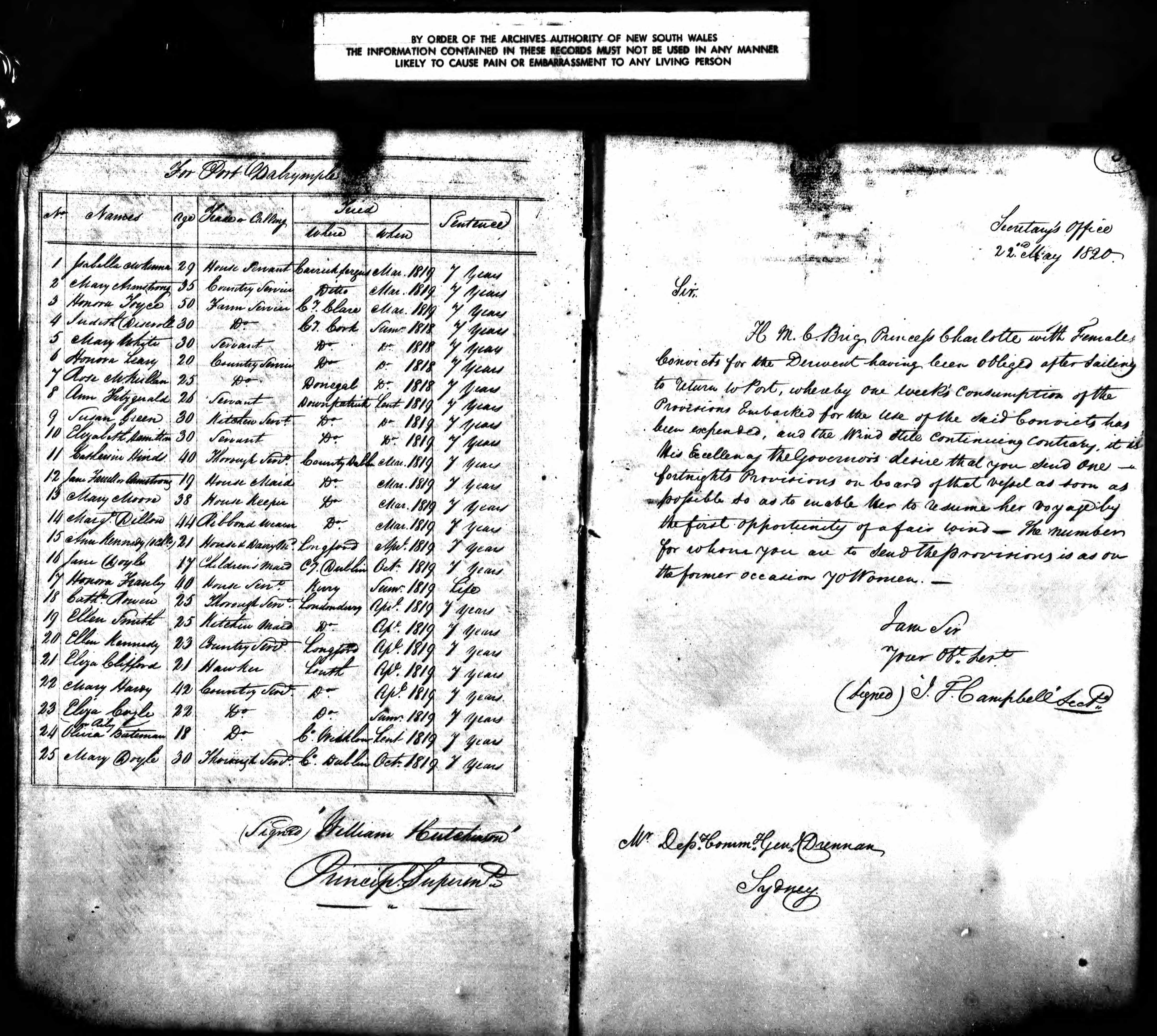
We now turn to Mary Regan. Mary Regan also appears in the convictrecords.com.au database. She arrived in Sydney on 3 May 1820 on the ship Janus. We have a document dated 16 May 1820 stating she in a group of 43 women convicts transferred to the brig Princess Charlotte bound for Hobart Town. She is number 22 in the list, and we find she is aged 18, a kitchen-maid, was tried in London in July 1819 and sentenced to 7 years.
Sydney Gazette and New South Wales Advertiser, Saturday 20 May 1820
Ship News.
Same day sailed for Hobart Town, the Government colonial brig Princess Charlotte, Captain Devine. She has on board to convey to that Settlement, most of the female prisoners that arrived by the ship Janus.
It was a slow trip. We have a report that the Princess Charlotte set out from Sydney but returned due to adverse winds. She called briefly at Port Dalrymple (Launceston) on 9 June. She arrived in Hobart Town on 23 June. It was winter, and battling south to Launceston and then Hobart would not have been a pleasant trip. Lachlan Macquarie’s diary tells us it arrived back in Sydney on 12 July. On her next trip to Hobart the Princess Charlotte left on 27 September and was never seen again.
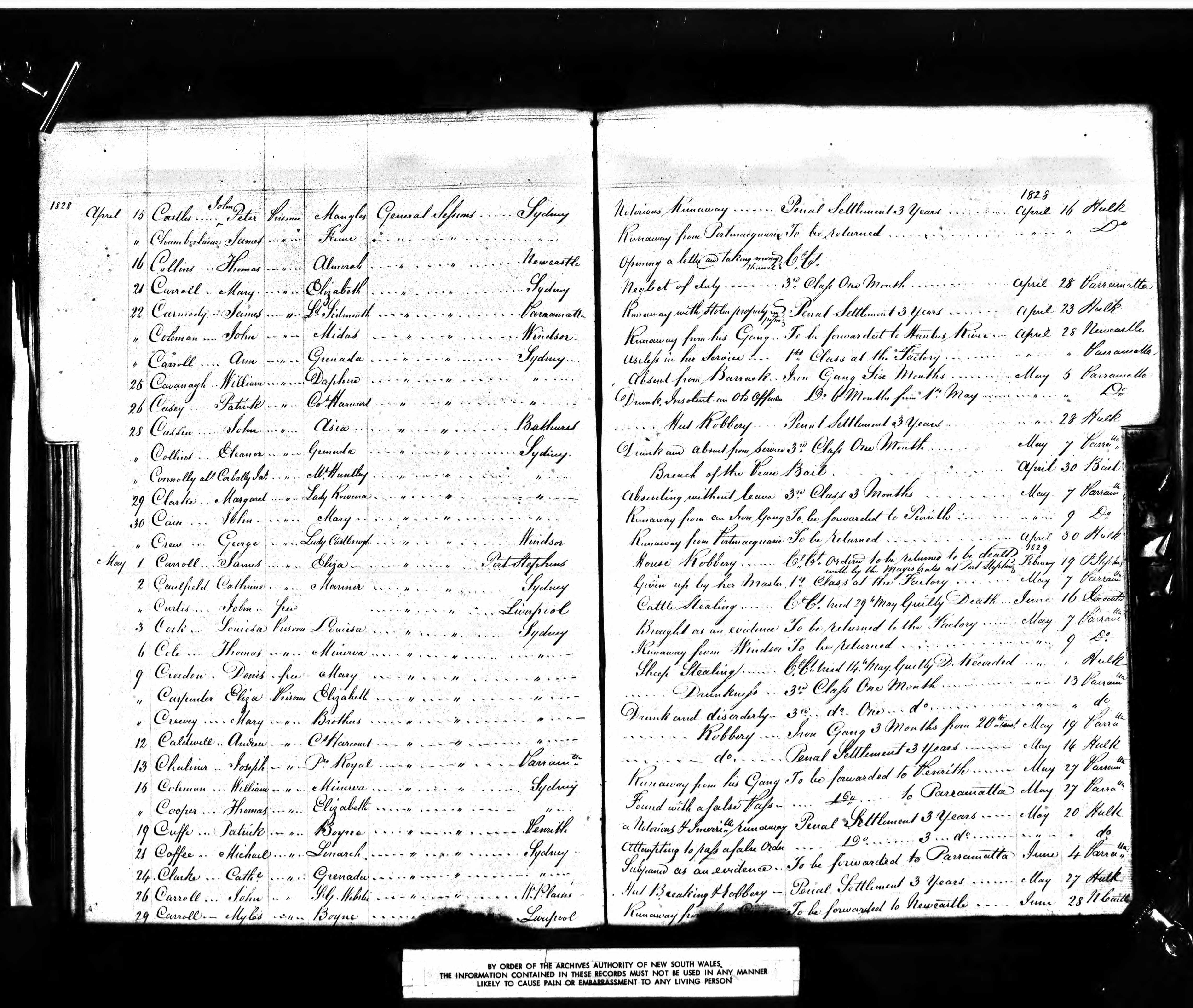
Mary Regan didn’t last long in Van Dieman’s Land. She has a record in a list of female convicts. She seems to be called Mary Ryan, but it is certainly her. By 7 July she is reported for
Drunk and disorderly and neglect of duty as servant of Mr R. Lewis. Solitary cell 14 days on bread and water.
On 2 September 1820 she has
Absconded from her master Mr R Lewis. Sentenced to be sent to the Factory at Port Jackson.
Maybe that was what she wanted all along. Here Richard Lewis was the Government Auctioneer and a substantial merchant in Hobart Town.
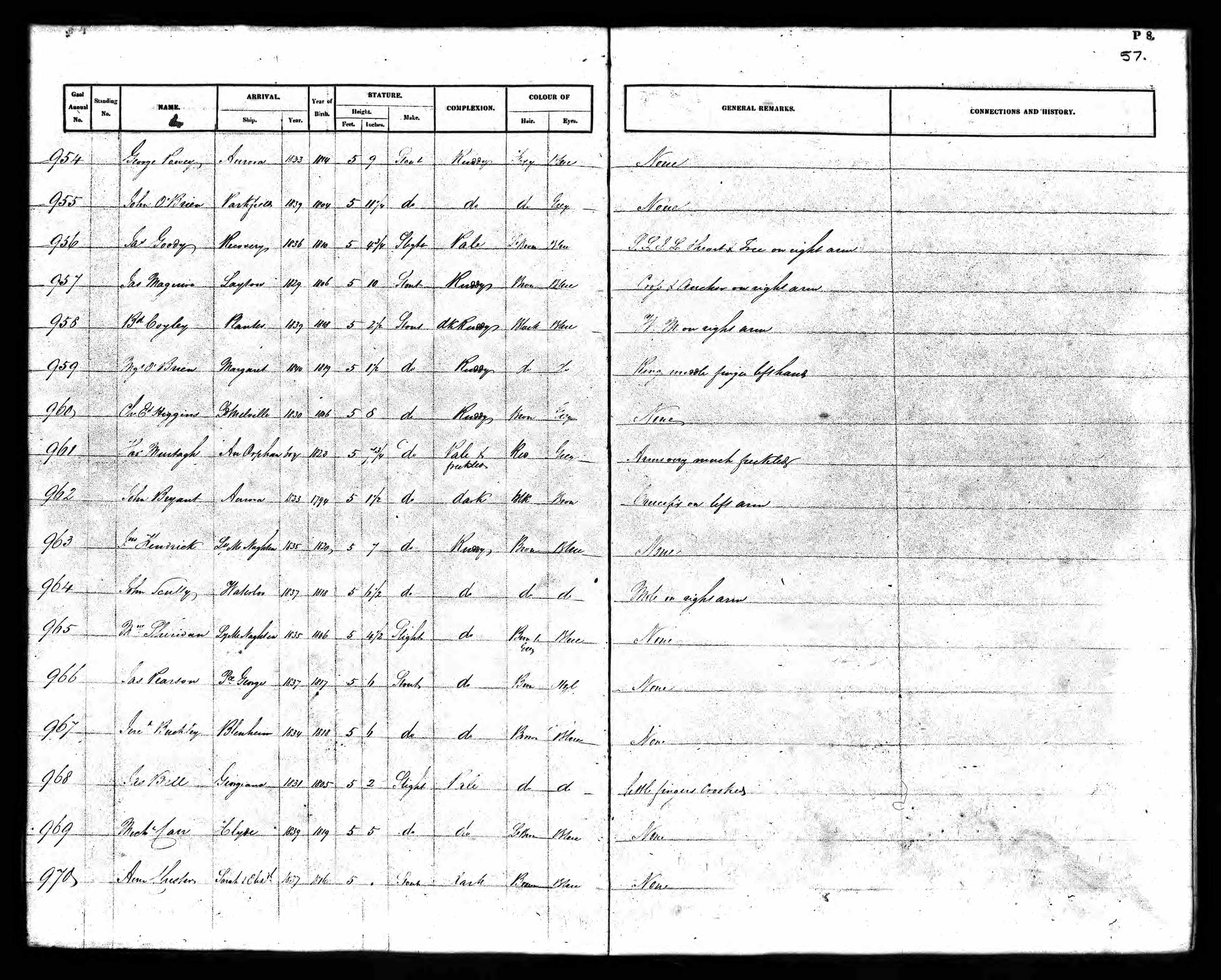
The above record comes from a remarkable document. Image 1 shows us that it is a leather-bound book. Image 2 describes it as:
Principal Superintendent of Convicts: Alphabetical record book of female convicts arriving in Van Dieman’s land: M:1803-1835, N:1803-1835, O:1803-1835, P:1803-1835, Q:1803-1835, R:1803-1835
It seems to be chronological inside each letter. Maybe the records were kept loose-leaf, two entries per page, and then bound later. It is entertaining to look at some of the other convicts. For example, Marion Patterson (image 232). Dear Marion was completely incorrigible.
Mary didn’t have to wait long. She was one of seven female convicts sent back to Sydney on the ship Morley. This ship had arrived in Hobart on 28 August from England carrying female convicts (99 days, which seems to be a fast trip for the time). She unloaded some convicts and left for Sydney on 14 September, with the rest of the convicts and the seven recalcitrants. The fact that Hobart effectively dumped the problem of the seven women back on Sydney was an issue of some discussion. An analysis of the issue is available.
We don’t have a record of Mary in Parramatta. The Female Factory as we know it today was not opened until January 1821. Maybe she assigned out in October 1820. In any event she found Charles Murtagh in Parramatta as their Permission to Marry is dated June 1821. Once married she seems to drop out of the convict records.
As just outlined, 1828 finds the family farming in Bringelly, some 25 km to the west of Liverpool. Events now take a completely Gothic turn.
The key event is a criminal trial in the Supreme Court of New South Wales. It is described in a legal report on the Australasian Legal Information Institute website.
We are interested in the timeline.
26 April: Charles Murtagh has a land-holding at Bringelly, as does one John Curtis. The latter adjoins a large holding by D’arcy Wentworth. The Murtaghs seem to be living with Curtis in a house on the Curtis landholding. Late on the 26 April, Curtis is alleged to have a killed a bullock belonging to Wentworth (finishing it off by drowning it in the Nepean river).
27 April: The Chief Constable of Bringelly, Robert Smith, with two other constables turn up at Curtis’s house with search warrants. They discover fresh cuts of beef in the house, and bullock remains outside. The bullock was identified as belonging to Mr Wentworth. All three (John Curtis, Charles Murtagh and Mary Muratgh) were taken into custody.
29 May: John Curtis is tried for cattle stealing (a capital offence) and Mary Murtagh is tried for being an accessory after the fact. Charles Murtagh is stated to have died since the arrest (in jail, one would presume). After several minutes deliberation the jury finds Curtis guilty and Mary not guilty.
6 June: After a suitable sermon, Curtis is sentenced to death.
16 June: Attended by the Roman Catholic Chaplain (Reverend Mr Power) Curtis is executed. He left a wife and several children, and is said to have possessed property in land and cattle to the value of £1,500. He was 61 years old.
I have not been able to identify John Curtis (there are many with that name in the Sydney records). His time in Sydney Goal is recorded (he is number 17 on the page).
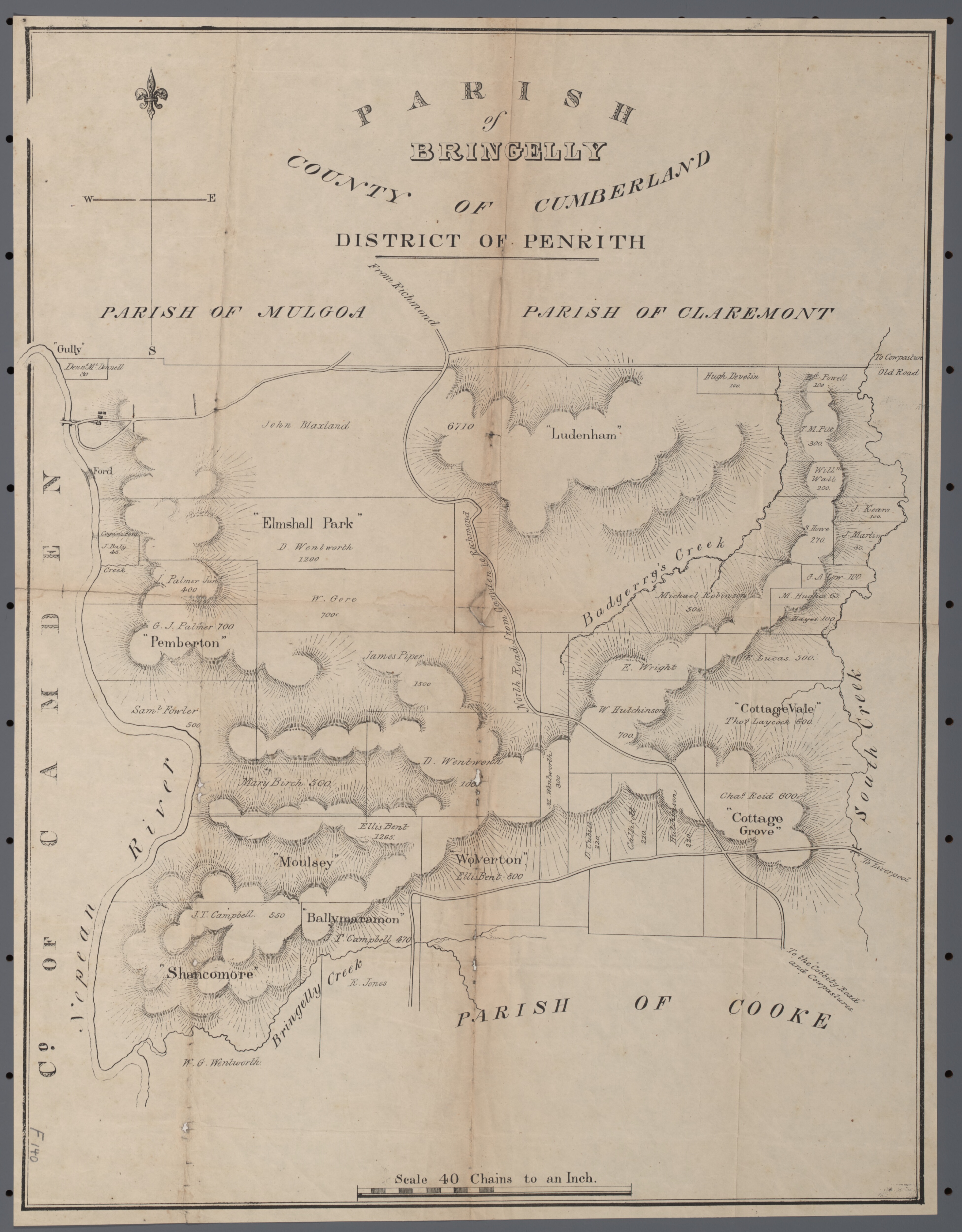
We have a map of Bringelly. The properties are labelled with the recipient of the original grant, even if the property was subsequently leased or transferred to someone else. Wentworth’s estate Elmshall Park is clearly shown. The trial narrative make sense if the properties labelled J. Baly and J. Palmer were occupied by Murtagh and Curtis. The land to the west of the Nepean River had not been released in grants. This would have been Curtis’s “cattle run”.
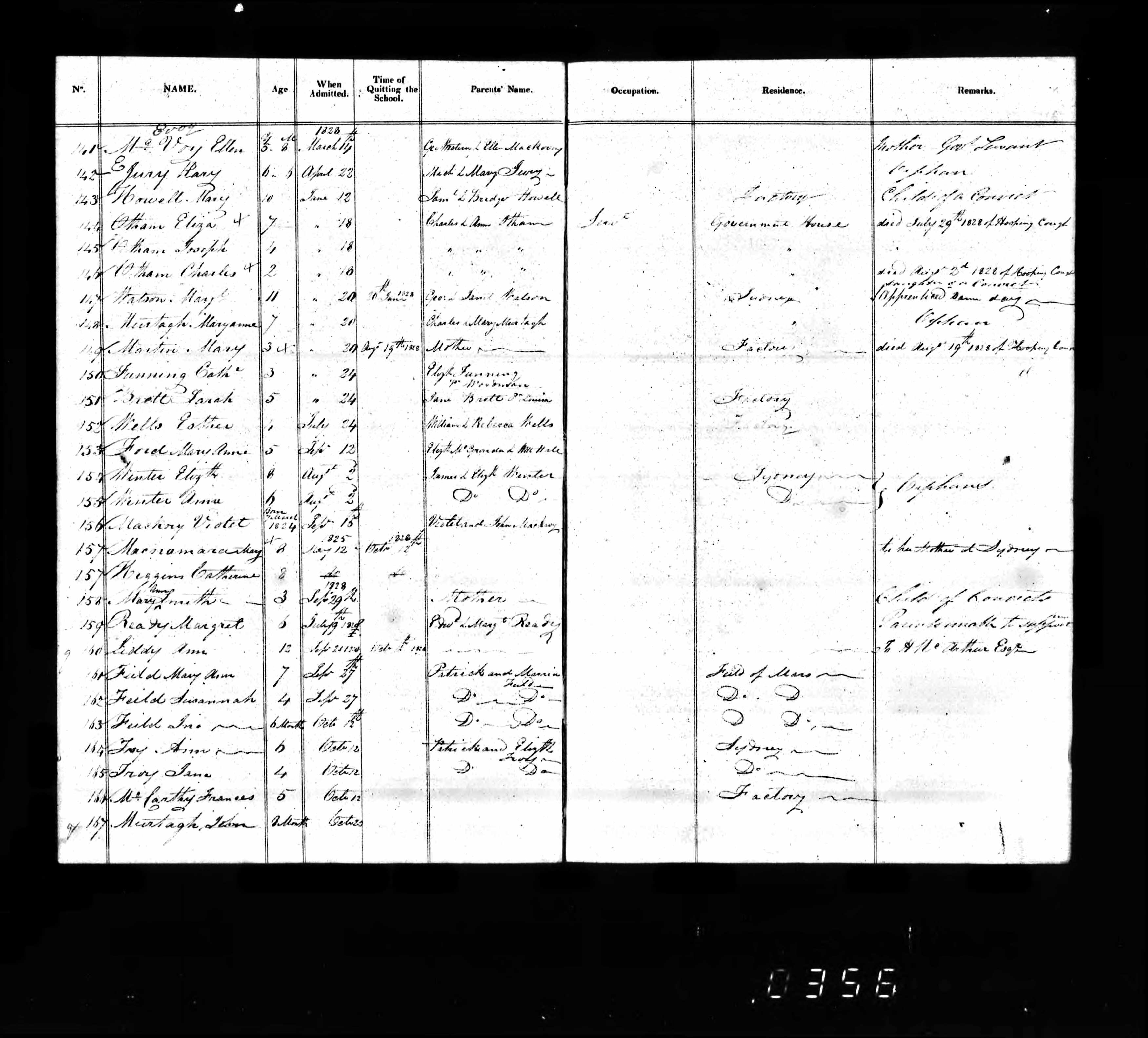
The worst is yet to come - what happened to the four Murtagh children? The three eldest children (Mary Ann 8, Thomas 3, Henry 2) were admitted to the Girls Orphan School and the Boys Orphan School, respectively, in June. We have the application and supporting documentation which was put together on 17 June, and received by the Trustees on 20 June. It is worth making some details clear. The application itself says
The humble Petition of Mary Ann Murtah in behalf of Mary Ann, Thomas and Henry Murtah sheweth that the said are the children of Charles and mary Murtah. That the father died about six weeks since and that he has left nothing to support the said children whatsoever.
It is signed by Mary, with her mark. She obviously could not write. Heaven knows what upbringing she had. A footnote says that the children were all christened by Rev Mr Therry (who had married the parents in 1821).
There are two supporting statements.
Catherine Tribe wife of George Tribe Settler of Bringelly came before me John Coghill Esquire one of His Majesties Justices of the Peace for the said Territory and this day maketh oath and saith that at the time of Mary Murtagh’s commitment for trial this deponent was requested by the Bench of Magistrates at Bringelly to take under her care three children belonging to the said Mary Murtagh that this deponent has had charge of the said children upwards of five weeks that their mother Mary Murtagh has been acquitted of the charge that was against her and has been released from prison nineteen days but having never been to inquire after her children this deponent is of the opinion that she has forsaken them. Deponent further saith that the Father of the children is dead and there is no money of their support left
(signed) Catherine Tribe
Sworn before me this 17 June 1828
(signed) John Coghill J.P.
Robert Smith Chief Constable of Bringelly came before me John Coghill Esquire one of His Majesties Justices of the Peace for the said Territory and this day maketh oath and saith that nineteen days since Mary Murtagh was tried at the Supreme Court and acquitted on a charge of cattle stealing that at the time of the said Mary Murtagh’s committal for trial her three children were left in the care of Mrs Tribe of Bringelly that nineteen days having elapsed since she was acquitted and having never been near to enquire after her children this deponent believes she has forsaken them - deponent further saith that the father of the said children is dead, and the said Mary Murtagh their mother is a woman of a bad character
(signed) Robert Smith
sworn before me this 17th day of June 1828
(signed) John Coghill J.P.
The system had carted the parents off to jail but had at least looked after the three eldest children, and was now arranging their transfer to the Orphan Schools.
The youngest, barely several months old, had obviously gone with the mother into custody if not into goal. The authorities in Sydney took the child off Mary and placed it in the Girls Orphan home. The application is undated and not made by Mary - maybe she had abandoned the child. It is, interestingly enough, signed by Mrs Darling, wife of the Governor Sir Ralph Darling. In his biography it is said of Eliza Darling
Although occupied with her own nursery and painting, she still found time to entertain hospitably, to write comforting letters of sympathy and encouragement, and to preside over many benevolent committees.
A record in the Admission Book for the Female Orphan School shows John was admitted on 20 October.
The census of 1828 (dated November) provides an entry for the Murtagh children. Thomas and Henry (numbers 3740, 3741) are in the Male Orphans School, Cabramatta and Mary Ann and John (numbers 3743, 3744) are in the Female Orphans School, Parramatta. Charles is dead, and Mary doesn’t seem to be listed (at least, she is not in the index).
Mary seems to have died in 1829 (there is a death record for Mary A Murtagh, for St. Mary’s Church). In any event, she never reclaimed her children.
Having identified how the children arrived at the Orphan Schools, how did they get out?
The baby is, sadly, the easiest. John died in January 1829, and was buried in the cemetery of St John’s Church, Parramatta. Click M in the index and find Murtagh.
The boys are listed as “quitting the school” on 12 Apr 1836, to “Mr John Burke”. In fact more is available. We have an application dated February 1836 from a Mr John Burke, Catholic, Farmer of Fairfield, County Murray, for two boys to be trained in the calling of “farmer”.
Mr John Burke (born in Ireland) turned up in Sydney in 1830 with a family, from Rio de Janiero with a “Brazil fortune”. Like most such immigrants, he applied for and was awarded a land grant.
(New South Wales Government Gazette, 17 Aug 1836)
Colonial Secretary’s Office,
Sydney, 15th August, 1836.
GRANTS OF LAND.
THE following descriptions of Grants of Land, with the names of the Persons to whom they were respectively promised, are published for general information, in order that all parties concerned may have an opportunity of correcting any errors or omissions which may have been made inadvertently. And Notice is hereby given, that at the end of three months from this date, unless written Caveats be previously lodged at this Office, Deeds of Grant will be prepared accordingly.
MURRAY.
78 - JOHN BURKE, 2560, Two thousand five hundred and sixty acres, parish unnamed, at Krarwarre ; bounded on the south by a line west 326 chains, commencing at the north-east corner of G. C. Curlewis’ grant ; on the west by a line north 60 chains ; and on the north by a line east 308 chains ; and on the east by the Shoalhaven River, to the north-east corner of G. C. Curlewis’ grant as aforesaid.
Promised on 19th July, 1831, by Sir Ralph Darling, and possession authorised on the 27th September, 1831, as a Primary Grant.
Quit-rent, £21 6s. 8d. sterling, per annum, commencing 1st January, 1839.
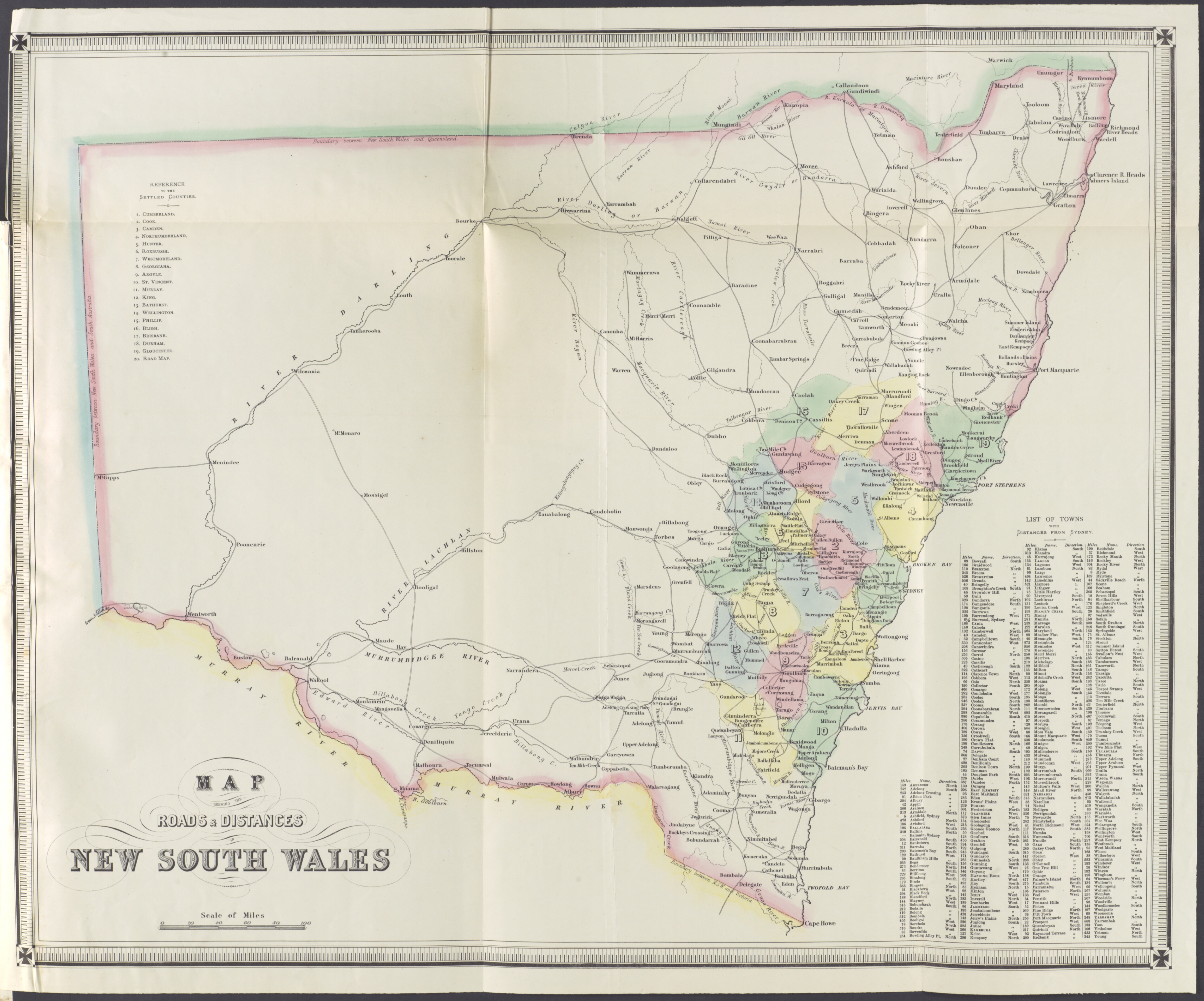
The farm was at the end of the known world, about 50 km south of Braidwood on the headwaters of the Shoalhaven River. Murray was one of the 19 counties of NSW. Official land grants applied inside the 19 counties; outside that were the squatters.
It was just to the north of Curlewis’s grant. Curlewis was selling his farm in 1839. The following advertisement shows that real-estate optimism was as prevalent in 1839 as it is now.
(Sydney Morning Herald, 25 Dec 1839)
Extensive Estate and Homestead on the Shoalhaven River for Sale.
The valuable Estate of Krarwarre, in the County of Murray, the Properly of Mr. Curlewis, containing three thousand three hundred and thirty acres of Land; bounded on the east by the Shoalhaven River; to which it has a frontage of nearly two miles and a half; on the west by the Croomeir Creek a never-failing stream, which during the late drought always ran as strong as in ordinary seasons ; on the north by Mr. Burke’s grant ; on the south by a line being the boundary of the Colony.
The whole of the Land is richly grassed, and there are cleared alluvial flats on the bank of the river, affording sufficient cultivation for the wants of a large establishment ; besides the running water at the east and west boundaries, there is a chain of ponds running through the centre of the Property. The District is remarkable for the certainty of the crops, the Proprietor last year, notwithstanding the failure of the harvest else-where, having reaped thirty bushels per acre, and in eight years having had but one failure, and that from frost. About seventy acres of Land are in cultivation ; there are upwards of a thousand rods of three and four-rail Fencing, and a large Grazing Paddock.
The Buildings consist of a comfortable slab Cottage, rough plastered inside and out, shingled and floored, having five rooms, a store and passage ; three of the rooms have stone chimneys. Also, of an unfinished stone Cottage, containing a dining room and a drawing room, each eighteen feet by fourteen feet, a hall, spacious verandah, six bedrooms, and a cellar ; there are fireplaces in six of the rooms The Cottage is roofed and shingled, and three of the rooms, with the hall, are floored, There is an excellent Garden of two acres, stocked with fruit trees in full bearing. Also, a temporary kitchen, a barn, men’s huts, &c , and a large substantial five-rail stockyard, with milking bails, calf-pen, &c.
This Estate, being situate at the extreme limits of location, commands a most extensive and excellent run for Sheep and Cattle outside the boundaries, the right to which will be transferred to the Purchaser of the Property. The run is watered by four running streams, and upon it are erected a substantial five-rail stock yard for a thousand head of cattle, stockmen’s and shepherd’s huts, &c.
Terms - One thousand pounds in Cash, or approved bills with interest; the residue may remain at interest at ten per cent, per annum for seven years.
Title - Grants from the Crown; the primary Grant, two thousand five hundred and sixty acres, being subject to a quit-rent of £21 13s 4d. per annum ; the remainder free of quit-rent.
This Property would be very well suited lo any Immigrant of moderate capital requiring a Homestead, and a run sufficient to keep all his Stock immediately about him. It is situate about twenty-five miles from the sea, a fine view of which is to be had from the mountain in the rear. It is also about thirty miles from Maneroo by the mountain road. Should the contemplated road to Bateman’s or Jervis’ Bay be carried into effect, it will very materially enhance the value of the Property. Almost immediate possession can be given.
Note: Maneroo is an old spelling of Monaro.
Burke died in 1847 - he seems to have given up the farm by then.
A 1872 map shows the counties and indeed shows Fairfield. Find Braidwood and go about 30 miles south. Fairfield was never a town, but was a postal area.
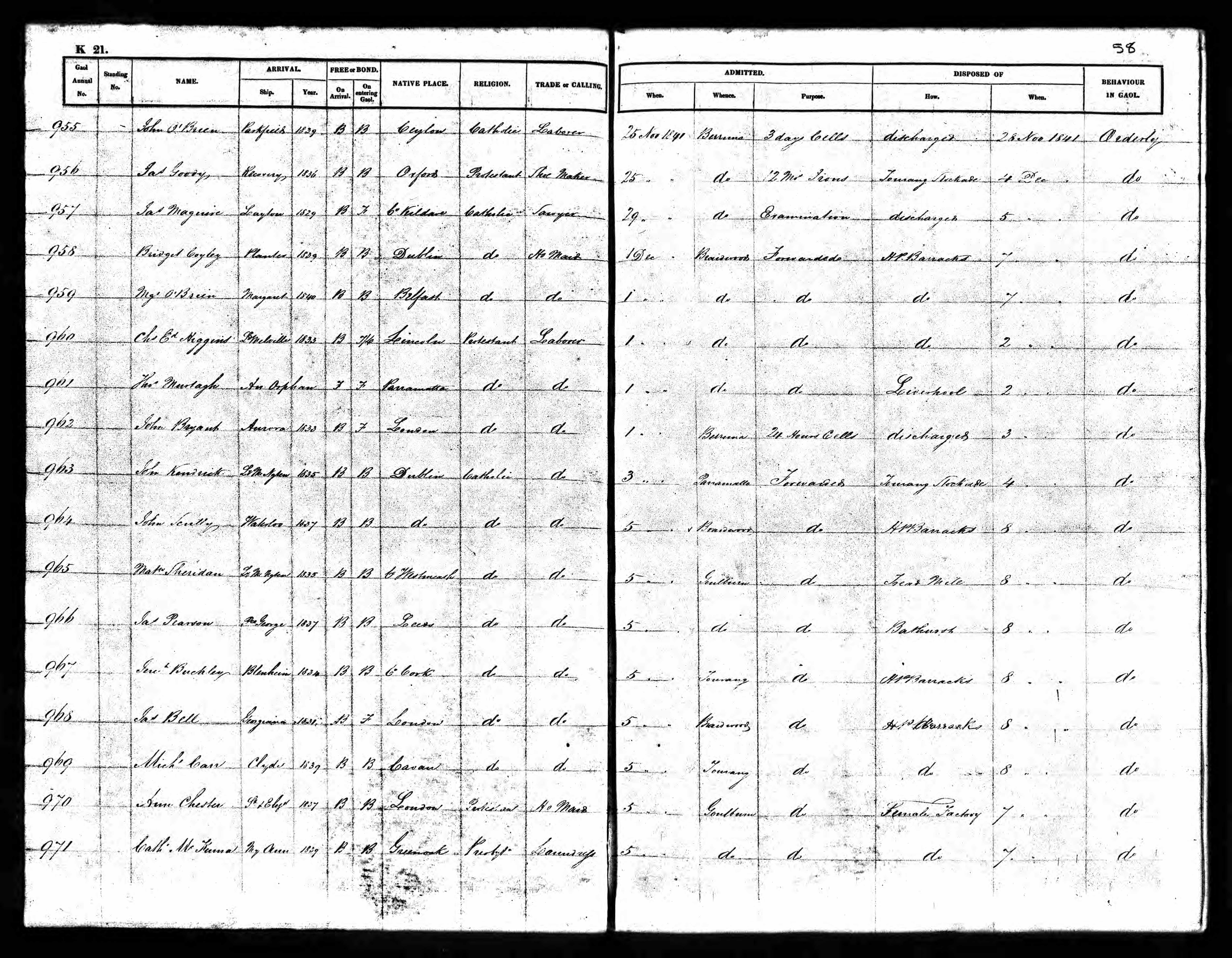
On 01 Dec 1841, Thomas Murtagh “an Orphan” passes through Berrima Goal, listed as coming from Braidwood Goal, and being transferred to Liverpool Goal on the next day. The document provides a detailed description of Thomas (they didn’t have photos). He is number 961. He is listed as “an Orphan Boy”, while all the other prisoners on that page are convicts. Braidwood Court records aren’t available, so we don’t know his offence.
He and Henry then disappear from the records. NSW death records start about 1850. Before that, churches kept burial records. But if you died in the bush, or on a remote farm, you would have been buried locally without any record.
Mary Ann got lucky. She was one of a small group of girls who were kept on at the School to work (cheap labour) rather than being apprenticed out at age 12. This letter from 1834 lists her (at age 13) as “one of the girls who do the work in their turns of washing and cleaning .. “. She is listed as being able to read (but not write). In 1839 she is listed as a cook at the School. She was married two years later.
We haven’t any specific information about her after her marriage. This branch of the family was unknown to us when I was growing up, on the other side of the country. I am not sure that the identification of convict ancestors would have been then regarded as a plus. Now, it is a regarded as a considerable badge of honour.
In order to show the full range of partners and siblings we need another family tree:
Charles Orlando Atkins (descendants) (fullscreen)
Alfred was the fourth of the eight surviving Atkins siblings. He was born in Hobart in December 1856, Eliza’s fifth pregnancy in just under seven years.
One wonders what education they had. The education system in Tasmania in the nineteenth century was poor. Compulsory education was not introduced until 1868 (it was compulsory but not free), and an education Department was not set up until 1885. Maybe the Atkins children went to a church school.
Alfred seems to have been the only one to have left Tasmania. He is in Melbourne by 1880 (The Age, 31 May 1880, page 2)
The following cases have been admitted to the Melbourne Hospital : — On the 29 th inst. Alfred Atkins, aged 24, residing at Hoddle-street, Richmond, suffering from an injury to the hip, which he received from a fall. He was repairing the roof of the Colonial Bank Hotel last Saturday when he fell a distance of 25 feet.
For most of his life he seems to have been a waiter. In 1903 a report has him as the chief waiter at Hosie’s Hotel at the corner of Flinders and Elizabeth Street in the city of Melbourne.
He is the first person in this chapter of whom we have a family memory. He was my mother’s grandfather, and she remembered him visiting Bunbury in his retirement. She said he was a dapper little man, very particular with his appearance.
The South Western Times of 21 December 1920 reported that
Mr. Alf. Atkins, father of Les, the genial proprietor of the Bunbury baths, arrived recently from the Eastern States and will remain in Bunbury for some months. He is a remarkably athletic old gentleman and can show many of the budding swimmers a few points. He has been approached with regard to starting a class for non-swimmers.
He was 64 at this time, and his wife had died some seven years before.
In the end he seems to have stayed over six years (South Western Times, 14 April 1927):
The many friends of Mr. A. H. “Dad” Atkins, who left for Melbourne (Vic.) on the Katoomba for the purpose of undergoing an optical operation, will be pleased to learn that he is progressing favourably.
The Williamstown Chronicle of 22 October 1932 gave him a short obituary:
A. H. ATKINS. A well-known resident of 45 Cecil street, in the person of Mr. Alfred Henry Atkins, died on Tuesday morning at his residence, after a brief illness. Born at Hobart, Tasmania, 74 years ago, deceased had resided locally for about 40 years. The funeral, largely attended, took place on Wednesday afternoon, leaving his residence for interment in the local cemetery. Ernest W. Jackson was the undertaker, and the Rev. J. Walker held a house service and officiated at the cemetery.
Brief Notes on his siblings:
Charles Richard Atkins (1851-1940). A distinguished civil servant. Married Mary Sealy in 1879. Six children, who all stayed in Tasmania.
Edwin Orlando Atkins (1852-1930). Seems to have been a bachelor. His will divides his estate between his two sisters, Florence and Edith Elinor. Publisher of the monthly temperance broadsheet Peoples Friend. Sadly, this has not been digitised.
Eliza Jane Atkins (1855-1934). Married Richard George Burn, three children. Died 1930 in the Mental Diseases Hospital, New Norfolk. Richard Burn seems to have remarried in 1902. Maybe Eliza Jane was mentally ill after her last child in 1895.
Ada Atkins (1861-1923). Spinster. Address: 8 Patrick Street, Hobart.
Florence Atkins (1862-1948). Spinster. death notice. The last of the generation.
George Herbert Atkins (1865-1916). Married late (age 41). One child (Beryl Joyce), who seems to have looked after her maiden aunts. Died at age 49.
Edith Elinor Atkins (1867-1942). Spinster. death notice.
(to be written)
Of the four siblings in this generation, three moved to Bunbury, and two (George and Leslie) stayed. Because of the role the town has in this part of our story, some Bunbury Notes are provided as a separate page.
George Arthur was born in Carlton, an inner suburb of Melbourne, in 1881. He married Abigail May (Dolly) Braund in Bunbury, WA, in 1903. He and Dolly lived in Bunbury all their lives, George dying in 1958 and Dolly in 1971. They had 16 children, of whom 13 reached maturity.
I have one photograph, showing 12 of the children.
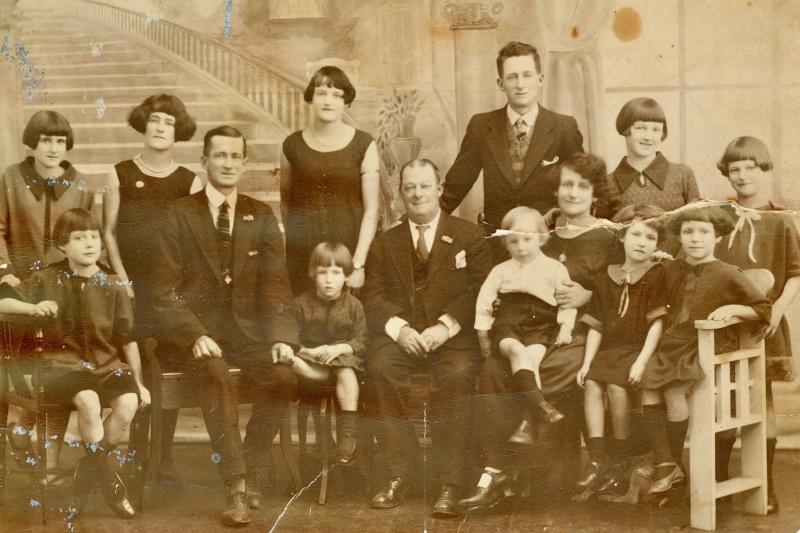
An article in the South Western Times of 27 July 1944 in informative. It shows a photograph of the 10 girls in the family, with the caption:
Back Row (left to right): Betty, Maud (Mrs. H. Gardiner, Kellerberrin), Hazel (Mrs. Proud, Perth), Winnie (Mrs. F. Mills, Bunbury), Nancy (Mrs. Colin McDougall, Perth). Front Row: May (Mrs. Tonkin, Fremantle), Isabel, Alice (Mrs. B. Brady, Cue), Pauline, Dorothy (Mrs. Pat Molloy, Bunbury).
It tells us
A FINE FAMILY. The ten daughters of Mr. and Mrs. Geo. Atkins, of Moore street, Bunbury, and two sons, Gunner Tom of the A.I.F., and Keith (Fremantle), complete the family. Another son George, well remembered in Bunbury, was accidentally killed some years ago, and three girls died in infancy. Mrs. Atkins, then May Braund, arrived in Bunbury in 1895; five years later George arrived, and in 1903 were married, and have lived at their present address ever since. “Geordie” Atkins is one of our best-known residents. He claims to be the original dance band leader introducing ragtime to the local lads and was in great demand at all social entertainments. Mrs. Atkins finds relaxation amongst her flowers, being the holder of many horticultural trophies, including three silver medals for “Yates” best collection of cut flowers. She should have a gold medal for the collection depicted above. All of the seven sons-in-law are either in the A.I.F. or R.A.A.F., son Tom in the A.I.F., and Dad George did his two years in the Garrison. Congratulations and best wishes to a fine Australian family.
Both George and Dolly were buried as Congregational (the same as old Charles Orlando). So maybe they met through the church. An obituary for Dolly’s father (Robert Ascot Braund) records that the family moved from Victoria to Bunbury in 1896.
The electoral rolls tell us that from 1903 George is described a a “labourer”, and from 1916 through to his retirement as a “carter”. They apparently moved into 2 Moore Street on their marriage, and never moved again.
He is best known as being a popular musician at local dances, balls and social gatherings (easily tracked through Trove). At times, he is listed as George Atkins Jazz Band. A little far from New Orleans, perhaps. He is said to be “a demon on the drums, and “a master on the piano”. He must have had some musical training, and considerable musical aptitude. He was never a professional musician (Bunbury was too small for that). But it clearly provided extra income for their large family.
The South Western Times of 18 November 1948 tells us
Following the hearing of charges of stealing and receiving against an old age pensioner and his son at Bunbury Court on Monday, both were placed on £10 bonds to be of good behaviour for six months: in default one month’s imprisonment.
Keith Henry Atkins, (20), carpenter’s labourer, of Moore Street, Bunbury, pleaded guilty to having stolen a washbasin and fittings, valued at about £4, the property of William Mapleton Brown. His father, George Henry Atkins, (67), old age pensioner, of the same address, was found guilty of receiving the washbasin.
The report tells us how a plain-clothes detective cracked the case.
Rather surprisingly, I do not have have a memory of George or Dolly. I was 14 at the time he died, and had lived in Bunbury for most of that time. The two families, of brothers in the same town, did not seem to interact much. Mum made mention of her many cousins, but only regularly saw one or two.
Someone once mentioned that Aunt Dolly must have been overwhelmed by housework. Mum said: “On the contrary. Once the oldest girls reached 12 or so, they did all the work. Aunt Dolly sat in the corner, reading penny dreadfuls.” I think the girls escaped the household as soon as they could.
Every family has the occasional ratbag, and Ernest Charles certainly qualifies as one for this generation.
The Argus of 10 December 1909 reported:
At the City Police Court yesterday a young man named Ernest Charles Atkins was charged with having as a servant, stolen a gross and a half boxes of pills, valued at £12, the property of his employers Rocke, Tompsitt and Co, wholesale druggists Flinders street. Francis Selby, 24 years of age was charged with having aided and abetted Atkins in the theft of the pills, and Henry Pethers 35 years of age was charged with having feloniously received the said pills knowing them to have been stolen.
Not the brightest, to steal directly from your employer. They all pleaded guilty. Ernest got three months. The Police Gazette reported his release from Pentridge.
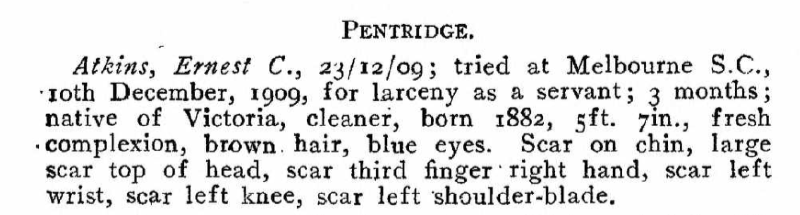
He seems to have been released in time for Christmas, serving only about two weeks.
In 1939 his long-suffering wife successfully divorces him, on grounds of desertion. The divorce petition does not make pleasant reading.
Surprisingly, he marries again that year. He and his second wife are buried in the Woden Cemetery, in Canberra.
Leslie William Atkins (Les to his family) was born in Carlton, Melbourne in 1885. He moved to Bunbury in about 1903. He married Margaret Connole (herself a recent arrival from South Australia) in 1908. They lived almost all their life in Bunbury. Margaret died in 1956. Les’s eyesight failed and he moved to Braille Home for Aged, Victoria Park. He died in 1977, aged 92.
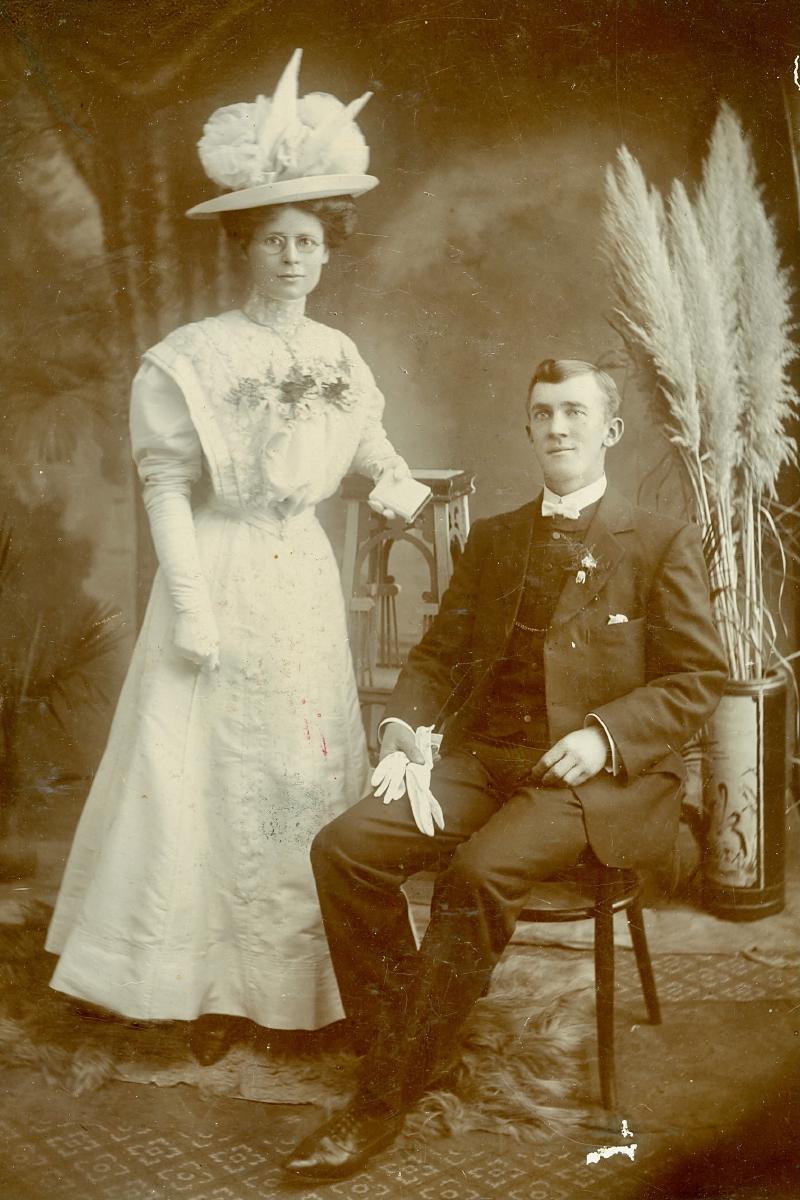
In Victoria, schooling was compulsory to the age of 15, and most children left school at that age. Les would have been no different. Later, he sometimes stated his occupation as “carpenter”. It is not clear that he served an apprenticeship on that trade. I remember him telling me that as a boy he sold papers on the steps of Flinders Street Railway Station.
We can extract the following from the electoral rolls:
We can look at Les’s entrepreneurial career in more detail.
The Southern Times of 28 January 1911 reported:
Mr. Les Atkins, accompanied by Mrs. Atkins, left Bunbury by yesterday morning’s train for Adelaide, where both their parents reside, and where they intend to remain. Mr. Atkins was well known and very popular in Bunbury football circles, whilst his wife has been one of the best workers in the local Roman Catholic circles.
In the event they didn’t stay. Family legend has it that Les couldn’t find suitable work.
His first enterprise involved taking the lease of the Bunbury Municipal Baths for the period 1919-1925. The South Western Times of 23 December 1919 reported:
The Baths Opened. — Mr. Les Atkins has now taken over the Bunbury Baths and same will be open from today for public bathing. Bathing costumes, towels, etc., are procurable at the baths and within a few days everything will be in first rate order. Mr. Atkins now has men engaged in cleaning out the baths in a thorough manner, and promises that it will be made inviting to the large number of visitors and swimmers.
The baths had been constructed by the Bunbury Municipal Council to provide a safe environment for swimmers. It was part of a policy to make Bunbury an attractive holiday environment. The lessee paid a rent to the Council, and undertook to run and maintain the facilities such as changing sheds. The usage fees accrued to the lessee - there was a clear incentive for the lessee to increase patronage. The associated tearooms were run by the lessee, again a clear incentive to increase patronage. It was very much a seasonal business. Very busy on a sunny summer’s day, but minimal on a typical winter Tuesday.
The local papers report various efforts by Les to drum up business. He installed a open-air dance floor, and ran dance nights in summer. Brother George’s jazz band provided the music. It was a family enterprise. Family legend has it that Margaret ran the tearooms seven days a week. The children were too young to provide much help. Maybe that was why father Alfred arrived in December 1920, in time to help with the summer season. He stayed until April 1927 - his help would have been welcome.
The second enterprise involved taking the lease of the Rocky Point Tearooms for the period 1924-1929. The South Western Times of 29 November 1924 reported
Rocky Point Tea Rooms. — With the arrival of summer weather and the extensive patronage of the beach by bathers, the Rocky Point Tea Rooms are being opened to-day for the season by Mr. Les. Atkins. Every provision will be made for visitors and the wants of picnic parties will be specially catered for.
The tearooms (and associated five-room dwelling) had been built in 1920 by a local businessman Mr. H. Powers on land leased from the Council at the end of Wellington Street. This street ran from the center of town about 1 km directly west towards the ocean, and terminated where it hit the sandhills. Directly past the sandhills was a long basalt outcrop running north-south. This outcrop terminated about 100m to the south, after which there was a wide sandy beach that ran as far as the eye could see.
It seems that over that summer, the family ran both businesses. It looks like Les ran the Baths, and Margaret ran the Rocky Point tearooms. The following report (Mirror of 10 January 1925) clearly indicates that the business was associated with Margaret (referred to in the style of the times as “Mrs. Les Atkins”).
A COSY CORNER. Since our Council has given so much attention to the back beach, a pleasant afternoon can be spent at Rocky Point Tea Rooms without unduly overtaxing the energy of those who prefer surf bathing. Mrs. Les Atkins, so popular at the baths for five years with visitors from Collie, Bridgetown, and other centres, has decided to install private bathing boxes, a jazz floor for visitors who enjoy open-air dancing, and make the handy-to-town rooms a fashionable summer resort. Anybody who is anybody in Bunbury now flocks to the popular rooms, where new management is making a long-looked-for change.
By the end of the year, Les seems to have reestablished himself as “mine host”. The South Western Times of 31 December 1925 reported
Dancing at Rocky Point. Dancing at Rocky Point palais de dance is rapidly being recognised as the most enjoyable of summer evening pastimes in Bunbury, and since the opening of the season on Wednesday night, the congenial lessee of Rocky Point tea-rooms (Mr. Les. Atkins) has been a very busy man indeed. He is to be congratulated on his enterprise in catering for the wishes of the holiday public, and also on the success which has so far attended his efforts
While clearly very busy in summer, the tearooms were clearly active all year round. The local papers report how various groups (such as the Surf Club) would hold meetings at the tearooms, and it operated as a small reception center for social gatherings such as farewell parties.
The South Western Times of 5 March 1925 reported:
A Surprise. — Mr. Les Atkins, having worked a night shift, was resting on the bed at his residence, Rocky Point, on Tuesday, when he was startled by a crash. A lump of basalt, weighing 15 lbs. smashed a hole through the roof and splintered the ceiling, but fortunately two boards stopped its further progress. The jagged lump of rock remained suspended immediately over the bed. It was a “fragment” dislodged by a shot fired in the course of operations at the quarry.
Maybe Les was working as a lumper. With the summer season over, the family might have needed a cash flow. There was a quarry working the basalt at Rocky Point. The crushed basalt was used for road works through the town. The quarry works ceased soon after. Clearly it was too close to the town, and apparently the crushing equipment was obsolete. The quarry excavation was still there when I was a child, though filled with drifting sand.
A letter to the editor (South Western Times, 6 December 1926) indicates the local concern about sharks.
“TINY” AND THE SHARKS. (To the Editor.)
Sir, — There is no doubt that “Tiny” Brown has been a good Samaritan to bathers in Bunbury. Whenever there is a report that a shark has been seen “Tiny” is off home to get his gear. I remember one year at the baths someone said that they saw a shark outside the fence; “Tiny” was there that night with his lines, and it was not long before he had two hungry looking brutes, one 10 ft. long and the other 8 ft. 6 in. Last year while fishing on the big rock at the back beach I saw a shark swimming about. I sent word to “Tiny” and that night he had it. Yesterday two sharks were seen; “Tiny” was sent for, and now they are to be seen on the beach. One 9 ft. 8 in. and the other 8 ft . Well, Sir, I think “Tiny” Brown is deserving of some consideration for the good work he is doing, and it is up to us to “put in” to enable him to get good gear, plenty of it, and a little for himself. While on the beach last night I was approached to start this fund. The following gentlemen have responded: Mr. Fred Roberts 10/-, Les Atkins 5/-, M. Elliot 2/6, Mr. Skewes 2/6. Mr. Johnson 2/6, Mr. Abberly 2/6, Mr. Brittain 5/-, Dean Edwards 2/6, Mr. Hunter 2/6, Tom Prentice 2/6. Mr. Foreman 2/6, Mr. Sherlock 2/-, Harry Phillips 2/-, Mr. Jenour 2/6, Mr. Woods (Rose Hotel), 10/-; Mr. Thomas 2/-, H. Walker 2 Mr. Doust 1/-, collected 4/6.
Yours, etc. LES ATKINS.
The third enterprise involved Les constructing a tearooms and boarding house on a freehold land on the edge of splendid beach at Scarborough (in the northeast of Perth). A notice in the Perth Mirror, 12 July 1930, tells us:
TEAROOMS AT SCARBOROUGH. Mr. Les Atkins, who was for six years lessee of the Bunbury Baths and for five years lessee of a tearooms and bathing sheds at the Back Beach, Bunbury, intends erecting shortly a tearooms at Scarborough.
It was essentially the first business in Scarborough catering to the beach trade. In the two previous businesses involved Les a lessee. The capital requirements had been relatively modest. Les had now clearly accumulated enough capital to construct premises from scratch. Les (and the family) ran this business from late 1930 until 1934.
A family photo shows the tearooms soon after construction. The tearooms front an unmade road (The Esplanade) and face sandhills and then the beach. We see three youths (with surfboards) making their way down a path to the beach.
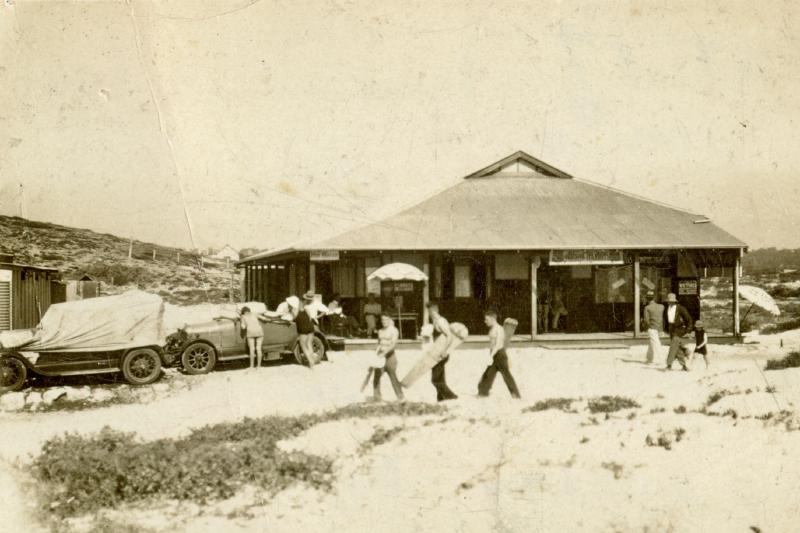
By 1932 the road has become a sealed promenade, and an advertisement outlines the services available.
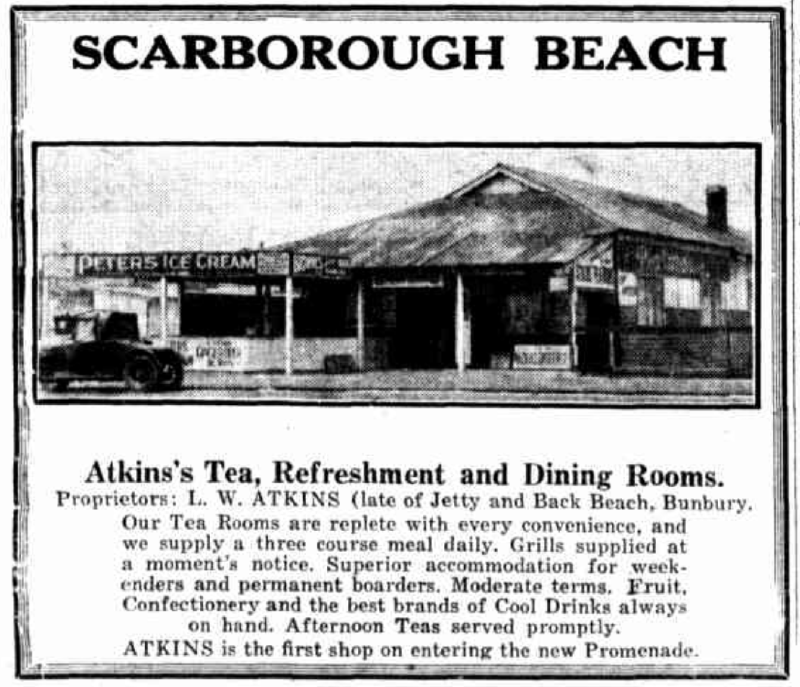
It was very much a family business. Margaret clearly provided the “three-course lunches” and “grills supplied at a moment’s notice”, and ran the accommodation (meals provided). Ivy was a somewhat free spirit and was a good jazz pianist. She provided a jazz band (Ivy Atkins Jazz Orchestra) for Saturday night and Sunday night dances at the tearooms in summer. Murray and Lily (my mother) had left school and were impressed into the business. With the Depression hitting, there were not many other options, anyway.
Murray was killed in a traffic accident in November 1932. Family legend has it that Margaret took the death of her eldest son very badly, and her enthusiasm for the beach business enterprise faded. The business was sold.
The family returned to Bunbury in 1934, building a new house in Wittenoom Street. Les described himself as a “dealer”. Family legend has it that he had a brief and spectacularly unsuccessful career as an SP bookie at the Burlington Hotel. Margaret was reduced to taking in boarders (with meals) for the family to make ends meet. In 1937 he opened a short-lived business selling new and second-hand furniture.
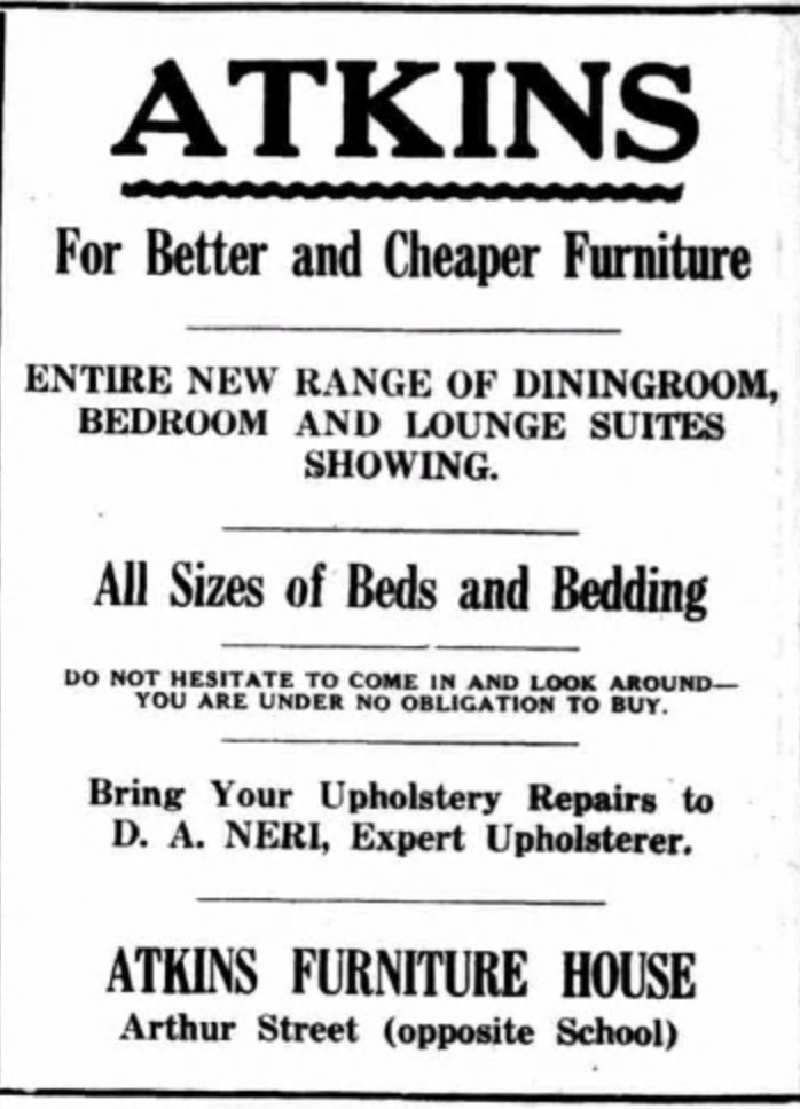
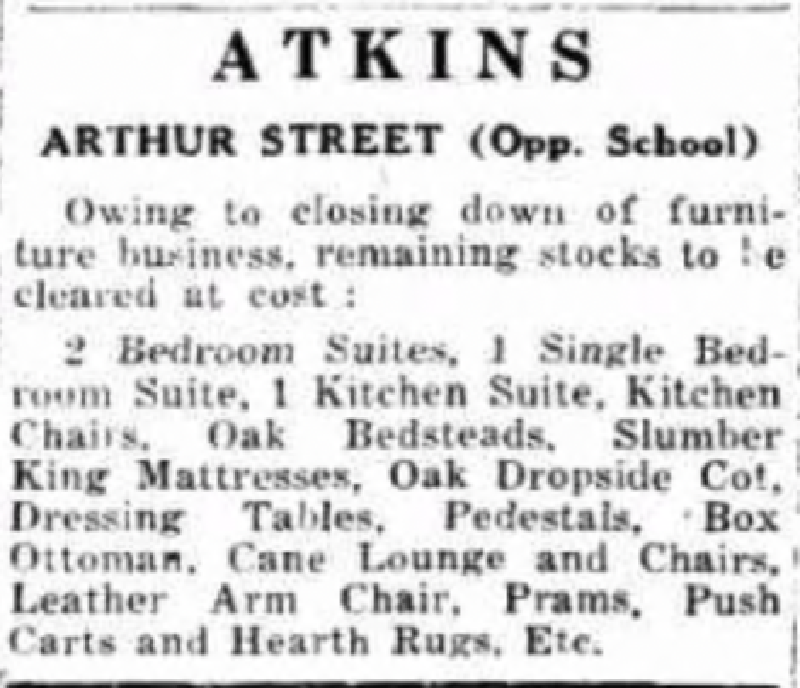
Les opened his last enterprise, a milk bar, in late 1937.
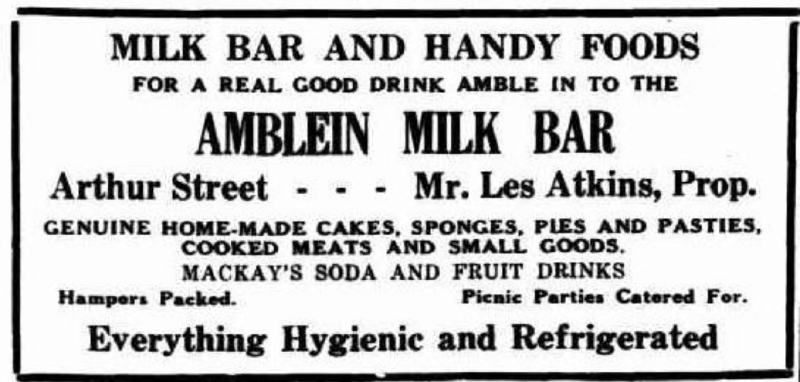
This business ran until at least 1950. We moved to Bunbury in late 1949, and I have a specific memory of the shop still running. I think the family left Les to run it, with hired staff. 1950 would have put him at age 65, at which point he could have got the old-age pension. He must have sold the business about then.
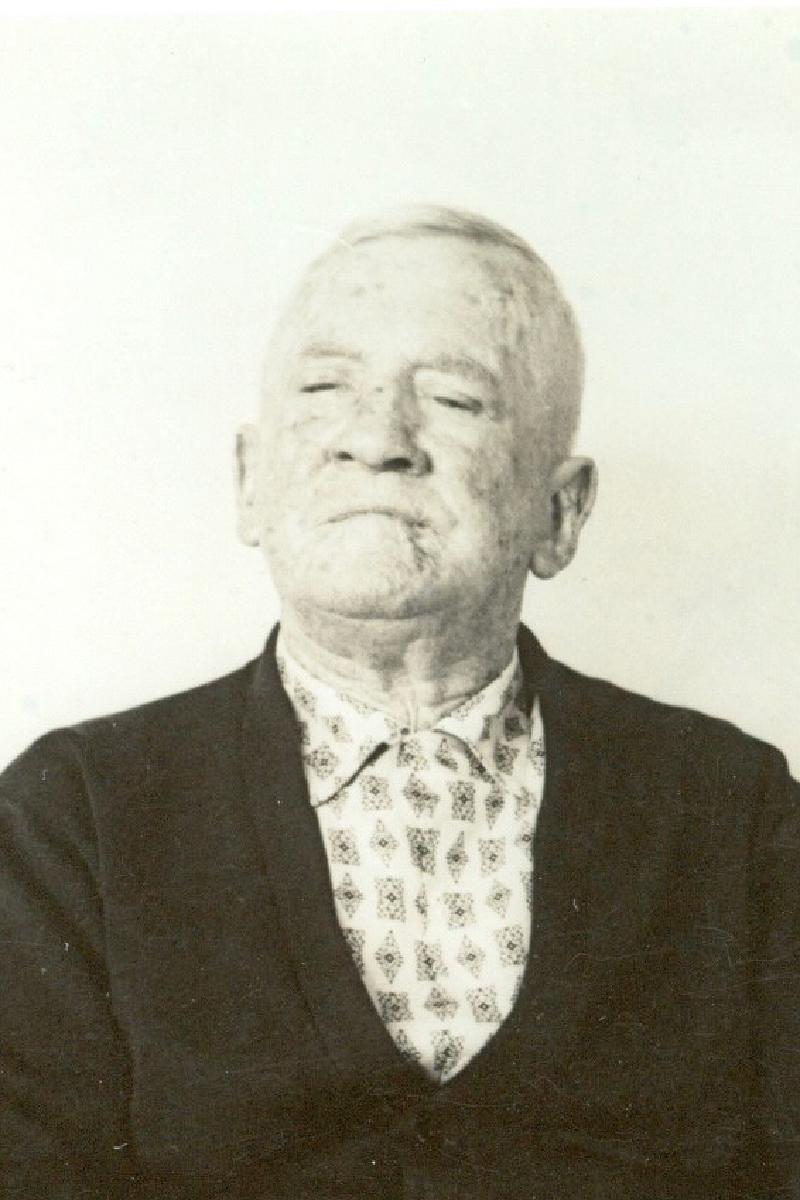
We moved to Stockley Road around 1951, and a little after Les and Margaret moved into a rather nice house directly across the road. I can remember the wide verandah around two sides. About this time Les progressively lost his sight (I think macular degeneration might have been the problem). In any event there was no treatment then available. After Margaret died in 1956 it became progressively harder for Les to live by himself. In around 1958 he moved to the braille Home for the Aged in Victoria Park, in Perth. The following photograph shows Les at this time. His sight has completely gone, and his face shows the results of skin cancers that plagued the Anglo-Saxons in the Australian climate.
I was at university in Perth through 1961-1965, and I would visit him regularly in his room at the Aged Home. He remained remarkably cheerful and positive despite the turn of events. When I arrived he would typically be listening to the broadcast of Parliament from Canberra - he was a ferocious Labor Party supporter. He would follow with interest all the family minutia, of who was doing what. Les still had his hearing. He would arrange a weekly outing with two other old codgers at the Home. One had a little sight in his left eye, and the other had a little sight in his right. Suitably equipped the trio would sally forth and walk down to the Victoria Park shops, cheerfully passing the time of day with regulars along their way. They would purchase a lottery ticket, perhaps place a bet at the TAB, and then make their way back in time for lunch.
He met life head-on in his own way. As with my other grandparents, life hadn’t dealt him any favours and he had to manage the best he could.
He died in 1977, aged 92.
Alice followed her siblings George and Leslie to Bunbury. She married Lewis Braund, the brother of George’s wife Dolly, in Bunbury, in 1908. They had moved to 21 Nelson St, Williamstown, Victoria by 1914. Lewis is a “driver”. By 1934, they are at 85 Elphin St, Williamstown, and Lewis is a “pensioner”. By 1941 they are at 120 Woods St, Newport. Alice died there in 1944, and Lewis died in 1966. They had five children.
We have a photo of the eldest three siblings, dated about 1918.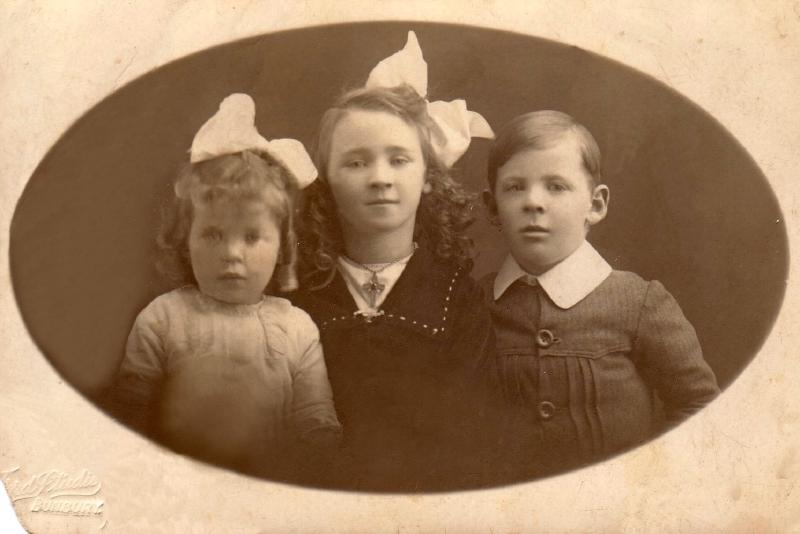
I wrote a short eulogy for Ivy’s funeral:
One thing to remember about our beloved Aunt is that, not having children of her own, the extended Atkins clan and their associated friends were her family. She loved all of us, and never forgot a birthday and never lost track of who was doing what, no matter how far away they were. Auntie predated us all, and in a literal sense none of us can remember a time without her.
I would like to contribute a few of my memories, to reflect wonderful gracious lady that we are saying goodbye to.
My first memories are of Byron Street in Leederville. I remember a piano in the dark cool dining room (Auntie still taught piano then) and a fascinating box of programs to music concerts and ballet performances that we allowed to look at if we were careful. Elegant black and white photographs of performers in evening dress, holding long cigarette holders. It was a world that I always associated with Auntie, that of well-groomed elegance and the love of music. And there were trips into the city on the Scarborough bus and visits to the big shops (even multi-storied). This was heady stuff for an eight-year old from country Bunbury, where concerts didn’t often happen and the shops were decidedly single-storey.
Later visits were to the house at Mt Yokine. I was now at university and Auntie and Uncle were getting close to retirement. I would turn up for a restorative cup of tea and a scone, as an antidote to college food. I don’t have a memory of a piano - I think she had phased out her teaching by then. I do remember taking Auntie (or did she take me) to a performance of “Swan Lake” by the Australian Ballet at His Majesty’s Theatre. Stan, I suspect, was happy to give it a miss.
The last phase was the time at Swan Cottages, first in the unit with Uncle Stan and then later in the more supported accommodation. My visits were necessarily occasional, whenever I was in Perth. Auntie would be impeccably groomed, and ever interested in the complex doings of the growing brood of grand-nephews and grand-nieces. On one of my last visits I showed her a video of even the next generation (our grandchildren) on the screen of my laptop. She was interested in the kids, of course, but to a lady who was born in 1909 the technology was a mystery.
She was the best Aunt we could have had. She showed us love and taught us that good manners and good grooming and indeed good style are forever in fashion. We will always remember her.
(to be completed)
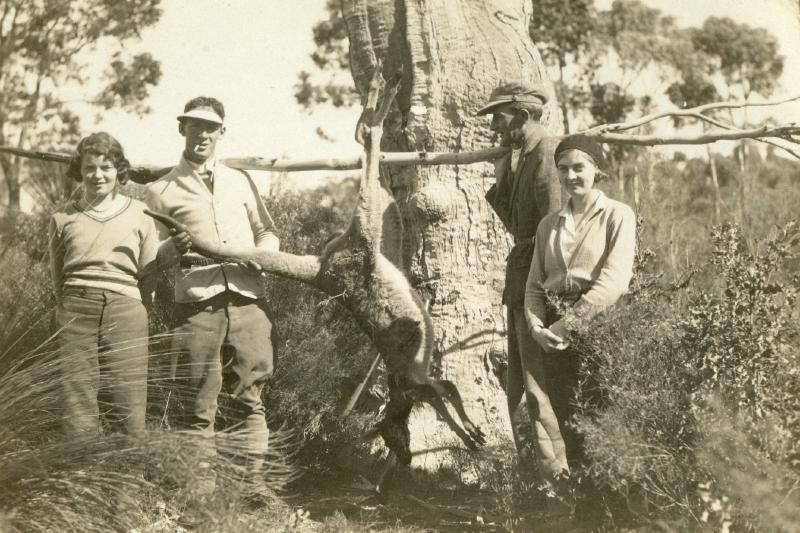
We have the following photo of Lily and Murray Atkins, dated about 1930. It shows the Australian enthusiasm of shooting things that moved (and chopping down things that didn’t). One doubts that the poor kangaroo was destined for the table.
Murray worked in the family businesses at Rocky Point and Scarborough. He was involved in a traffic accident on 28 November 1932, and died a day later.
The West Australian, 20 December 1932, reported the inquest:
SCARBOROUGH TRAGEDY. Lights and Brakes at Fault.
At the Perth Courthouse yesterday, the Coroner (Mr. T. Y. A. Lang, P.M.) conducted an inquest on the deaths of Peter Riela (37), single, a native of Holland, and Murray Atkins (20), single, of Beach Avenue, Scarborough. Both fatalities were the outcome of a collision on the Scarborough-road, on November 28, between a car driven by Atkins and a spring cart driven by Peter Baroiolo. Riela was seated beside the driver of the car, and was killed almost instantly by the left shaft of the cart, which smashed through the windscreen of the car and pierced his chest.
The Coroner was assisted by Sergeant Lynes. and Mr. D. M. Cleland (instructed by Messrs Villeneuve, Smith and Keall) represented the driver of the cart. Dr. I. O. Thorburn, medical registrar at Perth Hospital, stated that Atkins had died, in his opinion, from loss of blood and shock. He had a bad cut under the left arm, and one of the arteries was severed.
Leslie William Atkins, father of the deceased, said he was in his car on the night of November 28, when his son was driving towards Perth from Scarborough. Riela was in the front seat next to his son. When the car was nearing the bridge over the Njookenbooroo canal, witness saw something which he thought was a cow, on the other side of the bridge, and on the left side of the road. His son apparently saw it at the same time, because he eased up and went slowly over the bridge. Witness did not see any light. The driver then turned to his right a little, and a collision occurred just on the Perth side of the bridge. The car was almost stopped. Witness did not realise that the object he saw was a horse and cart until the crash. The horse mounted the front of the car, which was considerably damaged.
A plan of the locality was produced by Constable Cummings. He said that a hurricane lamp was found in the canal by Constable Richardson on the following morning. Constable Grey said he examined both vehicles, and found that one of the brakes of the car was less effective than the other. This would cause the car to swerve to the right when the brake was applied. Several witnesses stated that Baroiolo had told them that he was carrying a hurricane lamp in his hand while he was driving the cart, and Alexander Della, a dairyman, said that Baroiolo had a lamp in his hand when he came to store some milk at witness’s place just before the accident.
Baroiolo stated in evidence that he had been coming from Della’s place with his employer’s horse and cart, and was approaching the bridge, when he saw the lights of a car coming towards him from the direction of Scarborough. The car appeared to be going very fast, so witness went as far as possible to the left of the road, driving with one wheel in the sand at the side of the road. The car came on and struck the cart with the left front wheel, and witness was thrown out and knocked senseless. He remembered the police coming and looking for his lamp, which he had had in his right hard. They did not find it then, but they showed it to him on the following morning.
The Coroner found that the two deceased died, from injuries received in the collision of a motor car and a horse-drawn vehicle on the night of November 28. He added that the cause of the collision was contributed to by the inefficient lighting of the cart, and the faulty brakes of the motor car, and drew attention to the regulations for the lighting of horse-drawn vehicles.
Les was in the back seat, and was uninjured. The horse, surprisingly, was uninjured.
Lily Mariner Atkins, my mother, known as Lil, was born in Bunbury in 1915. She married Barney Molinari in 1942 and they had three children. Barney died in 1999 and Lil died in 2017 at the grand age of 101.
I gave the following eulogy at my mother’s funeral.
It is one of life’s big events for children to bury their parents; for one generation to say goodbye to the earlier generation and to become in their turn the family elders.
So it is that we three brothers have met twice in this very chapel. In 1999 we said goodbye to our father, Barney. Today, with you, we say goodbye to our mother Lily (better known as Lil).
As you know, she died on 4 June in Katanning, at the grand old age of 101. By any measure “a good innings”. It is with natural sadness that we farewell Lil but we surely do it in the context of the great cycle of life and we are surely comforted by the fact of a long life well lived.
Lil was the third of four children of Les and Margaret Atkins. She has long outlived her siblings, her relatives of the same generation (her cousins and second cousins) and all her contemporary friends. She has outlasted all but one of her in-laws. We are pleased to have Auntie Marge (the wife of Dad’s brother) with us today. A lady never divulges her age and I won’t either, but I can say that Auntie is getting up there.
Lil was born on 5 October 1915 (5.10.15 as she used to say), at the then family house at 18 Karri Street, not much more than one kilometre from here. I drove past there this morning and the simple but elegant house is still there.
She went to school here in Bunbury at St. Joseph Convent School, also not much more than one kilometre from here. She was very proud of having completed her Junior Certificate, a not insignificant feat in working-class Bunbury. That was in 1932, and her career options were heavily constrained by the Great Depression. In the event she spent the next few years working in the family business of beach cafes and kiosks, at Bunbury and Scarborough. These were the rather optimistic schemes of mad old grandfather Les. From what Mum said it was not so much the work itself but the fact that alternative options were essentially unavailable.
The family was back in Bunbury when Lil married Bernard Molinari (better known as Barney) in 1942. They married rather late - Dad was 28 and Mum was 26. Dad was rather dashing young blade from Cue and the nearby mining town of Big Bell. Big Bell was some 800km away on dreadful roads so it would seem to have been a classic long-distance courtship. Of other suitors we are a little in the dark, but I can remember her speaking rather wistfully of someone who was a racing car driver.
They lived in Big Bell until 1949, when they moved back to Bunbury. Mum moved to Katanning in 2012, so I reckon she spent something like 85 years of her life here in Bunbury.
They were effected, even scarred, by the Great Depression. They maintained a frugality long after it was relevant, and had no great trust in the modern world’s belief of continually growing prosperity.
They were disappointed when education took us to Perth and careers took us further afield. We children did not live near them, and their grandchildren were visitors (Carla excepted). They greatly loved them when they did visit, but the distance meant that my children didn’t really know Mum and Dad, a situation we all regretted.
If her kids and grandkids were not within reach, I think Lil compensated by making friends with anybody and just about everybody who was within reach. Many of you - her friends - are with us today. Perhaps anticipating that she would live so long, she made many friends with people who were younger than her. And perhaps this contributed to her longevity. She made friends with my schoolmates (Gerald and Pauline Logan are with us today); she made friends with her hairdresser; with a tenant; and with Kay who did some cleaning for her at Stirling Street.
Mum was what I call a social attractor. When I would visit from “The East”, the daily routine would involve a nonstop sequence of visitors with a corresponding flow of cups of tea. I would be introduced to the newer friends, and I rapidly discovered that Mum had regaled them my career highlights and the names of all the kids. Visits were also characterised by serious games of cribbage (15-2, 15-4 and the rest won’t score). To the end, Lil took very few prisoners when she played crib.
So that is how we should remember Lil. A gregarious character whose interest in life and in people was a defining characteristic. She knew people, she enjoyed their company and they enjoyed hers. She loved her sons, her grandchildren and her friends, and we all loved her in return.
We will long remember her.
Lily was educated in Bunbury by “the nuns”. This meant the convent and school in Wittenoom Street, just back from the town centre. The primary school was run by the St Joseph nuns, and took both boys and girls. The secondary school was run by the Sacred Heart nuns, and was girls only. In secondary school the first public examination was the Junior Certificate, taken at age 15, and then the Leaving Certificate, taken at age 17 (which provided matriculation into the University of Western Australia). Rather unusually for the time and place, Lily studied to Junior Certificate level and passed in five subjects in 1930 (English, Geography, Mathematics A, Drawing and Commercial Methods and Bookkeeping). The results are here. There seems to have been 10 girls in her class. The other secondary school was Bunbury High School, which seemed to have 25 students (9 boys and 16 girls). Taken together, some 74% of the Junior Certificate cohort was girls. I put this down to the sturdy disregard for education that the town had. Boys typically left school at 14 and cheerfully worked in the family business or took apprenticeships. The local port and the railways were important sources of employment. This had hardly changed when I was in the Junior Certificate class in Bunbury in 1958.
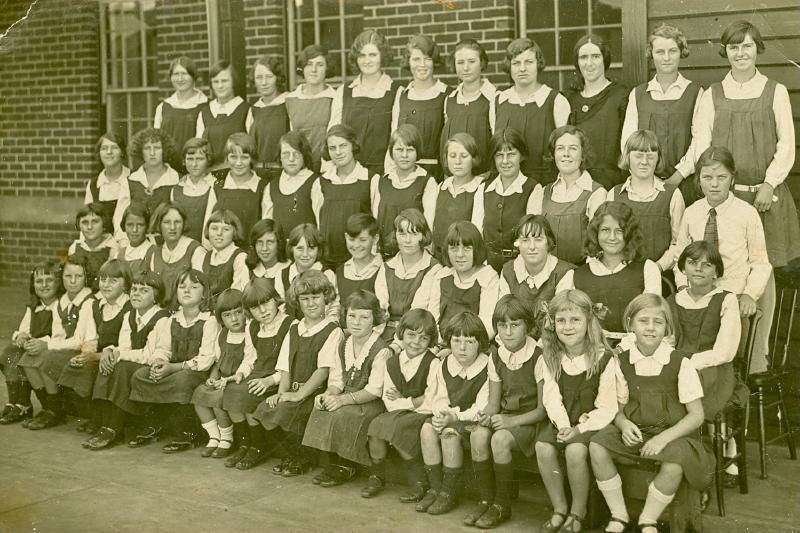
As related above, the family moved to Scarborough part-way through 1930. Lily must have stayed in Bunbury to complete her studies, either boarding with the Nuns or staying with family friends. When she too moved to Scarborough, her hopes for some sort of a secretarial career came to nought. She was needed in the family business, and the Depression had started. Businesses were taking on no new staff. The following studio photograph was taken about this time.
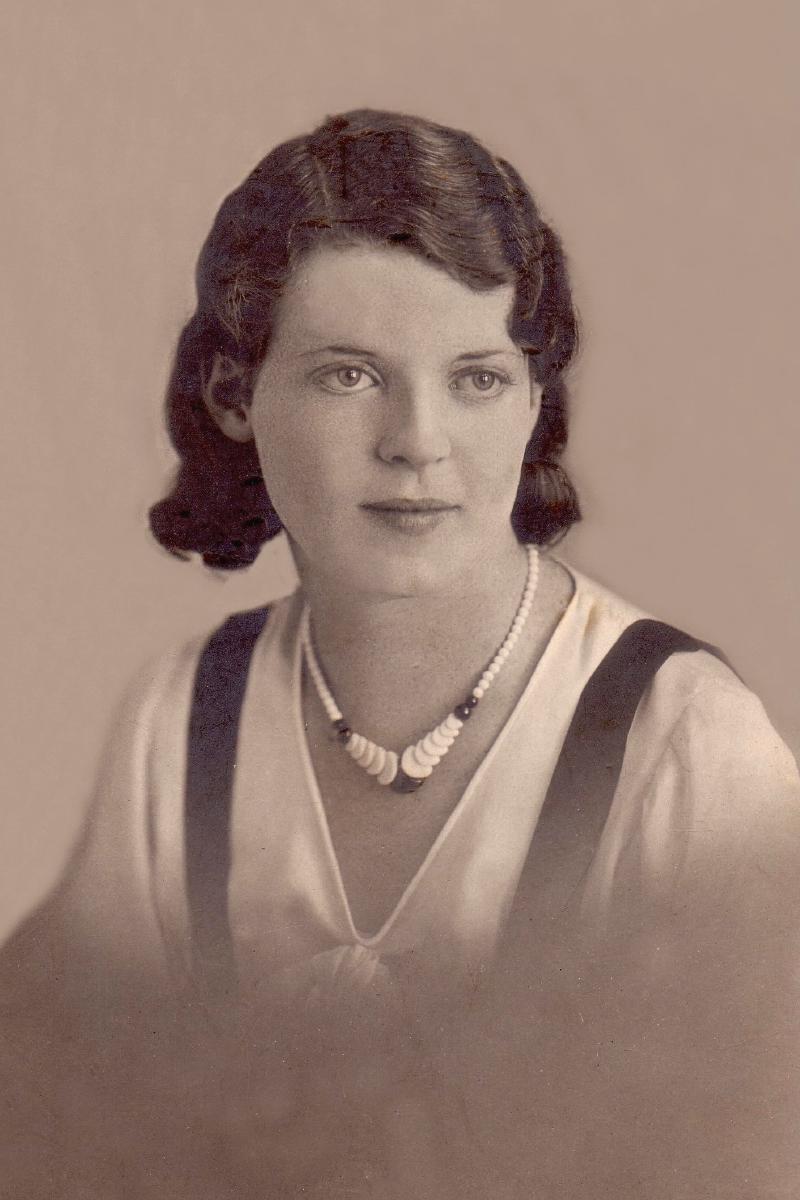
The family returned to Bunbury in late 1934. The West Australian of 23 August 1934 tells us:
The Scarborough Beach Social Club will hold its weekly social in Atkins’s tea-rooms tonight, when a farewell will be tendered to Mr. and Mrs. Atkins.
In Bunbury at least, Lily found commercial employment. She used to tell us that she was “Head Girl” at the local Woolworth’s store. A somewhat breathless report in the South Western Times tells us that the Bunbury store opened in mid 1939 and was
one of the most modern emporiums erected in any city in Australia.
At that stage Woolworths was a department chain focusing on low-priced items. It was Australian owned, and had adopted the name and style of the USA Woolworth chain which
was one of the first American retailers to put merchandise out for the shopping public to handle and select without the assistance of a sales clerk. Earlier retailers had kept all merchandise behind a counter and customers presented the clerk with a list of items they wished to buy.
Apparently the USA company had neglected to register its trademark in Australia. The Bunbury Woolworth’s store was unchanged in my childhood (1950-1960) and was an Aladdin’s cave of things that could be bought for modest amounts of pocket-money. Woolworth’s subsequently became a supermarket behemoth, and abandoned their variety stores.
Family legend has it that at this time Lily was good friends with Emma (Emmy) Callegari, later Emmy Styants. Emmy was Dad’s second cousin, as explained here. Dad, who was making good money in Big Bell, used to come to Perth once a year during his annual holidays with several mates in search of a good time. Barney and Lily met in Bunbury through cousin Emmy. They were married on 14 September 1942, in St Patrick’s Church, Bunbury.
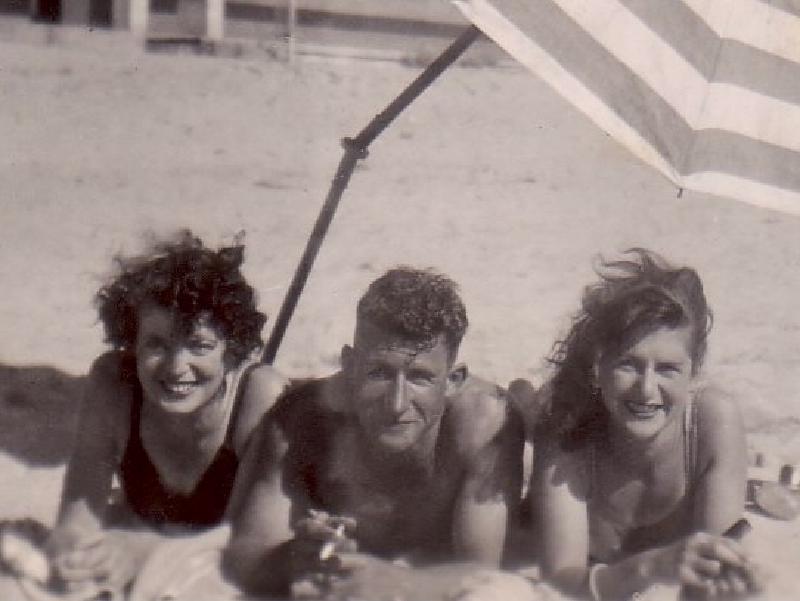
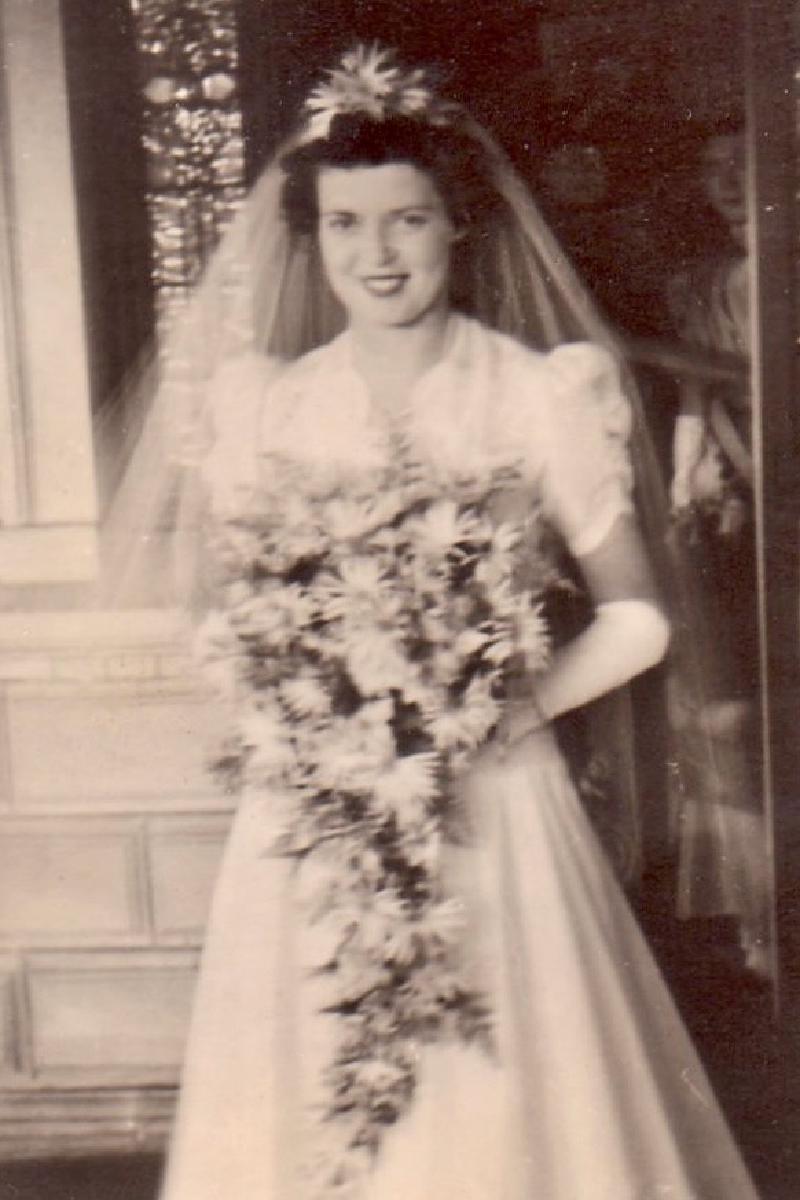
They started married life in the mining town of Big Bell, where Dad was employed as a foreman in the mine machine shop. Around 1943 the mine closed due to the war, and a small group of tradesmen (perhaps 10) were retained to carry out maintenance. Dad was one of that group. The mine reopened in late 1945.
I think Mum never took to life in a mining town in the Murchison district, some 800 km north-east of Perth. The summers were brutal, and she suffered badly from hay fever which hit in spring as the country dried out after whatever winter rains they might have got. I think she missed her family in the temperate South West. I suspect she never bonded much with her Italian in-laws - there was never any indication that she picked up the slightest trace of Italian language or culture. She would spend the summer months either in Perth (with her sister Ivy) or Bunbury (with her parents). In fact I was born in the 1943-1944 summer (in Perth) and Raymond was born in the 1945-1946 summer (in Bunbury).
The retreat to Perth was by train. You caught the train at Cue, officially 526 miles from Perth. There seemed to be two options. Arriving at Mullewa (with 331 miles to go) you could turn left and travel down the WAGR line to Northam and then to Perth. Or you could go a further 66 miles on to Geraldton (on the coast). There one could change to the Midland line and travel to Midland Junction and then Perth. This was a private line, very unusual in Australia. They developed the line in exchange for land grants (extending 40 miles each side of the line). There was a weekly passenger service.
I can’t find a contemporary timetable, but I don’t think you got much change out of a day and a half for the journey. WA trains didn’t hurry, and were liable to stop at any or all sidings along the way. I have a brief but clear memory of one such trip. Mum and baby brother and I were in a compartment, with I think another young mother with child or children. Maybe it converted to sleeping bunks. I have a clear memory of passing through a tunnel. This can only have been the Swan View Tunnel, some 340 m long, between Northam and Perth. Going through in steam train was not to be forgotten. In any event, that meant we were in a WAGR train that turned left at Mullewa.
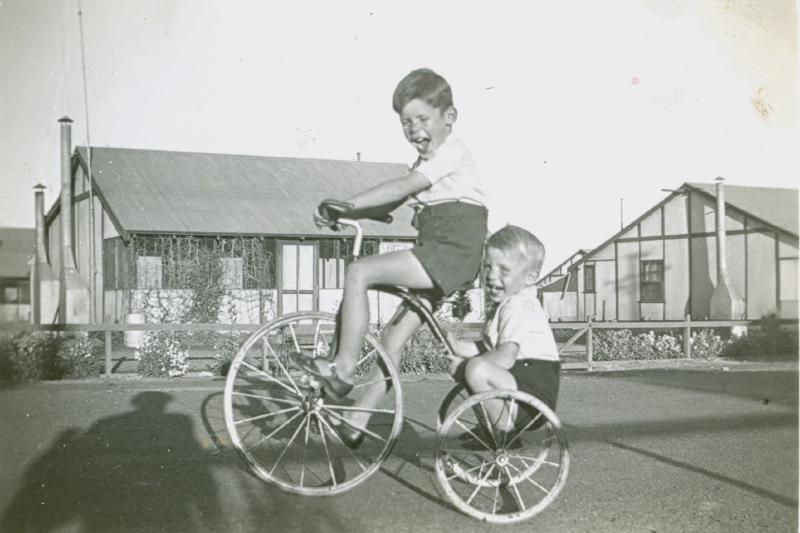
We have several photographs of this time. The first shows my brother and I, and other children, outside on what appears to be lawn. The second is my brother and I playing out in the street. The houses are built to a standard design. They are “staff houses”, constructed by the mine company and made available at a token rent. There was a water supply, but not enough for other than small gardens. The town itself was several km away, and had much more heterogeneous housing.
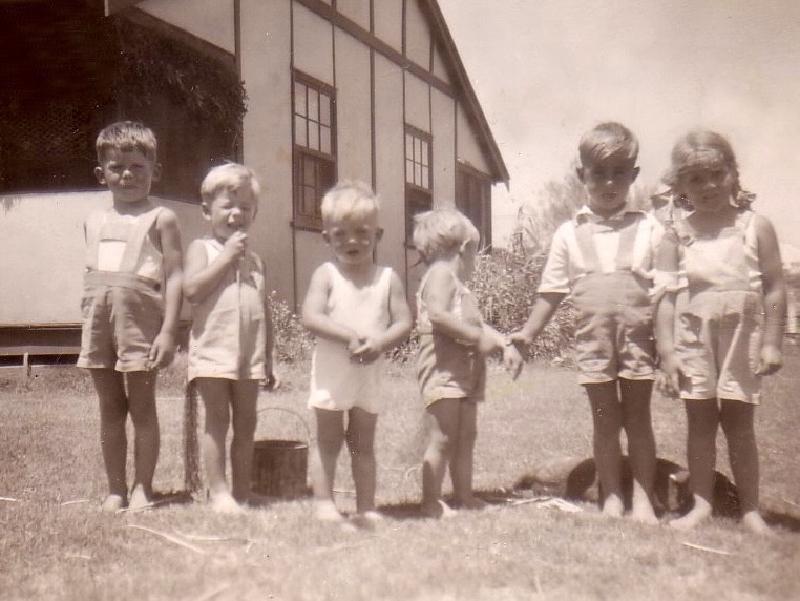
In 1948 we moved to Bunbury, presumably at Mum’s instigation. Dad was well-paid, enjoyed his work, and had a wide circle of friends and family in Big Bell and Cue, and it wouldn’t have been his first choice. Perhaps it only anticipated the inevitable - the mine closed some six years later and the family would have been forced to move then.
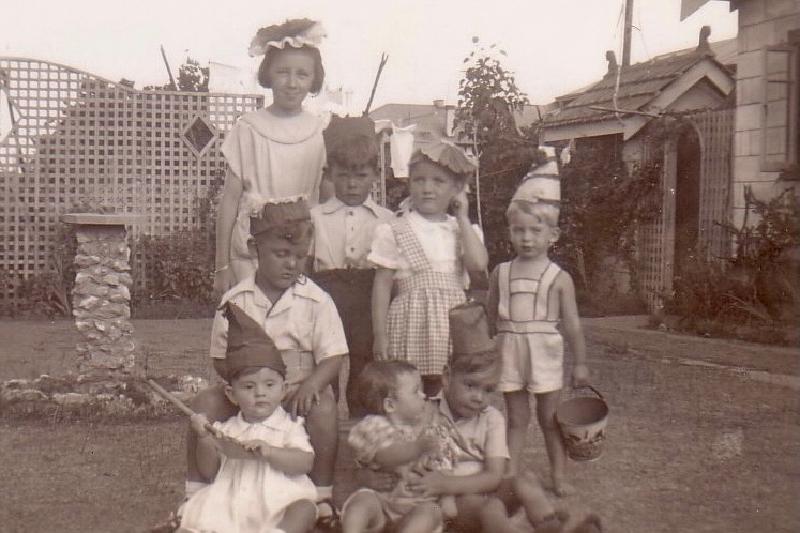
We first lived with Mum’s parents in 17 Wittenoom Street for a year or so. Houses were in short supply, as few had been built for a decade. Dad had the price of a house in his bank account, but it took some time to find a house, and for the vendors themselves to be able to move out. The following photograph was taken at that house. I am in the centre, and to my left Mary Kelly and brother Jim.
We moved to 86 Stockley Road sometime in 1949. It is still there, apparently unchanged, some 75 years later. Its weatherboard construction was typical of the time. Timber was plentiful, and relatively cheap.
Around 1954 we moved to 105 (?) Forrest Avenue. This was a new house, brick and tile. Forrest Avenue was then the main road into town, and relatively busy. The road system has been subsequently changed (several times) and the area is now zoned commercial. The house seems to have gone. This is a photograph of the house:
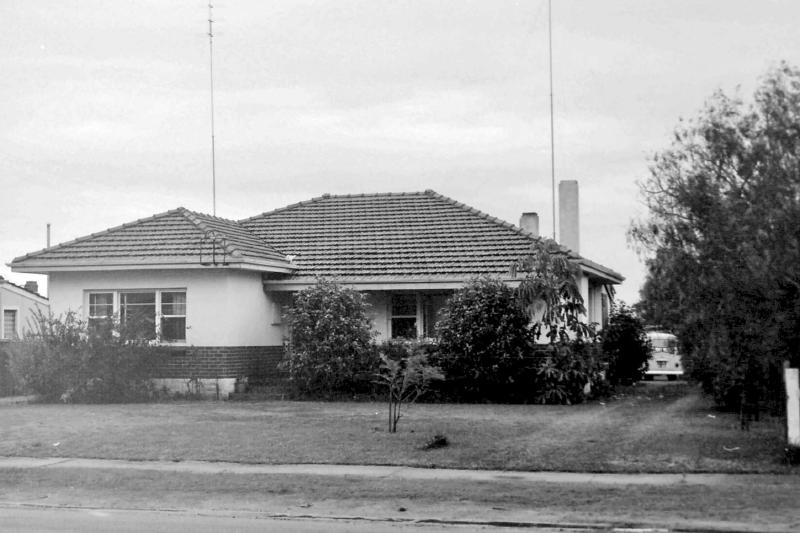
Note the 15m guyed poles with a television antenna on top. The nearest TV transmitters were in Perth, some 150 km away as the crow flew. This arrangement gave very marginal reception, and the picture (then black-and-white) would ghost badly when a truck went along the road at the front, or a train went past along the line at the back. All for an analog 625-line picture. Such was the allure of early TV that this arrangement was resorted to.
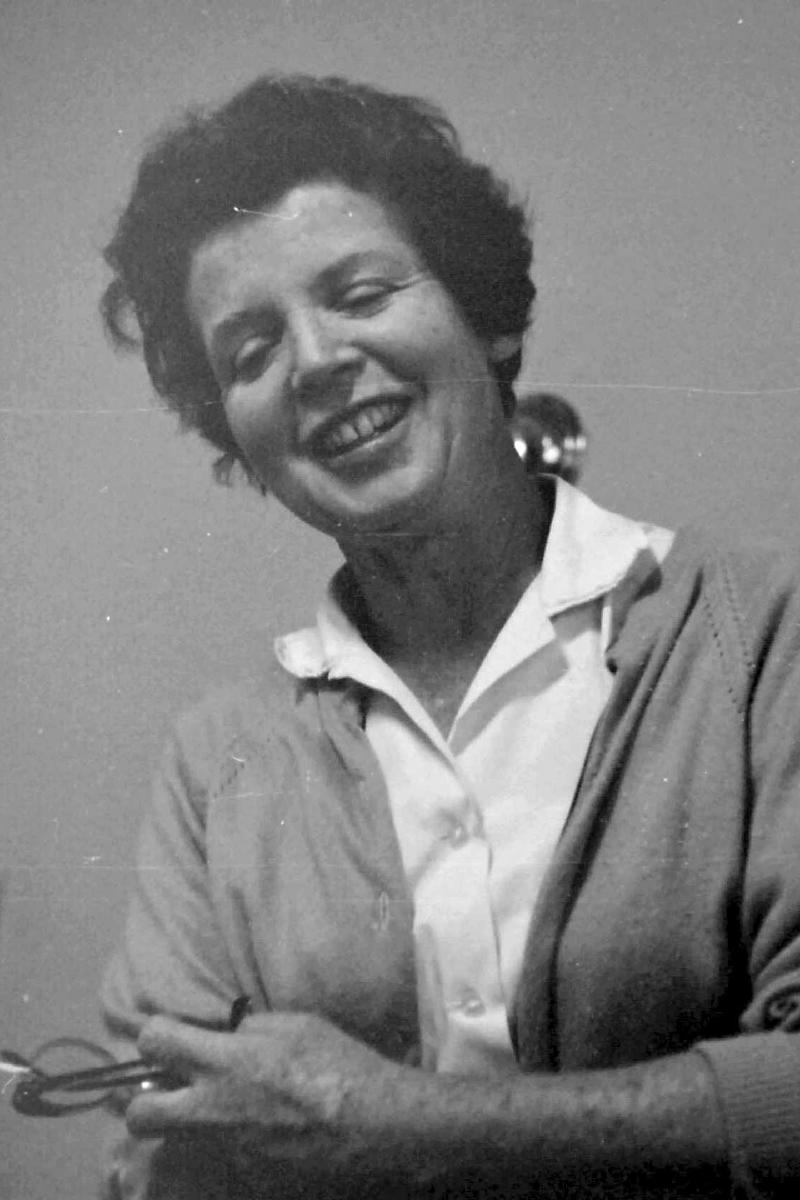
The following photograph was taken during this time.
Finally, around 1968 (?), they moved to 52 Stirling Street. Though the house was older, this was a very pleasant location. It was easy walking distance to the centre of town. It backed onto Queens gardens, and then the estuary. Dad had retired and enjoyed his workshop. Mum took an active interest in craft activities and was a member of a spinning group.
Mum always suffered from skin cancers on her face and hands - the legacy of time at the beach and no sunscreen and no hats (see the above photograph). She was forever getting them “burned off”. Then around 1984 she was diagnosed with a melanoma spot on the back of her right calf. The prognosis for melanoma then was poor, and the treatment was somewhat brutal. A big chunk of her calf was surgically removed (needing extensive skin grafts) and lymph nodes removed. An early chemotherapy was applied. The blood supply for her leg was bypassed to a primitive “heart-lung” machine while they put as much chemical as they dared into the supply. This was at levels that the rest of the body could not tolerate. In the event she survived, and the melanoma did not metastasise. From then on she was saddled with a swollen leg and the chore of putting on a tight pressure stocking each day. I have never heard of anyone else being subjected to this form of chemotherapy. I assume it was not long used.
These problems were put down to Mum’s English-Irish heritage. Dad, with his Italian heritage, had no such problems.
After Dad died (at home) in 1999, Mum moved to a retirement unit several hundred meters away, in the Leschenault Village community in Hayes Street. Mum was very happy there - the community suited her. She had wanted to move there earlier, but Dad didn’t cooperate. He didn’t want to be “cooped up in a little unit”. The following photograph was taken in late 2010 at Leschenault Villas, where we celebrated Mum’s 95th birthday.
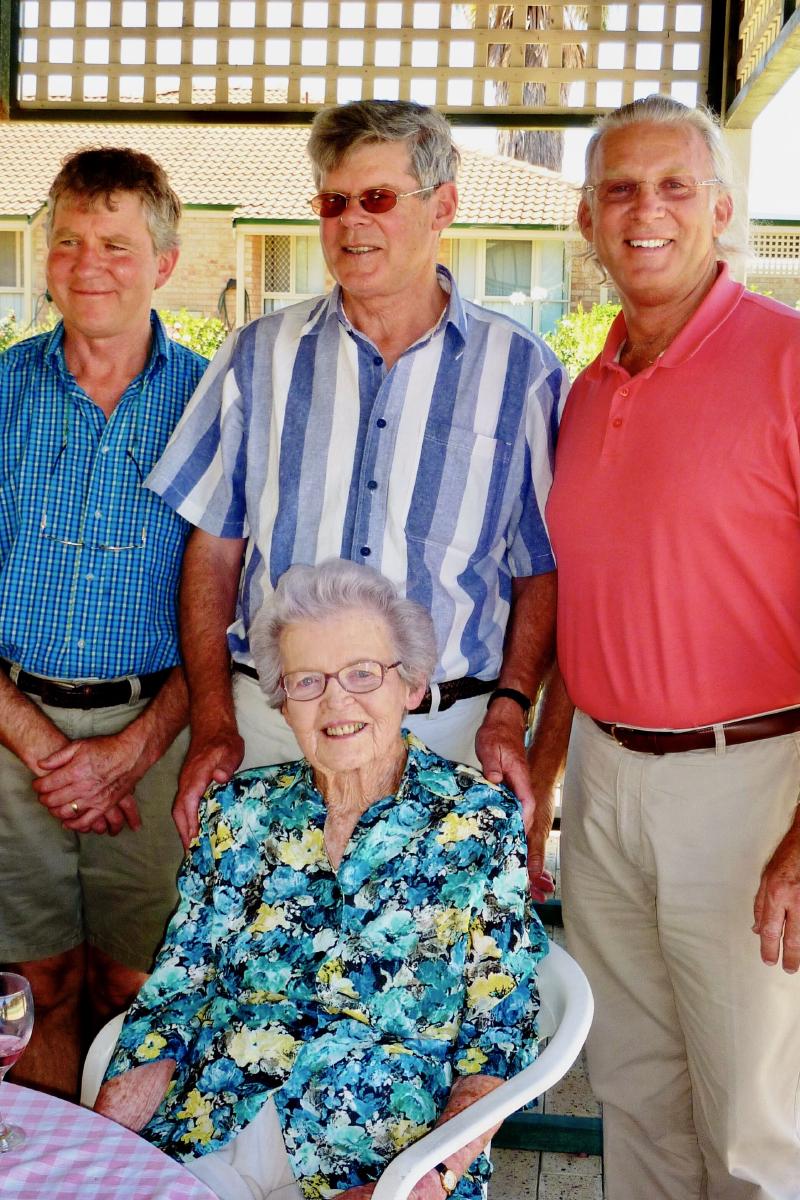
She was there until about 2011. She fell and cracked her pelvis (but did not “break her hip”). She recovered substantially and moved back to her unit but was not confident living alone at age 95. She tried a nursing home in Bunbury but it didn’t work out as, by now, she had no support network in Bunbury. In about 2012 she moved to the “Bethshan” nursing home in Katanning (where Peter and Christine lived). While the care there was excellent, Lil didn’t make many friends, and relied heavily on frequent visits from Peter and Christine (who lived walking distance away). The family celebrated her 100th birthday with her. Her elder sister Ivy had celebrated her own 100th birthday in 2009, then took to her bed several weeks later and died peacefully. Mum lasted another eighteen months. She wasn’t happy, as she got more frail with time. She was mentally sharp to the end, but had no joy in life. She died at Bethshan on 14 June 2017.
(incomplete)
The Stirling Times of 6 August 1986 reported:
Colin’s family moved from Bunbury to settle at Scarborough in 1930. His father, Les, bought the land on The Esplanade for 300 pounds. Les, a carpenter, built a guest house and tea rooms on it. Colin said that the tearooms were one of the first real shops in the area. They had no electricity, and a well and a pump were used for water. The family lived in a weatherboard house where the Nookenburra is now while the tearooms were being built. When they moved into the house their lifestyle changed considerably.
“Scarborough was a very isolated place in those days,” Colin said. “We hardly saw anyone during the winter.”
Colin said there was only one bus into town from Scarborough each day. It would leave at 7:50am and there wasn’t a bus back to Scarborough until 6pm. Buses ran more frequently between Perth and Osborne Park. Colin and his brothers and sisters went to school at St. Mary’s in Leederville. They would catch the bus in the morning but would have to walk home to Osborne Park in the afternoon. “It was a long walk,” Colin said. “Occasionally Mr. Della, who owned the diary in Scarborough, would come by with his horse and cart and give us a lift.”
Colin had a glint in his eye when he spoke of the privileges which came from living at the tearooms. His dad had built an open air dance floor where he held dances on Saturday and Sunday nights during the summer. Colin said his oldest sister Ivy had been one of Perth’s top jazz pianists. She would invite all the jazz players she knew to play at the tearooms. “So we often had a seven piece jazz band to listen to,” Colin said. “It was so lively around here.” Colin said his dad didn’t charge an entry fee because of licensing regulations. But members of the Scarborough Surf Club would take up a silver coin collection. “The thing I liked about those dances was the money I collected from the beer bottles that were left behind. I eventually saved up enough money to buy my first bike for five pounds.”
Colin said he had always been a beach lover. He was probably one of Scarborough’s first surfers. He surfed on a wooden board made by his father. The wooden surfboards were about 30cm thick and anywhere between one and two metres long. “Dad, being a carpenter, made about 300 of these and hired then out for six pence a day. Of course, the devils never brought them back, so my job was to round all the boards up.”
In the middle of the depression in 1934, Colin’s family moved back to Bunbury.
Editor’s note: Colin travelled to Leederville to school, but his elder sisters and brother had already left school. He would have walked home from Osborne Park. The surfboards were 30cm wide, not thick. In fact, the photo of the Atkins Tearooms shows three youths heading for the beach with such surfboards. The surfer put their body on the board and rode the broken wave into shore. The surfer did not stand on these boards.