Bunbury#
Overview#
Sources
A wide range of resources are collected on the Streets of Bunbury website, constructed by the Museum of Perth.
Bunbury and the Harbour#
Bunbury has no natural harbour. Rather, there has been a long battle, starting in 1864, to construct port facilities. A current view of the port and a timeline of the development is available here
The general situation is indicated in the following map, from 1913. The rather optimistically named Koombana Bay gives some protection at its most southern point, protection from the most common weather that comes in from the south-west and the west. Weather from the north is less common, but not unknown. At the southern extremity of the bay is the rather narrow and shallow entrance to the extensive Leschenault inlet, which is completely protected. The entrance was kept open by the outflow of the substantial Collie River from the east, and the smaller Preston River from the south-east.
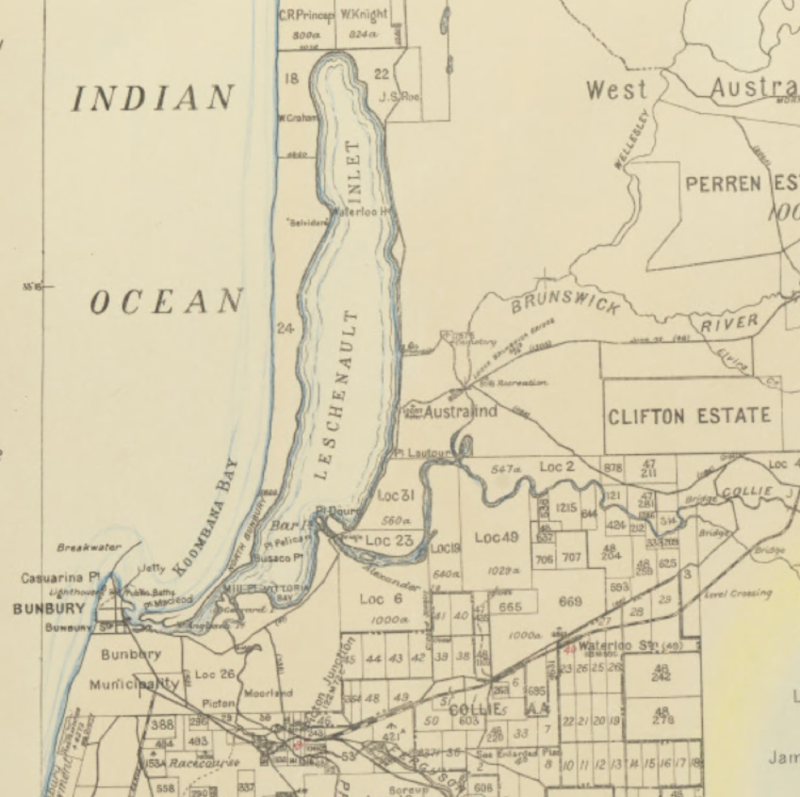
By 1913 there was a wooden jetty (commenced in 1864, and continually extended), protected by a stone breakwater (commenced in 1896). This gave a harbour that was effective except for weather from the north.
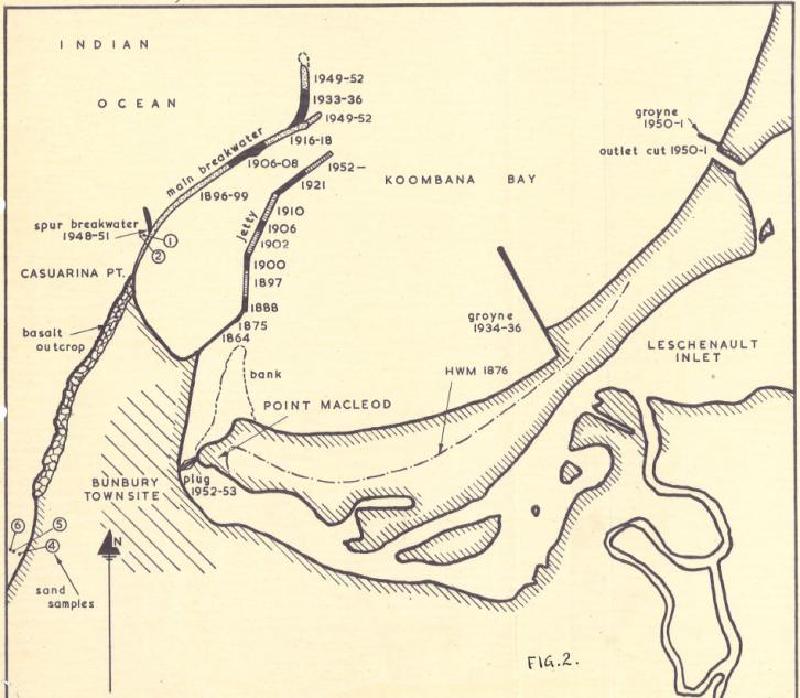
The situation by 1955 is shown in the following map. This is the Bunbury of my childhood. The breakwater and the jetty have been extended. Some brutal hydraulic engineering works had been applied to “improve the harbour”.
Leschenault Inlet itself had been formed by the slow southward movement of sand. Before the breakwater had been installed, the sand had moved into the southern end of Koombana Bay, the around Casuarina point, and continued south to Busselton and beyond. This flow was interrupted by the breakwater, and the harbour would now slowly fill up with sand. So a rock groyne was constructed in 1936 to “stop the sand flow”.
The rivers flowing into the Inlet still made their way to the sea at the southern point of the harbour. This flow now brought silt, particularly due to clearing higher up the rivers. This, too, affected the harbour. So a new path from the Inlet to the sea was dredged in 1951, protected once again by a rock groyne. This was known locally as “The Cut”. This was directly across the Inlet from the Collie River, on the basis that the currents would have the sense to find their own way across. To remind the currents who was boss, the old entrance of the Inlet near the harbour was blocked off. This was known locally as “The Plug”.
Bunbury and the Beach#
By 1900 the initial breakwater was in place. The Bunbury townsite was jammed hard against the harbour (perhaps the top half of the hatched area shown the the 1955 map). It had access to the sheltered beach either side of the jetty. Directly to the west of the town was the open ocean, edged by a basalt outcrop (which in conjunction with the southern sand flow had formed the townsite). South of this basalt outcrop was a splendid sandy beach that ran as far as Busselton, 40 km to the south. This beach was backed by a band of bare sandhills a kilometre or so wide. This matched the sandhills of the peninsula that formed Leschenault Inlet. There was no easy access from the town to this ocean beach, nor it seems, much enthusiasm for such access.
By 1912 the Bunbury Council had constructed the second version of its Municipal Baths, situated between the breakwater and the jetty. There was some 8 acres (about 320 metres by 100 metres) of water enclosed by little more than a paling fence with netting attached to render a shark-proof enclosure. In the center was a small jetty with diving board. In newspaper articles, it was said to be the biggest Baths area in the State, in Australia, and even “in the Commonwealth”.
The Southern Times of January 1912 reported the opening.
From 6 o clock in the morning, when the baths are opened by the lessee Mr. W. Dobbins, to 8 p.m., the official closing hour (and often later) a merry throng of bathers are always in evidence. Mixed bathing, with certain restrictions, is permissible and has greatly added to the popularity of the baths. The total expanse of water enclosed by the substantial shark-proof fence, is eight acres (which truly magnificent area is unparalleled in Australia). The main building is the lessee’s shop in which are hired costumes and towels and light refreshments etc. are sold, with a room behind for afternoon tea, etc, adjoining this. There are twenty well appointed dressing rooms for gentlemen, and the same number for ladies (each with a Yale lock), to which access is gained through separate doors, also shower baths. These are all built well off the ground, and have a platform in front, from which numerous steps give access directly to the water. From the centre of the platform a jetty 170 feet long runs into the water, and at the end of this jetty a good depth of water is obtained. There are two diving spring-boards at the end of the jetty. Under the jetty runs a picket fence, dividing off the ladies portion of the baths from the men’s.
In addition to the dressing rooms mentioned above, the Council have erected a long detached dressing room, which accommodates 50 bathers, also nearer the sea jetty, a children’s dressing room has been built, to be used by youngsters under 10 only.
In the water is a large raft, which is in constant demand. The lessee has a boat moored handy for use in case of necessity. In front of the men’s dressing rooms is a gallery for spectators, for use when carnivals are being held.
The Sunday Times of 24 December 1911 reported:
The present baths have an area of eight and a half acres. They are closely fenced in, and are absolutely shark-proof. The spot is an ideal one for a dip. The beach is all fine sand, without a sign of mud in any part. The water shoals from 2 feet to 11 feet at the outer fence. The Council have spared no expense in making these baths as up-to-date as possible. It has expended £2,000 on the venture, and towards this the Government has promised a subsidy of £500. There are 45 dressing rooms, freshwater showers, and electric light for night bathing. On one side of the diving platform the men take their dip, while the other side is reserved for ladies.
There is no actual division, as in the Claremont baths, so that in effect it is almost mixed bathing. The Council have made the charges very liberal. Children under 10 can bathe free. Between 10 and 14 the fee is 1d., and over that age 3d. is charged. The charge for bath towel and costume is 6d. The weekly ticket for adults is 1s. Children visiting Bunbury under the auspices of the Fresh Air League with attendants are admitted free a concession which at a penny per head works out at £50 per annum.
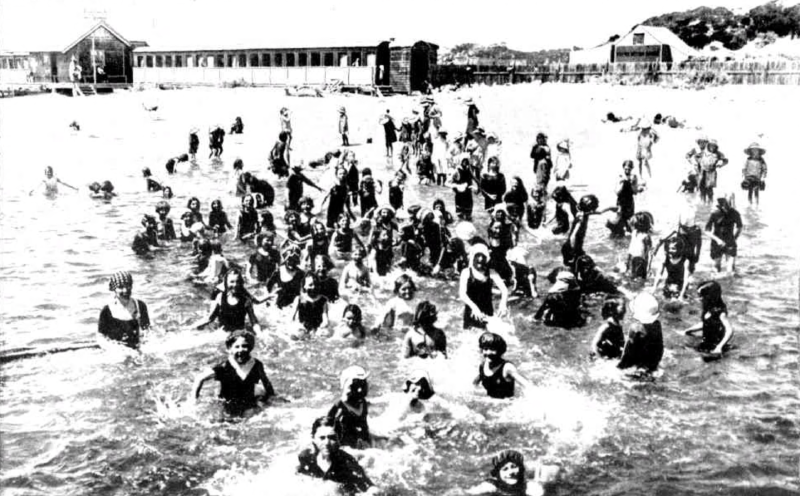
The following photo dates from 1919. It shows what is clearly the “ladies side” of the dining platform. The raggedy fence in the background shows the outer enclosure.
The following photo is presumably taken from the baths jetty looking back to shore. It shows an arrangement of 20 change rooms. There is clearly an external fence to the Baths, ensuring that you paid to get in.
Further information on the Fresh Air League is provided in this report.
Most coastal cities and towns had similar baths, some private but most provided by the Council. In Melbourne, the long history of the St Kilda Baths is indicated in this timeline. The Sydney story is told in a PhD thesis by Jean Allen. The catalogue entry is available here, from where the thesis can be downloaded.
The South Western Times of 11 October 1928 reported:
BUNBURY BATHS.
MEND THEM OR END THEM, WHERE HAS THE WATER GONE?
The Bunbury baths were at one time an attraction of the town; to-day they are an eyesore, and a continual source of expense. Piles have given way to pig netting for a shark proof fence, and where a few years ago a bather could take a header into the sea to-day there is not sufficient water for a child to paddle. The rising generation has learnt to take its pleasures in the surf instead of in enclosed water and with an ever-increasing patronage of the beach naturally the takings at the baths have decreased each year, Mrs. O’Loughlin, lessee of the baths, finding the conditions getting worse, had an interview with the Works Committee and then wrote to the Council suggesting, as she did to the Committee, that as the baths were in a very bad state of repair and as the water had receded so far that there was likely to be less patronage next summer, that the baths be separated from the shop and the rental reduced from £3 to £1 per week for the remainder of the lease. The Mayor said that the committee thought it unwise to spend any more money on the baths. The place had silted up, the jetty needed three piles to make it safe, and the iron on the roof was in a bad state of repair.
The Western Mail of 30 January 1930 reported:
It was only during the last four years that surf life-saving became popular at Bunbury. Formerly competitive swimming was conducted in the Bunbury baths (now obsolete) by the Amateur Swimming Club of Bunbury, which has since disbanded.
The South Western Times of 16 january 1935 reported:
Cr. H. H. Sherry said that he had visited the baths during the recent holidays. The manager of the baths had approached him and pointed out that despite the fact that there were more that 20 persons bathing outside the baths reserve, there were less than a dozen in the baths themselves. He claimed that the baths in their present condition were valueless. All conveniences on the beach were used for the purpose of dressing and undressing and if any of the bathers desired a shower they swam around the fence into the enclosure. The position so far as his lease was concerned was practically hopeless and unless he were given some assistance he would experience a most difficult time.
A severe storm from the north in March 1937 delivered the coup de grace:
STORM DAMAGE AT BUNBURY Jetty Baths to be Demolished.
The town clerk-engineer (Mr. C. B. Vincent) said today that it had been decided to demolish the jetty baths because the damage done by the recent storm was so severe that repairs were out of the question. The sum of £750 had been put on the estimates for providing new baths.
By March 1938:
BUNBURY BATHS OPENED.
The inaugural carnival of the newly-formed Bunbury Amateur Swimming Club was held at the new municipal baths yesterday under perfect weather conditions and was witnessed by a large crowd.
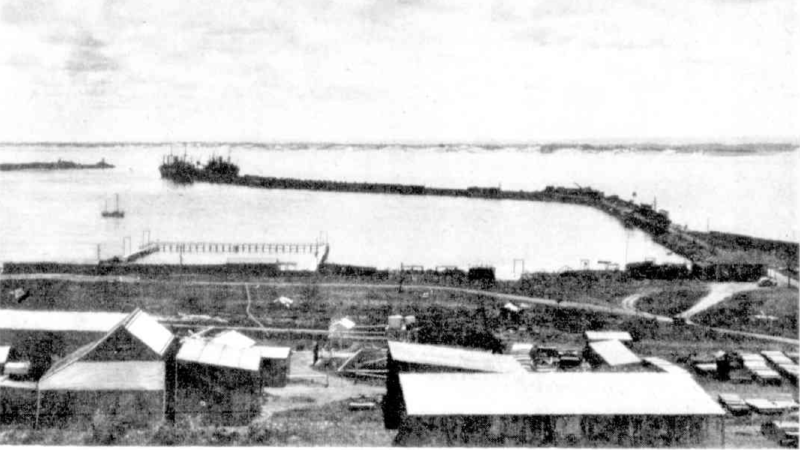
The following photo of the harbour shows the configuration of the Baths version 3. The two jetties out from the shore are 55 yards apart, allowing for swimming races. The main jetty dominates the view. The end of the breakwater is to the left. The sandhills of the Leschenault Inlet peninsular are on the horizon. This is the Bunbury of my childhood. The Baths were still there in the fifties, and I remember swimming lessons in the summer school holidays. I don’t remember changing sheds. Rather, you left home ready for the water.
Version 3 of the Baths has now gone as well. It was made, as the earlier versions, of timber piles and timber decking. These slowly and inevitably deteriorate.
Rocky Point Tearooms#
The South Western Times of 16 December 1920 reported:
Rocky Point Refreshment Rooms. — An announcement in another portion of the paper draws attention to the fact that the newly erected refreshment rooms at the terminus of Wellington-street, have now been opened under the name of the “Rocky Point Refreshment Rooms.” Miss L Patten has been fortunate in securing a lease of these premises and is confident that with her experience she can make them attractive to visitors and residents alike. Hot water, cool drinks, ices and afternoon teas are procurable, together with confectionary and tobacco. There is a spacious pavilion for promenades, etc., with a piano and good floor for social gatherings. A limited number of residents are being accepted over the Christmas holidays. The commencement of this establishment will fill a long felt want in Bunbury, and doubtless will be well patronised by residents and visitors to the beach.