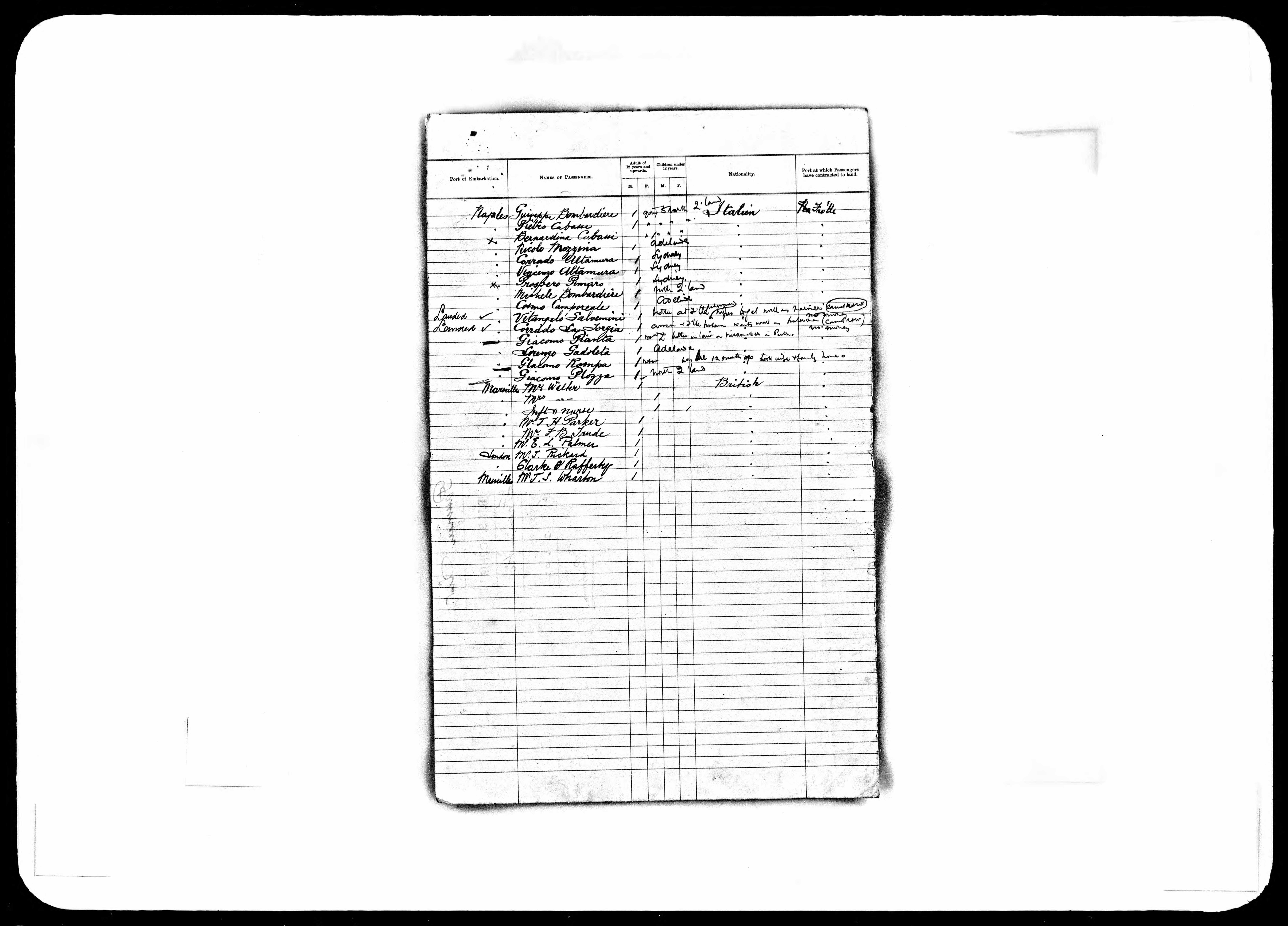
York Coffee Palace
583 words·3 mins
My paternal grandfather is Giovan’ Domenico Molinari (1882-1959). He was born in Tirano, Sondrio, Italy and emigrated to Perth, Western Australia in 1900. Three siblings (two brothers and a sister) migrated from Tirano to Perth in the first fifteen years of the twentieth century. What was the context of them leaving at that time, and why Australia?
The family recorded history and oral history is rather weak. The sister died early (in 1941). The younger brother went back to Tirano in 1975. They didn’t much write to one another, or at least didn’t reply to letters. One resource we do have is some notes made by my second cousin Noel Howieson. Much of the information she records was provided by our mutual second cousin Roma Molinari. It turns out that some of the details provided by Roma were incorrect.
In 2021 I discovered that the civil records (births, marriages and deaths) for the province of Sondrio were available online (see Tirano Records). That has allowed a family tree for my Molinari ancestors to be constructed, and some of the family story to be identified.
This is provided by
Jacqueline Templeton, “From the Mountains to the Bush: Italian migrants write home from Australia, 1860-1962”, University of Western Australia Press, 2003.
This is a study of migration from this area of Italy. It constituted the great majority of migration in the 1880-1914 time. The area was agricultural and poor. The population consisted of small landholders. Land was in short supply. There was a tradition of younger sons working outside the area either seasonally or for a number of years. Money was sent back regularly, or accumulated until return. This happened in Europe (Switzerland, France) where unskilled farm labouring jobs were available. To some extent this system was transferred to Australia.
The author (Templeton) has found access to a number of letters from the (single) sojourners in Australia back to Tirano. Many stories tell of isolation and loneliness. They tended to work together in small contacting arrangements, and the opportunities of interaction with the broader community were limited.
There is a considerable amount of Italian-Australian studies now available. The journal Italian Historical Society has a number of articles, and in fact lead me to find the Sondrio records.
For the Molinari ancestors, it is convenient to show a family tree for my great-grandfather Bernardo. This is shown in-line, and it is best viewed at a zoom of 100% or bigger. For convenience a link to a full-screen version is provided in the caption.
Family tree: Bernardo Molinari (fullscreen)
Bernardo was the youngest of five siblings. As far as we can see, his parents and his siblings were all born in Tirano and spent all their lives there.
Bernardo (1842-1918) was married FOUR times. Wives and children:
Maria died 24 December 1871 in Tirano (obviously from complications), aged 30.
Marta died 20 Nov 1876 in Teglio, aged 28.
Maria died 22 Oct 1902 in Tirano, aged 57.
No children and I can’t see when she died. Bernardo was 62 at this stage.
None of his wives came from Tirano - God only knows how he found them and persuaded them to marry him.
He seems to have spent the time 1888-1901 (or thereabouts) in Australia.
Domenico Molinari of Madonna di Tirano emigrated to Australia in 1888, leaving his wife and three children. The younger of two brothers, Bernardo, was 2 when his father left but nearly 14 when he returned twelve years later and immediately expected obedience. To Bernardo, his father was a usurper whose authority he refused to recognise and, as soon as he was able, he left permanently for Australia, following his brother who had already gone, perhaps for the same reasons.
(Templeton, page 93, who attributes the information to a conversation with Bernardo’s daughter Roma).
The travel date is probably correct. There is a Bernardo Molinari (“workman”, aged 32) on the passenger list of the Salier which arrived in Melbourne on 03 August 1888. The age given is wrong (he was 46) but there seems to have been no requirements to carry an identity document which could be checked. The baby Bernardo was not yet 1.
He is still away in April 1901. On his daughter’s marriage certificate (in Tirano) his address is recorded as “ignota in Australia” (unknown in Australia).
He was back in Tirano when Maria died in October 1902.
No details of his stay in Australia have been found and no record of his return trip to Italy. There is a vague family story that there was a second trip to Australia, and indeed that he had another family there. If there was, indeed, a second trip he would have “abandoned” his fourth wife when in his early sixties.
In any event, he was back in Tirano when he died in 1918.
It is convenient to show a separate family tree for my great-grandmother (as not all details can be mapped into a single tree).
Family tree: Maria Reghenzani (fullscreen)
Maria was the oldest of four siblings. She was born in the comune of Teglio, some 10km down the valley from Tirano. Her parents and siblings were born in Teglio, and seemed to have spent their entire lives there.
Maria was married THREE times, each time in Tirano. Husbands and children:
No children in the period of the records. Giovanni died in 1870 aged 47.
Domenico died 1 Feb 1875 aged 54.
When Bernardo disappeared on his 12-year sojourn in Australia, Maria had in fact five children to look after, aged 15, 14, 8, 6 and 1 years. The older two were from her earlier marriage to Domenico Ferrari. It is not clear that she even knew where Bernardo was (see the above comment from his daughter Domenica’s marriage certificate), so it is not clear that he regularly sent money back. By the time Bernardo returned the oldest three (all girls) were married and the next (my grandfather) had left for Australia. A family story has that his main childhood memory was of being hungry, with meat being afforded only several times a year.
Remarkably, we have a photograph from this period, taken in about 1885.
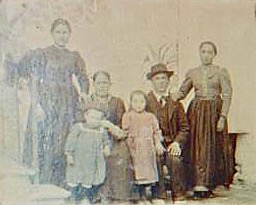
Molinari Family. Tirano 1885
It shows Maria and Bernardo, seated. At the back are Maria’s daughters Maria Giovanna and Caterina, from her earlier marriage to Domenico Ferrari. At the front are their son Domenico (aged about 2) and their daughter Maria Domenica (aged about 4). Their third child is not yet born.
The photo is in the carte de visite format. This was a relatively affordable technology, where the photo was directly printed from a negative without any enlargement. The photographer has added a little colouring by hand.
The resolution of this image is very poor, only 256x205 pixels. I do not have access to the original photograph. Rather, a photo of the original was taken by my second cousin Noel Howieson, and what I have is a scan of that second-generation photo.
Life was clearly cheap in Tirano. By my reckoning Bernardo had 12 children, of whom only three reached maturity. Maria had 9 children (7 with Bernardo), of whom five reached maturity.
There were a large number of Molinaris and Piantas and Ferraris in Tirano, but almost none in the next communes Villa di Tirano and Teglio. Clearly it was a tribal way of life.
The three Molinari siblings migrated to Perth in close succession: Domenico in 1900, Bernardo in 1908, and Maria Domenica in 1916. They left two half-sisters in Tirano (from their mother’s earlier marriage). The second of those sisters, Caterina Ferrari, had three children, of whom two also migrated to Perth: Eliza Ferrari in 1923 and Battista Della Torre in 1924. The first sister, Maria Giovanna Ferrari, stayed in Tirano and her family were the rather indistinct “Tirano relatives” of my childhood. She had married Giovanni Molinari, so these relatives bore the Molinari surname (but from a different family).
Some background information relevant to this generation is described separately.
Dominic arrived in Perth (or, more precisely, the port of Fremantle) on the Nord-Lloyd ship Gera on 10 April 1900. He was just 18 years old and clearly would have spoken barely a word of English. Family folklore has it that he had trained as a wheelwright.
The passenger list is available. It shows that he was one of four Italians who joined the boat in Antwerp, rather than being among the group of 29 who joined the boat in Genoa - the latter option being the cheaper and more convenient. Being 18 years of age, he was liable for military service, and would have needed a passport to be able to board the ship in Italy. Being sound of wind and limb he would not have been given the passport until he had completed military service. The alternative was to cross the nearby Swiss border, and head to Belgium by train. It looks like two of the other three Antwerp passengers may have been in the same situation.
It is convenient to show a timeline of where he lived and worked.
This is Domenico at his marriage to Giacinta Dall’Acqua in 1911, aged 29.
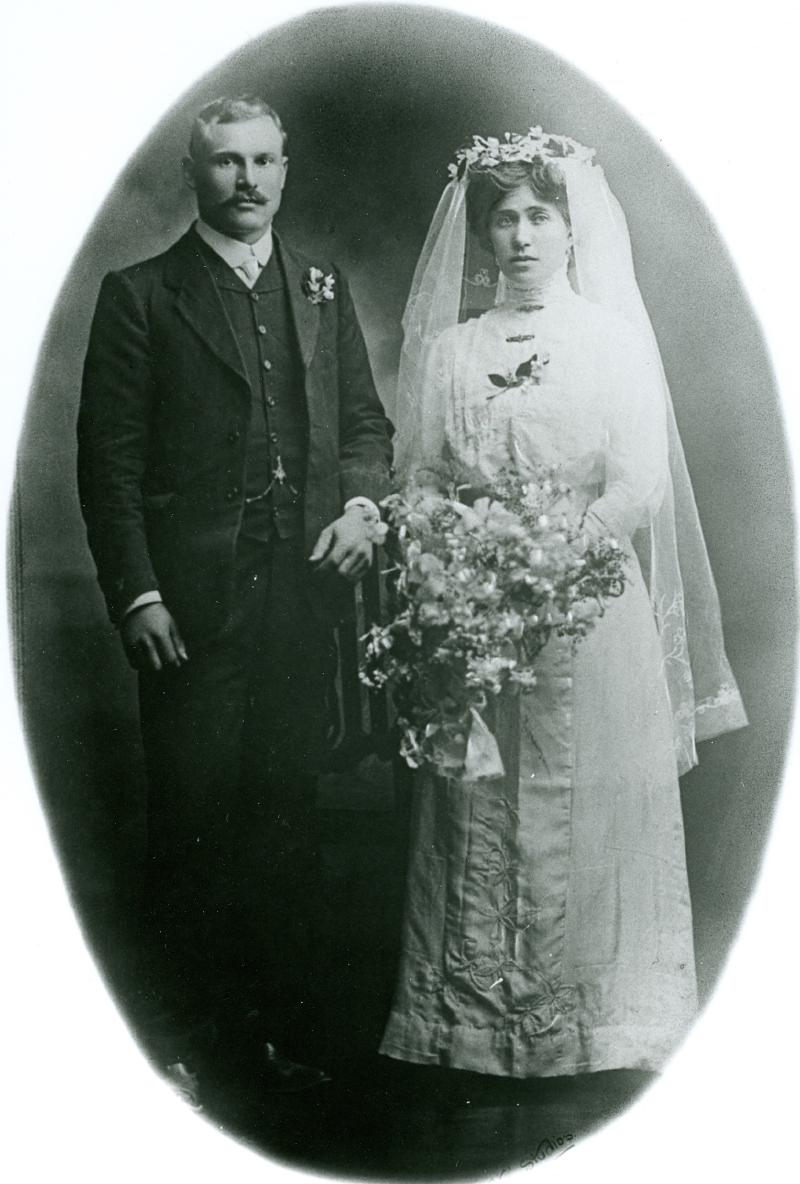
He applied for naturalisation in 1911, soon after his marriage. As wife, Giacinta obtained the status automatically.
The York Coffee Palace, at 557-559 Wellington Street, Perth plays a key role in the affairs of Dominic, his brother Bernardo, and his brother-in-law Giacomo Pianta. Clearly, it finished up in the management of Bernardo from about 1920. Family folklore has it that Dominic and Giacomo owned the business (but not the property), and that they were later bought out by Bernardo. Giacomo used his capital to buy a dairy farm about 1915, and Dominic used his capital to buy the Cosmopolitan Hotel in Day Dawn about 1916.
It is hard to pin this down. A starting point is 1906, when Giovanni Gettaz acquired a colonial wine licence and hence opened a wine saloon on the premises. It is possible that Dominic and Giacomo had built up some savings by then - it was certainly the Tirano ethos to do so. It seems clear that the York Coffee Palace, with its wine saloon and its accommodation, became a focus of the Italian community. My reading is that it was a three-way arrangement between Dominic, Giacomo Pianta and Giovanni Gettaz. In the Electoral Rolls from 1912 to 1921 Giacomo Pianta is listed as a “wine-saloon keeper”, of 559 Wellington Street. In other words, once Giacomo was naturalised in 1911, he registered to vote. Dominic doesn’t appear on the roll until 1921. It was not compulsory to vote until 1924, so presumably it was not compulsory to register. Similarly, the Electoral Rolls from 1910 to 1917 show Giovanni Gettaz as a “wine saloon keeper”, of 559 Wellington Street. Dominic is not listed until 1921 (in Cue).
The story is taken in more detail in my discussion of Bernardo.
The family machinations are much more evident for the Cosmopolitan Hotel. The starting point is clear. The owner of the hotel, Pietro Ceruti, gave the York Coffee Palace as his address in October 1914 (on his return from his disastrous commercial traveller trip to Sydney). At his bankruptcy hearing in June 1915 he says he has
three secured creditors, covered by mortgages to the total of £1,298. The three secured creditors are Italian.
One mortgagee was certainly Dominic, and I believe the others were Bernardo and Giovanni Gettaz. The old rogue Pietro had sold them a pup. In fact the luckless licensee of 1915, Urbain Martin, had been in some sort of partnership with Dominic and Giovanni. He had expended some £358, expecting to be reimbursed. Gettaz had paid up, but he took Dominic to court for the money. Dominic lost.
The story now starts to look like a Greek tragedy. Dominic and Bernardo are now co-owners of the hotel, and Bernardo wants his money out. To this effect he forces Dominic into a bankruptcy hearing in March 1917 (he seems to be the only creditor). He said that he and Dominic had been partners on a half-share basis
They kept no books. After about fourteen months he retired from the partnership, not being able to agree with his brother’s wife. He had also taken over a mortgage on the hotel at a cost of £400 and this he still held.
Dominic cleared the bankruptcy in June 1917.
Finally, a mortgagee sale of the hotel was advertised for 3 August 1917. This must have been initiated by Bernardo, to get at his capital. It is not clear that the sale ever took place. Maybe Dominic settled it somehow. Who knows, at this remove, why they could not have managed a settlement without recourse to such drama and expense. Maybe it says something about the Italian temperament.
Family legend has it that they were permanently estranged. Some 35 years later they lived in Perth in the same suburb (Osborne Park), but never spoke to one another.
In the event Dominic ran the hotel for another two years. At the end of 1919 the licence lapsed and the hotel was sold as an empty building.
Station Owners and Others: Tenders, addressed J. Metzke, Meekatharra, are invited for Purchase of the Cosmopolitan Hotel, Day Dawn, as a going concern or for removal. This is a well-built two-storey building and contains approximately 15 tons corrugated iron.
Day Dawn had imploded. Although family legend has it that he made good money while running the hotel, it would seem that he would have emerged from the adventure with very little of his capital intact. On the other hand, Bernardo had the York Coffee Palace and Giacomo had his diary farm. Perhaps Dominic rued the day when they responded to the siren sales pitch of Pietro Ceruti.
The family moved eight kilometres up the dusty road to Cue and Dominic ran a smithy business (blacksmith, farrier and wheelwright). This was his original trade. Perhaps he took over an existing business - Lord knows he wouldn’t have to pay much for it. In the 1923 edition of the Western Australian Directory [Wise’s] there are two blacksmiths listed for Cue (population 600). In the 1930 edition, Dominic is the only one.
Two events appear in the public record. In the Murchison Times of 28 May 1927 we read:
Cue Local Court.
DISPUTE ABOUT A GOAT. (Before E. Y. Butler, R.M., and G. A. Wright, J.P.)
Dominic Molinari v Maurice Fienberg. The defendant was charged that on the 11th day of May he detained one goat valued at 15/-, the property of plaintiff. He pleaded not guilty.
Dominic Molinari (sworn) said owned the goat. On 10th of May, defendant came to my shop and said, “Molinari, you have one of my goats; also three black kids.” He wanted to know what I had done with them, I told him if he liked he could inspect my goats and if he found any belonging to him he could take them away. At about 3 o’clock the same day Batterbury told me Fienberg had taken one of my goats. My wife demanded the return of the goat from Fienberg. He refused to give it up. Constable Ridley went to Fienberg, who said the goat was his and had been reared from a kid. I told him I would summon him. I bought the goat seven months ago from Mrs. Lyons, along with two others. I paid 7/6 each for them and sent the money with my son. Mrs. Bennett was present when my son paid Mrs. Lyons. I cannot produce the receipt. I cut the points off the horns of two of the goats and filed two marks in the horns. I killed one goat. The goat in question has been in my possession ever since.
By Defendant: Told you that goat in the railway yard had two kids. You said if the goat had kids it was not mine. By the Bench: Did not know much about the goats when I bought them and was not sure of the marks on them. Natural marks on goat were brown neck, white body, four black feet and spot on back as big as two hands. The colour was dark, not black. Antonio Issaponi said he knew Mrs. Lyons had goats and that Molinari bought them. Often saw the goat with Molinari’s goats. Mrs. Lyons told me she sold the goats to Molinari. By Defendant.—Believed the goats to be Mrs. Lyons, but could not describe the marks on them. By the Bench: The goat outside the door of the court was one of Mrs. Lyon’s goats as far as he knew. Ellen Bennett said she was present when Molinari’s boy paid Mrs. Lyons for tho goats, but she could not describe any of the animals in question. Barney Molinari, son of plaintiff, gave evidence as to payment for the goats and bringing them home.
Maurice Fienberg (sworn) said some time ago he let the goat go as she was not in milk. Can swear to her. In November she came back with three kids. Her horns wore not then cut or marked in any way. I called the goat “Saddle,” because of the mark on her back. A week or so ago I bought a goat from a person living near the railway station. When passing near plaintiff’s I saw the goat and noticed two horns cut and marks on them. I went to Molinari in his shop and said: “You have one of my goats, the one with a mark like a saddle on its back.” He said the goat belonged to him, and asked if it had any kids with it. I said “No.” He then said it was not my goat. He invited me to inspect the goats, and if my goat was there I could have it. Later in the day I again saw the goat and took it to my home. I refused to allow Mrs. Molinari to take the goat. By the Bench: I reared the goat, which is about 4 1/2 years old and have had it in my possession ever since. Can swear to the goat on account of the saddle mark on its back. Ellen Heydon said Fienberg had the goat ever since it was a kid. She was certain it was the goat on account of the mark on its back. By Plaintiff: She never saw another goat with a similar mark. Arthur H. Batterbury said he knew he goat outside the court with the mark on its back. It was pestering me, by coming to my house frequently. Knew the goats Lyons had; there were two brown and one blue. He was certain the goats Lyons had were not marked similar to the one in question. By Plaintiff: Never said Fienberg took your goat. I knew Lyons goats through having to kill the kids from time to time.
A verdict was given in favour of defendant with 23/6 costs.
The case shows that many households kept a small flock of goats, presumably for meat and where possible, milk. These goats roamed around the environs of the town, being recognised by their markings. The notion of possession seemed fluid.
The second event was Dominic’s conviction in June 1952 for being in unlawful possession of gold.
Dominic Molinari (70), married, blacksmith, was charged in the Cue Police Court today, before Warden Harwood. with having been in the unlawful possession of gold. He pleaded not guilty but was sentenced to three months’ hard labour and fined £50. He pleaded guilty to a charge of having had unregistered appliances and was fined £25. Det.Sgt. Douglas, of the Gold Stealing Detection Staff, said that a search of Molinari’s blacksmith shop had revealed 26 crucibles, five gold moulds and other equipment used for smelting. Molinari had claimed that certain material was brass, but on assay it proved to be 80 per cent gold. Evidence was given that some of the gold tailings which formed part of the charge assayed at a rate of 200 ounces a ton.
Presumably he had been happy to take gold (in lieu of cash) for blacksmithing services. Gold, to a traditional Italian, would have been better than cash. Maybe he was regarded as a small-scale local “fence”. In any event it was hardly a unique offence. A search of The West Australian for 1952 shows several dozen similar cases, all fairly small beer. Security in the gold mining and refining process was pretty weak, and this was offset by making gold possession, ipso facto, a punishable offence. Three months hard seemed to be the minimum sentence.
It was little spoken of in the family. Family legend had it that Dominic was extremely wary of banks. Cash was carefully buried (literally) rather than banked. This caused drama when the burial spot was temporarily mistaken. It was also suggested that not all the gold was seized by Sgt. Douglas.
Dominic made a trip back to Tirano after the war. We have the return details - he arrived back in Fremantle on 4 October 1950, on the Surriento. Family legend has it that there was still some family property in Tirano, which he disposed of in an inexpert fashion. In the old tradition he returned with a new piano accordion. It is still in the family, unplayed (my brother Peter has it)
The business was advertised in April 1953:
BLACKSMITH and Wheelwright shop with tools and machinery for sale, iron building 66ft. x 44ft, Apply G. Molinari. Cue.
We have a photograph of the house in Cue, around 45 years after they moved out. It has obviously seen better days. Not atypical of houses in a town that has shrunk to the edge of existence. Old houses have almost no residual value.
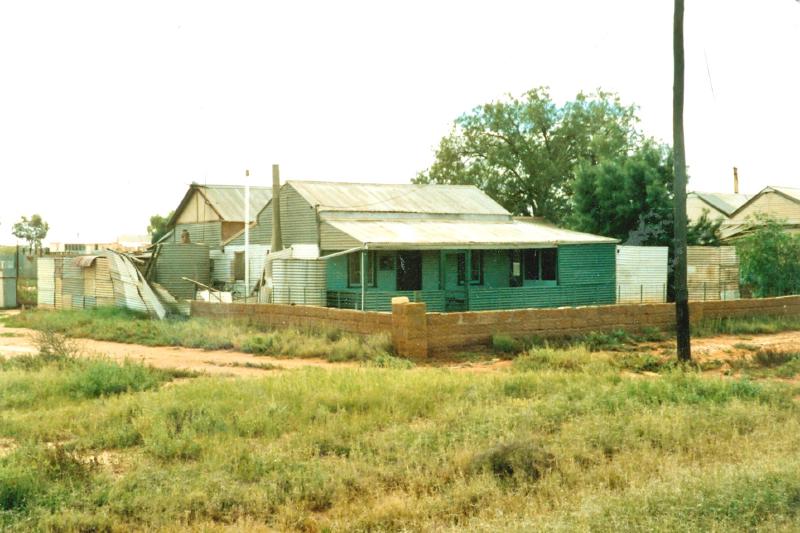
I have one memory of the house, which must date to about 1948. There were shady pepper trees in the front yard, with a bed frame under the trees. It was cool and dark inside. There were goats in a pen in the back yard. Family legend has it that milk from these goats was resorted to in raising either me or my younger brother.
My cousin Irene reports a memory of about the same time:
My memory of their house in Cue was that when we visited, we had goats milk. Next to the house was a big hill where we played. When Trish and I drove Mum and Dad back to Cue, not long before he died, we went to the house. That big hill was just a small rise, barely anything.
They moved to 3 Hector Street, Osborne Park on the (then) outskirts of Perth, and adopted a somewhat nostalgic lifestyle. They grew grapes and, I think, made wine. There were chickens and, I think, a cow. Some of his wrought iron stock from the blacksmith’s shop was too close to him to part with, and Dominic had it transported at great cost to Perth.
My cousin Irene remembers:
The memory I have of going to Grandparents out at Osborne Park, is that it was a little cottage on an enormous block. (Through the eyes of a child.) Giacinta always cooked Trish and myself fried eggs. Lots of discussion about Roma’s parents. They didn’t live too far away. They must have hired their house or property out to people for functions and did the catering. I realise now what they were talking about, but then, would have had no idea.
My brother Jim remembers:
I can remember going to our grandparents’s house in Osborne Park, where the house had a tree on the left side. Lots of old scrap iron in the front area. The back door opened onto the kitchen. There was not much to explore outside, not like Uncle Barney’s place: sheds with old cars, an underground cellar with wine casks.
Apparently Dom buried some gold in the garden and forgot where it was. He blamed Arty, but after digging up the entire back garden, he found it.
Apparently old Dom would never wear socks when he got dressed up, Uncle Barney was always telling him to wear socks. I think this was a Roma story.
I can remember going to the Bunbury nursing home to visit Giacinta, only the once, maybe we were together. I can remember her on the veranda, but not inside.
I can remember the family, including Giacinta, going to the Mayfair Theatre in Bunbury and that she complained of all the killing in the movie. She must have thought it was all true and not acted.
They lived there until Dominic died in 1959, aged 77. Giacinta eventually moved to a nursing home in Bunbury, where she died in 1973, aged 90.
Domenica, Dominic’s elder sister, had a tragic life. She was born in Tirano in 1880. Her father disappeared to Australia in 1888, when she was eight years old. He was still away in 1901, when she married Giacomo Pianta. Giacomo migrated to Perth in 1902, leaving her in Tirano with a very young son. She didn’t join him until 1916. They then ran a successful diary farm in Perth, but in 1926 Giacomo suffered serious head injuries in an accident on the farm and never recovered, spending the next 19 years in an invalid home. Domenica was left to run the farm by herself. She committed suicide in 1941, obviously suffering from depression.
Domenica and Giacomo were married in Tirano in April 1901. Their only child Giacomo Pietro was born in Tirano in June 1901.
Domenica was left to run the diary farm, with Nino and hired help. Nino was married in 1928 and, presumably, sought to go his own way. She made two trips back to Tirano. The outward details are not recorded, but the records provide the return journeys. She arrived in Fremantle on the Orsova on 15 November 1932, and on the Orama on 10 December 1935. With no parents or siblings in Tirano she was visiting her more extended family.
In September 1941 she committed suicide. The Daily News of 25 October 1941 gives a basic account of the inquest. The Mirror gives a more lurid account. Reference is made to her invalid husband and to chronic asthma problems. A suicide note was written in Italian. Even after 25 years in Australia she had not developed good English written skills.
We have her will, made a month before she died.
In June 1942 the farm was advertised for sale, described as
a registered wholesale dairy farm, of 94 acres, being in Harbour Street about 5 miles from the city.
Bernardo, my great-uncle, was a colourful character, to put it mildly.
He was born in Tirano in 1887, and migrated to WA in 1908. He was married twice. Firstly, in 1926 to his step-niece Elisa Ferrari. Secondly, in 1930 to Pierina Tognolini. He returned to Tirano in 1975 in his late eighties (with his daughter Roma), and died there in 1984 aged 96.
His childhood was eventful. His father disappeared to Australia, leaving Maria to look after Domenica (8 years), Domenico (6 years) and Bernardo (maybe eight months). By the time he returned (late 1901), Domenica was married, Domenico was in Perth and Bernardo was about 14 years. His mother died in October 1902, just before he turned 15. Family legend has it that he did not get on with his father, who was surely a stranger to him. His father remarried in 1904, when Bernardo was 16. So he was living with a father he did not like and a step-mother he did not know. Presumably he would have sought the company of his sister and his two half-sisters Maria and Caterina Ferrari.
He left Tirano in 1908, presumably as soon as he has saved enough money. He arrived in Fremantle in June 1908, aged 20 years. An important source for his subsequent movements is provided by his naturalisation application.
On his arrival he spent 9 months in Parkerville, close to where his brother Domenico was living. With presumably little or no English language skills, he would have needed help getting work and accommodation. He says his occupation was that of a carpenter. He then worked until mid 1916 at New Norcia. Presumably he was employed by the Benedictine monastery there and engaged in its building and maintenance activities. It would have been a quiet life, and he would have found it easy to slowly save some capital in the time-honoured way of the Tiranese. It is clear that he had steadily invested his capital while at New Norcia. By mid 1916 he was in a partnership with his brother Dominic in the Cosmopolitan Hotel. As we have seen, by the end of 1917 he had extracted his money from the partnership in a very messy process. He clearly had a major interest in the York Coffee Palace and on his move to Perth was effectively manager of the associated wine saloon and restaurant.
It is clear that by 1916 an applicant for a wine saloon licence (or a publican’s licence) needed to be a naturalised citizen. Dominic had been naturalised in 1912, and so could take over the licence of the Cosmopolitan Hotel. Bernardo needed a naturalisation certificate to get his wine-saloon licence. It took him until September 1920 to achieve this objective.
His naturalisation file makes interesting reading. He first applied in December 1916, only to told that
certificates of naturalisation are not being issued, at the present time, to Russians under fifty years of age
The country was at war, and clearly had other things to worry about.
He applied again in December 1917. The reply came sternly
Referring to your application for naturalisation I observe that you are 30 years of age. I shall be glad to know why you are not taking part in the war. If you are, however, not medically fit, please furnish me with evidence to that effect.
Bernardo replies
I beg to advise you that I was examined in my Country at 20 years of age and I was exempt from military training on account of an injury to my right eye through the ball of the eye being pierced by a nail which has left the eye disfigured and the sight greatly impaired.
Even so, he is informed that
no certificates are being granted at the present time.
He applied again in August 1919. The paper trail is an interesting comment on the times.
There is a standard police report of 24 October 1919 by one Constable Gee. The report affirms that
the applicant conformed, in every, respect with the War Precautions (Alien Registration) Regulations
and offers that
from my own personal knowledge this man is of good character.
The application was also referred to the Military Commandant, Perth, in what can only be interpreted as an early version of an internal security service. Who knew! The reply (page 20), from one Lieut. Colonel Peck, is surprisingly detailed. It concludes:
MOLINARI’S application raises the question of naturalisation of aliens whose main idea is to get into a position to enable them to apply for a (wine saloon) license.
It has been demonstrated during the war and in the case of the recent woodline strike and disturbances at Kalgoorlie that “national” hotels and saloons are not conducive to the welfare of the country and it is submitted that naturalisation should not be conferred upon aliens whose calling is such as would tend to foster or encourage alien centres in the community. The application of MOLINARI is objected to on such grounds.
Not much support for multiculturalism in 1919, then! This objection is trumped by a letter from the Premier’s Office which quotes from a WA Police report:
I respectfully report that this is the leading Wine saloon and restaurant kept and frequented by Italians in Perth. The place is well-conducted, and although exclusively frequented by Italians, could not be called an Italian Club. As the present licensee is an old man, it is probable that Molinari will apply for the license of these premises if his naturalisation is granted. Molinari always gave me every assistance in tracing Italians and other foreigners wanted for evasions of the War Precautions Act, and was always willing to assist in obtaining the required information.
In any event the objection was to no avail as his Certificate of Naturalisation was awarded on 20 January 1920.
This was just as well, for on 9 February 1920 both De Giovanni and Molinari were convicted of the charge
Each of you on January 11 were in possession of 68 bottles of Swan beer, seized at 559 Wellington Street, by virtue of a search warrant issued under the provisions of the Illicit sale of Liquor Act, 1913
They didn’t need to be caught selling beer in a wine saloon, mere possession was enough. One wonders if the Law had something better to do. Clearly, Lieut. Colonel Peck was apoplectic. He promptly wrote to the Home and Territories Department on 11 February, attaching the clipping from The Daily News, and doubling down his objection. The WA branch of the internal security service had little better to do than to note that an Italian had committed the un-Australian crime of being in possession of bottles of Swan Lager.
Bernardo managed to slowly finesse his problem. An application to transfer the license from De Antonio was refused on 26 April 1920. This seems to be rather moot, as dear old Antonio was buried on 8 April. The license seems to have been transferred to the trustee of Antonio’s estate and it was finally transferred from the trustee, Peter Porcelli, to Bernardo in September 1920.
The heritage entry for the building notes that
On 15 March 1926, Bernardo Molinari acquired the title to Commercial Building, 553 - 561 Wellington Street from Burt, Hooper and Drummond.
He clearly celebrated by putting Molinari Building on the facade, and making modifications to the bar and restaurant areas of the ground floor. A newspaper report of October 1927 provides the following:
Bernardo Molinari, who is one of our busiest of the Italian business men of the city, has been eighteen years in Wellington-street, where his Roma Wine Bars are regarded by the Italiano fraternity as being a sort of home-from-home. Bernardo was in his element a few evenings ago when he entertained some of the leading Italians and some of the most prominent English-speaking citizens of Perth to the celebrations marking the opening of his extended bars. The chief guests were the Italian Consul and his charming young wife, the Signor and Signora Loncelleti, who have been about eighteen months out from their native Italy. The Consul, speaking in Italian, declared the premises opened and proposed the health of Mr. Molinari, which everybody honoured with many “Bravos” in good Australian sparkling hock. Afterwards, at a sumptuous dinner, other toasts were honoured, the principal speakers being Mr. Molinari, Mr. Magi (president of the Italian club at Fremantle) who is quite an orator, Mr. Delri, and the Italian Consul. The culinary arrangements were perfect as the Caprera restaurant (which specialises in Italian cookery) could make them, and afterwards dancing was indulged in to the strains of a first-class orchestra. Those who were privileged to be present will not forget the event for its great hospitality and pleasantries.
It seems that the accommodation side of the business (the old York Coffee Palace) also boomed. Family legend has it that Bernardo would meet Italian migrants at the dock in Fremantle, and offer them accommodation and advice. A number of naturalisation applications in the 1920s list 559 Wellington Street as their address and Bernardo as their sponsor.
Bernardo featured in the lives of the two migrants of the next generation mentioned above, children of his half-sister Caterina. The first, Elisa Ferrari, was born in 1901 and arrived in 1923. Bernardo married Elisa in 1926. Sadly, the marriage was short-lived as Elisa (also called Elena) died of tuberculosis in September 1929. There were no children. We don’t have any more than the bare facts. Presumably Elena was ill for some time. This was the era of the TB sanatoria. There was no cure.
The second, Giovanni Battista Della Torre, was born in 1907 and arrived in 1924. He seemed to be known as Battista to the family. We have his photograph
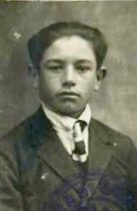
Battista Della Torre. 1924
taken from his passport. His naturalisation application of late 1929 gives his address as 559 Wellington Street and says he has been employed by Bernardo for the last five years. He can understand English, but can only read and write a little.
Surprisingly, we have a photograph of the three of them.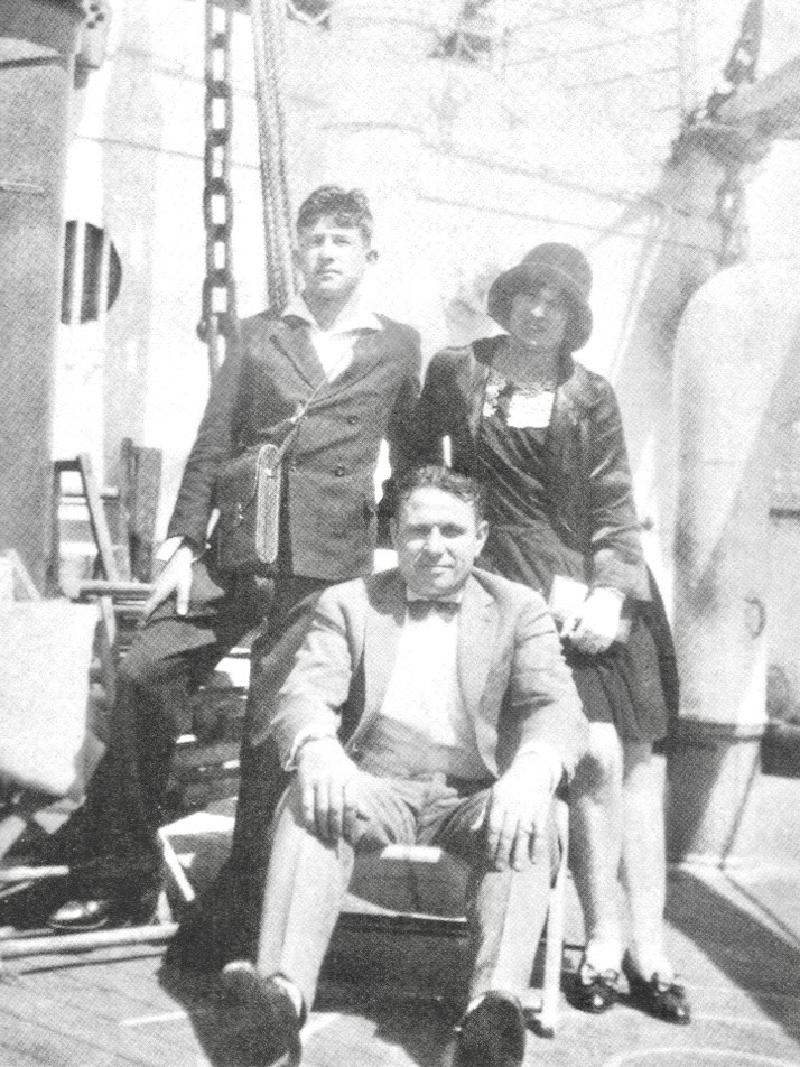
There are two sources for the photograph.
They must have a common source. They refer to Benito Molinari, when it is clearly Bernardo. They refer to Fremantle 1930. Bernardo in fact left Fremantle in 1928 on a six-month trip to Italy, and it is likely that they photo was taken on board the boat, farewelling him. Battista would have been 21 and Elena 27. The ages look about right. On a separate issue, Bernardo did not travel with his wife of two years. Maybe she was not well enough to travel.
There are two other entries in the Lombardy archive site. One, dated to 1925, is of a rather splendid Fiat car. A little detective work shows that the car is parked in Queen Street, with the Molinari Building in the background. I have a memory of the car in about 1955. It was still in Bernardo’s possession, in Osborne Park. The other is an interior shot of lunch at the Caffe Roma. Bernardo certainly packed the customers in.
Bernardo arrived back in Fremantle on 27 Nov 1928, on the Oronsay, travelling first class. There were 1600 passengers on the passenger list. In the days before jumbo jets, they certainly knew how to pack the passengers into the ocean liners. Bernardo’s trip was reported as follows;
Back from Italy, after a six months’ sojourn, Bernardo Molinari, a chap who was born neath the shades of Vesuvius and came to this country thirty years ago to make himself acquainted with affairs on the Golden Mile. Since then Bernardo has been a Perth business man and is now the recognised lingual and financial adviser to Italian immigrants. When an Italian finds himself in need of sympathy or wise direction he is advised to see Bernardo, who has such a strong acquaintance with Aussie conditions that he is never astray. During his trip home he had a personal interview with the Dictator, Signor Mussolini, who showed a very sincere personal interest in Australian affairs. Contrary to reports, it is said of Mussolini that he is an advocate of all Italians who come to Australia becoming Australianised and conforming to the conditions and laws of the country. On this point Bernardo found Mussolini very strong and the Duce was glad to be informed that Italians in Western Australia were joining up with the industrial unions and assuming the ordinary habits of the local community. Bernardo also had an inspection of the Fiat motor works and was surprised to note, as a comparison with other countries that he visited in Europe, that mechanically Italy was keeping well up to date.
It seemed to be a strong convention that an Italian migrant making a return visit to home would bring back to Australia a musical instrument. Piano accordions were a great favourite, even if no-one back in Australia could play it. Bernardo brought back a nickelodeon, to be played in the Caffe Roma. It has finished up in the Cue Museum. It would seem that it was made by Ottini and Pellandi of Navara. One can be seen in action here.
The following photo dates to about 1935. It shows my father as a young man, with his uncle Bernardo.
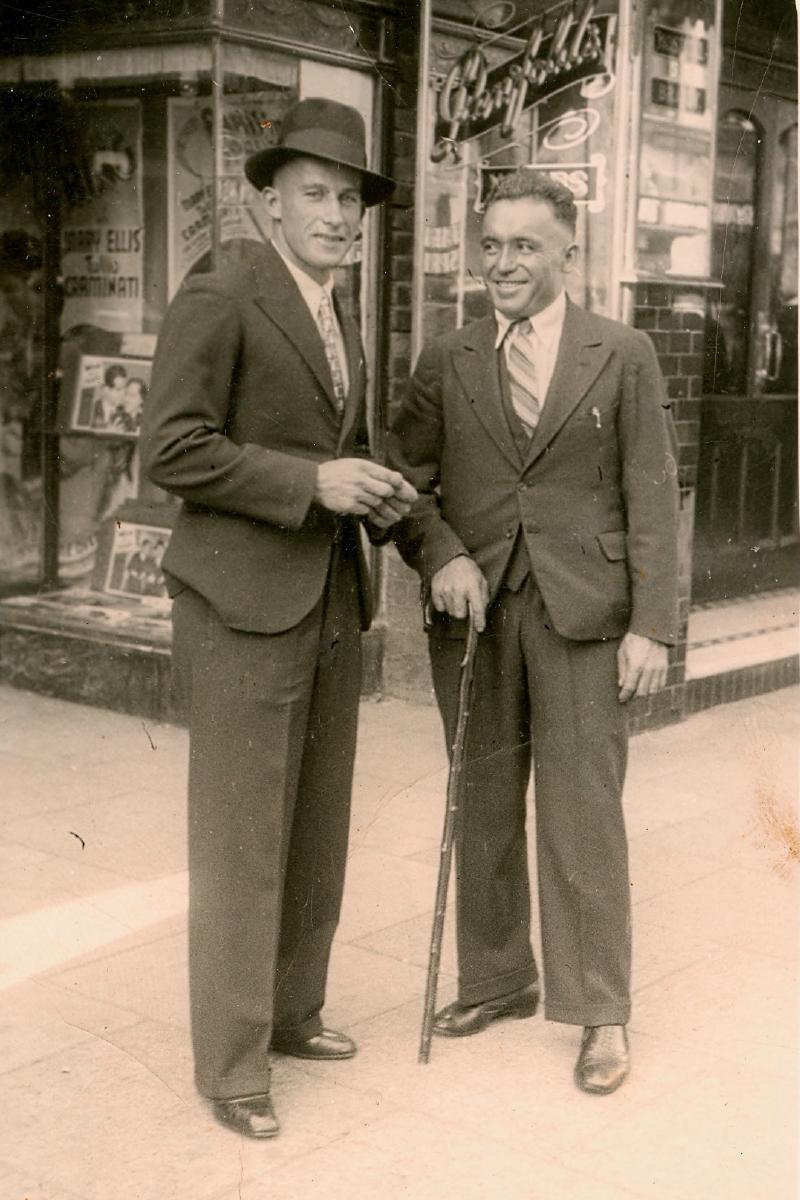
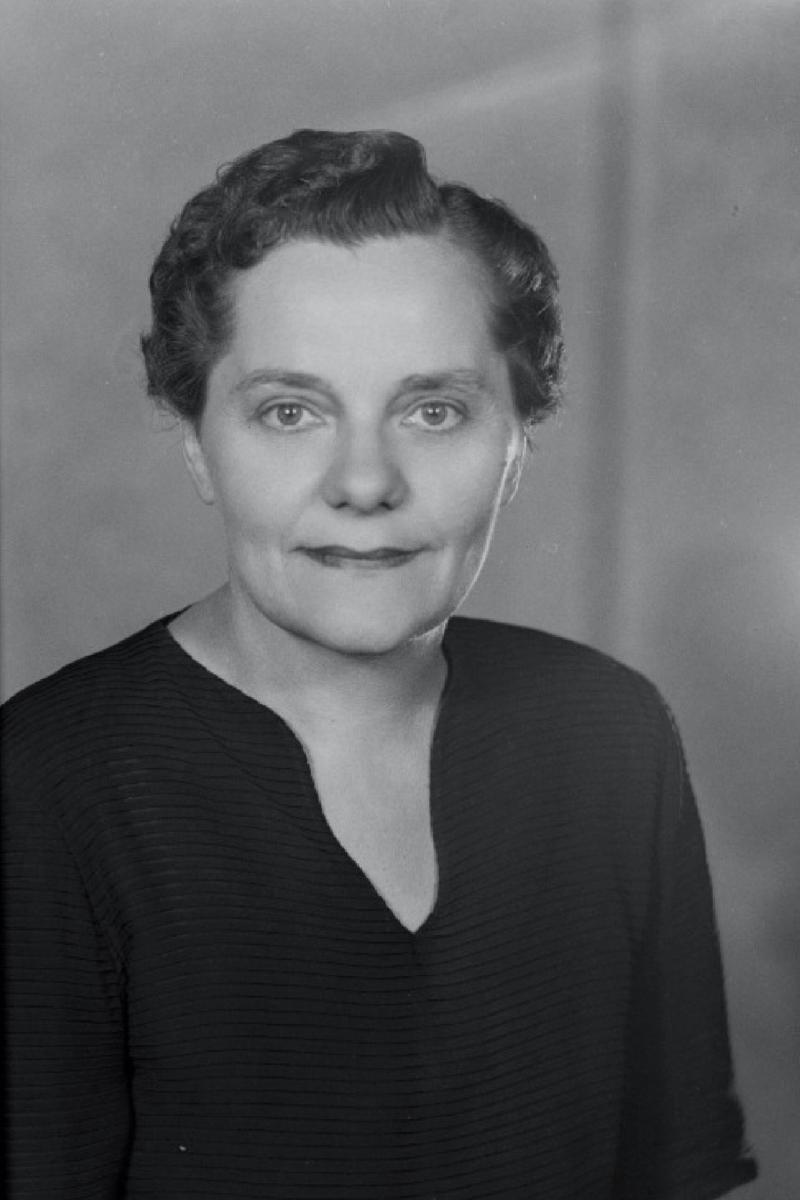
Bernardo remarried in 1930, to Pierina Tognolini (who was born in Tirano in 1904 and who immigrated to WA in 1921 with her parents and two siblings). It was Pierinia’s second marriage as well. Her first husband Michele Bonafazzi had been killed in a mining accident in Boulder, WA, in 1924. Bernardo and Pierina had a daughter, Roma Renata, born in 1931. We have a photo of Pierina:
Bernardo and Pierina established a substantial property at 168 Hertha Road, Osborne Park. It could operate as a restaurant and as a reception centre. During the War, and through to the fifties it was the go-to place in Perth for fine Italian dining and hospitality. For example, the social pages of the Sunday Times of 23 March 1952 reported
DINNER Party on Thursday Night was given to Farewell Mrs. Milly Higgins of Mt. Lawley who leaves for England on the ‘Dominion Monarch’ tomorrow. Friends who arranged it at Molinari’s Osborne Park, were …
The social pages of the Daily News of 29 October 1949 breathlessly reported
Out in Osborne Park there’s a spot called Molinari’s where the epicures of this city go in small gangs to consume Italian food and one thing and another. Band leader Harry Bluck (known far and wide for his skill with a skillet) organised just such an eating-meeting, briefing all hands to assemble at his flat at 1730 hours to fuel up on sherry and then proceed to Molinari’s. But, what with worrying over crochets and quavers and things, brother Bluck finished his broadcast, hopped into his car and drove direct to Osborne Park saying to himself: “I’ll bet there’s something I’ve forgotten.” At 9 p.m. when his guests still hadn’t turned up, he began to feel a little indignant at their churlish behaviour, but just then they all surged in. “We’ve had a lovely time,” they said as sweetly amiable as the hiss of a death adder. “We’ve been to a sherry party at your flat . . , you ought to have been there, you would have loved it.”
Bernardo seems to have wound down his interests in Wellington Street by about 1940. The wine license was transferred, and the cafe was advertised in another name. The coffee palace became a boarding house. The West Australian of 15 December 1948 reported:
Health Dangers At Boarding House. A fine of £4 was imposed by Mr. A. G. Smith, S.M., in the Perth Police Court yesterday on Bernardo Molinari of Hertha-road, Osborne Park, who was charged with having endangered health through the condition of a boarding house owned by him in Wellington-street. Prosecuting for the Perth City Council. Mr. J. Hale stated that the premises were damp, there were holes in the floorboards, rain came in through the roof and the place was an attraction to rats.
Bernardo sold the property in 1956.
In his retirement, Bernardo made two return trips to Tirano. The first in 1955 was a solo trip. He arrived back in Fremantle on 27 August 1955, on the Neptunia. After Pierina died in December 1961, he made a trip with his daughter Roma, returning on the Gallileo Galilei on 28 November 1963.
In 1975 Bernardo left with his daughter Roma on a trip to Tirano. They seemed to have left the property in Osborne Park vacant. After some months it was vandalised, and the valuable property (such as Pierina’s jewellery collection) stolen. Bernardo and Roma stayed in Tirano, and most the the property was sold for redevelopment and the house demolished. Bernardo died in Tirano in February 1984, aged 96.
Giovanni Battista Della Torre eventually left the employ of Bernardo. He registered for military service in December 1942 (showing his employment as a machine miner at Big Bell). He married Ivy Waterman in 1950. Ivy died in 1965 and Giovanni died in 1973. They had two sons.
Mary was born in Midland, Western Australia, in 1912. She married Robert Clement (Bob) Meotti in 1937. They had three children, all boys. Her husband died in 1984, and Mary died in 2001, both in Bunbury, WA.
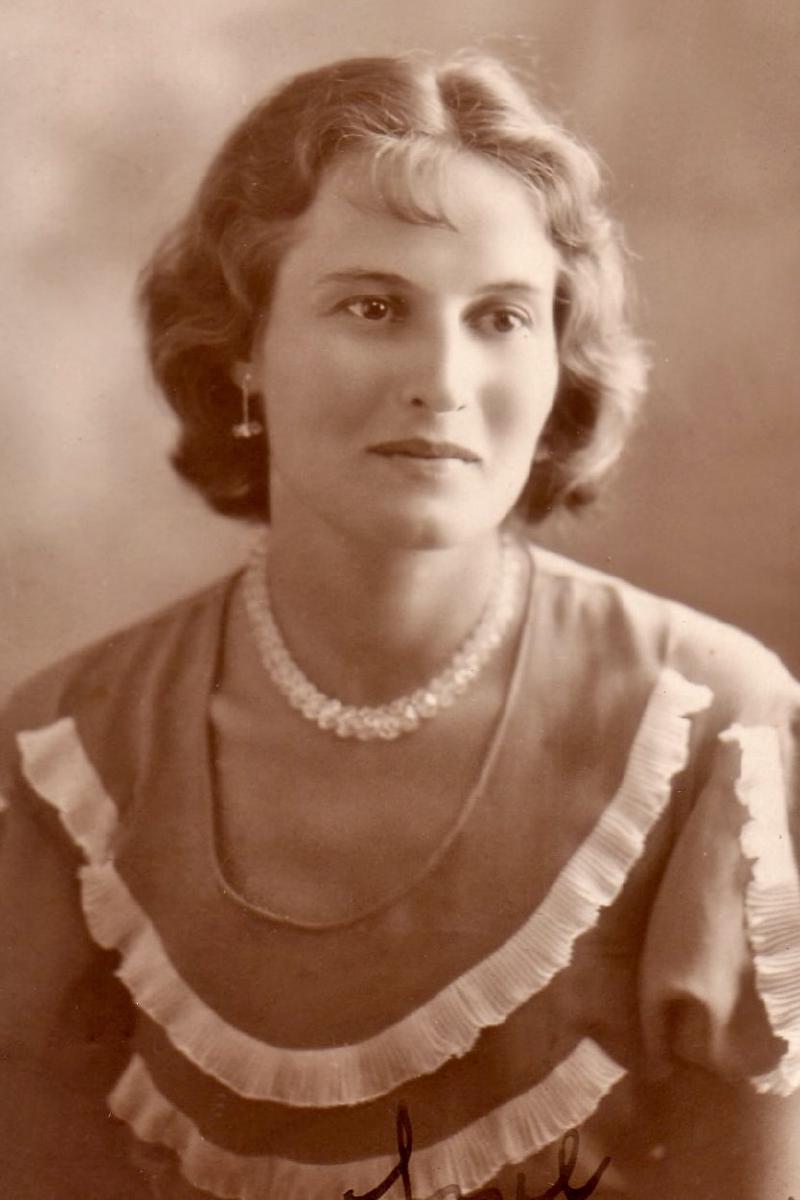
Mary attended the convent school at Day Dawn, and then at Cue (from perhaps 1920). The local papers carefully recorded the details of local events, and Mary is listed in various fancy dress parades and musical presentations.
Post school, she is listed in the period 1927-1932 as a keen tennis player, representing Cue against such tennis powerhouses as Meekatharra.
Presumably, Mary lived at home until she married, at age 25, Bob Meotti. Bob was a miner at Mt. Magnet (100 km south of Cue) and they seem to have lived in Mt Magnet after their marriage. Their three boys Bernie, Bobby and Francis were born in the next five years.
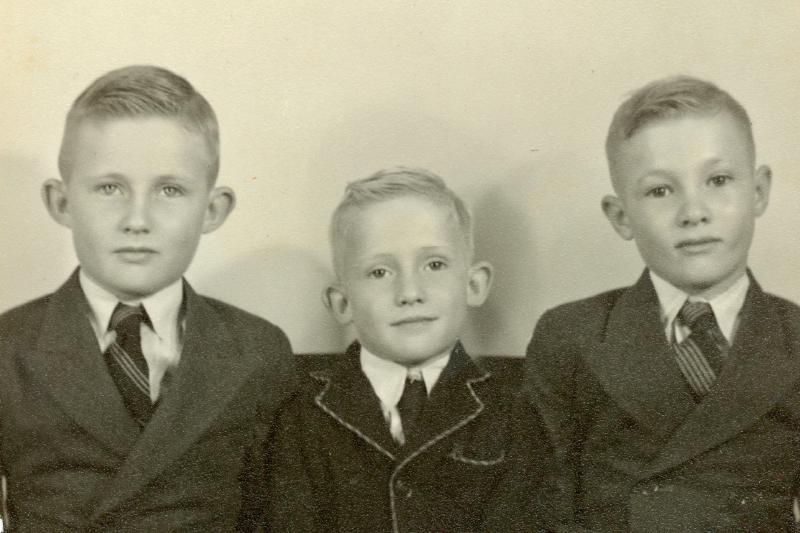
During the War, Bob was technically an Enemy Alien as he was still an Italian citizen. Family legend has it that he was interned in some sense. In any event he was naturalised on 21 June 1945. The file has not been digitised so we cannot check the details.
By 1947 they were living in Harvey, and Bob was listed on the Electoral Roll as a “wood contractor”. By the mid fifties he had a share in a timber mill at Argyle and eventually was the sole owner. The family moved to Boyanup, to be closer to the mill. Bob died in 1984, aged 68. Mary moved to Bunbury, and died in 2001 aged 88.
Bob Meotti’s background is shown in the following family tree of his grandfather.
Family tree: Clemente Meotti (fullscreen)
The family came from Edolo. Although it is in the next province, Brescia, it is only 32km from Tirano. Bob’s father, Clemente, came out to WA in 1924 and must have supported his family from afar. He went back to Edolo at some stage, as he and Bob (then aged 18) arrived in Fremantle on the Esquilino in October 1934. Bob’s mother and three sisters remained in Edolo.
Clemente worked in WA until perhaps the early fifties. He went back to Edolo and died there at 1966. He was naturalised about 1941, but again his file has not been digitised.
After the war, Bob sponsored the migration in 1949 of his cousin Pietro Moles. Pietro’s wife and two children immigrated in 1952.
A personal perspective.
Bob Meotti (Uncle Bob to me) was somewhat of a force of nature. Like many first-generation migrants he knew he wouldn’t make much money working for a wage, as he would be very much at the lower end of the spectrum. Rather, he sought to work as a contractor or develop his own business, where harder work and longer hours resulted (with a bit of luck) in a higher income. His wife Mary (Auntie Mary to me) was calm and relaxed, somewhat in contrast to her husband.
His sawmill was not far from Bunbury where we lived. You turned off the main road, and drove a kilometre or so up a little valley. Bob had also taken up horses, and he owned and trained trotters. He kept horses next to the mill, and had a training track there. On one visit he was showing us the stables and the tack room. “What are those bottles?”, Dad asked. “Horse tonic” replied Bob. “But I won’t give a horse anything that I won’t take myself”. And he got out a teaspoon and took a couple of samples.
His horses were trotters (harness racing with a sulky and driver). He raced them at local meetings and at higher stakes races in Perth. His horses certainly won now and again, but whether he made money overall is unclear. The sport was almost irredeemably corrupt. A compliant driver could lose any race at will, no matter how good the horse was, by getting boxed in. They only tried when the odds were good enough. The poor punters didn’t have a chance.
He had a couple of kangaroo dogs at the mill. On one visit he let them go “for a run”. Suddenly they were in full pursuit of a kangaroo fleeing for its life along the other side of the valley. As we watched, the dogs caught up to the kangaroo, and brought it down. We all went across and Bob put the poor roo out of its misery. Not a pretty sight. Such kangaroo hunting has long been illegal, and the kangaroo dog is deemed extinct. Good riddance, but not many people have seen them in action.
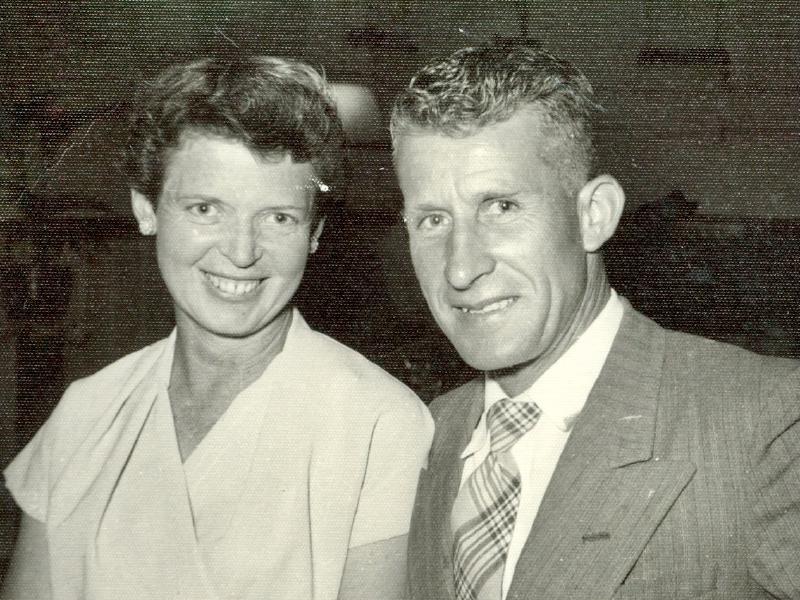
Bernard Dominic Molinari (Barney to all) was born on New Year’s Eve, 1913. He lived in the Murchison Goldfields from about 1916 to 1948. From about 1935 to 1948 he worked at the Big Bell Mine (about 35km from Cue). In 1942 he married Lily Atkins. In 1948 they moved to Bunbury. Barney died in Bunbury, in 1999.
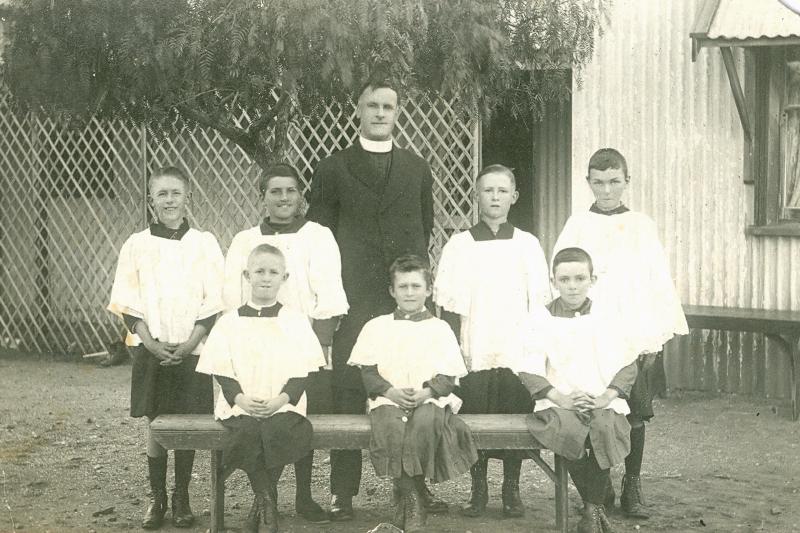
He probably started school at the Dominican Convent School in Cue in 1920 and would have finished school at the end of 1927, having just turned 14. We have one photo of Barney during this time, as an altar boy at the Catholic Church in Cue.
As the eldest boy and hence the first to leave school he would have worked with Dominic in the blacksmith shop. 1931 was the second year of the Great Depression, when commercial activity dropped 10% and when unemployment hit something like 30%. It was not a good time to be 17, in an ever-shrinking goldfields town.
We have a record from the W.A. Government Railways that shows Barney employed from 9 March 1933, as a labourer. The pay was 13 shillings a day, and it may only have lasted for a week or so. The was no unemployment benefit in the current sense. Rather, the Federal Government gave money to the States, who provided employment short term. Below that, there was the susso.
As young men, Barney and his younger brother Arthur were sportsmen. The following report of Jun 1938 shows them on opposite teams.
CUE OVERWHELMED. HEAVY GROUND MARS GAME
At Big Bell on Sunday, the Bell team showed a complete reversal of the form they displayed at Reedy the previous week and simply overwhelmed Cue on what must be the heaviest ground on which football has ever been played. Apart from the interest in the number of goals O’Reilly might kick from his numerous shots, the main interest in the game was trying to solve the problem of who had the ball, as the perpetual cloud of dust during the game made vision very foggy. Although he Cue team was a street or two behind in the scores, the play was not one-sided as might be thought. The ball was in front of the goal on numerous occasions, but lack of a forward to cope with the brilliant defence of Bill Gilbertson was responsible for the lowness of the score. At the other end of the ground Ivan O’Reilly was in a dashing mood and secured possession of the ball at will. Apart from these players the Bell had two match-winners in Giles and Howell, who were in their element plowing through the inches thick dust. Their experience underground must have stood them in good stead. Bonner was another effective man but was held in check during the second half of the game by Allan Plaisted, who is improving with each game. Barney Molinari proved a bit too much for brother Arty, but when changed to opposite wings, the latter gave his forwards plenty to do. Apart from those already picked out from the Bell team, there was not a passenger in that team, all pulling their ton of dirt, even the small men. For Cue, very few were able to get the measure of the bounce of the ball and were left standing by yards in a race for the ball. Bob Regan received a lot of attention and was interfered with on many occasions, but it must be said there was no malice attached to this attention. He gave invaluable service. Ned Doody was his usual solid self, even though he up against such a player as O’Reilly.
Norm Grenfell gave a good performance wherever placed and was invaluable. Of the others none were outstanding but came in for some useful play at times. The final scores of the game were: Big Bell 11 goals 18 behinds. Cue 3 goals 5 behinds. The game was umpired by G. Cream of Reedy, who gave a good exhibition, although some of his decisions were most unorthodox. His mistake of blowing the whistle for a mark and then calling play on was most disconcerting.
By 1938 Barney seems to be playing for the Big Bell team in the local competition, but for the Cue District team in the district competition.
In 1932 both Barney and his brother Arthur were winning in the Sunday morning cycling competition.
Finally, both Barney and Artie were members of the Cue Fire Brigade.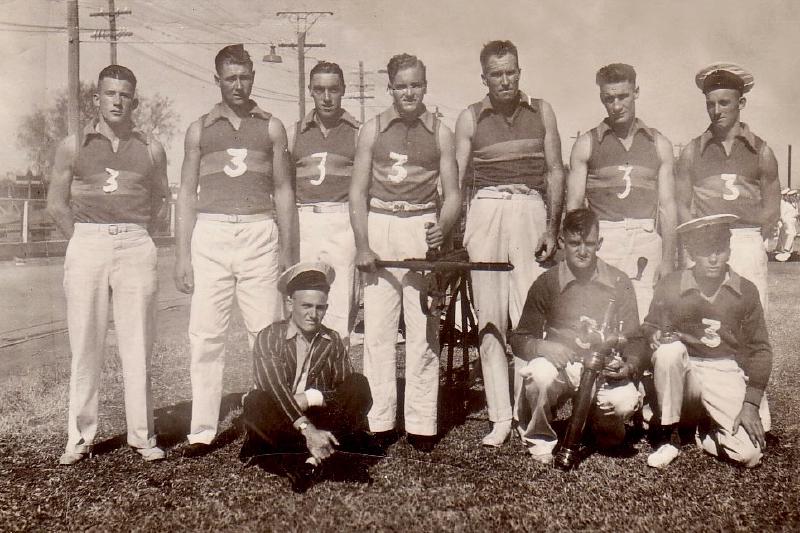
Barney got lucky. Family legend has it that about this time an assessment of the old Big Bell mine was made by an American company. A small group of American engineers came through Cue and then camped at the site some 35 km away. Barney was hired as little more than a camp assistant. He sufficiently impressed them so that when they returned several years later to manage the development of the new mine, Barney was employed in the machine shop. In 1941 he gave his employment as a welder, and in 1942 as a foreman welder.
The effects of the Depression were still being felt. The West Australian of 21 January 1937 reported
BIG BELL MINE. Warning to Unemployed. CUE, Jan. 18. Owing to false rumours being circulated of the wonderful opportunities of obtaining jobs at the Big Bell mine, numbers of men and youths continue to arrive at Cue in search of employment. In many cases these men use all their ready money to get here, and as there are practically no jobs available, they are in financial difficulties. The mine management has all the labour it needs and a long list of applications from experienced men, which is drawn on as required. Jobs on the mine are therefore few, more particularly for unskilled labour, but the men are not aware of the position until they arrive here. Business people and householders of Cue and Big Bell are being called upon every day to assist disappointed men with food and the bare necessities of life. Cases of men being stranded here could be quoted, and it is to be hoped that others who look on the Big Bell as their golden opportunity for a job will be saved the expense of the journey and the consequent disappointment by the true position being made known.
In fact, Barney (who was working on the mine by then) related this situation with feeling, saying that the people were milling around the gates of the mine, begging for work.
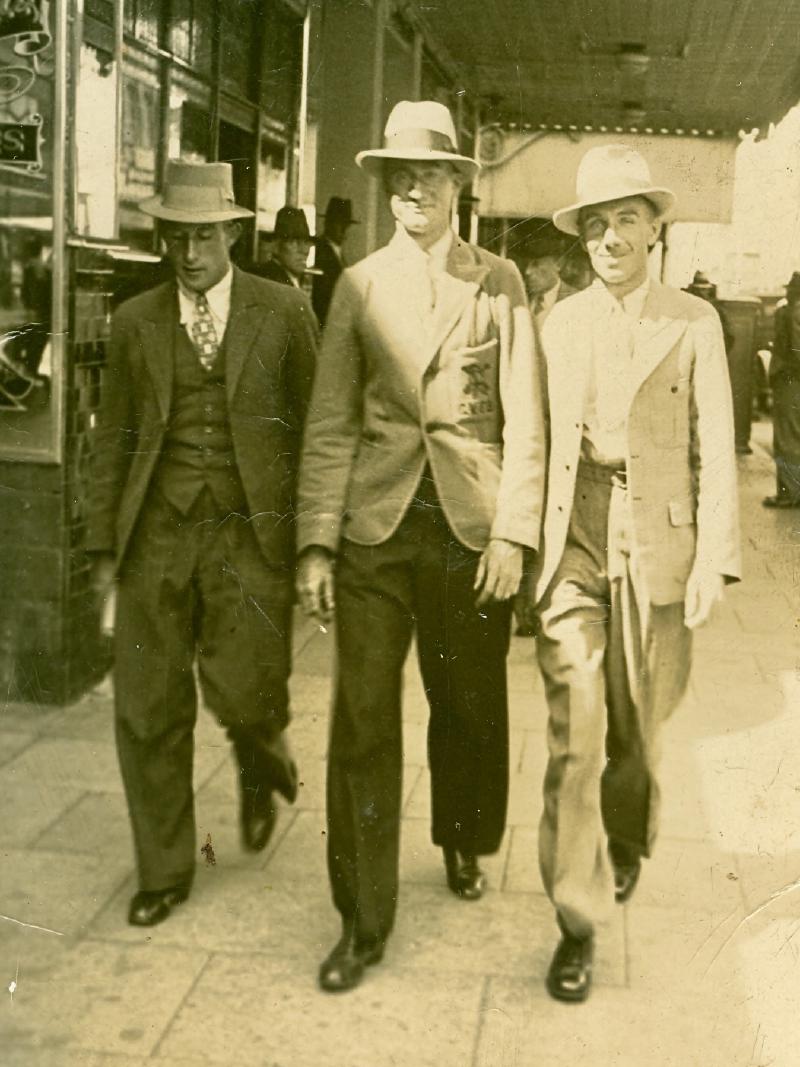
During the War Barney seems to have been called up twice, according to his military record. A Mobilization Attestation Form was filled out on 8 May 1941 and a medical report done, but it was not proceeded with. No Oath of Enlistment was made. A second form was filled in on 5 July 1942 and an Oath of Enlistment made. The Mine closed in February 1943, and for the rest of the War a very small group of tradesmen (less than 10) maintained the mine equipment. Barney was one of that group. This seems to have been part of his war service. He was moved “To Reserve” in July 1944, and discharged on 15 October 1945. Family folklore has it that he was further promoted after the War, and was in charge of the machine shop on the mine. He was certainly on the staff, rather than being a standard employee. They lived in the “staff area” near the mine, in a company-supplied house.
At the end of 1948, the family left Big Bell and moved to Bunbury. Barney took a position with the South West Co-Operative Dairy Company (known as SunnyWest). They had a string of milk depots, cheese factories and butter factories throughout the South West, from Harvey to Albany. Barney was foreman of a maintenance crew that supported the full collection of factories. The task was quite wide: the equipment ranged from boilers to refrigeration, from butter churns to butter-packing machines. Family legend has it that he was shocked when he got his first pay packet - it was much less than his last salary at the mine.
In fact, it was the last job that he ever had. He worked at this job through to his retirement around 1973. I think he had other opportunities from time to time - he was certainly a very competent and experienced tradesman. But I think he valued “steady employment” above all. He could have set up a small engineering business, either alone or with others, but he was very risk-averse.
From the early 1950s we always seemed to have a boat. The motivation was that in Bunbury you had access to Leschenault Inlet, known as “The Estuary”. The protected waters of the Estuary were ideal for boating, and were the home to blue swimmer crabs.
The first boat we had was a small traditional clinker-built hull, with a little cabin that Dad put on, and a putt-putt engine that was started by putting a leather strap around the flywheel and pulling. It was the slowest boat on the river, due to the dubious power output of the engine and the inappropriate propeller that Dad had fitted. On a Sunday afternoon in summer we would set off from near the rowing club, and head up the Estuary, past Pig Island and the power station and Turkey Point, past “The Cut”, to where was judged to be a good crabbing spot. Four miles, taking one hour, was the rule. Once there we anchored and drop nets were baited and thrown over. If a net was pulled up with several large male crabs, much entertainment was had. They had to be handled by the back of the shell, and put into a bucket or kerosene tin. Some would escape from the net and scurry around the bottom of the boat, and would have to be caught. On a good day (most days were good days) the yield was deemed to be a “good feed of crabs”.
There was a ritual in cooking them back at home, in the back yard. A large pot of salted water (aficionados said that sea water was best) was brought to the boil and the unfortunate (live) crabs were inserted. The shells rapidly turned a red colour. After a few minutes (each cook had their own metric) they were lifted out and more crabs inserted. As soon as they could be handled they had to be cleaned, a messy business. They now give you a pamphlet on how to do it. The kitchen table was covered with newspaper, and the crabs put in the centre of the table, along with bread and butter and beer for the adults. They were consumed by breaking them apart. Big claws were fractured by bringing the back of the fist down on them. Bits of shell and debris would go everywhere. At the end it was all wrapped up and binned.
At the time we didn’t realise what a delicacy it was, and we thought them inexhaustible. Modern regulations have preserved the fishery.
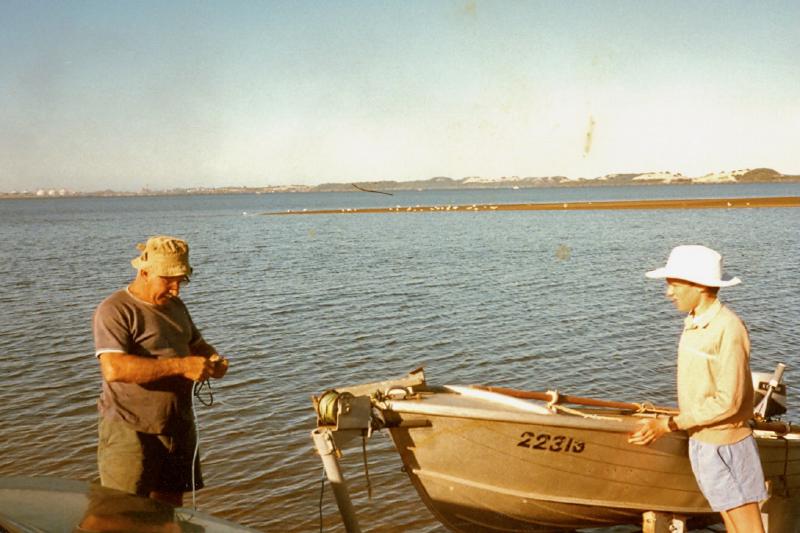
The second boat was more spacious, perhaps 5m in length, shown here pulled into a jetty on the Collie River, just off the Estuary. Dad built it himself from a set of plans, and modified a 4-cylinder Vanguard engine as an inboard drive. It was considerably faster than its predecessor. No one thought to give it a name.
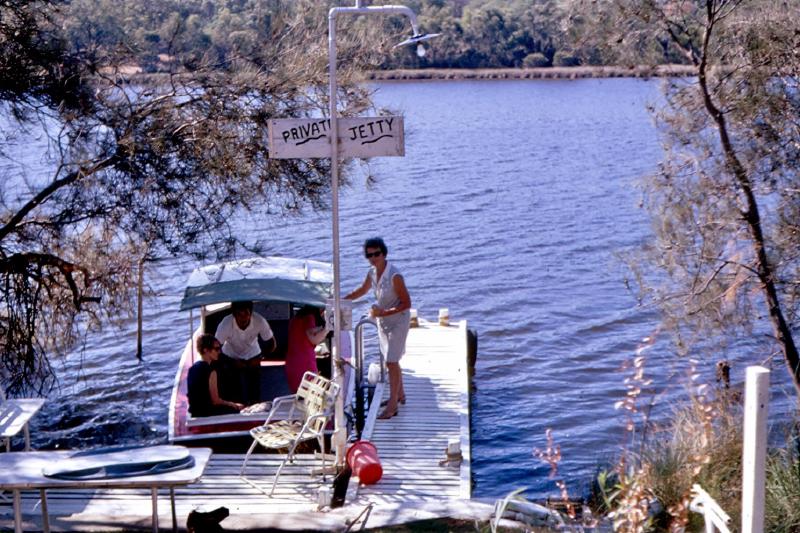
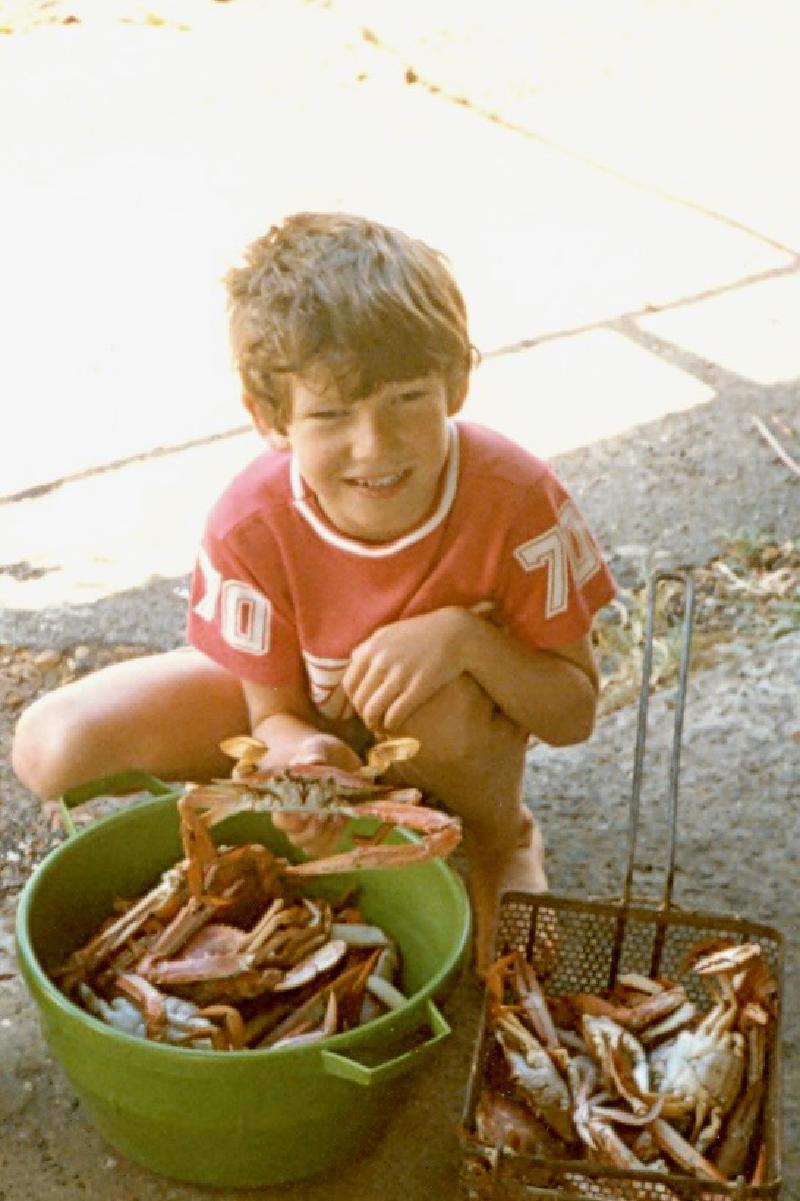
I also show a crab supper from this time.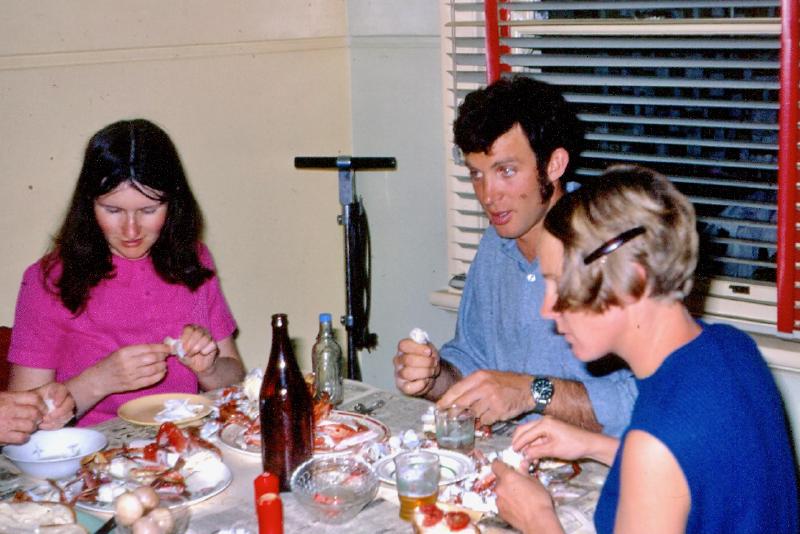
The last boat was an aluminium dinghy, with an outboard motor. This photograph show Barney in about 1982, with his grandson Rory.
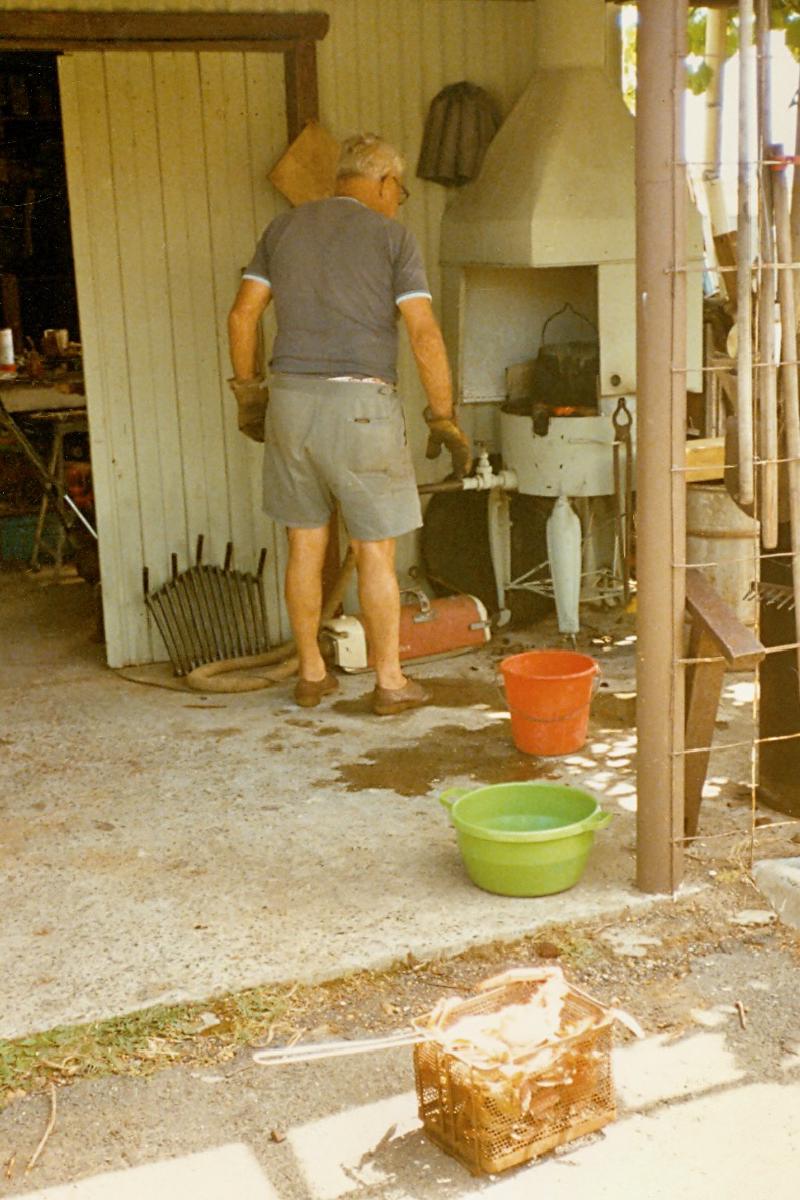
The home arrangements had been considerably improved. Here Barney is cooking crabs on his custom forge (built out of an old washing machine and driven by an old vacuum cleaner). He always had a small forge: “You never know when you need to heat up a bit of metal”.
Grandson James is admiring the result of the days outing.
While he enjoyed robust health for almost all his life, Barney accumulated some wear and tear along the way. He was playing with a detonator as a child (perhaps age twelve) and it detonated. He lost part of two fingers on his left hand, and a fragment of the detonator lodged in his left eye. The medical care of Cue must have been good enough to treat him at the time. While at Stockley Road, in about 1952, he took the tip of his right thumb off with a 24-inch diameter crosscut saw. He always had a substantial crosscut saw. For a while it was driven by a stationary petrol engine, and was later fitted with a serious electric motor. The thumb was sewn up and healed, and in fact the nail grew back. When he first visited us in Canberra the grandchildren were fascinated, and would bring in their little friends from the neighbourhood to “see Poppa’s fingers”.
After being stable for years, about 1962 his injured eye deteriorated and had to be removed. He had a glass eye from then on - you never noticed it.
When they were visiting us in Cambridge in 1967, Dad had a major heart attack. Presumably this was preceded by years of high cholesterol and high blood pressure, but in the medical practice of the time it was not diagnosed or treated. There was little treatment for a heart attack - he spent four weeks in Addenbrooks Hospital waiting for the damaged section of heart to heal (and hoping that there was not another heart attack). He slowly recovered, and he and Mum made it back to Bunbury. He had no interest in any more travel outside Australia.
Towards the end he progressively lost sight in his good eye, and suffered from slow heart failure. He took it stoically, and was not interested in pursuing any surgical options. He lived at home to the end, and died in his sleep at the age of 85. He would have greatly preferred this to living longer, and needing to move to a nursing home.
Finally, I include the text of the eulogy that I gave at Dad’s funeral service.
James remains a somewhat indistinct person. The only photograph I have is one of the four siblings, in circa 1934. He seems to have played football but is only listed in the sports results several times, in contrast to his brothers Barney and Arthur.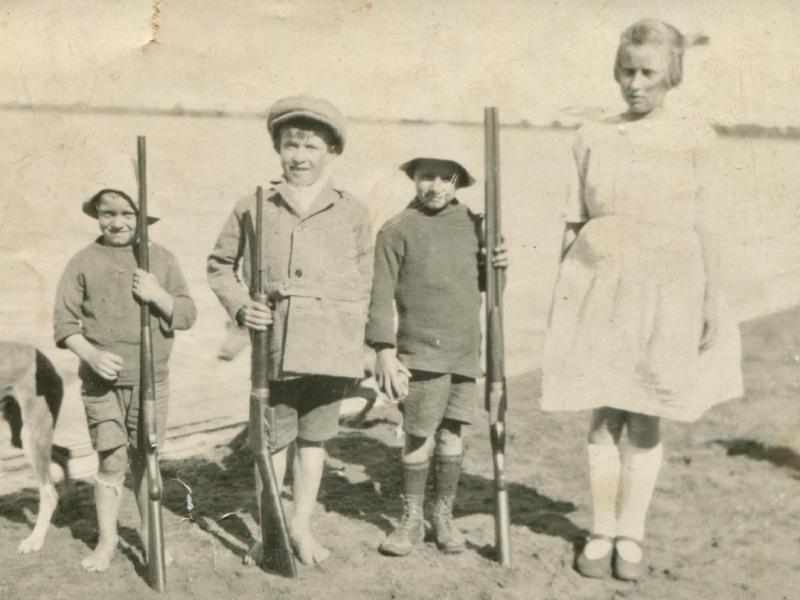
We have his brief military record. He enrolled on 8 May 1941, giving his address as “Cue”, and his occupation as “truck driver”.
He was killed in a traffic accident on New Year’s Day 1942. A report of the inquest on 23 February 1942 makes bleak reading. James was unlucky - a car pulled out in front of him and he ran directly into the side of the car. He was Absent Without Leave from the Army, was speeding, and the motor cycle he was riding was “stolen”. Maybe it was an Army motorcycle. Presumably he was not wearing a safety helmet. He died in an army hospital several hours later. He was given a military funeral.
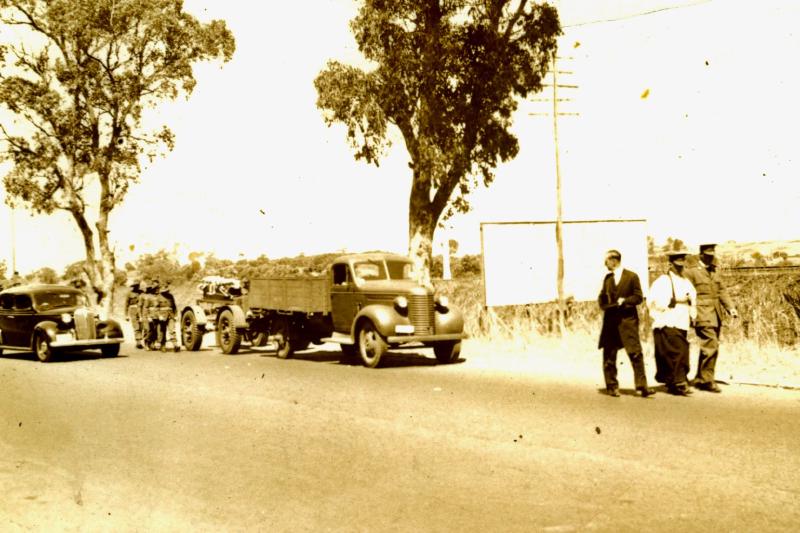
He was obviously deeply missed by the family. They placed memoriam messages in The West Australian for the best part of a decade.
Arthur would have attended the Dominican Convent School in Cue, and would have finished school in 1931, when he turned 14. It seems clear that he then worked for a while in the blacksmith shop with Dominic. He was an active sportsman like his elder brother Barney, in football, cycling and fire brigade. He married Marjorie Hall in November 1939.
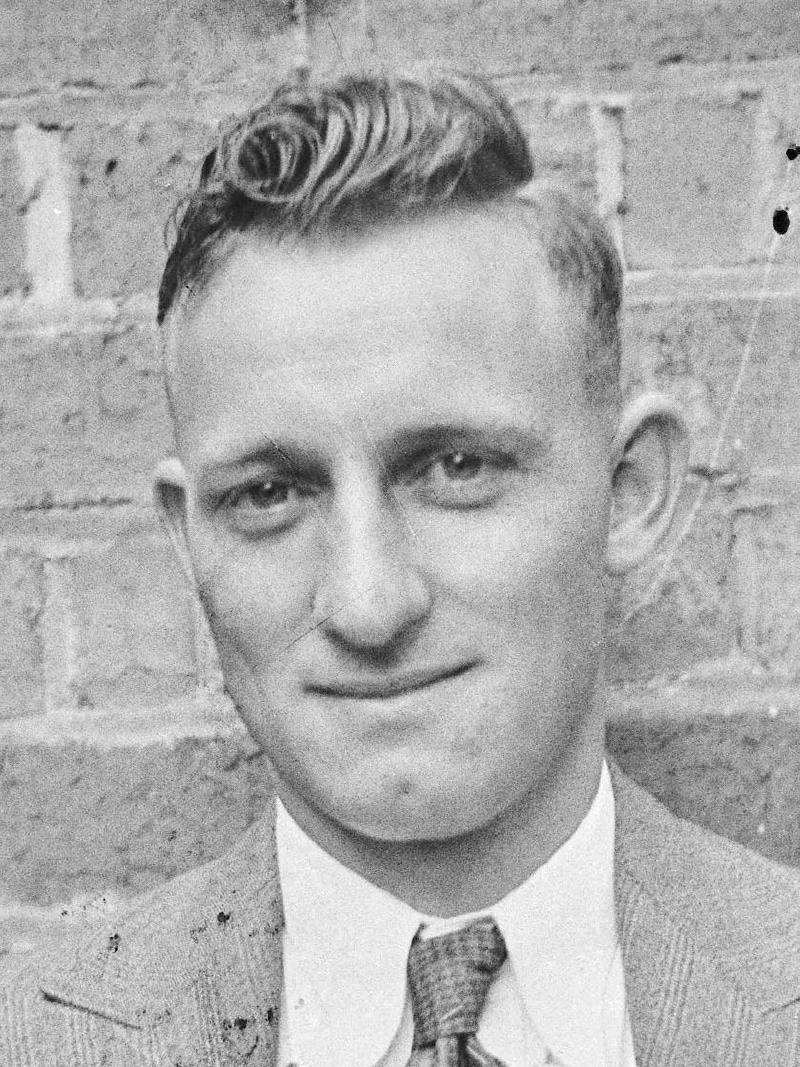
He was working in the blacksmith shop at Big Bell Mine in October 1939. The Electoral Roll for 1939 gives his occupation as a striker. This is a niche skill in the blacksmithing trade. An explanation is given in this video. An historic demonstration of forge welding is given in this video (persevere until half-way through).
His military record is informative. He applied for enlistment in the Air Force, on 29 December 1942, giving his trade background (page 48) as
I have spent over 4 years as a blacksmith striker and 12 months on light smithing and also 11 months doing lathe work.
He also says he “was called up earlier and was exempted”. On the basis of a trade test he was judged suitable as a Trainee Technical, and his enlistment was approved on 7 January 1941. In processing his application the Air Force requested of the Registrar General
will you please verify the undermentioned particulars. I enclose herewith the sum of Ninepence (9d), in payment of the necessary search fee
His birth certificate showed he was registered as Erico Arturo, and he had to attest that he was that person. After training he had the rank of L.A.C. (Leading Aircraftman).
His enlistment was standard: “for the duration”, being for the duration of the war and twelve months afterwards. On 16 November 1945 the Office of Manpower wrote to the Air Force (page 31) saying that Big Bell Mines had requested the release of Arthur to facilitate the opening of the mine in the very near future. Technically, Arthur had to apply for release, which was approved on 24 November 1945.
The family moved from Big Bell in about 1948, and Arthur took a job as a maintenance tradesman at the Boyanup butter factory. They later moved to Bunbury. Arthur died in Bunbury in 2008. Marge lived to the grand age of 100, and died in Perth in 2020.
Helen was born in 1920, and died in November 1920 at the age of about nine months. She may have died of Spanish influenza (which was prevalent in Cue and Day Dawn in 1919), or it may have been just one of the many conditions that then afflicted infants. She has a stainless steel plaque on her gravestone in the Cue-Day Dawn cemetery, constructed and installed by Arthur.
Giacinta took the death hard. Arthur told me: “Mum was never the same again”.
Giacomo Pietro Pianta was born in Tirano in 1901. He arrived in Fremantle, with his mother Domenica, in April 1916. In Australia he was known as James Peter Pianta, as Nino to his family, and as Jim to us.
In 1927 he submitted a naturalisation application. His father Giacomo was naturalised in 1911, but at that time Jim was still in Tirano, and it was not clear whether he inherited British (i.e., Australian) citizenship from Giacomo. From that application we know:
the family lived in Perth for a year (perhaps at the ever-popular York Coffee Palace), and then from 1917 at the diary farm at Harbourne Street, Glendalough.
he described himself as a self-employed dairyman. It seems he ran a retail milk delivery round, while his parents ran the wholesale diary.
He married Elaine Newton in 1928. They lived in Bencubbin from 1928 until about 1937, where he is listed as a “farmer”. In the Electoral Rolls from 1939 to 1980 he is listed as a “farmer”, residing at 283 Harbourne Street. The parents’ diary farm was also in Harbourne Street. It is not clear whether Jim acquired a separate property in the same area, or whether it is one and the same property.
He became interested in trotting while running his milk round (being a horse and cart), and seemed to be a keen owner and driver through the twenties. Later he became identified as a successful trainer and horse breeder. For example, we have a photo on him in 1942, having won the Easter Cup. More details are given in this report.
In 1947 he spent nine months in Italy, and reported on Italian trotting on his return.
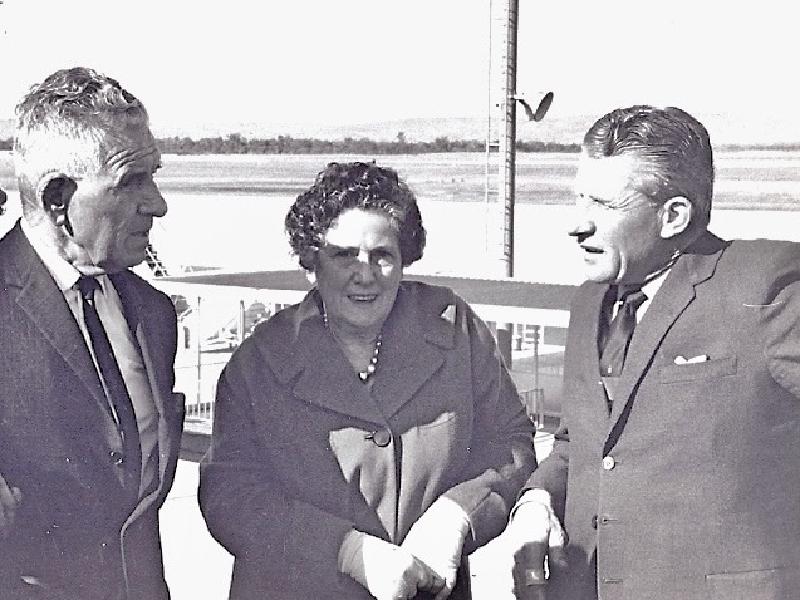
Roma Molinari was born in Perth, in 1931. In 1975 she (and her widowed father Bernardo) left on a trip to Tirano, and stayed there. She died in Tirano in 2021.
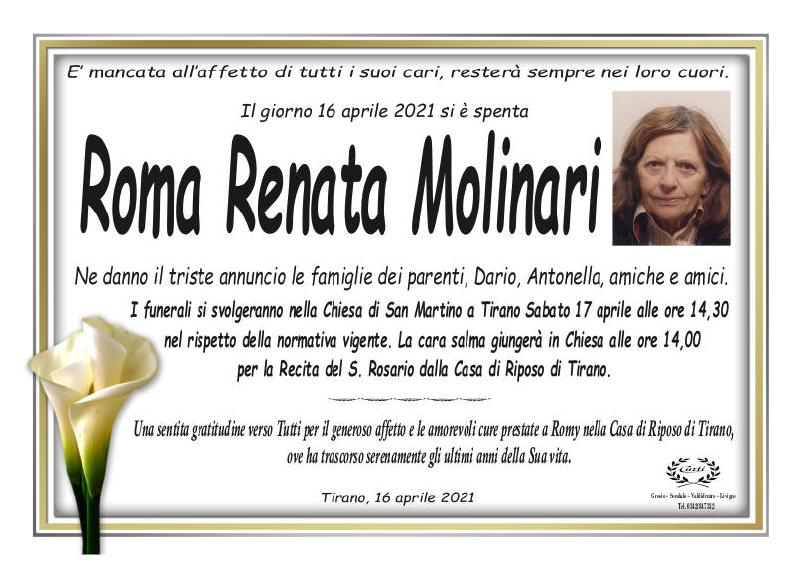
Roma was a glamorous young woman and often appeared in the social notes of the Perth newspapers. The following photo from 1954 is typical. She gave her occupation as “electro-cardiographer” and, I think, worked at Royal Perth Hospital.
On a trip to Tirano she fell in love with Dario, and the 1975 trip was undertaken on the basis that it would take the form of a permanent relationship. In the end, it seems Dario never quite left his family. She gave English lessons to Italian speakers, and Italian lessons to English speakers, and was a well-known personality in Tirano.
Over the years various relatives from Australia on a European trip would seek to “drop in on Roma in Tirano”. Most of these relatives were second cousins at best, and Roma was somewhat defensive of her privacy.
My brother Jim comments:
Roma always chose not to reply to email nor answer phone calls from outside of Italy. In 2015 when I was living in Sardinia I travelled to Tirano and appeared on her door step, calling her from there. And having an Italian phone number I was able to have her respond.
Roma was very fit and well in 2015. She was very involved in teaching English to students and hiking around the Aprica Ski Resort. She still referred to Perth as home.
Since 2015 I have sent her many emails and haven’t received a reply.
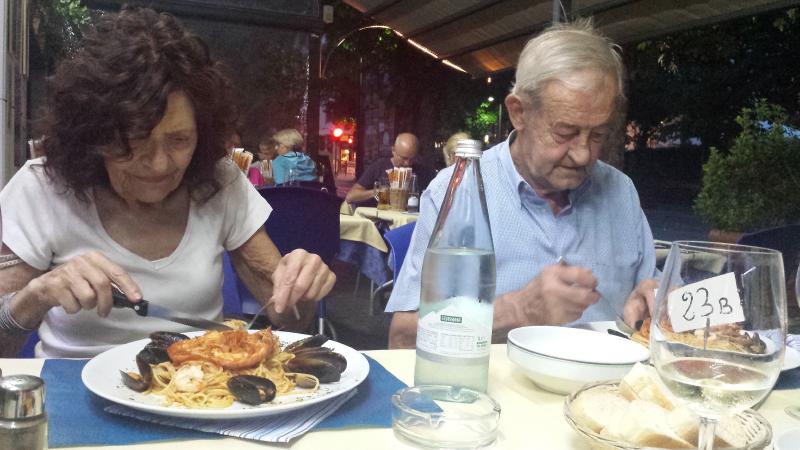
Roma was the last of the first generation born in Australia. With her passed the first-hand stories of the migrant generation. What I have been able to recover of these stories for these pages is but a poor alternative.
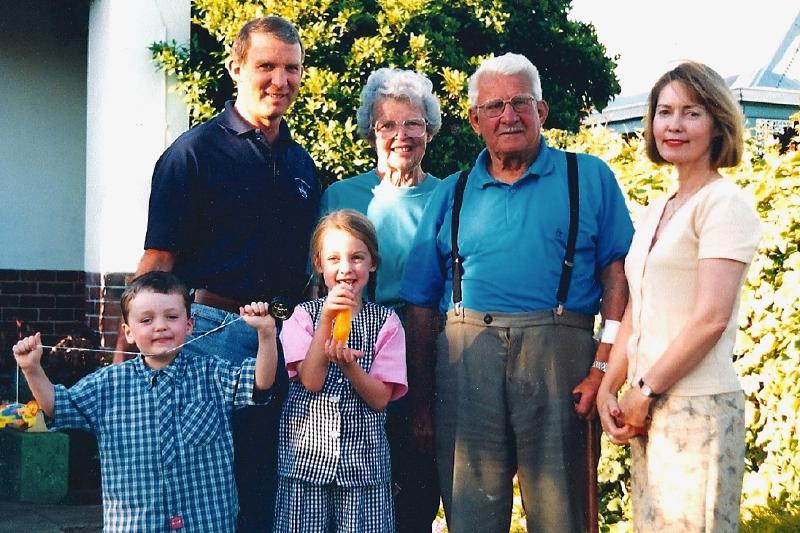
The coverage here will be brief, perhaps aimed at giving our grandchildren an idea of what we were like when we were young. Generally, in the interest of privacy, our children and grandchildren will not be identified.
As identified above, my father’s aunt Domenica was married to Giacomo Pianta. It is convenient to show a family tree for Giacomo’s father.
Family tree: Giacomo Pianta (fullscreen)
This gives an indication of the social conditions in Tirano in the late nineteenth century. There are 11 children, of whom only four reach the age of 20 (and who marry). Two of the young children died in the space of two days, presumably from a common cause. Of the four Piantas who married, three married Molinaris (apparently from different families).
Noel Howieson indicates that the patriarch Giacomo travelled to Western Australia and worked for a while on the Mundaring dam project. Presumably this would be after the birth of the last child (in 1897). It seems that this would predate the migration of Dominic Molinari and Giacomo’s two eldest sons in the period 1900-1902, and would likely be the primary reason that they chose WA. I have been unable to find a passenger arrival for old Giacomo. Passenger departures do not seem to have been systematically recorded.
Giacomo was the first child, born in 1877. As explained above, he married Domenica Molinari in Tirano, in 1901. He migrated to WA in early 1902, to join his father (we think) and his brother-in-law Dominic Molinari.
Giacomo is on the passenger list of the ship Ophir which arrived in Fremantle on 6 February 1902. The notes seem to say that he can “read and write”, and that he has a “brother-in-law a brick-maker in Perth”. That is presumably Dominic’s occupation at that stage.
It is interesting to note the two Italian passengers on the list, just above Giacomo. They cannot read and write, and have no money. None-the-less, they were allowed to land.
As far as I can tell, Giacomo did not see his wife and child for another 14 years. On his application for naturalisation (in 1927), his son Giacomo Pietro says he arrived on the Osterley on March 1916. With his mother Domenica, one would presume. But they do not appear on the passenger list. Passing strange.
He seems to be a rather uncommitted husband. The Pianta family legend has it that he did not organise the migration of his wife and son to Perth, but rather Bernardo did.
We know Giacomo was naturalised in May 1911, but his file has not been digitised. That he had a close association with Dominic is clear from the fact he was the best man at Dominic’s wedding. I do not have a photo of Domenica.
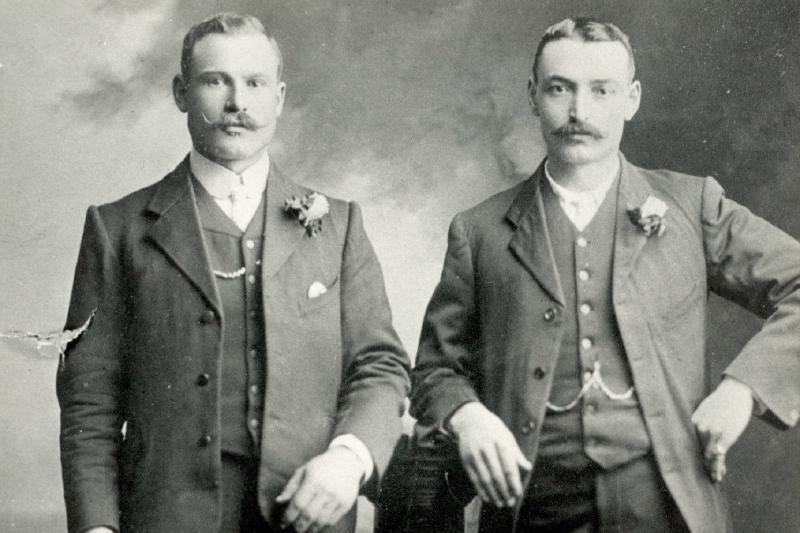
As explained above, about a year after his family arrived, they acquired a dairy farm in Harbourne Street, Osborne Park.
Giacomo and Domenica acquired a dairy farm on the Glendalough Estate.
The name honours a Catholic centre in Ireland, where a hermitage was established in the 7th Century. A crown grant for Glendalough and a portion of Herdsman Lake was made in 1837 to Thomas Helms and eventually transferred to Bishop Gibney in 1887, who leased much of it to market gardeners.
The locality of Glendalough has a strong association with the Catholic Church with the northern portion passing through several orders of the Roman Catholic Church until 1921, when the Little Sisters of the Poor used it as a site for a rest home. In 1949, the State Housing Commission bought part of Glendalough for subdivision and began to develop the area.
It seems that Giacomo would have leased the land (as the Catholic Church never sells unless it is forced to). A notice in The West Australian of 31 May 1915:
STRAYED into paddock, black and white Calf. Owner may have same by paying expenses. Pianta, Glendalough Dairy, Leederville.
gives a starting date for the farm.
In November 1926 he was severely injured:
James Pianta was admitted to the Perth Hospital from Osborne Park late last night suffering from severe head injuries, and soon after admission his name was placed on the danger list. No information could be obtained concerning the manner in which he received his injuries.
He never recovered, and was looked after at The Little Sister’s of the Poor home on the Glendalough Estate. He died in 1945.
Luigi was the second child, born in 1879. He is on the passenger list of the Ortona, arriving in Fremantle on 5 March 1902 (he is number 9 in the list of italians who embarked at Naples). In particular:
Against each passenger is written a WA contact, the passenger’s trade, and a money amount (presumably the cash that the passenger was carrying). This looks like some sort of migration agent was involved.
Luigi is a labourer, and nominates a brother in Mundaring. (Obviously, this is Giacomo). He was carrying £6, about two weeks wages. The other Italians were carrying similar amounts. They all needed to find work pretty quickly.
Luigi’s naturalisation application in November 1912 tells us that he lived in Greenmount for five years until 1907, and then moved to Osborne Park. We know that Dominic moved to Greenmount in about 1902, and presumably Giacomo and then Luigi joined him there, at least initially. The Tiranese stuck together.
In three years in Osborne Park he found and married an Australian bride, presumably meeting through the local Catholic church. This is an impressive event of assimilation, considering that he arrived in Fremantle eight years before with £6 and presumably not a word of English. The Daily News of 31 October 1910 tells us:
WEDDING PIANTA - FRANKLIN
A quiet and pretty wedding was solemnised on Monday, October 24, at 9 a.m. at St. Brigid’s Church, West Perth, between Mr. Luigi Pianta of Osborne Park and Miss Cecilia Franklin, daughter of Mr. and Mrs. Franklin, of North Beach road, North Perth. The ceremony was performed by the Rev. Dr. O’Hurley, who also officiated at the Nuptial Mass. The bride, who was given away by her father, wore cream silk, trimmed with silk lace and hat trimmed with cream silk and ostrich feathers. The Misses Marion Franklin and Mary Kenny (nieces of the bride), who acted as bridesmaids, wore dresses of silver lustre with silk trimmings. Mr M. Franklin (brother of bride) acted as best man, and Mr. E. Kenny as groomsman.
In the evening a reception was tendered at Arranmore Schooolroom, Leederville, by Mr. and Mrs. Franklin in honour of the occasion, fully 80 guests being present. Including the Rev. Dr.O’Hurley, and Mr. and Mrs. Paul Barratt (Mayor and Mayoress of Leederville). During the evening a programme of vocal and instrumental items was carried out by friends of the bride and bridegroom when the health and happiness of Mr and Mrs. Pianta was proposed and honored, by all present. At the reception the bride wore a handsome and costly gold pendant with amethyst and pearls the gift of Mr. Giacomo Pianta (brother of bridegroom). Many beautiful presents were received from the relations and friends of the bride and bridegroom, Including a handsome afternoon tea set and wicker furniture, presented by the parishioners of Arranmore Church at a social evening given on Wednesday, October 19, in recognition of the bride’s untiring and enthusiastic work in behalf of the church; also a beautiful statue of the Madonna and child by the Sodality of the Children of Mary. The Rev Dr. O’Hurley made the presentation on behalf of those present in a congratulatory speech, whilst Mr M. Franklin, suitably, responded on behalf of his sister.
His brother Giacomo gives a “handsome and costly” gift to the bride, but does not act as best man at the wedding.
After Luigi’s naturalisation, his wife Cecelia inquired as to her status. A letter came back from External Affairs in Melbourne saying in part:
that I have the honour to inform you that a British subject who marries an alien adopts her husband’s nationality and consequently is a statutory alien in the eyes of the law.
As your husband, an Italian, has been naturalised by the Commonwealth and is now a British subject, his new citizenship extends to you and therefore saves you the necessity of becoming naturalised to regain your original citizenship, namely British.
So that’s all right, then. A woman, as a wife, didn’t have many rights on her own account. Why didn’t her husband inherit her citizenship?
Luigi and Cecelia did not have any children. Cecelia died in 1962 and Luigi died in 1967.