Cue, Day Dawn and the Cosmopolitan Hotel#
Overview#
The sleepy state of Western Australia was transformed in the period 1880 to 1900 by a wave of gold rushes. In contradistinction to the earlier gold rushes in New South Wales and Victoria (1855-1870) the finds in WA were in the dry interior of the huge state, way beyond the settled areas. All supplies and equipment had to be hauled hundreds of kilometres from the coastal towns of Perth and Geraldton. Initially this had to be done by horse and by camel, along bush tracks. Through the 1890’s railways were pushed to the main mining centres, greatly simplifying transport.
The Murchison Goldfield was declared in 1891, after discoveries of gold at Nannine in 1890. This declaration meant that a Government Mining Warden was installed, and an elaborate scheme of mining leases was put in place (and enforced).
A group of prospectors including Tom Cue found gold in 1892, some 60 km south of Nannine and Tom travelled to Nannine to register their claim. A townsite was gazetted in 1893 and named Cue after him. This gazetting meant that a street layout was determined, blocks of land were sold by the Government, and land titles issued. The great Australian preoccupation of buying and selling land could could now be indulged in. Cue was the the location of a number of rich reefs, and intensive mining developed. A railway from Mullewa to Cue, some 320 km, was completed in 1898. At its heyday, in the decade 1900 to 1910, Cue had a population of around 10,000. Mining activity was curtailed during the 1914-1918 war, and it did not recover after the war. The population steadily declined, but Cue remained viable as a minor regional centre (current population 120).
Several mines were established some 8 km south of Cue, which resulted in a separate township being gazetted in March 1894, called Bundawadra. By May 1894 it was renamed Day Dawn, after the name given to the main reef. The most successful mine, The Great Fingall, operated from 1898, and employed over 500 miners. At its heyday, also in the decade 1900-1910, the population of Day Dawn was 2500. In 1918 the mine closed, and being a one-mine town Day Dawn rapidly collapsed into that Australian icon, a ghost town. The only building remaining is the Mine Office.
A collection of early maps of the WA goldfields is available here.
Day Dawn Notes#
Day Dawn supported a local newspaper, The Day Dawn Chronicle, which was published from 1902 to 1909 (first once a week and then twice a week). Four pages per issue, price 3d.
This is somewhat surprising, because only 8 km away two newspapers were published in Cue:
The Murchison Times and Day Dawn Gazette (1894-1925)
Murchison Advocate (1898-1912)
There was an earlier newspaper, The Murchison Miner (1893-1894), which ran into libel problems. This is not available in the Trove database.
The Great Fingall mine was, for a while, one of the most successful mines in Australia. A 1906 article in the Day Dawn Chronicle pointed out that an original investor in the company had received a dividend return of 1000% over the eight years, as well as a share increase of 400%. The mine then employed over 700 workers (at an average wage of about 4 pounds per week).
There were a considerable number of Italians working in the Cue-Day Dawn area.
Some 75% of the underground miners on the Great Fingall were Italian, suspected of slinging kickbacks to the overseers to get work. This was regarded as being offensive by the Italians but not, apparently, by the non-Italian shift bosses.
The fuel for the mine operations was exclusively supplied by locally-cut timber. This was a wood-line system was based on light railways, moved as the timber in an area was cut out. The timber getting was heavily dependent on Italians, working on a contract arrangement. This was brutally hard work in an isolated environment, and the workers had little opportunity to improve their English language skills. The Great Fingall closed for a while in 1908 when the timber getters went on strike.
The same system operated, on a larger scale, out of Kalgoorlie. There was no coal supply in WA (the first coal mine at Collie did not open until 1927). The gold mining industry was said to be the biggest industry completely dependent on timber as a fuel, in the world. Amazing for an arid environment.
The collapse of Day Dawn was sudden, and complete. From a 1924 newspaper article:
Sunday Times (Perth, WA : 1902 - 1954), Sunday 20 July 1924, page 12
Day Dawn’s Sunset
Future Hopes and Possibilities. The Sadness of a Dying Field. By Quaker
When the Great Fingall mine at Day Dawn ceased activities some six years ago that little mining centre was delivered a blow from which it has never recovered, nor is it at all likely that it will ever even partly recover as things are at present. For some little time prior to the actual closing of the mine it was more or less common knowledge that something was going to happen, and a few of the knowing and thrifty members of the community proved their sagacity by selling their homes and seeking fresh fields and pastures new. But, alas, for the unfortunate ones - optimistic until the end - they hung on until the final word was given to stop work. What a blow! Then came the general exodus. Homes and lifelong collections, none of them the most handsome by any means, for such is not the miner’s lot, were sacrificed. Houses were sold to dealers, who stripped them of their iron and marketable fittings, but in many cases leaving the framework. In less than a year a thriving little mining centre became a veritable “dead-end.”
We, where 60 head of stamps had merrily banged out the joyful news, with somewhat deafening glee, that the elusive “dwt” was being snatched from Mother Earth, were soon to start the work of devastation. The magnificent machinery used in the work of production was soon to be the prey of the dismantlers. Within a few months engines and plants which cost thousands of pounds were sold for scrap iron, as it was impossible to obtain a price for them complete, the industry being on the decline and mining machinery not in demand.
With the demolition of the mining plant and houses came the closing of many of the numerous hotels and business places. No longer would one hear the singing of the Italian miners on Saturdays and pay-nights in the old “Cosmopolitan” and “Commercial”, the old accordions and concertinas would no longer wheeze out the happy accompaniments to the midnight serenaders wending their way homewards to “ski-town.” Now perhaps a few stray dogs or goats inhabit the streets of the silent town, and nose among the rubbish heaps left to indicate where once so many happy times were spent, even if superseded by a “big head” when it was time to “pusha da truck” next day. No longer does an enthusiastic crowd congregate each Sunday afternoon at the old recreation ground to cheer the “Rovers” to victory over the “Fire Brigade” in the contest for football supremacy, and, more important still, no longer does the old yellow Ford (the mine car) travel to Cue each fortnight with the superintendent and accountant in it, with the usual two or three bars of gold. It is only a fleeting recollection which brings the “pay” back to the mine twice a month. Alas! It is a reality no longer.
Such is the fate of one mining town. How brave and hopeful are the few who still struggle along making ends meet in the district, trusting in then own convictions that some day another Fingall will be found to reward their patience. May it be so!.
To the individual uneducated in the customs, life, and, for that matter, the death of a mining district, it is no doubt hard to conceive that such a change can be brought about in such a short time; but when the fact is brought home that not very many years ago the Fingall mine employed several hundreds of men and at the time of closing upwards of 200, which represented those upon whom about 90 per cent of the population were dependent, the failure of a mining concern appears all the more appalling.
The directors of the company, in delivering their ultimatum, said “the high cost of mining stores, the high cost of wages, and the inefficient labor obtainable, through the number of miners enlisting for the war necessitating the employment of the unskilled,” were the main factors which were responsible for their drastic action, a truly deplorable combination of facts. The war-apparently the chief cause of it all- has ended, and we are gradually becoming restored to our equilibrium after its awful aftermath; but still we find that the mining activities in the Day Dawn district are still in a state of stagnation. The district is dead. Surely there must be something in the locality which would warrant the investment of a little capital to seek it. It is hard to even make oneself try to believe there is only one Fingall in a 60-mile radius. It is incomprehensible even to a lay mind! So while the terrible possibilities of hardship and desolation on the Kalgoorlie goldfields are before us, let those who are in a position advocate for the sympathy and practical -help which the Cinderella field - the Murchison - deserves.
In and around the Cue-Day Dawn district very many good gold producers to the water level mark have been known, and only the want of capital to install the plant necessary to mine below this level has prevented the testing of the reefs. This district is too far distant from the city and share markets to attract the speculator, when the Kalgoorlie district is so conveniently situated and offers so many attractions in the competition for the investors’ affections; but let us hope that the trusting few, struggling along, some 500-odd miles north of the city, may some day be rewarded by the investment of some of the available capital, which could prove their judgement and reward their patience, to the aid of and in reviving a dying industry - gold mining.
Hotels in Day Dawn#
There were seven hotels in Day Dawn. A hotel was a nontrivial enterprise.
There was the owner of the building, who was also the title-holder of the block on which it was built. There may also have been a mortgage on the building and land.
There was the publican, the holder of the hotel and liquor licence issued by the Government. Without a liquor licence you ran a temperance hotel, and there was little money in that.
The owner and the publican were not necessarily the same person. You had to be a British subject to hold a hotel license, but perhaps this was not required of the owner.
The Licensing Court met in Cue, every quarter. The report of the March 1902 meting makes interesting reading.
The Cosmopolitan Hotel#
We have a photo of the hotel in 1918.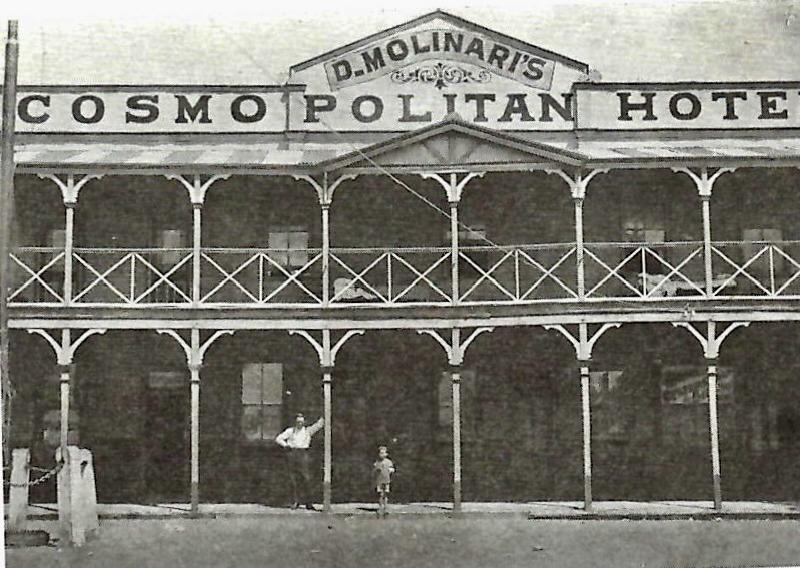
The hotel was owned from 1901 until 1915 by a remarkable character named Pietro Ceruti (1867-1921), as described at one of his bankruptcy hearings. He arrived in Albany with his family, in December 1896. After an eventful three years in Coolgardie he moved to Day Dawn. In May 1901 an application is made to upgrade the license of the Cosmopolitan Hotel from that of a Wine and Beer Saloon to that of a Public House. The building consists of
two sitting rooms and fifteen bedrooms (exclusive of those required by the family)
and is listed as being owned by Pietro. In August 1902 he and his family returned to Italy, leaving the hotel rented (at a claimed 14 pounds per week).
By October 1911 he was back in Perth, giving evidence to a commission on miners’ lung disease. By September 1912 he is back at Day Dawn, successfully applying for naturalisation. His stint as publican was unsuccessful, and by June 1913 the hotel lease (and publican’s licence) was taken over by Bartolo Pozzi and Carlo Saligari. By December 1914 they had gone broke (as explained in their bankruptcy hearing). The hotel then lost its licence, due to repairs being needed. By March 1915 it was open again, with a tricolour flag flying from its flagpole. Its publican was one Urbain Martin, a Frenchman. By later in the year he was selling up the complete contents of the hotel, notionally on the basis that he was a French Reservist and had been called up to serve in France.
The hotel was taken over (in late 1915 or early 1916) by my grandfather, Dominic, with ownership being a partnership with his brother Bernardo. This lead to a bitter family dispute, described elsewhere. The hotel was, according to family legend, quite profitable and was clearly still operating in May 1919. By the end of the year, however, the end was in sight. In an advertisement addressed to Station Owners and Others, it was described
as a going concern or for removal. This is a well-built two-storey building and contains approximately 15 tons corrugated iron.
The license lapsed in December 1919, and it disappears completely from the records. One can only assume it was demolished.
In the same edition of the Murchison Times and Day Dawn Gazette, one Mrs. M. Gibson is shown to be an incurable optimist. She announces she has taken the lease of the Commercial Hotel in Day Dawn, and is soliciting patronage.
Pietro Ceruti is worth a postscript. His career to 1915 is summarised in an article entitled Snakes, Opium and Statues that is simply impossible to summarise. In November 1919 he was again bankrupt. In November 1920 he arrived back in Fremantle on the ship Charon, in possession of a brand-new Italian passport that was issued in Singapore, and only valid for a one-way trip to Australia. It was promptly confiscated on arrival. He died in 1921.
Schools#
We have photographs of the two schools in Cue in 1906. The larger is the Cue State School. This was opened in 1896, only three years after the town was gazetted. It is still open in 2025 with 32 students (of which 7 are secondary students). There never seems to have been a high school.
The smaller is the Dominican Convent School. This was founded in 1899, initially in a temporary building. The school moved in to new building in 1906. Surprisingly, the convent school moved into a new building in 1949. It was certainly closed by 1971.
There were corresponding schools in Day Dawn, five kilometres away. The State School opened in 1895 and lasted until 1929. The Dominican Convent School opened in 1902 and was closed by 1919.
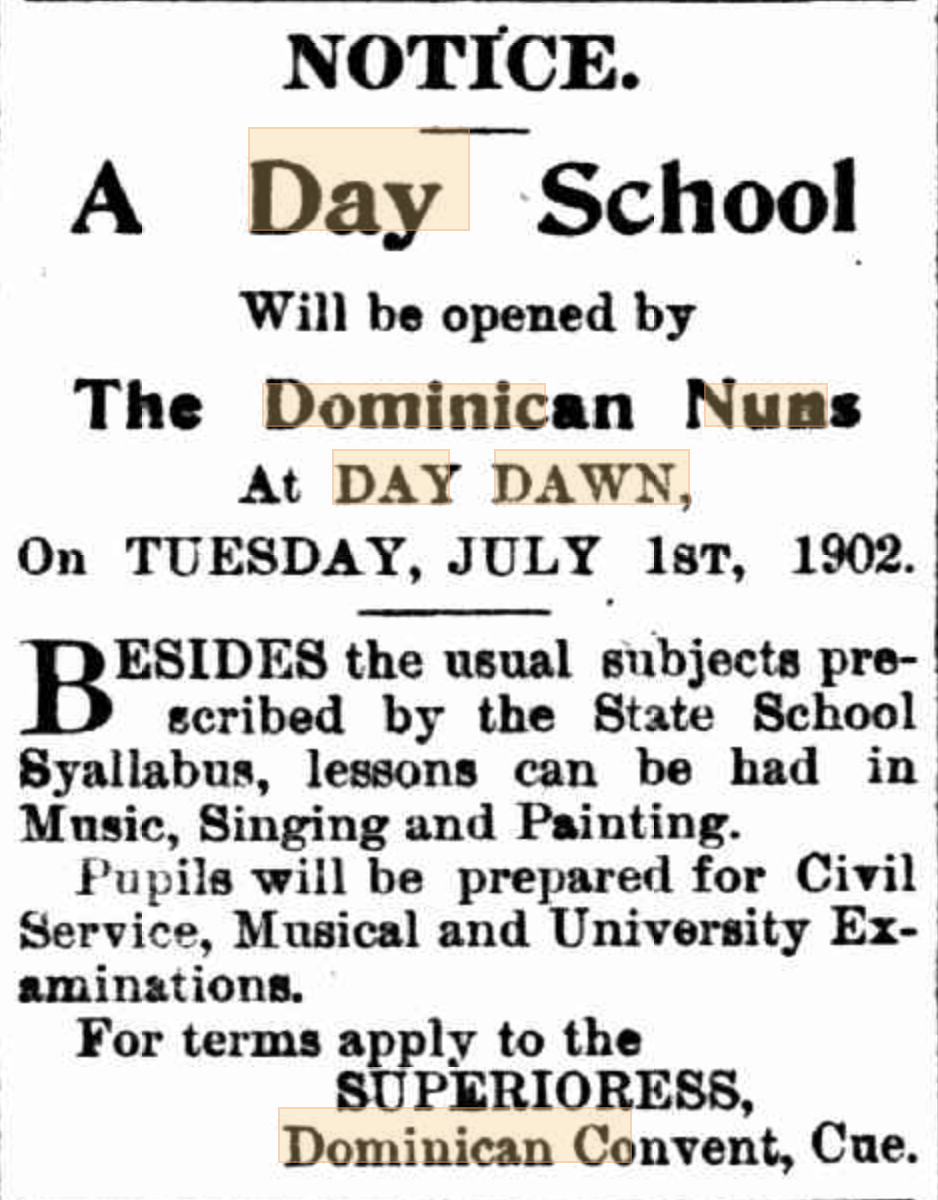
Note that these were simply called schools. The state schools honoured the commitment that schooling was free and compulsory up until the school leaving age of 14. The convent schools were due to the fact that the Catholic Church hierarchy regarded the state schools as godless, to the extent that a completely separate school system was needed. This system was paid for by the parishioners, as there was no state support. They were not called primary schools because, at the time, there were no secondary schools as such. There were a small number of colleges in the State, mainly with church affiliation, supported by fees which provided what we now call secondary education.
The Dominican Nuns#
How did that icon, the convent school, arrive in Cue and Day Dawn?
From Dublin in Ireland via Dunedin in New Zealand is one part of the answer. In 1899 a steely-eyed Irish nun in her sixties, Mother Gabriel Gill, arrived at Geraldton with five other Dominican nuns. In six years the number of nuns had grown to 20, and she had established a Mother house for the community at Dongarra (1901), and convents and associated convent schools at Cue(1899), Leonora (1903), Gwalia(1904) and Day Dawn(1905).
She died in Day Dawn in 1906. The Murchison Advocate (29 April 1905, page 3) published an obituary:
On Holy Saturday morning, the 22nd inst., there occurred at Day Dawn the death of the Rev Mother Gabriel, Prioress of the Dominican Order in this State. The cause of death was pneumonia, to which she succumbed in less than forty-eight hours after the commencement of the attack. The Deceased religious had a somewhat remarkable career. Brought up in a luxurious home and equipped with an education on which no expense had been spared, and which was broadened by much travel, she resolved, while still very young, to leave the world and devote herself to the service of God and her fellows in a Religious Order. In pursuance of this intention she entered the famous Dominican Convent of Sion Hill, near Dublin. Her high culture, her activity, and her talent for administration marked her out for office, and at an unusually early age she was chosen Superior of a branch of Missionary Nuns who sailed for New Zealand at the request of the late Bishop Moran. Her life thereafter was a particularly strenuous one, filled with such arduous labours as the wise ruling of the Order, journeys to Europe to augment their number, the establishment of Novitiates, the opening of schools and the foundation of branch convents. Her chief, and indeed it may be said her only motive, was the promotion of the true welfare of mankind and especially of the young, and she devoted herself to the various works which it involved with an eager and ceaseless, but with an ever prudent energy. In 1899, at the invitation of Bishop Kelly, she came to the new Diocese of Geraldton, accompanied by a community of her Order. Her life in this State was one of constant activity. Among her undertakings during this period may be enumerated the foundation of schools at the Back Flats and Gwalia, and of convents and schools at Greenough, Dongarra, Cue, Leonora, and Day Dawn. During her entire life her influence was widely and deeply felt and always made for good. She won easily and maintained the love, admiration and confidence of her pupils, and was the constant wise adviser of their elders. It is not too much to say that her death, which cut short her career in the full tide of its beneficent activity, will be felt as a distinct loss far beyond tbe bounds of the Religious Order to which she belonged. Her funeral on Sunday was attended by representatives of all sections of the community.
How Irish nuns, in their medieval outfits, coped with the dust and the heat of the Murchison Goldfields one can only imagine. It is clear that once school was over for the year they decamped for the summer from the inland convents to the relative relief of Dongarra, near the coast.
A Heritage WA report (section 13.4) relates the story of the Dominican convent at Yalgoo. It was constructed in 1921, and the report tells us
most of the materials for the new convent were acquired by relocating the old convent from the near derelict Goldfields town of Day Dawn.
Also
The Yalgoo Courthouse had been erected in Day Dawn in 1904 and brought to Yalgoo in 1921 to replace the original Courthouse which had been destroyed in a storm.
Clearly, the building stock of Day Dawn was being rapidly depleted.
The convent at Yalgoo closed its doors at the end of 1949 because of a lack of students. The convent was dismantled (again) and the material used to build a shearing shed on a nearby station.
The Mother house at Dongarra and its associated Ladies College continued until 1971, when they were severely damaged by flood. The Mother house was moved to Perth. A monument records the spot.
As the last schools closed the final phase occurred:
From 1972 until 1986, the Sisters conducted a Motor Mission with its base at Morawa from where they visited schools and homes at Morawa, Perenjori, Latham, Buntine, Mingenew, Dongara, Walkaway, Cue, Meekatharra, Yuna, Nabawa and, after the closure of the school at Three Springs in 1974, at Eneabba, Carnamah and Coorow.
The remaining nuns moved to Perth. The gold rush was at a complete end.
Big Bell Mine#
On 1 December 1934 the Murchison Times reported:
IMPORTANT TESTING PLAN. American Smelting and Refining Company of New York has taken an option over the Big Bell gold mine and an area of 1,200 acres, two and a half miles long by three-quarters of a mile wide near Cue. Diamond drilling over the last two years has disclosed a low grade ore body 80ft. wide over a length of 1,000ft. If a grade of 3 1/2 dwt. a ton can be proved the American company is prepared to erect a treatment plant with a capacity of 1,000 tons a day and to expend £2,000,000 on development and equipment of the mine. The option is taken for 12 months and the company has agreed to spend at least £600 a month on testing the property.
The mine itself had been developed in the halcyon days of the Cue goldrush, and had operated from 1913 to 1924. Various entrepreneurs had held the lease since then, and had eventually enticed American capital to investigate a large-scale mine. The State Government was an enthusiastic urger, for gold production meant employment and export earnings. The Depression still held the nation in its grip.
A report of April 1935 showed the company had started this work.
A long article in The West Australian on 6 December 1935 reports a detailed tour of The Murchison, and puts the Big Bell project into the context of the other activities in the region.
In the event, The West Australian reported on 5 March 1936 that the company had committed to the project, while the State Government had committed to build a rail link from Cue to the mine. The townsite was surveyed by June 1936, and land sales commenced the next month. More importantly, the licence for the town hotel was awarded on 17 September 1936.
The mine and the railway were opened to great fanfare on 2 October 1937.
The mine was closed in February 1943. Some of the larger pieces of equipment were taken away for the war effort.
The mine reopened in October 1945. Three months later the mine was still trying to recover its main power plant. It was packed up and sent to darwin, never to be uncrated or used. A visitor’s report of October 1947 gives a glowing account of the town and its associated facilities. It would seem to have been American capitalism at its best.
The mine closed in early 1955. The entire assemblage of mining equipment was sold off in a series of auction sales. The houses in the town were auctioned off for the value of the materials. The town soon became a ghost town. The only building that remains is the impressive art deco hotel. In the grand Australian tradition it was soon trashed beyond repair.