OHanlon
Table of Contents
Introduction#
Kerry’s maternal grandfather is Michael John O’Hanlon. His father was born in County Cork, Ireland and emigrated to Victoria in 1860. His mother was born in Cavan, County Cavan, Ireland and emigrated to Victoria in 1870. They were married in Bendigo in 1872, and had seven children. The following is a family tree for Michael John O’Hanlon’s ancestors and descendants.
Family tree: Michael John O’Hanlon (fullscreen)
We have some notes put together by Sheila O’Hare, Michael John’s daughter. Sheila worked some forty years ago, before any access to online indexed records. Her family stories are valuable.
Great-Grandparent Generation#
Timothy O’Hanlon (1841-1886)#
We know little definite about his early life. A death notice (see below) tells us he was the second son of Patrick O’Hanlon of County Cork, Ireland, and that he was 44 years of age when he died. This places his birth date around 1841.
Timothy O’Hanlon’s descendants are shown in the following family tree.
Family tree: Timothy O’Hanlon (fullscreen)
He may have arrived in 1860. There is a Tim Hanlan, Irish, aged 22, labourer, on the Lord Raglan, which arrived in Melbourne on 25 November 1860. In the passenger list he is ticket number 8339 (5 from the bottom).
The Age of 26 November 1860 provided the standard cryptic report:
Lord Raglan, White Star ship, 1905 tons, Joseph Roper, from Liverpool, 23rd August. Passengers— cabin : Mr. and Mrs. Dickson and family (5), Miss Blackmore, Mr. and Mrs. Everest and child, Rev. Mr. Harcus, Mrs. Harcus and family (6),, Mr. and Mrs. Leroy, Mrs. Richmond, Mrs. and Miss Blyth, Messrs Black, Wilkinson, B. K. Smith, A. G. Smith, and 243 in the second cabin and steerage. Lorimer, Mackie and Co., agents.
He married Mary Ann Kavanagh in Bendigo, in 1872. Several of the children were born in the Bendigo district, and they then moved to Rochester (a farming area) around 1874. In around 1878 Timothy selected block 60A, parish of Kotupna, and the family moved to the farm about 1880. Some sort of basic house would have to be built before the family could move in. This was about 8km south of the town of Nathalia. At the same time John O’Hare selected a block in the parish of Barwo, some 5km to the north-west of Nathalia.
He died suddenly in 1886, aged 44. We have the following reports. It would seem that the poetry in these reports was written by his wife Mary Ann.
The Nathalia Herald and Picola, Narioka, Kotupna and Moira Advertiser of 7 January 1886 tells us:
DEATH OF MR. T. O’HANLON.
We regret to announce the death of Mr. Timothy O’Hanlon, which occurred at his residence, Deep Creek, Kotupna, yesterday, after a very short illness. The deceased seemed perfectly well when he retired to rest on Monday evening, and after some conversation, said it was time to go sleep. He turned over and almost immediately fell off the bed. Medical assistance was obtained and the usual restoratives applied, but the patient never rallied, remaining unconscious to the time of his death. The cause of death was apoplexy. Mr. O’Hanlon was an old resident of Kotupna, and was well known and much respected by a large circle of friends. He was 44 years of age, and seemed to be, up to the time of his seizure, in strong bodily health, the news of his sudden demise coming with a shock to all who knew him. He will be interred in the Nathalia Cemetery to-morrow. Deceased leaves a wife and several children.
The Leader of 23 January 1886 tells us:
DEATHS.
O’HANLON. On the 6th January, at his residence, Deep Creek, Kotupna, after a short illness, Timothy O’Hanlon, second son of Mr. Patrick O’Hanlon, Cork, Ireland. Deceased was an old resident, well known and respected by a large circle of friends. Aged 44 years.
The Advocate of 13 February 1886 tells us:
DEATHS.
O’HANLON. On the 6th of January, at his residence, Deep Creek, Kotupna, Timothy O’Hanlon, the beloved husband of Mary Anne O’Hanlon, and second son of Patrick O’Hanlon, County Cork, Ireland.
A loving husband, true and kind
He proved to be, both in heart and mind;
A loving father, true as well;
When he on earth with us did dwell.
But now he is gone to a better home, while I, his wife, and 7 children, his loss deplore. Lord have mercy on his soul .
The Advocate of 8 January 1887:
IN MEMORIAM.
O’HANLON. In memory of the late Timothy O’Hanlon who departed this life at his residence, Coolmone Farm, on 6th January, 1886, by his loving wife, M. A. O’Hanlon.
On this day twelve months ago it was a sad case to see
the Almighty God’s will done to take my husband, who was always true and dear to me.
As it was God’s holy will to take him o’er,
I hope to meet him in that blessed land where we will part no more.
May his soul rest in peace.
He did not leave a will, and his wife had to apply for a grant of administration. His estate was assessed for probate.
Mary Ann Kavanagh (1850-1926)#
Mary Ann Kavanagh was born in the town of Cavan, in County Cavan, Ireland in about 1850. She and her sister Elizabeth emigrated to Melbourne in 1870. Her brother William Kavanagh had emigrated earlier. She married Timothy O’Hanlon in 1872. She was widowed in 1886, with six children aged 13, 12, 10, 7, 5 and 3, with another about to be born. She raised them all, on the family farm in Kotupna. She retired to Melbourne in 1915, and died there in 1926.
Mary Ann’s parents and siblings (and their descendants) are shown in the following family tree.
Family tree: Edward Kavanagh (fullscreen)
The Nathalia Herald of 4 May 1926 provided the following obituary:
It is with regret we have to record the demise of Mrs M. A. O’Hanlon, which occurred at her late residence, 16 Lindsay Avenue, St. Kilda, in the early morn of Tuesday, April 27th. The late Mrs O’Hanlon resided at Kotupna from 1880 to 1915, in the latter year leaving to reside at St. Kilda. Perhaps no one better known (and most favourably, too) ever lived in the Goulburn Valley. She was one of the great pioneers who with her late husband, Mr T. O’Hanlon (who predeceased her about 40 years ago), came along and accepted the hard knocks, as well as the easy ones, so familiar to the illustrious pioneers who blazed the track of this great southern land. Many are the experiences that could be related of those early days. For instance, Nathalia was then known as Barwo, and had only a few residences (if they could be called such). The Blakes, the Manifolds and the Kostadts were there, and a street now bears the name of each of those people, also some others who came along about the same time as the O’Hanlon family. The kangaroos, the emus and the wild horses (then named the “fizzers”) roamed at large, and the Kotupna plains were a favourite place for them. Now what a transformation! A beautiful plateau from the Goulburn to the Murray in verdure and in green!
The late Mrs O’Hanlon did her part nobly and well. The deceased lady came from stalwart stock: the Kavanaghs from Cavan in the North of Ireland. Her father there occupied a good position, and took his share of interest in public affairs. This strain is kept well alive to-day by one of her sons, whose efforts and ambitions are known to most people around Nathalia. Again, the Kavanaghs had literary gifts, and the late Mrs O’Hanlon was a poetess of no mean order. Mrs O’Hanlon was married to the late Mr Timothy O’Hanlon at Bendigo in the seventies, and for a time they lived there, and afterwards at Top Creek, Rochester. Then her late husband selected land between Nathalia and McCoy’s Bridge. The sudden death of her husband in 1886 was a great blow, and all the more so because of being left with seven children. Notwithstanding she prospered, and reared a family to manhood and womanhood that do her credit. A second great grief was the death of a daughter in 1894, but through all her spirit never failed - she worked on and succeeded against droughts, floods and other visitations.
The late Mrs O’Hanlon possessed a kind and benevolent disposition and many can tell of her hospitality . Every weary traveller was welcomed and “the cup that cheers” given to them. Again, she possessed the true Christian spirit of a broad tolerant Christianity. A strict Catholic, she loved her church, and the Numurkah and Nathalia Catholic Churches owe much to her generosity. She most regular attendant the whole of her life.
Mrs O’Hanlon has left six surviving children, viz., Mr P.D.K. O’Hanlon who lives at and owns the family homestead at Kotupna ; Mr E.G. O’Hanlon (J. L. Jeffers and Co.) The Olderfleet, Melbourne ; Mr M.J. O’Hanlon, of Elwood ; Miss Marie, who tenderly nursed he mother in her last illness ; Mrs Stevens, wife of Dr Stevens, of Gladesville, Sydney ; and Mrs M.J. Galligan, of Anthony Horden’s Emporium, Sydney, whose husband is an old employee of the firm. All her children visited her prior to her death.
Her remains were conveyed to Numurkah by the early morning train from Melbourne on Wednesday last, and then by special train to Nathalia. Considering the short notice, a very large assemblage met and followed “all that was mortal” to the Nathalia cemetery. The pall bearers were her three stalwart sons, Mr Henry Kavanagh (nephew), and Messrs Alex. McDonell and John Broom, old friends of the family. The councillors of the Namurkah Shire were largely in attendance out of respect to her and sympathy for her councillor son. The Rev Father Murphy officiated at the Graveside, and Messrs A B. Binger and Sons had charge of the mortuary arrangements.
Mary Ann and her sister Eliza arrived in Melbourne on the ship Alumbagh on 20 November 1870. On the passenger list they are about two-thirds down the page. Aged 22 and 18, respectively. They are both “servants”, meaning domestic servants.
The Argus of 31 October 1870 reports the arrival in the usual cryptic fashion:
Alumbagh, ship, 1,137 tons, John G. Lowe, from London via Plymouth 1st August, with 412 Government immigrants, W. H. Pearse, M.D., surgeon-superintendent. Holmes, White, and Co., agents.
The Herald of 31 October 1870 tells us:
THE IMMIGRANT SHIP ALUMBAGH.
This morning the Immigration Commissioners proceeded on board the ship Alumbagh, which arrived in the Bay yesterday. The purport of the visit was to inspect the immigrants arriving by that vessel. To-morrow morning the Commissioners will hold a meeting on board the Alumbagh, after which the vessel will be brought alongside the Williamstown Railway Pier, when a clearance of the passengers will be made, the female portion being brought on by special train, from which they will proceed to the Immigration Depot, Latrobe-street, where everything is in readiness to ensure their comfort. The new arrivals are classed as follows : — 80 married people, 150 single women, 96 single men, 38 boys, 44 girls, and 5 infants. Miss Robinson acted as matron, and the immigrants were under the charge of Dr. Pearse, Captain Lowe and the ship’s officers acting in conjunction with Miss Robinson.
On 2 November 1870 it tells us:
IMMIGRATION DEPOT.
The female immigrants per Alambagh were duly housed in the depot, Latrobe-street, during the afternoon of yesterday. The inspection made of the immigrants on board ship by the immigration Commissioners, yesterday, passed off very satisfactorily. Last evening thirty-five of the warrant-holders were claimed by their friends, and went away in high glee to their various homes. During to-day many more of this class have been called for by their relations or friends, and took a kindly farewell of such of their fellow-passengers as still remain in the depot. The ladies’ committee meet to-morrow morning, at 11 o’clock, to portion out the needlework executed by the female immigrants during the voyage. The time for the hiring of the Government female immigrants has not yet been decided ; but Friday may probably be set aside for this purpose.
In the event, the Herald of 7 November 1870 tells us that everything went off swimmingly.
The Immigration Depot.
At 11 o’clock this morning the female immigrants arriving per ship Alumbagh were placed on hire at the Immigration Depot, Latrobe-street. The appearance of these new arrivals, as they were seated in the hiring-room, prior to the business of the day commencing, was one particularly neat and tidy, fully bearing out the opinion expressed by Mrs. Ferguson, the matron of the depot, that a better class of Government female immigrants had never been received into the depot. Previous to the doors being thrown open to the public, a large number of ladies and others wishing to secure the services of the girls, thronged the waiting-rooms at the depot, eagerly seeking for cards of admission to the hiring room. The number of the female immigrants placed on hire was forty-one, classed as follows: cooks and laundresses, 6 ; general servants, 14 ; nurse-maids, 9 ; housemaids, 14 ; independent of several who had come out under the warrant system. Amongst the cooks was one who spoke French and Spanish fluently. But very little time was lost in getting to business after the doors of the hiring room were opened to those in search of such domestic labor as was offered, and in about two hour’s time or less the whole of the girls, with the exception of two nursemaids and two general servants, had accepted service at rates as follows : — Nursemaids, from £12 to £18 per annum ; general servants, £16 to £22 per annum ; housemaids, £18 to £22 per annum ; cooks and laundresses, £20 to £25 per annum. It must be a great satisfaction to all concerned that these newly engaged servants go away to different homes bearing with them characters of an unexceptionable kind.
We have a list of the assisted female immigrants (and the following page). Mary Ann and Eliza are not on the list. They must have come out on the “warrant system”, nominated to their brother who by that time was a Police Constable in Bendigo.
Having being suddenly tasked with running the farm, she has to manage as best she could. The following letter in the Shepparton Advertiser of 26 August 1898 explains a financial issue.
AN EXPLANATION.
TO THE EDITOR OF THE ADVERTISER.
Sir, In your report of the County Court case, Kilpatrick v. O’Hanlon, it is stated that Kilpatrick, in answer to Mr Johnson, said he was “further induced to give a full cheque because he had a mortgage over defendant’s stock.” Now, as defendant, let me explain : About five or six years ago. I bought, through Kilpatrick, a block of land adjoining my homestead. I am administratrix of the homestead property. After I had paid a deposit and was arranging for a transfer of the land I had bought, Kilpatrick suddenly discovered that I could not raise any money on the original 320 acres, because I was administratrix; consequently not legal to obtain money thereon. I confess I was astonished, and was in an ugly corner ; because if I withdrew from the purchase my deposit, etc., would all be forfeited. The money required was only about £160. Kilpatrick suggested, as the only means out of the difficulty, to mortgage my stock for twelve months, and at the end of that period I surely could pay it off. To mortgage stock does not look nice ; but as the only means available I did so. I did this because Kilpatrick said no money could be raised on the original 320 acres, as I was administratrix. At the end of those twelve months I paid every penny of the £160 ; but I neglected to get a discharge, simply because I thought at the time that when I paid the full amount it there ended. It appears a discharge must be obtained ; otherwise the mortgage runs legally on. Now, this stock mortgage was arranged some five years ago. Your readers can judge of my surprise when I saw this “mortgage affair” brought to light on last County Court day. It was the first mortgage I had anything to do with ; hence my want of knowledge in seeing to its discharge. From those facts it will be seen that the mortgage under notice was arranged as the only loop hole of escape from exceptional trying circumstances, and not the well-known ordinary course too well known to the majority of your readers. Thanking you for the insertion of this letter,
I am, yours, etc.
Mrs M. A. O’HANLON. Kotupna, August 20th.
The court case itself is here (it involved the sale price of some barley). It also triggered an impassioned letter to the editor by her son Patrick. In turn, this caused the editor to attach the following note:
[It appears very strange that Messrs Kilpatrick and Co. should take the stand indicated by the above letter (from Patrick O’Hanlon), when they, against the advice of their solicitors, declined to take the costs they were entitled to, as winners of the case, and told them they would give it to the plaintiff who, being a widow, they (Kilpatrick and Co.) considered she was put into the position by the advice of her son; the saving to her in this matter was fully £30. Ed.]
It seems that Patrick was a serial, and singularly unsuccessful, litigant.
She moved to Melbourne in early 1916. The Nathalia Herald and Picola, Narioka, Kotupna and Moira Advertiser of 14 March 1916 reported a district farewell:
Presentation to Mrs. O’Hanlon.
A Pleasing Function.
On Saturday, 4th March, a number of friends of Mrs O’Hanlon, who has retired and gone to Melbourne to live, met at Gray’s Bridge Hotel, to bid her farewell and show in some small way their appreciation of her services to the district. The Shire President (Cr. Alex. McDonnell) presided. A most bountiful repast had been prepared by Mrs. Gray, and was greatly enjoyed by those present.
The chairman said they all knew the reason they had met that day. They were present to say farewell to a highly esteemed friend in Mrs O’Hanlon who was going from their midst to live in Melbourne. From childhood he had had the greatest admiration for Mrs O’Hanlon. She had the right to be called one of the pioneers of the district. Mrs. O’Hanlon lost her husband while the family was young, and the way she had brought them up was a great credit to her. The way she had reared her family was an example to us all. He had known her for 38 years and could not find words enough to show his appreciation for Mrs O’Hanlon, who was a woman held in the highest esteem throughout the district. He thought she was doing the right thing to retire and let those she had battled for against drought and flood look after her. It fell to his pleasing duty to present her, on behalf of Kotupna and Nathalia friends, with a beautiful tea and coffee service, suitably inscribed, and trusted she would live long to enjoy it, and remember the good days she lived in Kotupna. (Applause).
Cr. J. Ball said he was pleased to be present to do honor to Mrs O’Hanlon. He had known her for a long time and she was one of the early pioneers of the district, and she had done a great deal better than a lot of the men. Now that her family were able to do for them-selves he was pleased to know she was going to take a well earned rest. Mrs O’Hanlon was well known throughout the district for to hospitality. He trusted she would live for a long time and enjoy a well earned rest.
Mr A. Geary said that as one who had gone to school with the family in the Old Country, where they were greatly respected, and one who had known them in this district, he was pleased to say a few words in regret in losing Mrs O’Hanlon from the district, and hoped she would get on well in Melbourne.
Cr. J. H. Tuckett said there was no doubt great credit was due to Mrs O’Hanlon for the way she had brought her family up, and it had held her up to men in the district for the way she had managed her farm, land when it was taken up first was recognised to be the worst in the district. No lady deserved more credit than she did. He wished her long life and prosperity.
Dr. Keyes said he could add very little to what the previous speakers had said. Mrs O’Hanlon had been held in high esteem throughout the district and they were sorry to lose her. He wished her every happiness in her new sphere.
Mr. A. Rathbone said he had known Mrs O’Hanlon for 25 years and she had been a very good neighbour. He always found her trying to do her best for the district and herself. She was going to have a well deserved rest, which she had thoroughly earned.
Rev. Father Tehan said it gave him great pleasure to join in bidding farewell to Mrs O’Hanlon. From his short acquaintance of her he had found out her hospitality. He could only wish her every happiness in her future home.
Senior Constable Steedman, as a newcomer, said that from the first time he had shaken hands with Mrs. OHanlon he had the greatest respect for her. After so successful a struggle he was pleased she was going to take a rest and wished her every prosperity in her new home.
Mr. S. McLees said he could not say very much as he was a newcomer to the district, but the little time he known Mrs O’Hanlon she been a good neighbour. He was sorry she was going away, but was glad was to rest.
Cr. P.D.K. O’Hanlon, on behalf of his mother, said he had to sincerely thank them for their very fine present. His mother had resided in Kotupna for 38 years, and was leaving that home and himself and was going to take a well earned rest in the eventide of her life. When she looked at the present it would not only remind her of her friends in Kotupna and Nathalia, but would recall many happy associations of the past. He hoped they would accept the thanks of his mother. He was pleased to see the shire president there that day. He might say that during his term of office the duties had never before carried out with more dignity and honor. He again sincerely thanked them. (Applause).
By 1916 it seems clear that only Mary Ann, her eldest daughter Marie and eldest son Patrick still lived in Kotupna. Sons Edward and Michael had certainly moved to Melbourne, Elizabeth was a nurse and must have moved earlier for training, and Helena seems to be working in Sydney. Sheila O’Hare tells us
My father Michael and one of his sisters, Marie, bought a house in Elwood and she took in boarders.
This is the 16 Lindsay Avenue residence identified in Mary Ann’s death notice below. At some stage Lindsay Avenue seems to have been reclassified from St Kilda to Elwood (they are neighbouring suburbs). The Electoral Rolls have Mary Ann, Michael and Marie living there in 1917 and 1919. Michael moved out after his marriage in 1919, and the Rolls have Mary Ann and Marie living there until Mary Ann died in 1926. In fact, Marie lived there until she died in 1966.
The Numurkah Leader of 5 May 1926 reported her death:
DEATHS.
O’HANLON. On the 27th April, at her residence, 16 Lindsay Avenue, St. Kilda, Mary Ann, relic of the late T. O’Hanlon, Kotupna, and beloved mother of Patrick D. K., Edward G., Michael J., Sissie (deceased), Marie, Elizabeth (Mrs Stevens), and Helena (Mrs Galligan). R.I.P.
Dear Mother, thy enfolding love was boundless as the sea.
The great solicitude and care, one with Infinity.
Love faltered not at grief or pain, or duty’s hard decree
When Heaven planned a flawless gem, she fashioned thee
A spirit bright with duties done, to grace God’s Ample Fold.
A nature great with virtue’s attributes - heart of Gold.
The poetry in the notice was perhaps written by her son Michael.
Elizabeth Kavanagh (1862-1934)#
The Cobram Courier of 27 September 1934 provided an obituary:
Mrs ELIZABETH LEAVEY.
A pioneer of the Sandmount district in the person of Mrs Elizabeth Leavey, wife of the late Mr Thomas Leavey, passed away at the residence of her son-in-law, Mr. J. Parnell, Cobram, on Friday. Deceased, who was in her 78th year was a native of County Cavan, Ireland, and with her late husband, came from Bendigo in 1876; and selected a property at Sandmount, where with her late husband she reared a family of three sons and three daughters consisting of Mary (Mrs Brady, deceased), Edward, Margaret (Mrs J. Parnell), Thomas, William, and Bessie (Mrs Logan). Deceased was of the earliest settlers that helped to open up the district fifty-eight years ago. and proved an excellent friend to many. The funeral took place at the Numurkah Cemetery on Saturday afternoon, Rev. Father Ellis reading the burial service.
William Kavanagh (1841-1901)#
William Kavanagh seems to have arrived in Melbourne on the Ocean Chief on 26 June 1857. He married Mary Ann Behan in 1867, and they had four children. He died in 1901, aged 60 years.
In the passenger list he is about two-thirds down the left page, is a “labourer”, and says he is 20 years old. He was probably more like 17.
The Argus of 30 June 1857 reported:
The Ocean Chief, 79 days from Liverpool, arrived at Melbourne on the 26th ult. Several cases of small-pox having occurred on board during her passage, the Governor, with the advice of the Executive Council, has placed the said ship and the crew and passengers thereof under quarantine for a period of fourteen clear days from the convalescence of the last case of small-pox. The following are the names of the saloon passengers: Mr. and Mrs. Lawson, Mr. Lawson, Miss Lawson, Mrs. M’Clelland and child, Master and Misses (2) Hewitt, Miss Frith, Miss Forbes, Miss Williams, Miss Grimley, Miss Worthington, Mr. Palmer. Mr. Stoker, and Mr.T.H. Kidd. It will be satisfactory for the friends and relatives of the passengers by this ship to know that out of the fourteen cases of small-pox that have occurred during the voyage, only one has resulted fatally, and that was a child aged four years, named Amelia Vail. Two other deaths occurred from natural causes on the passage out. Only one case is at present under treatment, so that we may expect a speedy release of the ship from quarantine.
In 1870 he seems to have been a police constable in Raywood, a mining town some 25km north of Bendigo. The Leader of 17 December 1870 tells us:
The following payment has been made from the police reward fund during the past week:— To constable William Kavanagh, at Raywood, Sandhurst district, £3, in acknowledgement of his services in the arrest and prosecution of John Ryan, sentenced to six years for housebreaking and stealing from a dwelling.
His sisters would have joined his family there - they were both married in the Bendigo area (respectively, two years and six years after they arrived).
Late he was a hotel publican, mine host of the Cavan Hotel in Fitzroy, Melbourne. The Argus of 4 March 1901 tells us:
SUDDEN DEATH.
A remarkably sudden death occurred last evening at the Cavan Hotel, Brunswick street, Fitzroy. Mr. Synon Kavanagh, aged 25, the son of the licensee, Mr. William Kavanagh, was taken ill while the family were at tea, and died in a few minutes. He had not been suffering from any complaint for some time past, but was in rather delicate health. Shortly before 7 o’clock last evening he complained of feeling faint, and said that he would not have any tea. He was assisted to another room and was laid on a sofa, but his condition became rapidly worse, and Mr. Yelland, M.B., was sent for. Kavanagh was dead on his arrival, and, as he was not able to state definitely the cause of death, an inquest will be necessary. Death is supposed to be due to heart failure.
William died three days later. The Age of 8 March 1901 reported his death:
KAVANAGH. On the 7th March, at his residence, Cavan Hotel, Brunswick-street, Fitzroy, William, the loved husband of Mary, and father of H. G., W. J. and E. J. Kavanagh, of Victorian Railways, ex-sergeant of police, aged 60 years. R.I.P.
Later, the Age of 11 April 1901 reported:
WILLS AND BEQUESTS
The will of William Kavanagh, late of Cavan Hotel, Fitzroy, licensed victualler, has also been lodged for probate. Testator executed his will on 5th February last year, and died on the 7th of last month. The real estate was valued at £4500, and the personal at £790, all of which was devised to the widow and children.
Grandparent Generation#
When their father Timothy died in 1886, the seven children were brought up by their rather indomitable mother Mary Ann, on the family farm. They existed as a family collective (somewhat like the O’Hares at Snugborough) with the three boys working the farm. The farm, enlarged over time, was divided in some way between the boys. Edward and Michael sold their shares about 1911, and set up business in Melbourne. Patrick took over the original family farm, and continued to farm.
Michael John O’Hanlon (1878-1958)#
Michael John O’Hanlon was born in 1878 in Rochester, Victoria, the third of seven children. Soon afterwards the family selected a farm at Kotupna, near Nathalia. Until the age of 33 he was part of the family farming enterprise. Around 1911 he moved to Melbourne, and ran a successful stock and station agency. He married Eily Irina McMahon in Melbourne, in 1919. They had two children (in 1920 and 1923). In 1929, at the age of 51, he returned to farming when the family moved to Balkuling, WA. He died in Quairading, WA, in 1958.
His daughter, Sheila O’Hare, provides the following notes.
Both Martin Patrick O’Hare and Michael John O’Hanlon grew up in Nathalia, Victoria. The O’Hare’s farm “Snugborough” joined the Broken Creek, while the O’Hanlon farm was on the Goulburn River on the other side of Nathalia township - but they knew each other from meeting at Mass.
Martin O’Hare married Angela Raselli, and for several years they lived in Queensland on a dairy farm near Gympie. Families were usually too large for sons all to remain on the home farm. Their family was Honor (Pusenjak), Frank, Martin, Ned and Betty (Teresa Margaret Elizabeth) who married James Stokes, whose sister patricia married Martin O’Hare. Honor was a schoolteacher, and she married Bogdan Pusenjak and they had a son, Nicholas, before an early divorce. Martin was a Duntroon graduate and rose to become a Brigadier.
The family lived in Nathalia, after leaving Queensland, for a year or so. Martin senior developed Dengue Fever but which was first thought to be TB. In 1928 they moved to Bilbarin, WA, while my family came to Balkuling, WA in 1929.
Martin senior and Michael renewed acquaintance at Annual Farmers’ Union Meetings, and then the O"Hares bought a larger farm near near Cunderdin (Yenelin) in early 1938 (or possibly late 1938) and the O’Hares and my family became regular visitors to each other’s homes.
My family had left Melbourne in 1929 because of the Great Depression and the effect it had on Land and Estate, in which Dad had worked after leaving Nathalia for Melbourne early in the century. He and one of his sisters, Marie, bought a house in Elwood and she took in boarders, on of which was my mother, and a romance developed between Michael and Eily McMahon! Things were good and they built a lovely home in Elwood, close to the beach. I was born in 1920 and my brother, Richard, was born on 1923. They lived there until 1929 till their enforced move to WA where land was cheaper, because they could see no other option but a return to the land.
Their Elwood house was the sole deposit on “Spring Dallah”, Balkuling, which was fairly close to Cunderdin. Dick and I had correspondence lessons for a year while we learned to ride ponies, and then went to Doodenanning School, 5 miles away. Our education was a great source of worry to our parents, but fortunately we both won Secondary Scholarships. I went to Sacred Heart and became a teacher, and Dick went to Aquinas and became a Doctor, practising at Lilydale Vic before his untimely death at 59.
The Kotupna Years#
Presumably all seven children were educated at the local school, to age 14.
Small country towns at that time (pre popular entertainment via cinema and radio) had a vibrant community life. Michael John was the Honorary Secretary of the Kotupna Debating Society and was president of the local branch of the Australian Natives Association. He had a considerable literary bent, perhaps encouraged by his mother. In 1903 he won first prize (and 1 guinea) for an essay submitted to the Namurkah Competitive Exhibition. The essay was published in the Namurkah Leader here. He is the only poet to grace these narratives, so it worth reproducing two of his published efforts in full.
The Numurkah Leader of 22 July 1897
THE CRIMINAL
(BY M. J. O HANLON, KOTUPNA.)
They say by instinct it is there,
The sense that prompts to deeds unfair.
A fire innate that burns within
And kindles blood to acts of sin.
A fierce desire to commit
An act which law will not permit.
But let it be not understood
It’s that alone that dons the hood,
So black, so foul, impure and dire,
The essence of a living fire;
To be avoided and abhorred,
Repulsed and scorned and deplored.
It’s habit turns from good to ill
And in the heart the germs instil,
That nourished long will spring and bloom,
And over virtue cast a gloom :
And glow forth with a ruddy fire
Equal to the innate desire.
The youth, with tendencies quite pure,
Will slowly sink and ne’er endure,
When left to revel in a place.
With small temptations to disgrace;
For one appeased, will rise again
On an increased and broader plane.
And thus command by precedent,
To be appeased without comment:
For once performed, the act remains,
And the same privilege retains ;
While will, will give the struggle o’er
By reason of its fail before,
And so along by slow degrees
Like chronic malady or disease,
Vice gathers strength at every turn,
And bids command in accents stern :
While virtue bows in grim decay
And slowly, grimly ebbs away.
And so crime thrives by negligence,
And stolid cold indifference;
By those placed to train the young.
And mark for ere it has begun
To leave its tragic mark behind.
The tendency ev’ly destined.
The canker rooted will remain
And later effort prove in vain
To bend the evil stem, now strong
From deep indulgence in the wrong.
For that is gone which once would heal,
That shame which convicts ne’er can feel.
Numurkah Leader (Vic. : 1895 - 1948), Thursday 24 March 1898, page 7
WHEN LITTLE SADIE SMILED.
With flaxen hair and rosy-dimpled cheeks,
And laughing eyes that beauty’s charm completes,
For six short years, unclouded, happy years,
She shed a sweet and happy halo round,
And installed joy where grief before was found.
Within the sweet and baby smiling face
There was a charm that sadness did deface.
And heavy hearts from mourning were beguiled
— When little Sadie smiled.
And callous hearts, made sad from warring long
With sorrow, grief, and injury and wrong ;
The hearts that long, long, long had ceased to be
Warmed by the flame of human sympathy ;
That saw the woes of men without a sigh,
Or felt a thrill at pity’s piercing cry,
Were wakened from their cold and tranced sleep,
Were called from where sternness her vigils keep,
Were softy moved, were softened and made mild
— When little Sadie smiled.
And great, strong men, with valiant hearts and brave.
That from the world did never mercy crave ;
That trod through paths with deadly dangers fraught,
Nor safety, with a shrinking dif’dence bought:
That never to the despot’s nod did bow,
Or felt the chill of fear upon their brow :
Could not, though rugged were their forms, withstand
Her laughing, sweet and gentle-voiced command ;
And rigid sternness was a term illstyled
— When little Sadie smiled.
In fever’s grasp upon her bed she lay.
And feebly tossed while life slow ebbed away.
A luminary, heaven did allot
To be the joy of a poor humble cot,
Was passing now to where the angels dwelt;
And when with reason’s parting light she felt
Life could no longer death’s assaults endure,
She feebly smiled, fond hearts to reassure.
Ah then! then these hearts were wrung with ag’ny wild.
— When little Sadie smiled.
M. J. O’HANLON. Kotupna, 16 3 ‘98.
We have at least two others, here and here. On the other hand, the following brief note appeared in the Numurkah Leader of 21 October 1898:
NOTICE TO CORRESPONDENT.
M. J. O’Hanlon, Kotupna.- Verses respectfully declined.
Perhaps the poem When Little Sadie Smiled was reflective of the death of his sister Cissie, at age 15 in 1894.
The following report is from 1898, and shows that Mary Ann had passed on the management of the farm.
We are just in receipt of a sample of barley which is somewhat unique in the present season. It is from the farm of Mr O’Hanlon, Kotupna, and looks like a sample that any grower might be proud of. The area on which it was grown was 38 acres of loamy clay, and averaged 5 3/4 bags. The owner of the threshing machine, Mr Royal, who threshed through the Kyabram and Kotupna districts, has given tho grower permission to state that it is amongst the best samples which he has threshed during many years’ experience in this and other localities. The ground was ploughed and sowed in the ordinary way, and no fertilisers were used, but the soil shows by this result that, probably from its clayey nature, it is well adapted to the growing of this particular cereal.
—Nathalia Herald.
The Numurkah Leader of 13 February 1903 had several interesting items:
NATHALIA.
Mr Dan Colgan, proprietor of the “Murchison Times,” Cue, W.A., has returned to pay a visit to his parents and friends in this district. He speaks in glowing terms of the opportunities in the West for making money, and was very much surprised to find prospects in such a deplorable condition in this part of the Goulburn Valley.
A dwelling house on one of the O’Hanlon farms, Kotupna, has been destroyed by fire. How the fire originated is unknown. I understand that the building was fully covered by insurance.
As a countryman, Michael John seems somewhat accident prone. The Nathalia Herald and Picola, Narioka, Kotupna and Moira Advertiser of 22 May 1906 reported:
KICKED BY A HORSE.
Whilst Mr. M. O’Hanlon, of Kotupna, was in Mr. Colgan’s stable last week getting his horse, another animal in the next stall kicked him severely in the groin. He was disabled for some time, but is now able to get about with the aid of a stick.
On 17 May 1907 the same journal of record tells us:
Shocking Gun Accident.
On Friday afternoon last a gun accident happened at Kotupna, when Mr Michael O’Hanlon was within an ace of losing his life. It seems that Mr J D Gleeson, of the Australian Widow’s Fund Co, and Mr M. O’Hanlon were out shooting, and when within about two hundred yards from home, the latter was getting through a wire fence, holding two hares in one hand and his gun in the other. Whilst in a stooping position the gun caught on the wires and almost pulled it out of his hand and at the same time going off. The whole charge entered the muscular portion of the back and went upwards into the shoulder, making a ghastly wound. Mr Gleeson at once rushed to his assistance, but he would not allow himself to be moved until the doctor arrived. Mr. Gleeson then drove rapidly to Nathalia, from whom the accident was first known in the town, and it was then thought the unfortunate young man’s injuries were fatal. Dr. Keyes, Father Griffin and Nurse M’Donald made all haste out and then it was learned that there was no immediate danger, but that an operation was necessary. The patient was conveyed home and Dr Keyes made him as comfortable as possible for the night. On Saturday Drs Keyes, Florance and Damman performed the necessary operation of removing a portion of the shoulder blade. The dangerous nature of the injuries caused great anxiety to the whole district, as “Mick” was one of the great favourites of the community, and every day enquiries were made as to his condition. Yesterday Dr. Keyes informed us that his patient had turned the corner and was now doing splendidly, although some time must elapse before the wound heals.The doctor also says nothing but his fine constitution has saved him, most men would have died under similar injuries.
On 22 February 1908 we are told:
FALL FROM A HORSE. NATHALIA
Mr. M. J. O’Hanlon. who a few months back was accidentally shot, was riding a horse at a walking pace along the road, when the animal stumbled and fell, throwing its rider to the ground. The rider sustained concussion of the brain, and had two of his ribs broken.
The Numurkah Leader of 21 July 1911 tells us:
A very unpleasant and dangerous experience befell Mrs O’Hanlon of Kotupna on her way to church on Sunday last. Mr M. O’Hanlon was driving when the horse fell in the vehicle and his mother was precipitated on to the road, sustaining a broken finger and severe cuts about the face.
The Melbourne Years#
In 1911 he started to extricate himself from farming, and from Kotupna.
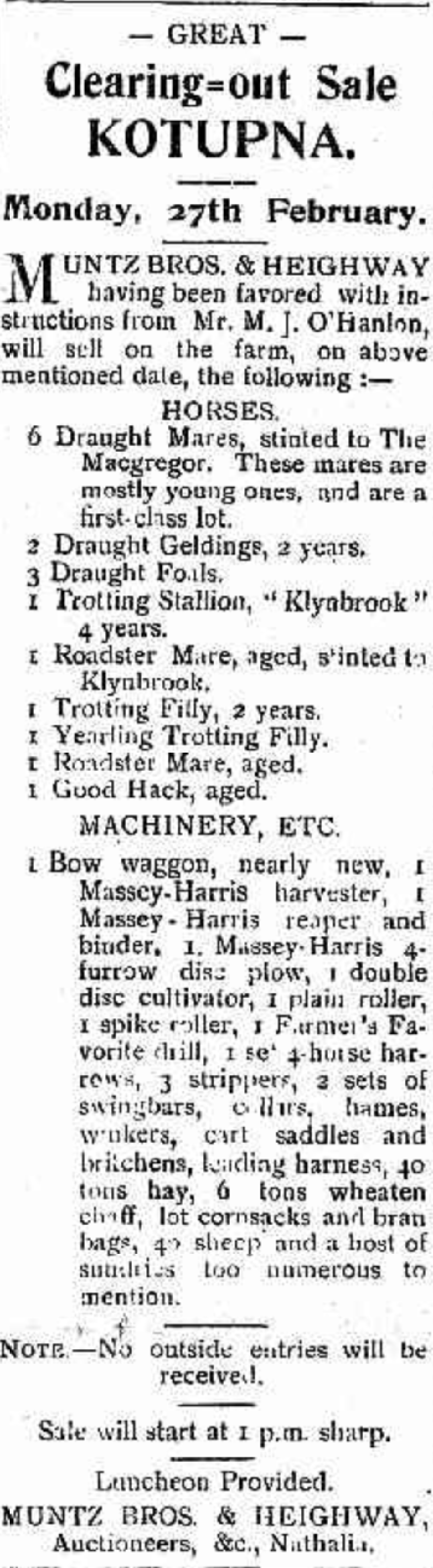
The Argus of 21 August 1915 has a report that was presumably written for them:
HOUSES AND LAND. EXTENSIVE LAND SALES.
M. F. O’Hanlon and Co., stock and station agents, land and property salesmen, 237 Collins-street, report having sold since February 1: (16 sales detailed.)
Total sales: £80,164.
He was married, to Eily McMahon, in 1919. We have a photograph of the bridal party, looking substantially prosperous.
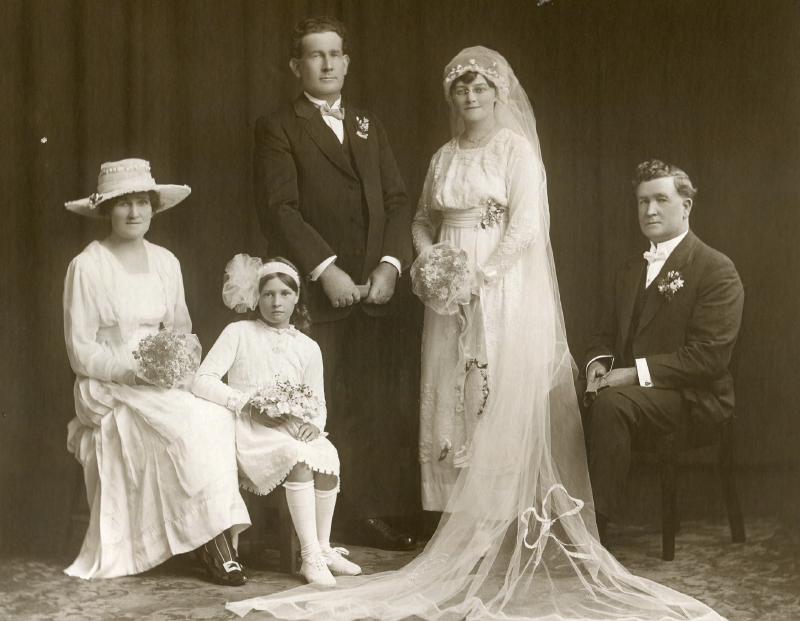
From left: Marie O’Hanlon, Dorothea Kelly, Michael O’Hanlon, Eily McMahon, Edward O’Hanlon. We also have the certificate of marriage. Michael is a “stock and station agent’, and Eily is a “clerk”. They were married by Archbishop Daniel Mannix himself.
They had two children, Sheila born in 1920 and Richard, born in 1923.
It seems that Michael and Eily constructed a new house, to move into after the wedding. It was at 29 Normandy Road, Elwood. We have two photographs. The first must be directly after construction, and shows Eily sitting on a small front verandah.
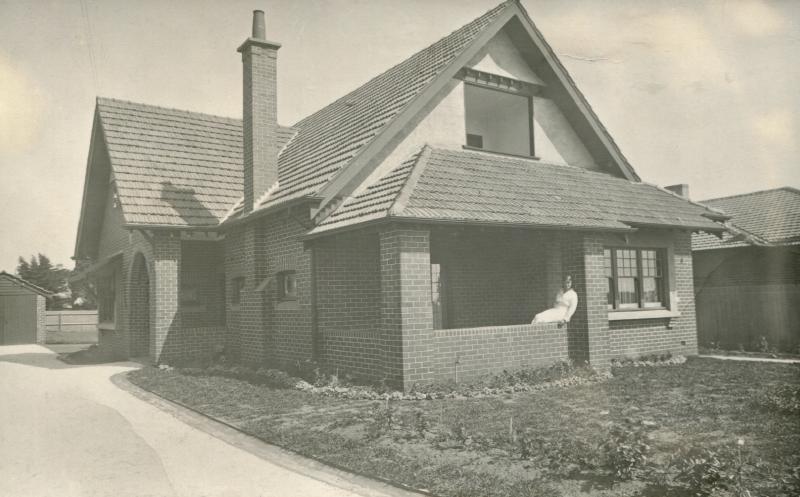
The second shows a front fence, and the verandah filled in, to expand the size of the front room.
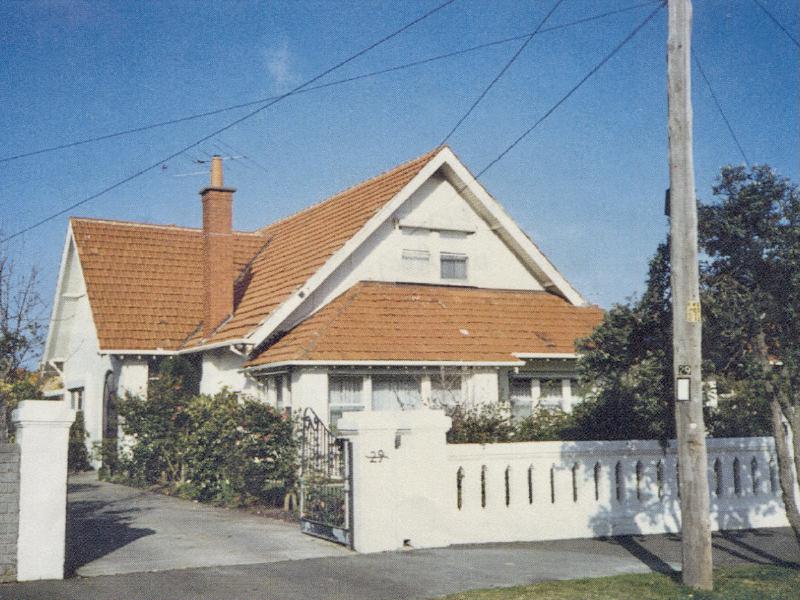
Sheila O’Hare provides the comment:
When we sold the house, 29 Normandy Rd., Elwood, in 1929, the upstairs attics were not enclosed. In summer, my parents slept in the front one, and Dick and I in the back one. The middle one, over the lounge room, was a very large one which we used as a playroom.
The house was robbed three times. Sheila O’Hanlon provides the following notes.
“Stolen on 26 January 1921.
- 5 stone diamond ring
- 8 stone diamond cluster ring
- 5 stone garnet cluster ring
- 1 brooch set with 2 large amethysts
- 1 brooch set with 5 small amethysts
- 1 brooch leaf shape with emerald in centre
- 2 pendent set with aquamarines and chain
- 1 gold brooch shaped as violin
Stolen on 29 July 1921.
- 1 gold watch chain inscribed “M. J. O’H. 12.4.19”
- 1 gold locket
Stolen 11 July 1922
- 1 gold wristlet watch inscribed “Mikie to Eily 25.12.17”
- 1 purse
Police were sure that the robberies were the work of “Squizzy” Taylor who lived close by in Elwood. Squizzy Taylor was a notorious burglar.”
Squizzy Taylor was a well-known gangster, described in a Australian Dictionary of Biography entry and a Wikipedia entry. The rather splendid sideboard from which the jewellery was stolen was known thereafter as “The Squizzy Taylor”, at least when it was inherited by Eily’s daughter. It remains in the family (Sheila’s daughter Anne has it).
Family legend has it that “grandfather crashed” in the depression. Perhaps the “crash” predated the Depression. The elements of the saga seem to be
- Late 1928. Three English confidence men, John Fergus Stone, Henry Barnes and Henry Harding, came to town, claiming to represent “big London investors”. They took an expensive flat, and entertained lavishly. They started by floating a local shell company. The Argus of 8 November 1928 tells us
Commercial and General Investment Trust Pty. Ltd. Registered Office, 405-407 Collins street, Melbourne. Capital £100,000 in £1 shares. Names subscribed to memorandum:- John Fergus Stone, 1 share; Henry Barnes, 1 share.
- They purported to acquire an asset. In the Argus of 7 December 1928:
The Stock Exchange was advised yesterday afternoon by the directors of the Asia Amalgamated Tin Syndicate No Liability that the syndicate had sold its interest in two tin mining properties at Pichon, Siam to the Commercial and General Investment Trust Pty Ltd for £45,000. Shareholders in Asia Amalgamated will be given the right to apply for 50 shares, of £1 each at par for each share held. At the date of the last annual meeting there were 1,503 live shares in the syndicate, which owing to the poor response to calls, was in debt.
More correctly, the dodgy brothers had agreed to buy the mines, but had not yet paid for them.
1 February 1929. Full page advertisements were placed for shares in a new tin mining company. The money raised by that company is to pay the dodgy brothers for their “interests” in the Siam tin mines (not yet paid for).
8 February 1929. Full page advertisements were placed in the Melbourne, Sydney and Perth press, selling to the public 50,000 shares in the Golden Washed Sands Pty Ltd.. Michael and Eily O’Hanlon owned the freehold to a sand deposit at Cranbourne, and the rights to remove sand from the Koo-Wee-Rup Canal. The dodgy brothers had somehow taken an “interest” in the property (presumably not yet paid for). The dodgy brothers had also set up the underwriting company. Any income from the sale of shares would have gone into an account controlled by them.
Discussion in financial press here and here. The latter article did a clinical filleting of the dodgy brothers in general, and the Golden Washed Sands proposition in particular.
By 18 March 1929 they had done a runner, leaving an empty office. The particular trigger was the deadline of paying for the Siam tin mine.
The Sun News-Pictorial of 18 March 1929 reported the immediate consequence:
Golden Washed Sand
The chairman of directors of Golden Washed Sand Ltd (Mr. M. J. O’Hanlon) notifies that the promotion agreement with the Commercial and General Investment Trust Pty. Ltd. has been cancelled, and arrangements made with the original vendors, Mr. and Mrs. O’Hanlon, to sell the sand deposits at Cranbourne direct to the company for £10,400, subject to mortgages to be discharged to the company amounting to £2,100.
- We don’t know the gory details of efforts to salvage the company. It would have been impossible to sell any more shares. The Sun News-Pictorial of 4 September 1929 reported the end:
Golden Washed Sand
The liquidator of Golden Washed Sand Ltd. (in liq.), Mr G. M. Fosbery, presented a statement to creditors at a meeting yesterday showing a deficiency of £1469. Creditors are owed £1671. Assets total £202, comprising £190 uncalled capital and £12 allotment money owing.
The Doodenanning Years#
The Golden Washed Sands fiasco and the general commercial decline of the depression must have made Michael’s commercial interests in Melbourne unviable. At the age of 52 he decided to return to farming. Just like the O’Hares in 1927, land in Victoria proved too expensive, and the O’Hanlons moved to the wheatbelt of West Australia.
A farm of some 3400 acres was acquired, some 8 km south of the small town of Doodenanning, itself some 45 km east of York. In the Coolgardie-Kalgoorlie goldrush, starting around 1887, the road to the goldfields started from York (the then railhead) and ran through Doodenanning. The railway to Kalgoorlie, completed in 1894, ran from Northam and not York, and passed some 20 km to the north of Doodenanning. A railway was later constructed east from York, reaching Quairading in 1907. This passed some 20 km to the south of the farm, with the nearest siding being Balkuling.
We have a local history: Beryl Green, 100 Years Around Doodenanning: 1897-1997, self published, 1997. The preface includes the statement:
Many thanks to Sheila O’Hare for proof-reading this book and for the time spent at Battye Library.
Michael clearly travelled to WA to find and negotiate the farm, perhaps early in 1929. Sheila tells us that the farm was purchased “from the Goodmans”, and indicates some sort of package was arranged, where the house in Elwood was exchanged as the full deposit on the farm. Perhaps the Elwood house was not sold on the open market. “The Goodmans” would seem to be Harry and Leonard Arthur Goodman, of the W.A. Farm Estates Co. They seem to be Arthur Daley characters, with a record of similar deals. They were flexible enough to sell the O’Hanlons a Dodge car on their arrival in WA - the Goodmans had been car dealers in Adelaide not long before.
The farm, called “Spring Dallah”, warrants a very brief heritage listing.
The farm was the site of the rifle range, tennis courts and golf course and provided the venue for much of the social and recreation activities of the early settlers.
The first reference to it seems to be in the West Australian of 17 November 1911:
STRAYED into my paddock and now with my horses, one very Light Bay Gelding, fairly well-bred, small white snip on nose, also small white star on forehead, black points, halter on neck, about 2 years old, no visible brand. If not claimed within time allowed by law will be sold to pay expenses. J. J. GEYER, Spring Dallah, Doodenanning, W.A.
The owner was a local worthy and Doodenanning booster, invariably referred to in press reports as “Mr J.J. Geyer, J.P.”.
In any event, the family travelled from Melbourne to Perth by rail in August 1929. Sheila reports that her mother wept as they left Melbourne, leaving behind her large close-knit family for distant WA, where neither she or her husband Michael had any family connections. Their furniture, acquired for their marriage in 1919, was sent by steamer. Family legend has it that Eily’s family helped out with moving the furniture.
Sheila speaks of the front of the house, constructed of cement bricks, as being an extension to the original house. This was built of mud brick, and did not have floors. She says her father, on his original visit, arranged for floors to be installed in two rooms, and a room selected as a bathroom, and a zinc bath installed. There was no running water. Rather, the main (underground) tank was some 100 metres away, with a hand-pump on top. There was a large wood stove in the kitchen, with a large “water fountain” on top. This was the hot-water system, providing hot water for washing-up (no sink) and baths. Laundry was done in the open, with a copper residing in the back yard.
She also speaks of a Wizard lantern system in two rooms, fed from a common tank outside. This would seem to be an Australian version of a premium American product.
We have some early photos of the farm.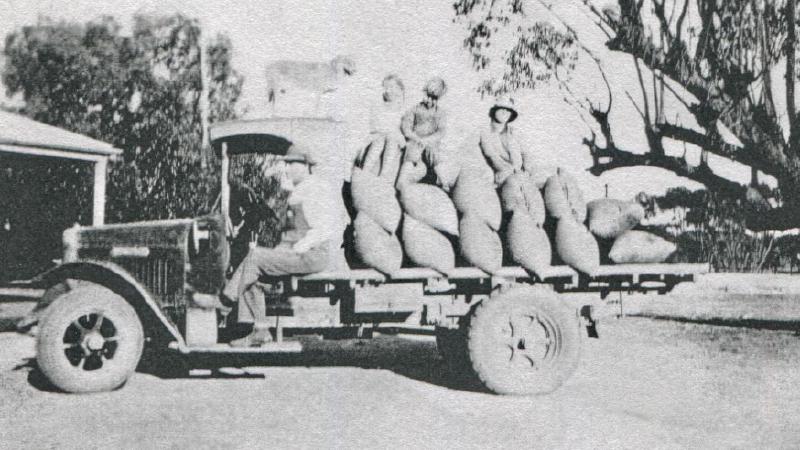
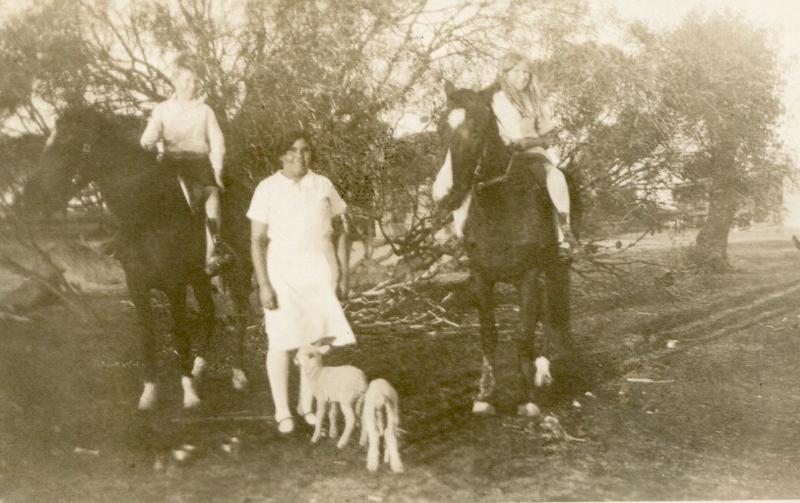
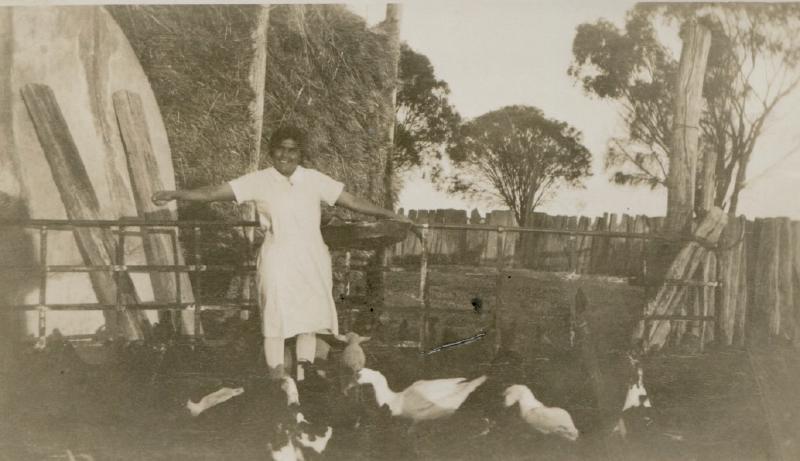
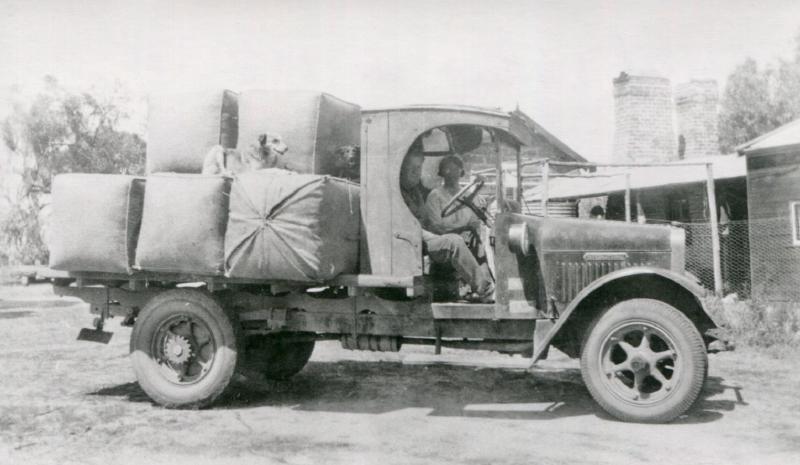
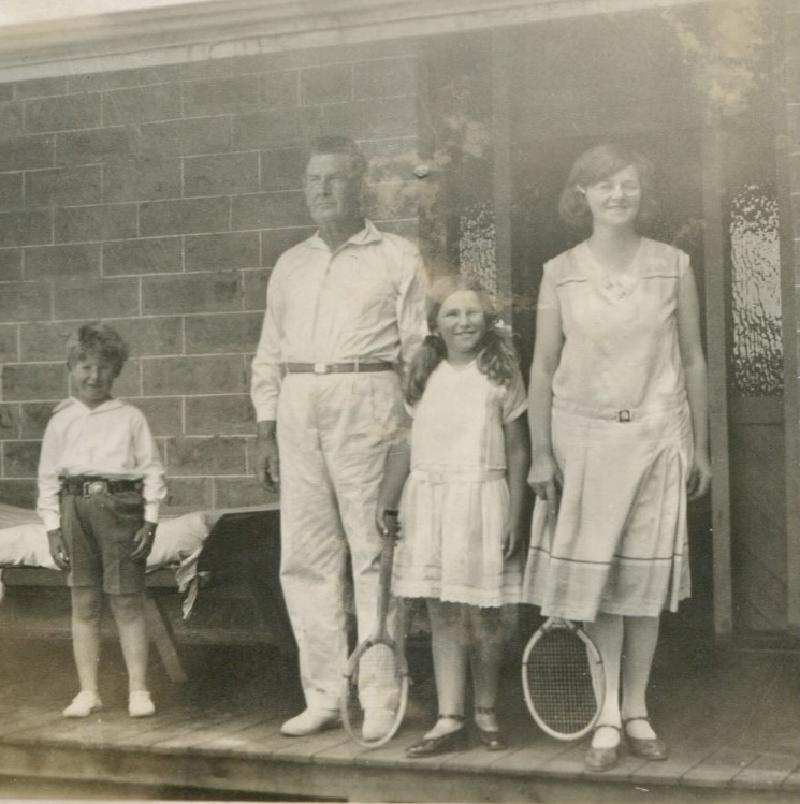
As indicated, they inherited an arrangement where the farm was the location of local sporting facilities. There were two clay tennis courts when Michael and Eily arrived, and soon after two more were constructed, of “ant-bed”.
The York Chronicle of 15 April 1932 tells us
The Spring Dallah tennis club were at home to the Doodenanning club on Sunday last. The weather was perfect and a very enjoyable time was spent by the players and spectators. After some very interesting and closely contested sets were played the home team proved victors by a narrow margin both in sets and games, the final scores being;— Spring Dallah, 22 sets 178 games; Doodenanning, 16 sets 168 games.
In October 1932 the York Chronicle tells us:
Great interest has been created in the district by the formation of a Tennis Association including the Balkuling, Rocky Gully, Doodenanning and Spring Dallah clubs. The first of a series of pennant matches was played between Spring Dallah and Doodenanning at the latter’s courts on Sunday, October 2nd and resulted in a win for Spring Dallah. A notable feature of the fixtures of the Association which was commended by Archdeacon Riley on his recent visit is the total avoidance of matches on Church Sundays. The next pennant match will take place on Sunday next at Rocky Gully between that club and Balkuling.
It was, presumably, acceptable to play tennis on Sundays when church was not scheduled.
There was also a golf course. The York Chronicle of 13 May 1938 tells us:
SPRING DALLAH GOLF CLUB
On Sunday the official opening of the above club took place at the Spring Dallah links. Mr. A. H. Fowler, the president of the club, extended a cordial welcome to the club members and the visitors to the links. He mentioned that some of the fairways had been recently graded and the greens attended to and expressed the hope that everybody would enjoy the afternoon’s game, which was to be a mixed foursome competition. Mr. Fowler announced that the Doodenanning Club would be officially opened on May 32 and that a hearty invitation had been extended to the members of the Spring Dallah Club to be present. He then asked Mr. H. L. Evans, of York, to officially open the club for the 1938 season. Mr. Evans expressed pleasure at the number of players present, which augured well for a successful season. He mentioned that the club was indeed indebted to Mr. M. J. O’Hanlon for making so much of his land available for the golf course. He wished the club and its members a very successful and enjoyable season and then declared the links open. A foursome competition of nine holes for the club’s trophy was then played, the event being won by Miss Marjorie Stubbs and Mr. Bill Thomas. A dainty afternoon tea was provided by the lady members.
The rifle club was no longer active. The tennis club and the golf club seemed to lapse during the war, and were not re-activated after the war.
The farm could not have made much money during the Depression years. On the other hand, hired help was not expensive. Eily could afford help in the house, as indicated in the above photos. Sheila tells us that Michael could hire workers for keep and £1 per week. You could not run a farm single-handed.
In fact he must have lost money on his first crop. This involved Michael representing himself in court, unsuccessfully, somewhat like his brother Patrick. The West Australian of 2 July 1931 tells us:
Merchants Sue Farmer.
An unusual case, of considerable interest to the farming community, engaged the attention of Mr. Justice Dwyer in the Supreme Court yesterday. when Bunge (Australia). Pty., Ltd., wheat merchants, brought a claim against Michael John O’Hanlon, farmer of Balkuling. Sir Walter James, K.C., with him Mr. N. P. Lappin (instructed by Messrs. Dwyer and Thomas), appeared for the plaintiffs, and the defendant conducted his own case. On the plaintiffs behalf it was set out that in December, 1929, the defendant had delivered to them a quantity of wheat (2,947 bushels), to be held in storage, the defendant being given an advance of 3/9 per bushel, the price of wheat at that time being well in excess of that figure. The defendant failed to sell his wheat before the price dropped lower than the amount of the advance, and when required to pay the difference, O’Hanlon undertook to deliver sufficient new season’s wheat to make up the deficiency. He failed to carry out this undertaking and the company, in accordance with its storage conditions, sold the wheat on December 31 last, at a price of 1/8 per bushel. It now claimed from the defendant the amount of the advance (£586, inclusive of interest), after crediting him with the sum realised on the sale (£245). Mr. Justice Dwyer listened patiently to a long address by the defendant, and when the latter made a reference to ‘business risk’ and to what he considered to be the motives of the company, his Honour sharply exclaimed, ‘Don’t talk rubbish; Mr. O’Hanlon - that sort of thing might be all very well for public meetings, but it won’t do here.’ His Honour put numerous questions to the defendant for the purpose of eliciting a definite statement as to the precise nature of the defence. O’Hanlon finally made it clear that the substance of his case was that the company had credited him for his consignment of 2,947 bushels; and that the company, though purporting to have sold at 1/8 per bushel on December 31 last, had, in fact, sold considerably earlier at a higher price; and he claimed to be allowed, as a credit, the average price received on sales throughout the season. He said that an oral agreement with the company’s agent at Balkuling, a Mr. Elliott, was the agreement on which the transaction was based, and he maintained that the whole case turned on this matter. “The later contract in writing respecting the storage was ultra vires,” he said, “as there was no mutuality and no conformity with the oral agreement which was the basis of the transaction.”
His Honour asked the defendant if he had any knowledge of the meaning of the legal phraseology he was using. On receiving O’Hanlon’s explanation of what he thought was meant by “ultra vires” and “mutuality,” his Honour said: “That is not what the terms mean at all, and I advise you to stick to plain English and words you understand.” When informed that random statements were useless, and that if he desired to substantiate his case he must call evidence, the defendant took the unorthodox course of calling the manager for this State of the plaintiff firm, Melville Smith. The witness said that at all material times the firm had had sufficient wheat at their disposal to re-deliver to the defendant all wheat stored by him. When pressed by the defendant for details as to how much wheat was held by the plaintiff firm in storage, and how much for outright sale on stated dates, the witness said that he was unable from memory, to give accurate answers. While the witness was in the box the defendant was repeatedly warned by his Honour that he must desist from making speeches, and must confine himself to direct examination of the witness. To his Honour, the witness said that he knew nothing about any sale of the defendant’s wheat by the company prior to December 31 last.
The defendant, in evidence. said that late in December, 1929, he asked the plaintiff company’s agent at Balkuling, Mr. Elliott, what were the terms on which the company received wheat in storage. Elliott replied that the company would provide free storage for 12 months, and that when this period expired a charge would be made of ¼d. per bushel per month. He said that, the company advanced 3/9 per bushel against wheat while in storage, until it was sold. Witness delivered 2,947 bushels of wheat to the company for storage. About two months later the agent’s daughter told witness, that she had the storage warrants, which she asked witness to sign. He did so, but did not peruse them at the time, as they purported to be merely receipts for the wheat delivered. A few months later witness examined the warrants and found that they set forth certain conditions. Witness considered he was not bound by these conditions, but he did nothing further in the matter until he received a letter from the company, to whom he then wrote undertaking to deliver new season’s wheat to make up a deficiency. There was much further correspondence between witness and the company; in January last he informed them, in effect, that they had sold the wheat without authority.
Cross-examined by Sir Walter James, whom he democratically styled ‘Mr. James,’ the witness said that he had not expected to be bound by any storage terms other than those mentioned in his oral agreement with the agent of the plaintiff firm. He relied entirely on the oral agreement. He admitted that this had related to storage charges only. Witness had not read the contract document when he received it; it was in the nature of a receipt or storage warrant and he signed it as a matter of course, and believing in its good faith. He had not checked the details as to the amounts of wheat, because he knew that if there had been a mistake it could be rectified later. Sir Walter: You sign receipts with a reckless disregard of consequences? — I did not think there would be any consequences. Then it appears that your receipts can never be relied on. Now as to the advances you received from the firm, what did you expect — that they would hold the wheat as long as you chose? — For a reasonable time. Your view now is that the firm had no right to sell the wheat until you gave the order? — Yes, that is my view. Irrespective of what the price of wheat might be?— Yes. His Honour (to the witness): Have you any reason to advance why you should not have repaid the firm the money lent to you ?— They repaid themselves by the sale of the wheat.
Delivering judgement for the plaintiffs, his Honour said that the question arose is to what should be allowed by way of deduction from the amount advanced by the firm to the defendant. The latter had not adopted a definite attitude in respect to the wheat which had been stored, and it had been impossible to bind him down. At one stage he had appeared to contend that he received credit for the amount, based on the wheat operations of the company in Western Australia, and later he had contended that there was no right to sell his wheat. As to the first contention, that he was entitled, to be allowed a sum based on the company’s operations, all that need be said was that there was no evidence to establish what was the average price obtained by the company for the sale of wheat. Even if there had been such evidence he (his Honour) would not have been prepared to act on the defendant’s contention. The defendant had raised the further points that his position was covered by oral agreement, under which there was no right to sell, and that this agreement was final, and that the written agreement made subsequently was not binding, and that there was no consideration for the contractual arrange ment. He (his Honour) would hold against the defendant on the contention that his position was covered by the oral agreement. The defendant: Can I have a word to say? His Honour: No. Proceeding, his Honour said that it was quite clear to him that the matter discussed with the plaintiff company’s agent was solely the question of storage, and not that of advances at all. Even if the question of advances had been discussed, and even if he (his Honour) could put such an interpretation on this fact as the defendant wished him to do, it would be impossible to hold that the subsequent written agreement was not binding on the defendant. His Honour attached no credence whatever to the defendant’s statement that he did not know the terms of the storage warrant and that he did not know what was oil the receipt when he signed it. The defendant was bound, he said, to comply with the terms of the agreement signed in August 1930, and the only question was how far the terms had been complied with. Probably the defendant’s wheat had been sold one day earlier than it should have been, but this was excusable in the circumstances, and at all events the defendant knew of the sale four days later. That way the date from which credit would be entered in his favour, and the sum of £12/10/ would be added to the credit allowed him by the plaintiff company on the claim. Direct judgement would be entered for the plaintiffs for £331/18/, with costs. The defendant: May I ask for a stay of proceedings? . His Honour: For what purpose? The defendant: So that I may consider the question of appeal. His Honour said that a stay would be granted on the usual terms that the defendant pay into Court forthwith the amount awarded the plaintiff company, with costs, and lodge notice of appeal within 14 days.
Michael was a victim of the Depression, and maybe he didn’t manage it as well as he might have. It seems that in December 1929 the wheat price was over 4/- a bushel, with the cost of production being about 3/6 a bushel. The price of wheat dropped by more than half through 1930, and the price Bunge got for Michael’s wheat in December 1930 was brutally low. It couldn’t be argued that it was not market value. Following the depreciation of the currency and Britain’s departure from the gold standard in late 1931, prices saw a temporary lift, with quotes reaching 3/4 to 3/9 per bushel in October/November before settling back to around 3/2 to 3/3 per bushel by late December 1931. So Michael’s wheat was sold, without his knowledge or agreement (but according to the contract), at the bottom of the market. He had to return a substantial amount to Bunge, in cash. Bunge operated legally, but exclusively in its own interest. It was ever thus. How he managed to find the cash has been lost in the mists of time. Banks would not have been helpful - they were reducing their loans as fast as they could. It seems that if he had taken the market price in December 1929 he would have at least broken even. Perhaps he was waiting for a better price.
In the event he survived. That area of the wheat-belt in WA had wetter years and drier years, with excellent crops and poor crops. But they never suffered drought where their crop failed completely.
The West Australian of 20 April 1937 tells us:
BALKULING, April 11.-The rainfall for March was 65 points, the total for the year being only 67 points. Rain is badly wanted now for the seeding, and many of the farmers’ rain water is very low.-Several Balkuling people went to Doodenanning on April 2 to a farewell social to Father Byrne, who is being transferred to Katanning, and also to welcome his successor, Father Cullen. On April 6 a number of farmers gathered at Mr. Aiken’s farm to see a demonstration of his new tractor. He and his son are both going in for power farming.-On April 9 a clearing sale was held at Spring Dallah, Mr. O’Hanlon’s farm, as he also has decided to use power on his farm.-A number of new farming machinery units have arrived this season.
The era of horse-drawn equipment on farms was coming to an end.
Michael bought a German-made Deutz diesel tractor. You can see a 1938 one-cylinder Deutz tractor (in a Tasmania-based collection) being started and driven in this YouTube video. Go to the 14:00 point of the video.
In the event, Michael’s particular tractor was a dud, and always breaking down. Sheila speaks of her father’s attachment to the machine, and his complete reluctance to cut his losses. Perhaps it was simply impossible to find a competent diesel mechanic in the Doodenanning environs.
In 1947 it was repaired by Kevill’s Auto in Quairading, and Michael disputed the bill. He was taken to court. This time he had the wit to engage a lawyer. It triggered a legal process that was to go for the best part of the next four years.
The Northam Advertiser of 19 November 1948 gave the basic details:
Claim by Garage
A PROTRACTED CASE
In the Northam local court on Wednesday, Mr K. H. Parker, S.M. continued the hearing of what promises to be a protracted case, in which W. G. Kevill, garage proprietor of Quairading, is claiming £138/7/1 for cost of repairs to a German Deutz tractor, from M. J. O’Hanlon, farmer of York. Defendant claims that the charge is excessive. He had offered £85/8/0 in settlement and this plaintiff refused to accept. Mr K. J. Mayberry, of Connor and Mayberry, Northam, is appearing for the plaintiff and defendant is represented by Mr T. J. Hughes, of Perth. The case was commenced in York on October 14 and adjourned to Northam. After occupying the whole day on Wednesday it was further adjourned to a date to be fixed.
The case started on 14 October 1948, then, over some £53. Judgement wasn’t determined until November 1949. It seems that Kevill’s bill was reduced to £97, which means that the difference was now some £12. The Northam Advertiser of 4 November 1949 tells us:
Protracted Case
JUDGEMENT FOR PLAINTIFF DEFENDANT TO APPEAL
In the Northam court on Monday, Mr. K. H. Parker, S.M., gave judgement for plaintiff in a case which had occupied some twelve days of hearing spread over the past six months. W. G. Kevill, garage proprietor of Quairading claimed £138/7/1 for work done in overhauling a tractor, the property of M. J. O’Hanlon, of Spring Dallah, Doodenanning. Defendant had paid £85 into court. Judgement was given for £97/16/8 and on the application of Mr. T. J. Hughes, of Perth, for defendant, a stay of proceedings for 21 days was granted, Mr. Hughes advising that there would be an appeal. Mr. K. J. Mayberry appeared for plaintiff.
Instead of letting it go and cutting his losses, Michael pressed on with the appeal. In the event the appeal failed. The West Australian of 17 May 1950 reported:
APPEAL CASE DISMISSED. Cost Of Tractor’s Overhaul
A decision by Mr. H. R. Parker, S.M., in the York Local Court on October 31 was the subject of an unsuccessful appeal yesterday to the Full Court-the Chief Justice (Sir John Dwyer) and Mr. Justice Walker- by Michael John O’Hanlon, a Balkuling farmer, the respondent being William Glanville Kevill, garage and engineering shop proprietor, of Quairading. The case before the magistrate was a claim by Kevill against O’Hanlon for £138/7/1 for work done and materials supplied in the course of overhauling O’Hanlon’s German-made tractor. Kevill was awarded a £97/16/8, with costs.
Yesterday’s appeal against this decision was based on the grounds that the magistrate, having rejected evidence submitted by Kevill in support of his case, should have dismissed the claim; that he misdirected himself as to the onus of proof resting on Kevill; that he misdirected himself in deciding to fill in the gaps in the evidence of one of O’Hanlon’s witnesses, George Meredith, motor mechanic, of Greenhills, and in any way founding any part of his judgement otherwise than on the evidence submitted; that he was in error in holding that Meredith was not expert, qualified and independent; that he was in error in finding that Meredith was in competition with Kevill and having done work for him in the past no doubt expected to do more in the future, there being no evidence to support such a finding; that there was no evidence to support the magistrate’s finding whereby he added 25 per cent to Meredith’s estimate of Kevill’s working hours on the Job in question; that the magistrate was in error in allowing a rate of 7/- per hour for all work done by Kevill, this fact being contrary to the evidence; that his finding allowing £54/15/8 for parts supplied by Kevill could not be supported by the evidence; and that in view of rejection of evidence tendered by Kevill in support of his claim the magistrate was in error, and did not exercise his discretion Judicially in allowing Kevill the costs of the claim.
After hearing advocacy by Mr. T. J. Rushes (for the appellant) and Mr. T. R. Ambrose (for the respondent), the court dismissed the appeal, with costs. The Chief Justice said that the magistrate, after going into the case very exhaustively, had come to a conclusion for which, on the evidence there was abundant justification indeed, in the appellate court’s opinion his final assessment of the hours worked by Kevill might well have been somewhat higher than his assessment actually was.
The appeal turned on assertions of failings by the magistrate - the High Court judges were going to be reluctant to make such findings.
Further developments were to follow. The West Australian of 18 December 1950 reported:
CHARGES OF PERJURY Woman And Six Men Arrested
NORTHAM, Dec. 17: At Quairading tonight, Det. P. G. Lee, of the Northam C.I.B., and Constable J. F. Trainor, of Quairading, arrested six men and a woman on perjury charges. Those arrested were William Glanville Kevill (44); Iris Lilian Myrtle Parker, clerk; Ned William Tonkin (30), mechanic; David William James Chandler (23), mechanic; Ira Ralph Kevill (43); contractor; Herbert Kenneth Carson (31 mechanic; and George Alfred Green (35), mechanic. They will appear in the Quairading Police Court tomorrow morning. The perjury charges relate to a civil action between W. G. Kevill, garage proprietor, of Quairading, and a Balkuling farmer named M. J. O’Hanlon. The action took place in the Local Courts of York and Northam in October and November, 1948, and on May 30 and 31, 1949. The accused were all released on bail.
Only the first two were sent for trial by jury, which was reported here. In the end, in March 1951 they were both acquitted here and here.
After training as a teacher, Sheila was living at home from 1942, and teaching at the local Doodenanning school. She married Frank O’Hare in early 1944, and they lived on the farm. Michael had applied to have Frank “man-powered out of the AIF”, to help work the farm. The arrangement applied until early 1948, when Frank and Sheila acquired a farm under a War Service allocation, and moved to “Nangunia” just north of Quairading.
The History of Doodenanning tells us:
In 1950 Mr and Mrs O’Hanlon built a house in Quairading where they lived until Mr O’Hanlon’s death in 1958. From 1950 Mr O’Hanlon let the farm to share-farmers - Tom Waters, Bill Overton and Bert Fowler. After his death “Spring Dallah” was bought by Jim Weeks and managed by Eric Lloyd until Jim’s death. Jim Weeks built a new house on the farm, as salt had become quite bad near the original house.
Eily died in 1956, and Michael died in 1958. The final will presumably left the Quairading house and the Doodenanning farm jointly to Sheila and Richard. They chose to auction “Spring Dallah”. Sheila speaks of wheat prices being low at the time, and the farm being sold for somewhat of a bargain price. Trove has digitised the local papers only up to 1954, and we cannot see any of the details of the sale.
Edward George O’Hanlon (1874-1932)#
We have an obituary, from the Dubbo Liberal and Macquarie Advocate of 10 December 1932:
OLD DUBBOITE GONE
E. G. O’HANLON
Mr. Edward George O’Hanlon, who died suddenly at St. Kilda private hospital on Saturday night, was a member of a well known Kotupna family, being the second son of the late Mr. and Mrs. T. O’Hanlon who were among the earliest settlers in that locality. The late Mr O’Hanlon, who was 54 years of age, was a native of Bendigo, but at an early age came to Kotupna, where the greater part of his life was spent. Possessing a genial personality, as well as being a musician and vocalist of some merit, he made a host of friends. Some 25 years ago he left Kotupna, where he had been engaged in farming, for Dubbo, where he entered into a stock and station business in which he retained an interest up to the time of his death. Some years later the firm decided to open a Melbourne branch, which he managed, and later bought, and latterly he had been the sole proprietor of the stock and station agency known as J. L. Jeffers and Co., of Bourke Street, Melbourne.
He is survived by two brothers and three sisters, viz. Messrs. P. D. K. O’Hanlon, Kotupna, M. J. O’Hanlon, West Australia, Miss M. O’Hanlon, St. Kilda, Mrs. Stevens, Gladesville, N.S.W,, and Mrs. Galligan, Mosman, N.S.W. The remains were interred in the Nathalia cemetery. The Rev. Father Cremmens read the burial service.
Uncle Eddie’s Will#
For perhaps 40 years after I entered the O’Hare family, a running saga was “Uncle Eddie’s will”. Eddie was the uncle of Sheila (Kerry’s mother), and had long since been dead. An annuity had come to Sheila since she was a young woman, and had gone on for close to seventy years. Sometime around 2005, the Trustees of this arrangement suggested that that it be wound up, and Sheila and the other recipients agreed in some fashion to forego their inheritance. The next generation received a cash payout of some $1700 each.
It is clear that “Uncle Eddie” is indeed Edward George O’Hanlon, and that he died a bachelor, with some wealth from his business. We do not have a copy of the will, but the following report in the Herald of 24 October 1933 provides some details:
ESTATE FALLS IN VALUE. LAND AGENT’S WILL.
Depreciation in the value of the estate of Edward George O’Hanlon, late of Bourke Street, Melbourne, land and estate agent, led to a difficulty in the administration of his estate, which was referred to the Acting Chief Justice (Sir Frederick Mann) in the Practice Court today. O’Hanlon died on November 5, 1932, and, when he made his will June 27, 1930, he believed that his property was worth from £13,000 to £15,000. He bequeathed £1000 each to five nephews and nieces and made gifts and annuities which require the setting aside of £160 a year. Today, O’Hanlon’s estate is valued at £4800, and the annual income is £180. Being unable to give effect to all the provisions of the will, the executor (The Perpetual Trustees, Executors and Agency Co.) decided to seek a direction from the Supreme Court as to what should be done in the circumstances. Mr. C. H. A. Eager (instructed by Messrs Luke Murphy and Co.) appeared for the executor, and the beneficiaries were represented by Mr. A. C. Morley (instructed by Messrs Fitzgerald and Fitzgerald), Mr T. S. Clyne (instructed by Mr Bernard Nolan), and Mr O. Gillard (instructed by Mr Vincent Nolan).
Mr Eager stated that the question for determination was whether the executor should pay, in full, all such annuities as were immediately payable, without regard to the possibility that the estate would be insufficient to pay all annuities and legacies which might hereafter become payable. There was sufficient money, in the estate, he said, to pay all present demands upon it , but it was difficult, if not impossible, to put a value upon all contingencies provided for by O’Hanlon in his will, and to make reservations for all these contingencies.
COURT’S DECISION
The judge decided that £10 a year bequeathed to the parish priest at St. Francis’s Church, Melbourne, for 21 years, should be paid in full until it appeared certain that the estate would not be sufficient to meet all demands upon it. The same direction, he said, applied to an annuity of £150 to Maureen Duff. No special provision need be made for any contingent legacies or annuities hereafter payable, except the reservation, by the executor, of the whole of the estate not required for payment of the annuities immediately payable. No portion of the surplus income of the estate should be paid out to the nephews and nieces until it was clear that there would be a residue available for them.
That little finding would not have come cheaply, with the various barristers and solicitors involved. The report refers to five nephews and nieces, but does not name them. Some more information is provided by the catalogue entry in the Public Records Office of Victoria. The defendants in the case are identified as:
Maureen Duff, Helena Galligan, Maria OHanlon, Theodore Stevens, Maxwell Stevens, Jocelyn Maria Stevens, Sheila Marie OHanlon, Richard OHanlon, Henri Lachance
The record seems silent about the identity of Maureen Duff - she may have been a long-serving employee of his firm. Helena Galligan and Maria O’Hanlon are Edward’s sisters (neither of whom had children) and must have been nominated for a bequest. The next five are nieces and nephews (children of his sister Elizabeth and his brother Michael), and are in the family tree above. In order, they died in 1984, 1992, 2014, 2019 and 1982. In particular, Sheila outlived Uncle Eddie by 87 years.
The last, Henri Lachance, was the priest in charge of St. Francis’ Church. From its website:
In 1929, St Francis’ Church became a Eucharistic shrine in the pastoral care of the Blessed Sacrament Congregation of priests and brothers, members of the French (now international) religious institute founded by St Peter Julian Eymard (1811-1868).
At the invitation of Melbourne’s Archbishop Daniel Mannix (1864-1963), the Congregation initially posted five priests and two brothers to St Francis’ from the United States and Canada. The pioneer group, led by 44-year-old French Canadian Fr Henri Lachance (1885-1963), arrived at St Francis’ on All Saints’ Day in 1929.
Almost from that moment, St Francis’ Church began to be transformed by the culture of Eucharistic devotion that the Congregation transplanted to Melbourne. Exposition and perpetual adoration brought people into the church during the day. The number of masses increased and demand for confessions was sometimes overwhelming.
It may be that Edward George had a serious religious bent. We are also told:
In 1949, a seriously ill Melbourne woman experienced a spontaneous and complete recovery from an incurable heart condition after a novena of prayers at St Francis’ Church requesting the intercession of the Congregation’s founder. Her cure was ultimately accepted by the Catholic Church as a miracle – the first in Australia to be accepted by the Church – and its authentication led to Eymard’s canonisation as a saint in 1962.
It is not every family narrative that can reference (albeit indirectly) a genuine accepted miracle and a genuine canonised saint!
Patrick Dennis Kavanagh O’Hanlon (1873-1943)#
When he died in 1943 the Age of 18 September 1943 reported a simple death notice.
O’HANLON. On September 15, at Kotupna (suddenly). Patrick Dennis Kavanagh, eldest son of the late T. and M. A..O’Hanlon, beloved brother of Edward (deceased). Michael (W.A.), Cissle (deceased), Marie, Elizabeth (Mrs. Stevens, Sydney). Helena (Mrs. Galligan, Sydney). R.I.P.
I have the following obituary from the Nathalia Herald of 21 September 1943, taken from a photocopy somehow acquired by Sheila O’Hare. Only the years 1925-1929 have been digitised by Trove.
Obituary.
Cr. P.D.K. O’Hanlon
The news that Cr. Patrick Denis Kavanagh O’Hanlon had died suddenly at his residence, Kotupna, on Wednesday afternoon came as a shock to district residents, as only the previous day he had been in Nathalia apparently in good health. As far as is known, the last person to see Mr. O’Hanlon alive was Mr. Albert Rathbone, of Kotupna, who called at his residence at about 1:30 pm on Wednesday on his way onto Nathalia to deliver some eggs that Mr. O’Hanlon had ordered on the previous day. At that time, Mr. O’Hanlon was well and cheerful. Returning to Kotupna in the evening shortly after five o’clock Mr. Rathbone noticed that Mr. O’Hanlon was lying on the ground near a gig, and on investigating found that he was dead. Indications were that Mr. O’Hanlon had loaded up his gig preparatory to driving into Nathalia and had collapsed and died when about to harness up the horse.
The eldest son of the late Mr. and Mrs. Timothy O’Hanlon, who selected land at Kotupna in 1880, Mr. O’Hanlon was born at Kangaroo Flat in 1877. He was elected to the Numurkah shire council as one of the Moira riding councillors in 1899, and with the exception of two short breaks had been a member of the council ever since, being president in 1904 and again in 1936. Throughout his long municipal life he took a leading part in furthering many progressive moves, and it was largely through his advocacy that the Murray Valley Highway took its present route through the shire. He was a member of the executive of the Goulburn Valley and North-Eastern Council Development Association at the time of his death, and was widely known in municipal circles throughout the State. While he made municipal work his hobby, he took a leading part in many district organisations and for a long period was the Nathalia Agricultural Society’s representative on the Chamber of Agriculture. He twice unsuccessfully sought to enter parliament, in 1936 contesting the Federal seat of Echuca as a Labor candidate, and on the retirement of the late Colonel Bourchier from the State Parliament was a candidate for the Goulburn Valley seat as a Country Party representative.
He leaves three sisters and a brother, Mrs. Stevens and Mrs. Galligan, both of Sydney, Miss M. O’Hanlon, Melbourne, and Mr. Michael O’Hanlon, Western Australia.
The Numurkah Leader of 21 September 1943 printed an obituary, but the page was incompletely scanned and we only have the following:
The death occurred suddenly at his home at Kotupna on Wednesday of Mr Patrick Denis Kavanagh O’Hanlon, who was well known throughout the shire and many parts of Victoria by reason of his public activities. The late Mr. O’Hanlon, who was 67 years of age, as a boy interested himself in debating societies, and when about 23 years of age entered the Numurkah Shire Council in 1890. He had represented the Moira Riding since, excepting for two intervals — once when he took up agency work in Queensland for a Victorian ..
If those dates are correct he was born in about 1876. This is inconsistent with the fact that he is usually listed as the first-born of the children. I have been unsuccessful in finding a birth record for him.
In 1936 he stood for State Parliament, and the Numurkah Leader of 1 September 1936 provided a candidate profile, which can serve as a partial obituary. Although this would have been substantially written by Patrick himself, it is nonetheless interesting.
Brief Resume of Candidates’ Activities.
Cr F. D. K. O’Hanlon, of Nathalia, who is a candidate for the Goulburn Valley seat, has led an active public life. As a youth in his native district of Kotupna he took part in public debates, and just after attaining his majority entered the Numurkah Shire Council, of he was President when aged 28 years, and which position he holds now, having been elected to the office for a second time nearly 12 months ago. He has led a very active public life, and has become one of the best known men in the shire. His work in connection with the Loch Garry flood protection scheme has had the effect of inducing the Commission to inquire into the claims of landholders in the district that the rates they have been called upon to pay should be rebated, and there is every hope that some relief will be granted. Cr O’Hanlon has represented the council at many important conferences, and at the moment is working in the direction of having a health inspector appointed conjointly with other shires. At the same time he is anxiously striving to have a rest room erected at Nathalia for the convenience of women travellers and district residents. He is a vice-President of the Nathalia branch of the U.C.P., and a past President of the Nathalia Agricultural Society whose representative he is on the Chamber of Agriculture. He is a member of the Baulkamaugh tent of the I.O.R. During his term as shire President he gave over 500 trees to schools, churches, and other bodies in order to encourage the growing and care of flora, in which subject he is deeply interested. He is a keen adherent of the policy laid down by the Country Roads Board, and in this connection has been successful in securing privileges for the shire, the portion of the Murray Valley highway that runs through portion of the Nathalia district having been strongly advocated by him. Recently he interested himself in the establishment of a forest camp for youths at the Barmah forest, and it is likely that as a result of his efforts many lads who might otherwise find themselves at a “dead end” will be usefully employed. Cr O’Hanlon has carried out his duties as shire President most conscientiously. He has attended many public functions, such as flower shows, and has not missed an opportunity of tendering civic welcomes to visitors of distinction, while he has been very ready to assist all religious bodies. He has lived in the Kotupna district for about 50 years, during which time he has engaged in farming and grazing, and has also been in business as a general agent. By virtue of his office of shire President he was sworn in a few weeks ago as a justice of the peace. He has devoted little or no time to sport, his whole attention being given to more serious matters, but while not participating in games, he has encouraged football, cricket, and tennis clubs by accepting office and by giving trophies, the games of bowls and croquet also benefiting in this way.
Note: The U C P is the United Country Party. The I O R is the Independent Order of Rechabites.
It seems that Patrick always escalated a situation, and then went to court as a response. An example is provided by the Nathalia Herald and Picola, Narioka, Kotupna and Moira Advertiser of1 March 1900. The reporter must have enjoyed writing it up.
O’HANLON v. JENKINS. A Kotupna Assault Case.
At Nathalia. Court of Petty Sessions last Thursday, before Messrs. F. H. Furze and E. Richardson, Js.P., Ogmore Jenkins and John Jenkins (brothers) were charged with unlawfully assaulting Edward George O’Hanlon at Kotupna on 9th February. The parties are neighbors residing on adjoining farms. Mr. Morrissy appeared for the complainant, and Mr. Johnson for defendants, who pleaded not guilty. At the outset Mr. Morrissy offered to withdraw the charges if defendants would apologise and pay the costs. This offer was not accepted by the defendants, and complainant then proceeded to state his case.
Edward George O’Hanlon, residing at Kotupna, stated that on the 9th February he was watering some stock at the Deep Creek when he heard some voices in angry altercation proceeding from the bed of the creek. Upon going to see what was wrong witness saw his own brother, Patrick D. K. O’Hanlon, and the defendant, Ogmore Jenkins, each trying to drive a pig up the bank. Witness called out, “What’s all this about ?” Patrick O’Hanlon replied, “Jenkins has shot two of our pigs and now wants to take this sow home to shoot her also.” Patrick O’Hanlon then started to drive the sow up the bank towards his home. Ogmore Jenkins said, “Our boar’s at your place, in your stable, and Pat says he won’t let us have it before we pay £5.” Witness went down to assist his brother drive the sow up the bank. He also said to Jenkins " You’d better go home while you are happy.” Ogmore Jenkins rushed at witness and said, “I’ll kill this —— sow or I’ll kill you.” Just then witness heard a noise behind him and looked round in time to dodge a blow aimed at him by the other defendant, John Jenkins, who had arrived on the scene with a stick. Ogmore Jenkins then struck witness with a stick and witness fell on to his knees, the blood gushing out of a wound in his head, and saturating his clothing. Patrick O’Hanlon who had been driving the sow home then rushed back and attacked the Jenkins with his stockwhip. After this witness and his brother went home and the two defendants did likewise. Subsequently witness went across to Jenkins house and asked them why they had struck him. Ogmore Jenkins said, " You are the only man among the O’Hanlon’s.” Witness then came into Nathalia and had the wound dressed by Dr. Mathwin.
Patrick D. K O’Hanlon, brother of last witness, deposed that on the 9th February he went to Jenkins to get some pigs which had strayed over there. Witness carried a whip to drive the pigs. Heard some shooting and meeting Ogmore Jenkins said to him, “Who’s firing?” He replied, “Jack is shooting your pigs, father told him to.” Witness next saw John Jenkins with a gun; who said he had potted two. Witness went down to the dam. Ogmore Jenkins rode up on horseback. Witness said, “You’e funny sort of neighbors, whenever our pigs or stock get into your place you impound or shoot them.” Ogmore Jenkins replied, “That’s the best way for us to live.” Witness retorted. “That’s the way you fellows have lived ever since you came here.” Ogmore Jenkins said “Oh, you’re easily upset.” Witness then proceeded to drive the pigs home and Ogmore Jenkins rode away ; he returned shortly afterwards, and said “Do you know where our boar is?” Witness said, “Yes he’s at my place but you won’t get him without my permission.” He said he would and rode off to witness’ place. Witness ran over also and got there soon. Told Ogmore Jenkins that before he got the boar back he would have to pay £5. He replied, “I will go and get my gun and shoot one of your sows that’s in our stubble paddock.” He singled out a sow, which was heavy in young — one of the lot of pigs which witness had been driving home from the dam — and said he would take her home and shoot her. He rode his horse at witness and said, “Clear home, or I’ll do for the pig and you too.” Witness replied, " I’ll die in the last ditch before you shall have the pig." Witness saw that Ogmore Jenkins was not frightened of him a little bit. He commenced to try and drive the sow one way and witness tried to drive her another. They were then in the bed of the creek. The sow could not get up the bank. Ogmore Jenkins struck at witness with a stick across the pig. He also beat the sow unmercifully, causing her to bleed. He said he would like to “have a go” at witness and “spoil my pretty nose.” He broke one stick beating the sow, and picked up another stick, and said to witness “Fancy a fellow like you being a councillor.” Just then witness’ brother Edward came along and said, " What’s up ? " Witness said, “Jenkins has shot two of our pigs and Ogmore wants to take this sow home and shoot her too.” Edward said to Jenkins, “Leave the pig alone and go home,” but he said to Edward, " I’ll do for the pig and you too ." Whilst they were arguing witness drove the sow up the bank towards home. John Jenkins then came up and appeared to be making a rush at Edward O’Hanlon. Then Ogmore Jenkins struck Edward a blow on the head with a heavy stick, Edward sank down and called out, “Come here, Pat.” Both defendants were standing over Edward hitting him with their fists and sticks. Witness ran up and plied his stockwhip about Ogmore Jenkins, who ran away. John Jenkins seized the whip and said, “You hit me with that whip if you dare.” Then he cleared too. Witness’ brother never struck either of the Jenkins’. Subsequently his brother went over to Jenkins’ house to show Ogmore the wound which, he had inflicted. Witness saw that Mr. Jenkins, senr., and his two sons were there, and as there was three to one he went over and joined his brother. Edward said to Ogmore Jenkins, “What did you hit me for?” The father said, “Good enough for you. You’ll find them tough little fellows.” Witness induced his brother to come away. He was saturated with blood, from his head down to his boots. After that he brought his brother in to see Dr. Mathwin.
(Cross-examination and other witnesses omitted.)
The Chairman (Mr. Furze) said the Bench considered such a quarrel between neighbors most unfortunate. It was an illustration of the old saying that “bad fences make bad neighbors.” Trespass of stock however was no excuse for personal assault. Each defendant would be fined £1, and the costs, £2 7s., would be equally divided. Distress to issue in default of payment.
The Leader of 22 May 1909 reported:
Messrs. Powers, Rutherford and Co. (in conjunction with Muntz Bros, and Heighway) report the sale by public auction of Mr. P. D. K. O’Hanlon’s farm at Kotupna, comprising 631 acres, at £4 10/ per acre.
[To be completed]
The Sisters#
Honora Cecelia died in 1894, at the age of 15. From the suggestion of several of Michael’s poems it seems that she might have died of fever, in a protracted and tragic fashion.
Marie died a spinster in 1966, aged about 87. She nursed he mother in her last years, and perhaps lived in the family home in St Kilda until the end.
The Argus of 31 May 1919 carried the following advertisement:
LADY, underclothing specialist, makes dainty underwear, trousseaux, hand embroidery; materials made up. Theresa, 16 Lindsay avenue, St Kilda. Windsor 3377.
Elizabeth Frances was a nurse, and her military record shows she joined up in December 1916. She was sent to India later that month, and arrived in Bombay in January 1917. On 1 January 1919 she married Arthur Raphael Steven at St Patrick’s Cathedral in Bangalore. Arthur seems to have been a medical doctor in the British Army, and trained at Glasgow University. She resigned her appointment in May 1919, and left for Australia on 1 December 1919 “with infant”, who I take to be Theodore Michael Steven.
The Advocate of 5 July 1919 rather belatedly tells us:
STEVENS—O’HANLON.—On 1st January, 1919, at St. Patrick’s Cathedral, Bangalore, India, by the Rev. Fr. Gabard, Captain (Dr.) Arthur Stevens, R.A.M.C., son of Mr. and Mrs. A. Stevens, Edinburgh, Scotland, to Elizabeth Frances (nurse A.I.F.) O’Hanlon, third eldest daughter of Mrs. M. A. O’Hanlon, St Kilda, and the late Mr. T. O’Hanlon, Nathalia.
Dr Steven followed them to Australia. He was registered to practice on 9 February 1921. They lived for some time in Gladesville, Sydney, and had two more children. It would seem they eventually separated. Arthur moved to Queensland, and then to Melbourne. Elizabeth died in Sydney, in 1959.
Helena Josephine married Michael Galligan in St Kilda in 1917. They lived in Sydney. They do not seem to have had any children.
Parent Generation#
Sheila Mary O’Hanlon (1920-2019)#
Sheila O’Hanlon was born at Elwood, Melbourne, in 1920, the first child of Michael and Eily O’Hanlon. The family lived a comfortable middle-class life in Elwood until mid 1929, when financial issues led them to take up farming at “Spring Dallah”, Balkuling, WA. She married Francis (Frank) O’Hare in 1944, and in 1948 they moved to “Nangunia”, Quairading, WA. They had four children. Frank was killed in a farm accident in late 1971. Sheila died in 2019, aged 98, after being a widow for 47 years.
She was a keen chronicler of her family history, and her efforts were not fully appreciated at the time. She worked before Trove was available, before the modern on-line records were available, and before one could have computers draw nice family trees. She summarised her work in an audio record made for her family. This was recorded on two cassette tapes in 1983 and 1985. The following provides a digital version of her recording. The digitisation is rather low quality, and the first 15 minutes of the fourth side is missing. (I will endeavour to provide a better quality version.)
| part | audio |
|---|---|
| part one | |
| part two | |
| part three | |
| part four |
Sheila relates her early childhood in Elwood as being happy and even indulged.
Her mother, Eily, had three sisters and two brothers in Melbourne and hence she and her brother Richard had a number of cousins. We have several photographs from this time.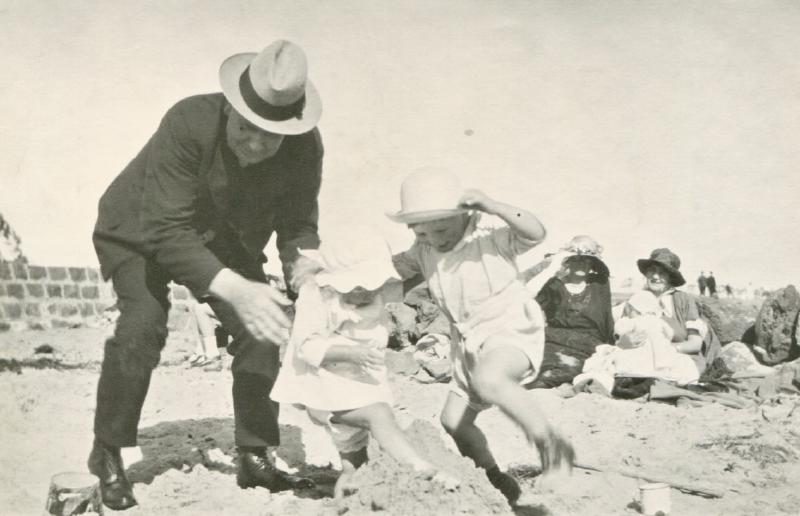
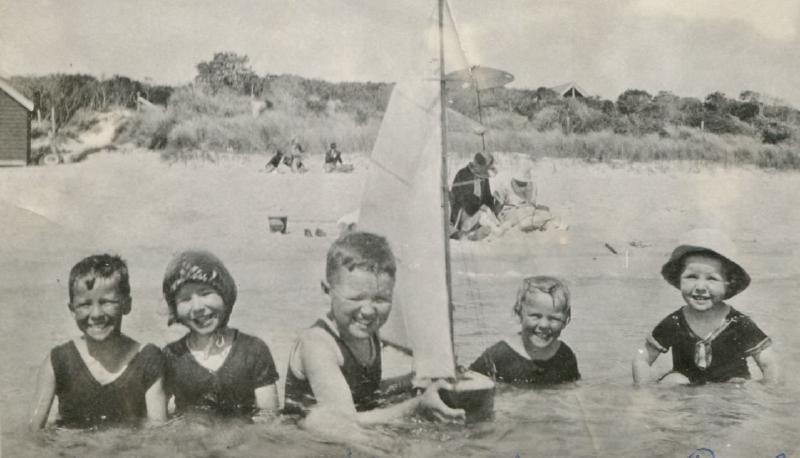
Sheila and Richard started school at St Columba’s Primary School, at the end of the street they lived in.
When the family arrived at “Spring Dallah” in August 1929, Sheila and Richard were home-schooled for the rest of 1929 and all of 1930. She notes that correspondence lessons arrived from Perth every two weeks The lesson sets were completed and returned to the Education Department for scrutiny. As both Sheila and Richard were bright, the sets were completed quite quickly and school-free days ensued.
Newspapers at the time encouraged children to enrol in a “club”, and to submit letters for the novelty of seeing their name in print. From the Western Mail of 25 December 1930:
KILLED FIVE SNAKES.
Spring Dallah, Doodenanning, via Balkuling.
Dear Aunt Mary, It is so long since I have written to you that I suppose you think I have forgotten you. We have finished hay cutting, and are now carting the hay to the shed. We were hay cutting up at the other end of the farm this year, and dad and the men took their lunch up there every day. One day Dick and I went with them, and while in the crop we saw a ginger rabbit, a brush kangaroo and a wild cat with two kittens. A few days later dad came home with a big kangaroo which he had caught by the tail while one of the men killed it. The kangaroo could not use its hind legs, as it had been shot and was just recovering. We have killed five snakes this year. The last was a tiger snake. I hope to see this letter in print.
I remain, your loving niece. SHEILA O’HANLON. B.B.
I always feel sad when I hear of poor old kangaroos being shot, don’t you, Sheila. It was really good that your father was able to put out of its misery one whose hind legs were useless.
AUNT MARY.
Country people had it in for snakes. In her nineties, when she was resident at a nursing home “Parker House” in Quairading, Sheila discovered a snake in her en-suite bathroom. Stout-hearted countrywoman that she was, she beat it to death with her walking stick.
In 1930 ponies were bought and the children learned to ride. Come 1931 they rode their ponies to the one-teacher Doodenanning School, some 8 km away. Sheila relates that the school attendance was 14, including three sets of twins. It seems Sheila attended Doodenanning School for 1931-1932, while Richard attended 1931-1935.
In November 1932 Sheila was awarded a secondary school scholarship. There seems to be 50 such scholarships awarded each year, with 10 “reserved” for children at small country schools. A scholarship provided free attendance at a government high school or at one of nominated list of private schools, £3 a year book allowance and £24 a year boarding allowance, if relevant. Who knows how much of the actual cost this covered, but it was certainly better than nothing. For country families of average means, it was perhaps the only avenue of secondary education for their children.
In the event, Sheila attended the Sacred Heart High School, Highgate, as a boarder for the five years 1933-1937. We have a photograph of her in her final year.
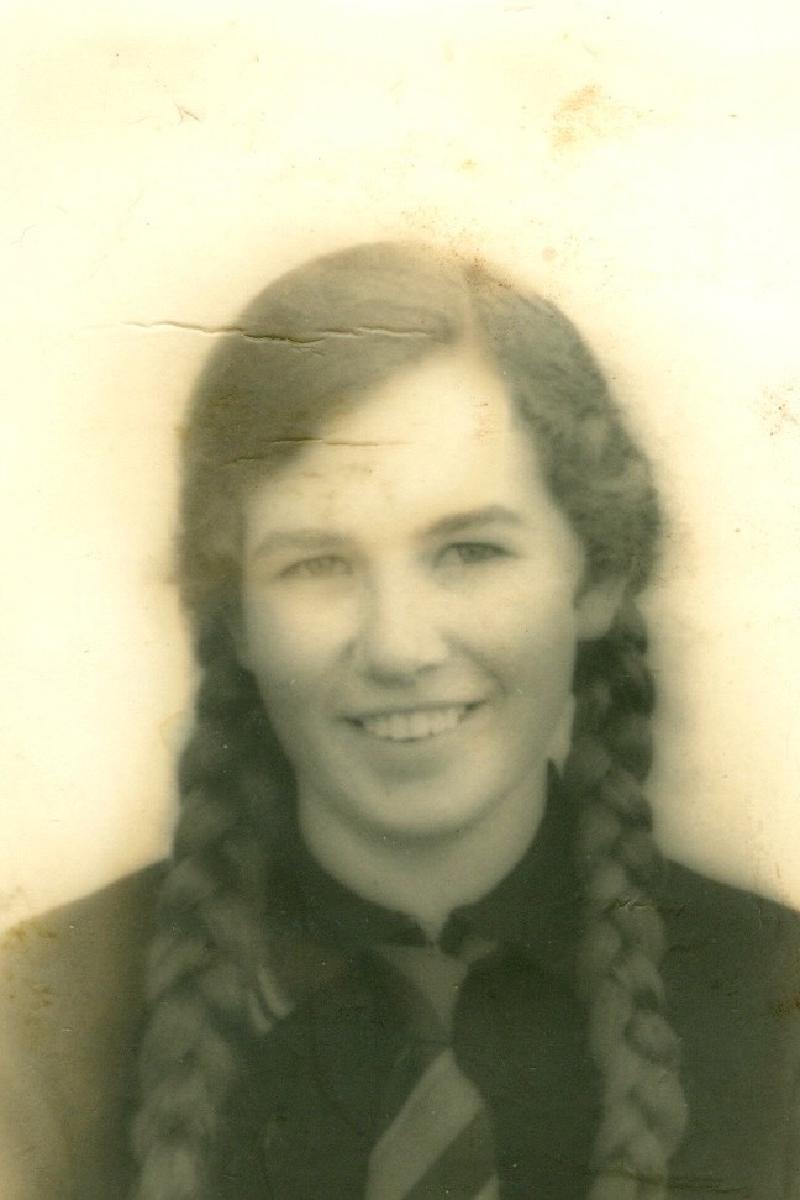
The year 1938 she spent at home, on the farm. There was a very close bond between Eily and Sheila, and it would seem that being away at boarding school for five years had been hard on them both. During the year Sheila “made her debut”.
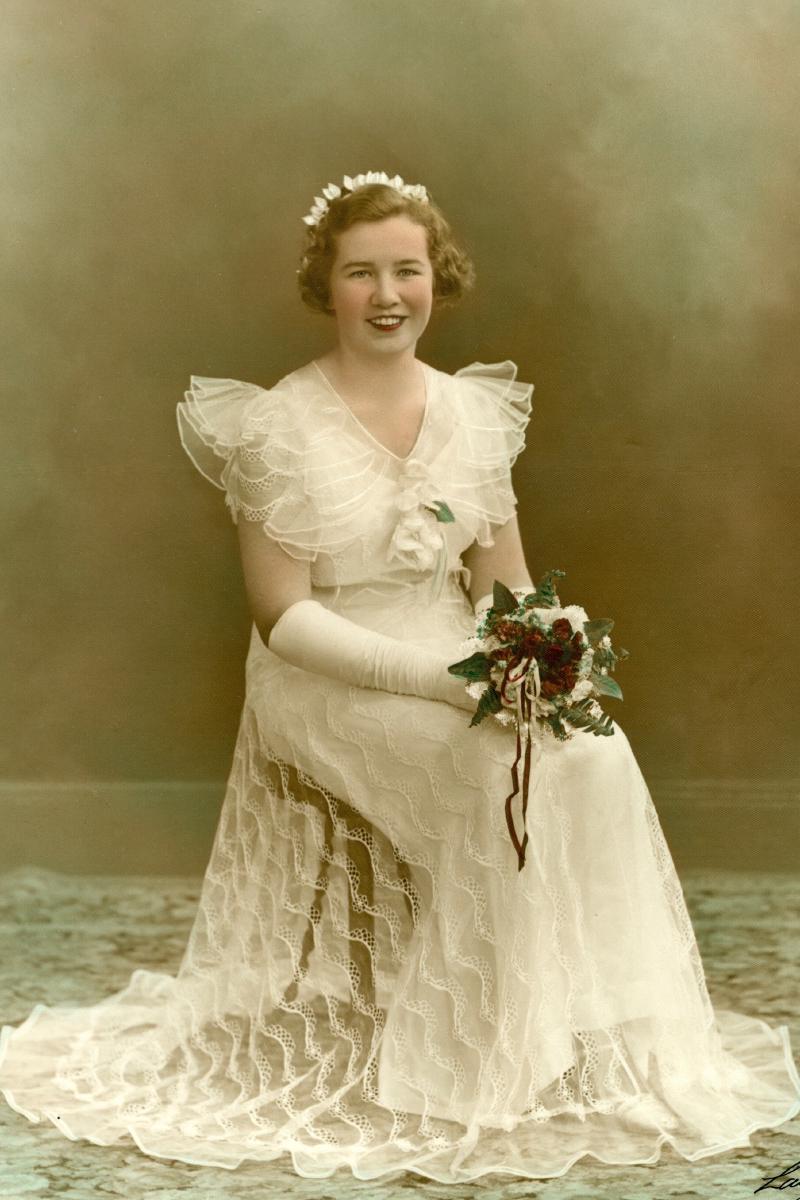
The Sunday Times of 7 August 1938 tells us:
THE Sacred Heart High School Old Girls’ Association held their ninth annual ball at Government House Ballroom on Wednesday. Twelve debutantes made their bow to the Archbishop of Perth, Dr. R. Prendiville, who with Rev. Father Winston and the Lord Mayor (Mr. C. Harper) and the Lady Mayoress (Miss S. Harper) were met on arrival by Miss May Holman. M.LA., the president of the association. The debutantes, who were preceded by two flower girls. Judith Green and Margaret Watt, who had been trained by Miss Mercia Scott, and after the presentation danced the valeta. Dainty youthful frocks were worn by the debs., and each carried a bouquet of red roses and white carnations, tied with red and white ribbon, to introduce the school colors. Those presented were Misses Nellie Gray, Peggy Stirk, Dorothy Hitch, Mollie Embleton, Beatrice Walker, Peg. O’Dea, Phyllis Coonan, Esther Brand, Sheila O’Hanlon, Patricia Southall, Mamie Callan and Mollie Branch. Miss Molly Wagner’s orchestra supplied the music, and vocal items were given by Miss Pat Wagner. Supper was served on tables decked with the school colors and adorned with almond blossom, peach blossom and Iceland poppies.
Sheila then pursued a teaching career. 1939 was spent as a monitor (teaching assistant) at the school at Mundijong, now an outer suburb of Perth. Her formal training consisted of a one-year course at Claremont Teachers College, which she did in 1940.
Being an employee of the WA Education Department, you had to go where you were sent. Her first assignment, in 1941, was to a school called Koondarni (spelling?) near Dumbleyung. Sheila mentions it at around 3:00 into part 2 of her audio. I have been unable to identify the actual location. In any event after six months she succeeded in being appointed to a one-teacher school at Bellakabella, some 8 km north of “Spring Dallah”, so she could live at home. Family legend has it that she rode a bicycle to and from school.
After eighteen months, Bellakabella school closed at the end of 1942 due to low enrolments, and Sheila was appointed to teach at her old school at Doodenanning. Both schools are shown here. As far as I can tell, “Spring Dallah” was to the south, along the Doodenanning-Mawson road. She taught there through 1943 and most of 1944. She married Frank O’Hare in January 1944, and gave birth to her first child, Kerry Patricia, in March 1945.
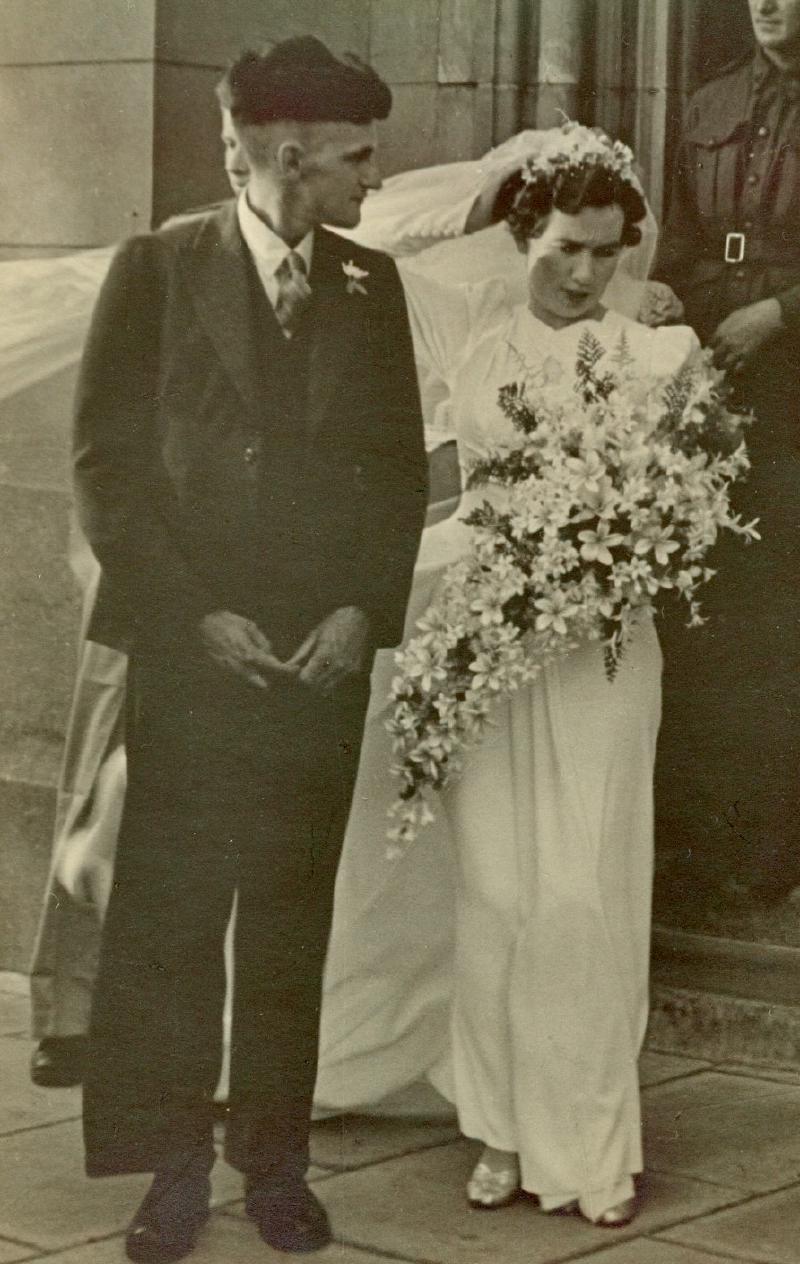
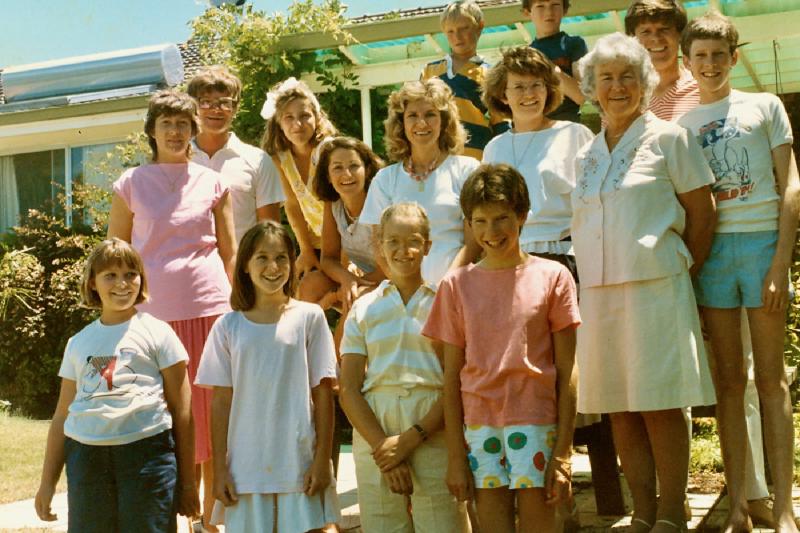
(To be completed.)
Richard Michael O’Hanlon (1923-1982)#
Richard O’Hanlon was born in Elwood, Melbourne, in 1923, the second child of Michael and Eily O’Hanlon. The family lived a comfortable middle-class life in Elwood until mid 1929, when financial issues led them to take up farming at “Spring Dallah”, Balkuling, WA. Richard studied Medicine at the University of Melbourne (1946-1950), after serving in the RAAF (1942-1946). He married Joanne Jackson in 1949. They had four children. He died in 1982, aged 59.
As described above, he and his sister Sheila attended the one-teacher school at Doodenanning, Richard finishing in 1935. In November 1935 he was awarded a Secondary School Scholarship. His secondary education (1936-1940) was spent first at Christian Brothers’ College and then Aquinas College (1938-1940). He obtained remarkable results in the Leaving Examination that year - distinction level in all seven subjects. The Leaving results are here and the award of a General exhibition is here.
In 1941 he pursued the first year of a science degree, at UWA. In what must have been an idealistic move, he then enlisted in the RAAF. His military record shows he enlisted on 6 April 1942, and was discharged on 12 February 1946. He was promoted through the officer ranks of Pilot Officer, Flight Officer and Flight Lieutenant. He seems to have been trained first in radio operations, and then radar operations. He spent time at 310 RDF Station (Vlaming Head) and 32 RDF Station (Rottnest Island) before working at the Radar School in Sydney.
We have an identity photograph taken at enlistment.
An informal history of radar in Australia during the Second War is available here.
Richard studied Medicine at the University of Melbourne 1946-1950. There was no Faculty of Medicine at UWA, and WA students had places available at Adelaide University and the University of Melbourne. Presumably he was entitled to some support under the Commonwealth Reconstruction Training Scheme. He graduated in 1950. The West Australian of 16 October 1950 tells us:
Mr. R. M. O’Hanlon, son of Mr. and Mrs. M. J. O’Hanlon, of Spring Dallah, Balkuling, has passed his final examinations in medicine and surgery, with honours in obstetrics and gynaecology.
He joined the medical practice in Lilydale run by his uncle Dr. Frank McMahon and cousin Dr. Peter McMahon.
He married Joanne Jackson in Melbourne on 9 March 1949. Sheila tells us that no family from WA were able to attend. The Age of 10 March 1949 tells us:
West Australian interest was attached to the marriage of Myra Joanne, elder daughter of Mr. and Mrs. A. W. Jackson, Canterbury, with Richard Michael, only son of Mr. and Mrs. Michael J. O’Hanlon, Spring Dallah, Balkuling, W.A. The ceremony took place at Mark’s, Camberwell, and Canon P. W. Robinson officiated. The bride chose a gown of white tulle and satin covered with a tulle veil held in place with a coronet of pearls. She carried a bouquet of white orchids and gardenias. The bride’s sister, Mrs. George Milne, was matron of honor and Miss Nanette Splatt was bridesmaid. Their silver-blue gowns featured off-the-shoulder necklines and they carried bouquets of tuberoses matching those worn In their hair. Dr. Peter McMahon was best man and Dr. Ian Aberdeen was groomsman. A reception was held at the Hotel Australia.
They had four children.
I have one memory of Richard and Joanne at Lilydale. We visited them in, I think, May 1975 for Sunday lunch, when our children were aged four and two. Richard and Joanne had Beddlington Terriers. They hurtled up and down the house without any apparent discipline. There may have only been three of them, but it seemed like a lot more. They bowled over our two-year-old several times. “Tell her to be careful”, said Joanne, “she might hurt them”.
Richard died of a heart attack, on the Royal Melbourne Golf Course, on 21 August 1982. aged 59.
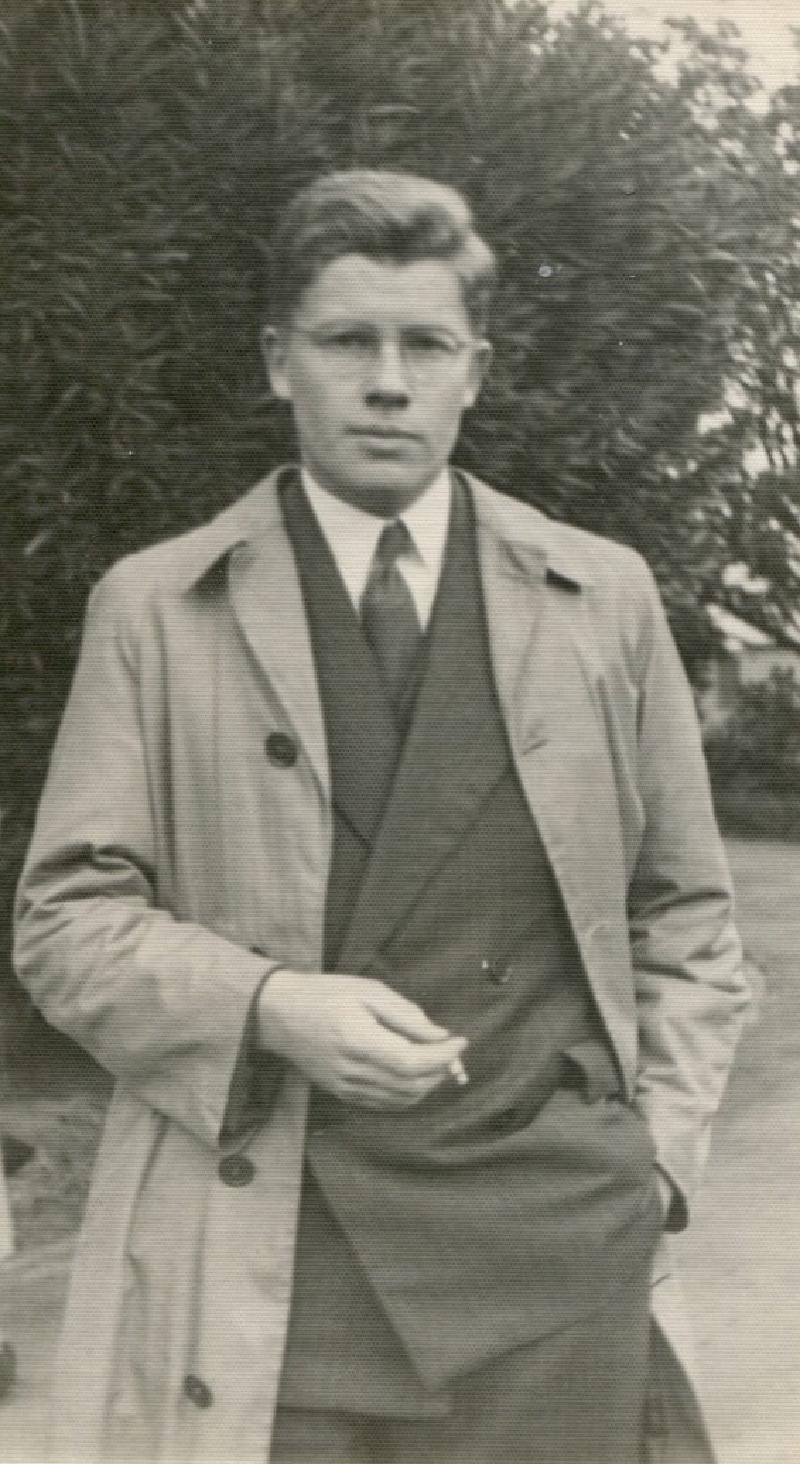
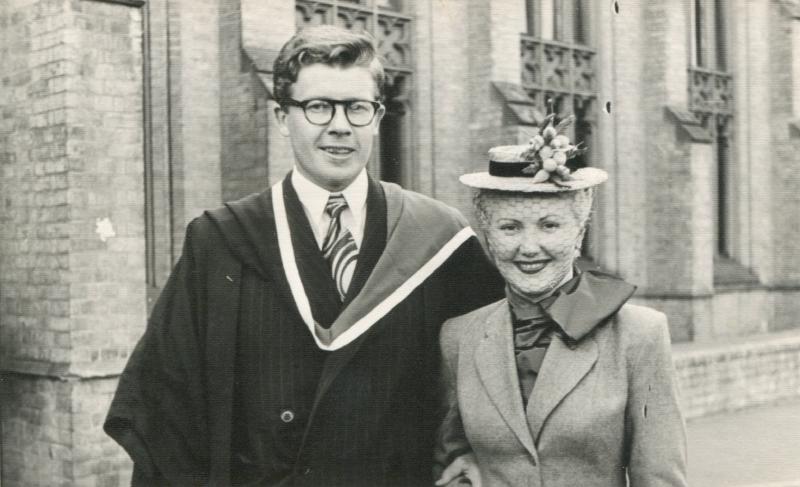
There are no articles to list here yet.