Clare
19 words·1 min
Kerry’s paternal grandfather is Martin Patrick O’Hare. His four grandparents were all born and married in Ireland, and emigrated to Australia in the 1850’s.
Family tree: Martin Patrick O’Hare (fullscreen)
We have two family memoirs to help us, and an historical publication.
Honor Pusenjak, As It Seemed To Me, Apollo Press, 1982.
Betty Stokes, Brains in Neutral, Tongues in Top Gear, 2000 (privately published).
Nathalia Historical Society, Pioneers of Nathalia and District: Pre 1900. Book 2, 1986. (entry for John Joseph O’Hare).
The spelling of the surname was not standardised at the time. Other spellings include O’Haire and O’Hehir, and the variations Hare and Hehir.
John O’Hare was born in about 1805 in the town of Ennis, County Clare in Ireland. We do not have a baptism certificate. We know the names of his parents (Daniel Hehir and Margaret Meade) and he may have had two brothers. What we do know is that only he came to Australia, and that contact has been lost with any relatives who stayed in Ireland.
John O’Hare married Margaret Hassett in Ennis, in 1831. We have an accurate date, but seem not to have copy of the marriage record. They had three children in Ennis that we know of.
Honor Pusenjak tells us:
Also living at Snugborough was Auntie Sara, grandfather John’s sister, or “old Aunt” or “Dadda’s Aunt”, to give her the various titles by which she was known. She came to Australia as a young girl with her father and mother, a Margaret Hassell, married to the first John O’Hare, my great-grandfather, who lies buried since 1863 in the Melbourne General Cemetery at Carlton.
Aunt Sara’s two brothers, John (Grandfather John) and Martin (Old Uncle) came to Australia later, as young men bringing with them a cousin, Margaret McCormick.
Honor wrote her memoir before Trove and before the online access to original records that we have now. She relates, with affection, the family legends. These get the themes correct, but the details get blurred and drift over time. If you didn’t consult the state archives directly, you were left with little more than a few birth, marriage and death records, and fading gravestones. With modern resources we can recover many of the details.
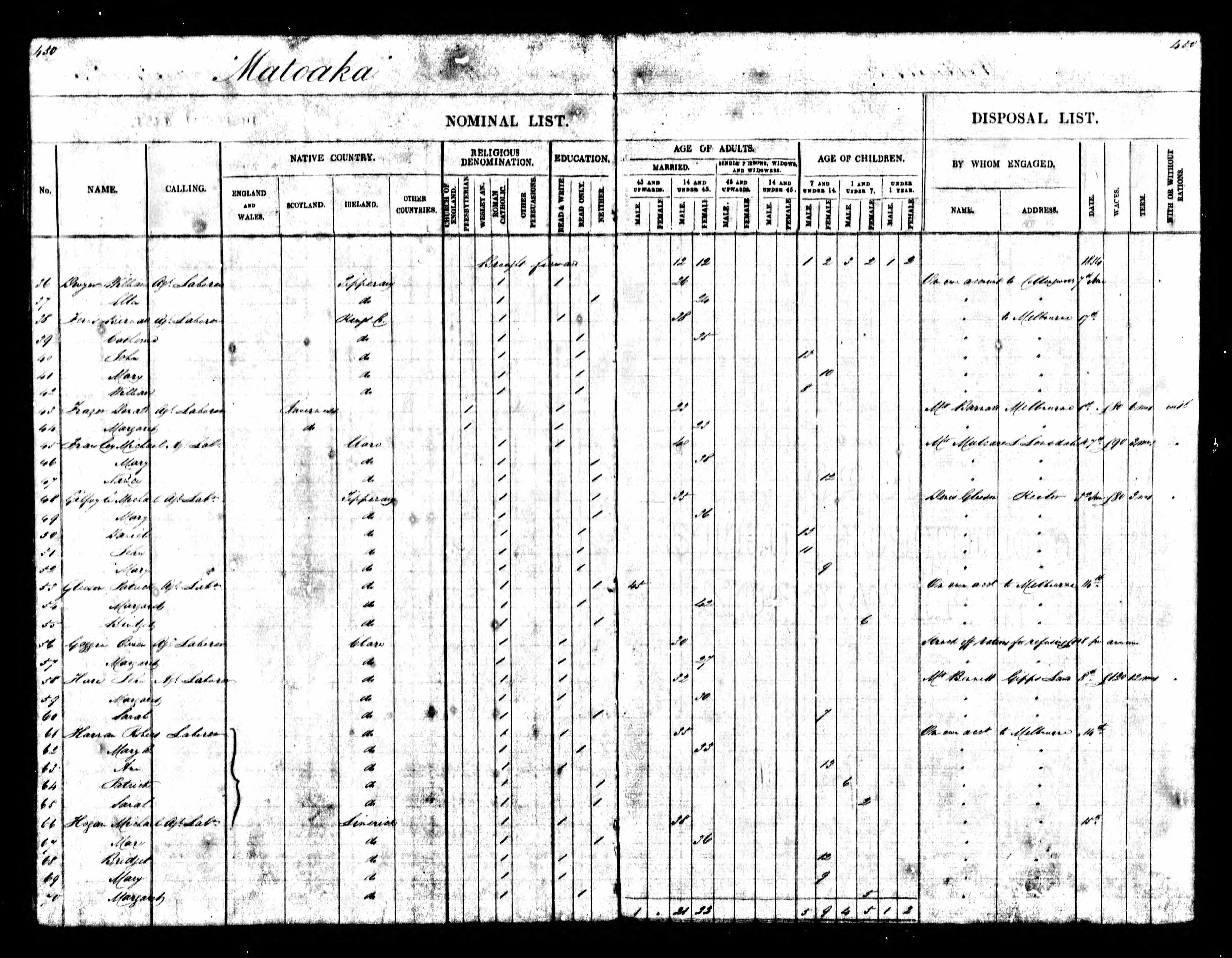
John and Margaret O’Hare, with their youngest child Sarah, arrived in Melbourne on 26 May 1854 on the ship Matoaka. I eventually found them on the ship’s passenger list. They are numbers 58, 59 and 60 in the list, and appear as
Of the 45 immigrants on the page, 43 come from Ireland (the other two come from Scotland). All the immigrants from Ireland identify as Roman Catholic. John and Margaret can read and write (about half the adults on the page can read only). John is an agricultural labourer. He was engaged to work by a Mr Bennett of Gippsland, on 8 June, pay £120 for 12 months with rations included.
The Argus of 27 May 1854 reports the arrival:
May 26. Matoaka, ship, 1320 tons, R. H. Ferguson, from Liverpool 28th February. Four hundred and six Government immigrants.
The ship didn’t waste time. The Argus of 29 May reported the “clearing out”:
May 27. Matoaka, ship, 1317 tons, R. H. Ferguson, for Bombay, in ballast. No passengers.
The voyage has an entry in wikitree, including a link to the full passenger list.
It is not clear how long the family stayed with Mr. Bennett. It is somewhat grasping at straws but there is a ship’s letter addressed to
John O’Hare, Sale, Victoria
in the Government Gazette of 1862. Maybe it was a letter from “home” and the sender did not have a more recent address.
Honor Pusenjak tells us:
Before selecting Snugborough the O’Hares lived in Brunswick. They had horses and drays and some type of contract helping to cart the bluestone used in so many of Melbourne’s public buildings. It must have been hard work but remunerative, insomuch as they were able to establish Snugborough and live as they did, surrounded by articles, many of which were beautiful as well as useful.
Brunswick is now an inner suburb of Melbourne, 5km north of the Central Business District. The Wikipedia article tells us:
Henry Search opened a butcher’s shop in 1850, on the south-west corner of Albert Street and Sydney Road. This was the first retail establishment in Brunswick. By 1851, gold diggers began making their way through the area, on their journey from the populous suburbs of Fitzroy and Collingwood. Brunswick provided a convenient place for lunch, before the diggers reached the beginnings of the roads to the goldfields, near present-day Essendon. A small village sprang up to meet the needs of the travellers, near the present day Cumberland Arms Hotel. The village included a tent market, described as being like a bazaar, where miners could buy goods needed for the goldfields. Brunswick Post Office opened on 1 January 1854.
In the 1850s, quarries and a large brickworks established in Brunswick, using the local clay and bluestone, quickly became the largest industry in the area.
This aligns with the family version. Perhaps the boys (who arrived in 1856) joined John and Margaret in Gippsland for some time, before all moving back to Melbourne. Finding work would not have been hard, and it was necessary to save the capital needed to purchase working horses and drays.
We actually have a reference to them in Brunswick in 1861; The Advocate of 7 September 1939 tells us:
Brunswick’s Catholic History
Sir,—During the course of your article on Brunswick’s Catholic history, it is mentioned that some time in 1864 Fr. O’Hea was seeking for a site for church purposes at Brunswick, and that on the site obtained he built a wooden school. Apparently it is not known that there was a school established at Brunswick some years previous. Rev. Dr. Bleasdale, secretary of the Bishop, in 1861, states: “There is a Catholic school at Brunswick, which was opened by Mr. Terence O’Boyle on November 26, 1860. … It is three miles from the Catholic school at North Melbourne. The children attending are .. ; Sarah O’Hare; .. . There are also eight children attending a night school at Brunswick, and it is conducted also by Thomas O’Boyle, who, Dr. Bleasdale adds, “is one of the best teachers that the Catholic schools have in Victoria.” One of the inspectors of the Denominational School Board visited the school on June 11, 1861. His report on the school is as follows: “This school has been in operation some time. … It is 2.5 miles from Pentridge, and is directly opposite the Wesleyan Church. … The school is at present in a room attached to the Brunswick Hotel. There is a small playground with a fence around. … The teacher is Mr. O’Boyle.” Apparently the school did not receive recognition from the Denominational School Board, for a memorial from the inhabitants of the district was presented by Dr. Bleasdale, who asks “that the board consider the claims of the Roman Catholic School, and the steps taken by the inhabitants.” An appeal was also made to the Government. Mr. O’Boyle did not remain teacher of the school very long, presumably because of the neglect of the School Board to give him a salary (he appears at a country school in 1861), for on June 6, 1862, Fr. O’Hea, as correspondent, writes and says: “William Flynn was the teacher of the Catholic school at Brunswick from 1/7/‘61 to 31/12/‘61.” He was succeeded by a Timothy Cronin, who also did not remain very long. The school was still in existence in August of 1862, as the attendance is stated to be 31, and a local school committee was. in existence. The discontinuance of the school must, later, have been carried out, which is probably the reason for stating that it was established in a wooden building in November, 1864. Perhaps some of the names I have given above are of persons who are still living, and it would be interesting to know when this school was discontinued, if it did, and whether it was held in the room of the hotel for very long.
Yours, etc., F. D. MINOGUE. Albert Park.
He died in 1863 after less than a decade in the colony. His death certificate lists him as “John OHaire”, aged 58. He and Margaret have an impressive gravestone.
Margaret Hassett was born in about 1811 in Ennis, County Clare, Ireland. We do not have a baptism record. We know the names of her parents (John Hassett and Sara Coulon) and she had at least one sister (Catherine, who stayed in Clare).
She married John O’Hare in 1831. They had three children that we know of, and the family of five emigrated to Victoria. After John died in 1863, she continued to live with her three children, first in Brunswick and then, after 1876, at a farm in Barwo, Victoria, that her eldest son John selected.
The family called the farm “Snugborough”, said to be named after where Margaret’s family came from in Clare. Snugborough is a townland (of 226 acres) in the civil parish of Tomfinlough.
The Advocate of Saturday 2 May 1891 reported:
DEATHS.
O’HARE. On the 14th April, at the residence of her sons, " Snugborough,” Nathalia, Margaret, relict of the late John O’Hare, of Brunswick, aged 80 years, formerly of Ennis, Co. Clare, Ireland. Requiscat in Pace.
The Advocate was a Catholic newspaper in Melbourne, published weekly.
Margaret and John share an impressive headstone in Melbourne General Cemetery.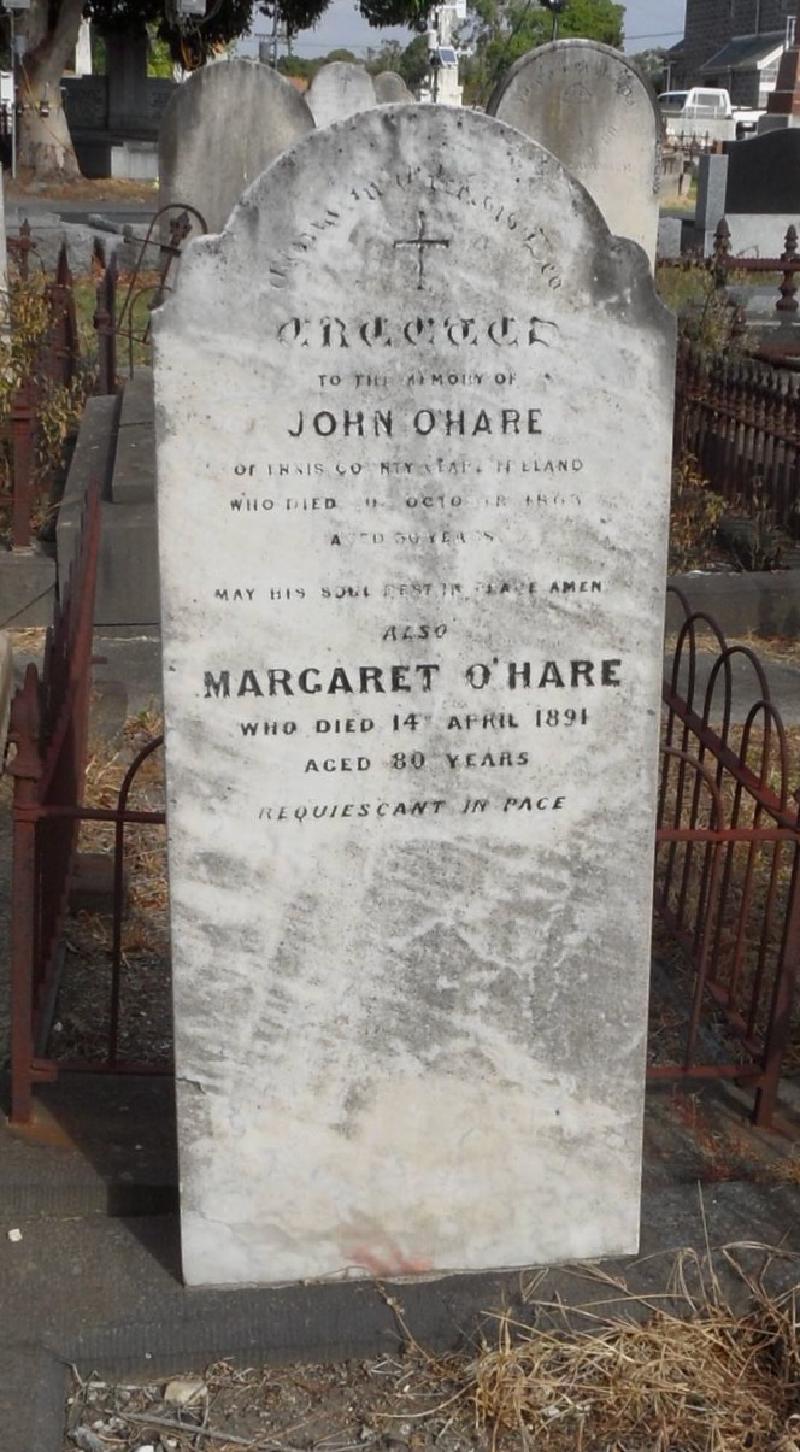
Gloria in Excelsis Deo
Erected to the Memory of
JOHN O’HARE
of Ennis, County Clare, Ireland
who died 29 Oct 1863
Aged 36 years
May his soul rest in peace Amen
also
MARGARET O’HARE
who died 14 April 1891
Aged 80 years
Requiescant in Pace
Note: this age for John is incorrect.
William Commons was born in Galbally, County Tipperary, Ireland in about 1820. He married Johanna Quirk in 1842. We have the wedding record. Together with their first three children they emigrated to Australia in 1854. Their fourth child seems to have born at sea, on the journey, and two further children born in Australia. I have been unable to find any record of their journey. Presumably, they would have travelled as assisted immigrants, like the O’Hares.
It seems clear that the family first went to Tasmania. We have a nice pair of records that places William in Jericho, a town half-way between Hobart and Launceston (on the major road that convicts had constructed).
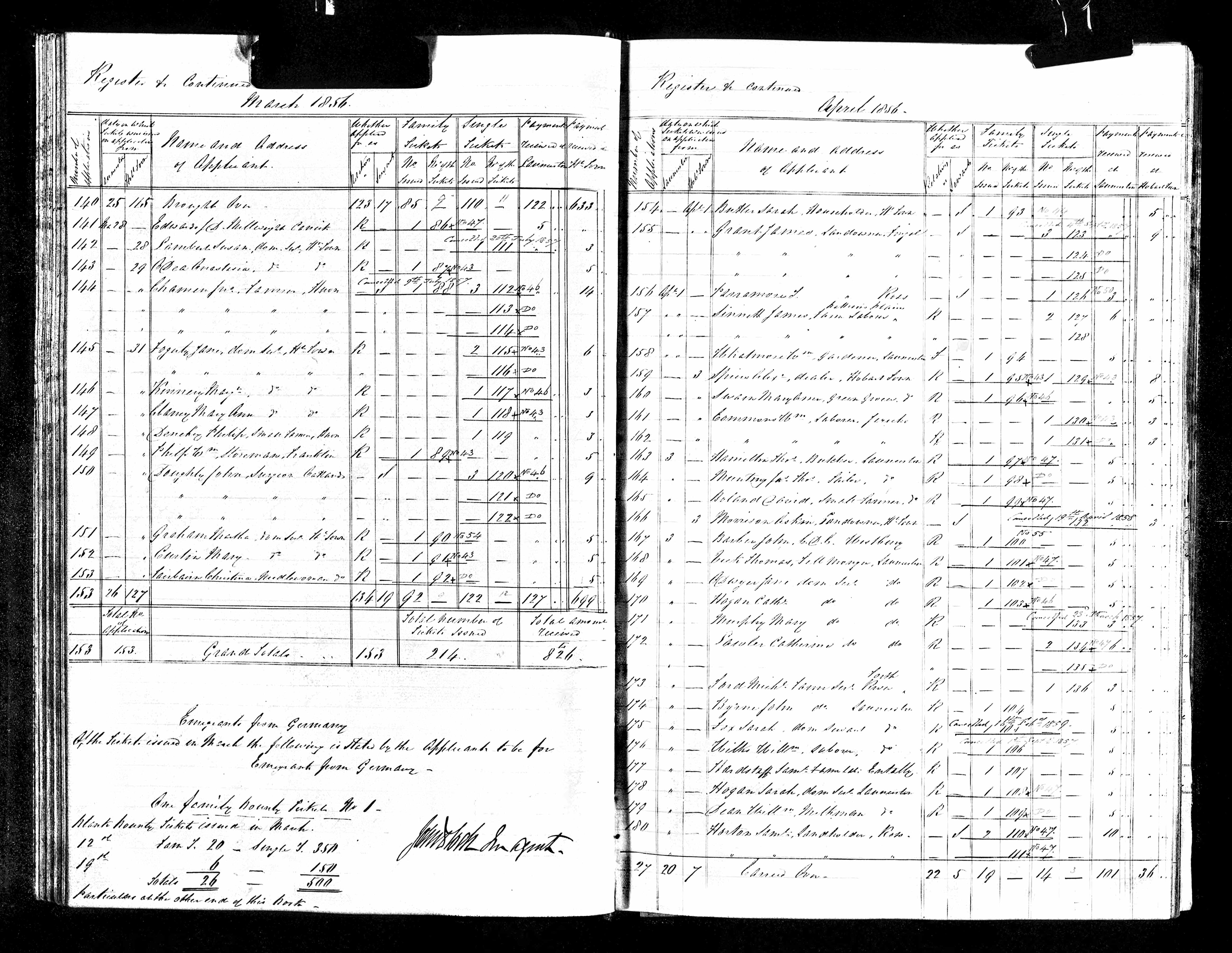
On 1 April 1856 William Commons, labourer, of Jericho applies for bounty tickets for two single immigrants (numbers 130 and 131), and pays £3 pounds for each ticket. On the record, look part-way down the right-hand side (sequence number 161).
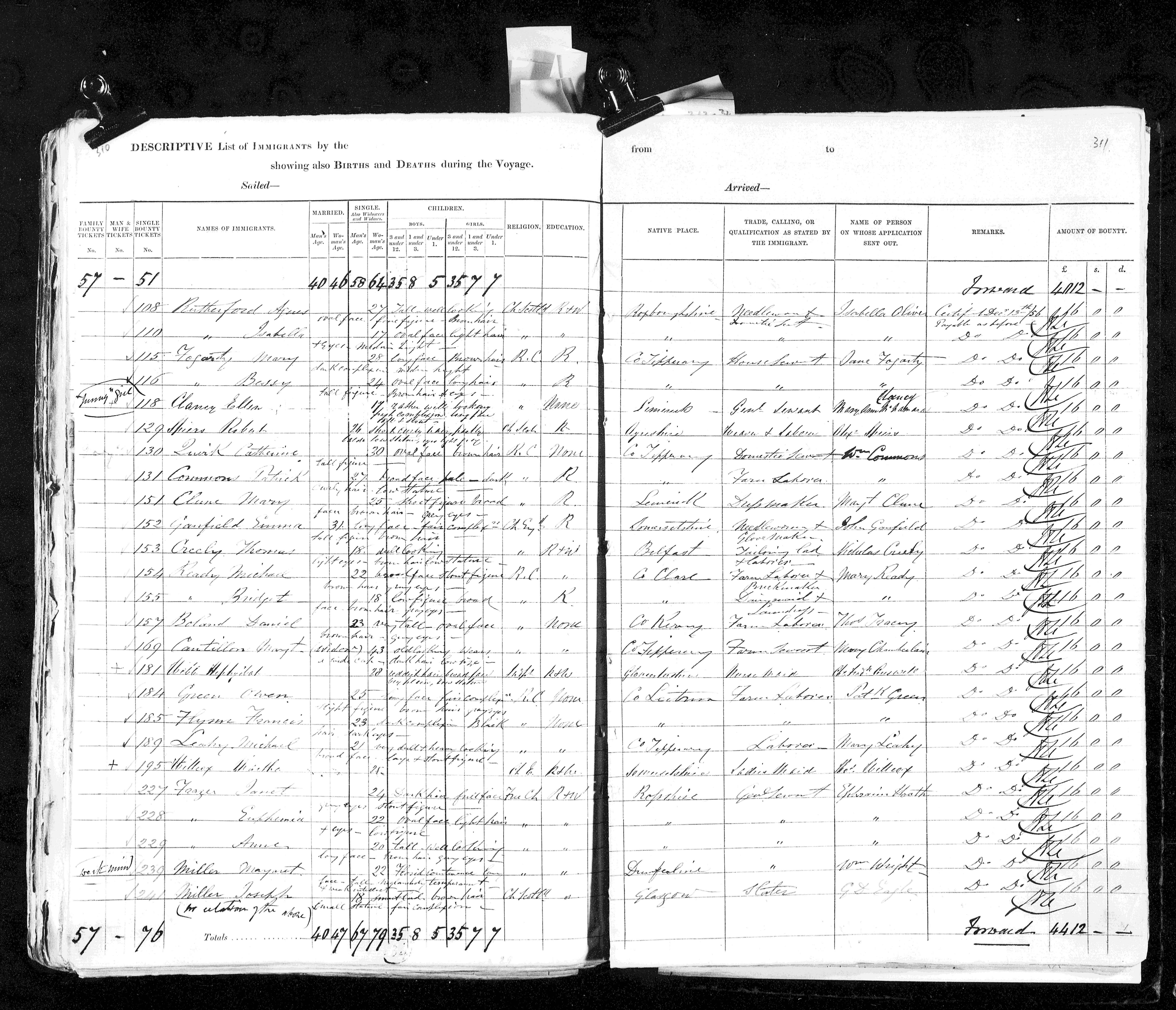
On 2 December 1856 two passengers arrive in Hobart on the Sir W. F. Williams listed against those bounty tickets, Catherine Quirk (his wife’s sister) and Patrick Commons (his younger brother). On the record they are listed against their ticket numbers, part-way down the page. The Colonial Government paid £16 pounds each for their travel.
The Hobarton Mercury of 3 December 1856 tells us
The Clipper Ship, Sir W F Williams, 869 tons,arrived in port last evening, after an excellent run of 81 days : she is a new ship, and iron built : she spoke no vessels since leaving the Equator. She brings 335 emigrants under the care of Dr. Hardy formerly surgeon of the ill-fated Schomberg, two children under 7 years of age and 2 infants died during the passage, the following is the account of tho emigrants : Married men 38, Married women, 49, Single men, 65, Single women, 74, Boys, from 7 to 14 years 26 ; Boys from 1 to 7 years, 23 ; Boys under 1 year 3. Girls from 7 to 14 years, 25 ; Girls from 1 to 7 years 25 ; Girls under 1 year II. They have arrived in good health, and the vessel presented a remarkable appearance of comfort and cleanliness, being admirably adapted for the purposes of a passenger traffic. We cannot refrain from expressing our obligation to Captain Rees for his courtesy in supplying us with the latest English News.
The Sir W. F. Williams. This magnificent ship, one of the Messrs. Baines’s Black Ball liners, has excited the greatest admiration of nautical men; and even those whose eyes are unaccustomed to see ships of her size, as she lay in the river, have expressed their delight at her beautiful appearance on the water. The Sir W F Williams sails this morning for Hobart Town, with 335 souls on board, besides a full cargo. We wish our departing friends a safe and a happy passage. Daily Post, September 10th.
This is impressive Victorian bureaucracy. There is just eight months between William applying for the bounty ticket, to the immigrants arriving. Mail had to travel from Hobart to Britain, and the immigrants had to get themselves from Tipperary to Liverpool.
At some stage the family left Tasmania for Victoria. With the gold-rush there were many more opportunities in Victoria. I cannot find any record of their passage to Melbourne. We have a brief indication of their first location in Victoria. Honor Pusenjak tells us:
William and Johanna Commons original property at Woodend is now owned by Michael Doherty’s son John.
His brothers (see below) obviously moved to Woodend at the same time, and stayed there.
The family then selected land in Barwo at the same time as the O’Hares. He died in 1888.
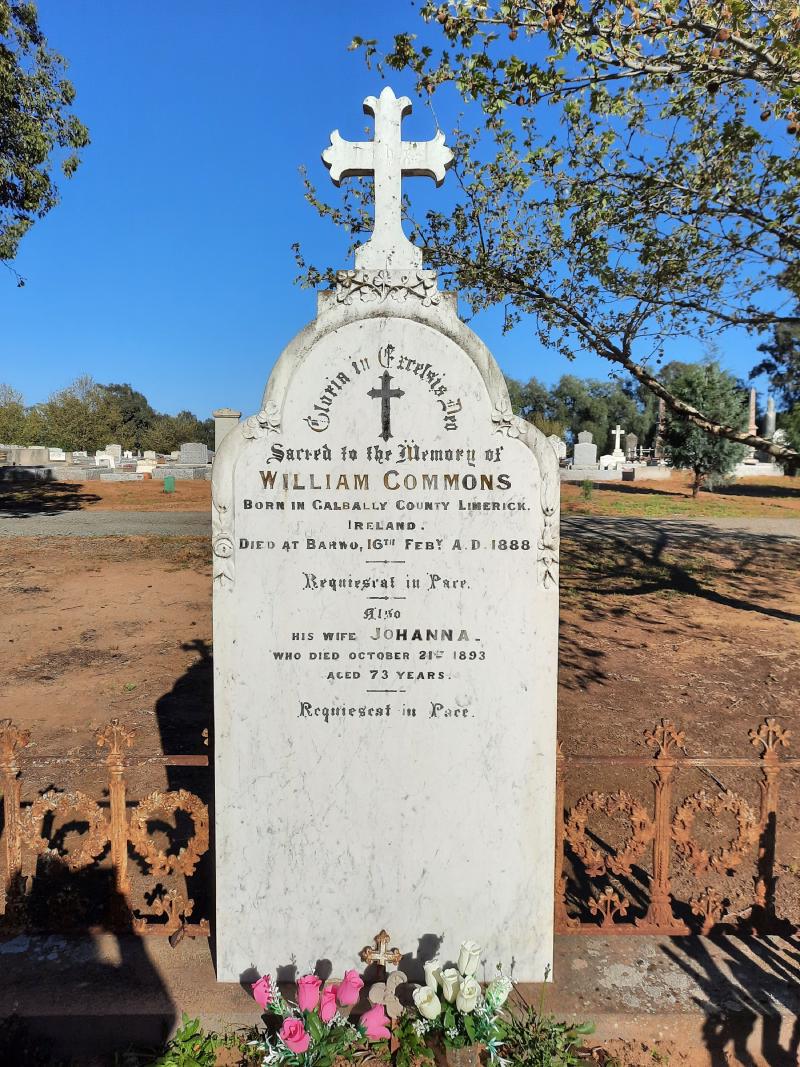
Two of William’s brothers also came to Victoria.
Patrick Commons (1827-1910) arrived first in Hobart, on the Sir W F Williams which arrived on 2 December 1856. We have a list of assisted passengers. He is fifth on the page. He says he is 27 (close enough), he is Roman Catholic, can read (but not write), comes from County Tipperary, is a “farm labourer”, he was sent out on the application of “William Commons”, he has a pale broad face, dark curly hair and is of a low stature.
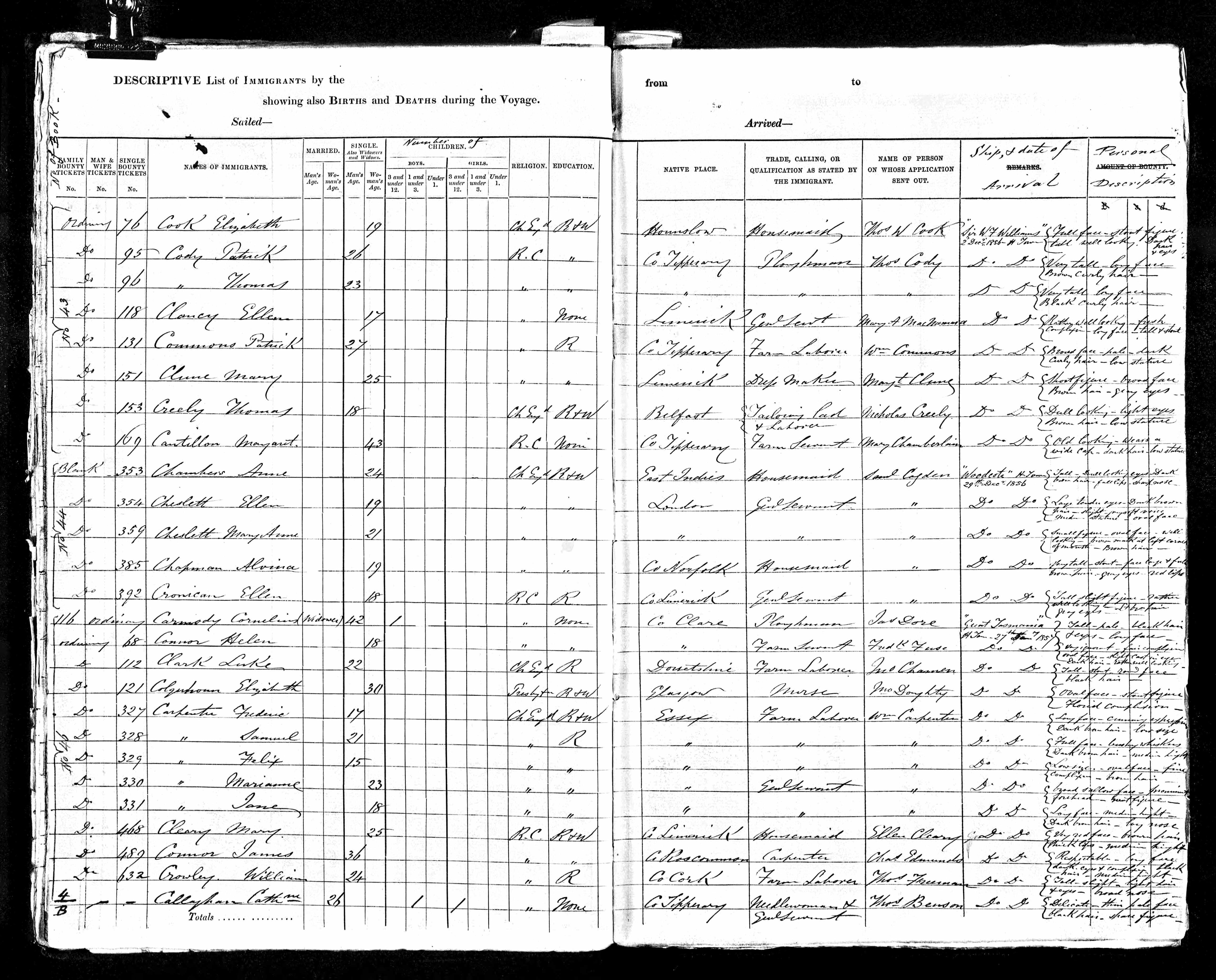
In February 1858 he travels to Melbourne on the steamship Royal Shepherd. Scroll down to the second page.
The following is probably him.
Kyneton Observer Tuesday 8 June 1875:
WOODEND. MONDAY, JUNE 7.
(Before J. C. Thomson, Esq., P.M., and Mr. Wm. Macqueen, J.P..)
DRUNK AND DISORDERLY.
Patrick Commons was charged by Constable Hanlon with the above offence, which prisoner admitted. This being the third offence within a short time (twelve months) the Bench sentenced the prisoner to one weeks’ imprisonment with hard labor in Kyneton gaol.
He dies, a bachelor, in Woodend on 1910.
Maurice Commons (1831-1908) seems to have immigrated directly to Victoria, but I cannot find his travel details. We have an obituary, in the Woodend Star of Saturday 22 August 1908.
DEATH OF MR MAURICE COMMONS
Another of our very old residents, in the person of Mr Maurice Commons, passed away at his late residence, Woodend South, on Thursday morning, at the age of 75 years. He had resided here for about 45 years, and was well respected. Deceased came to the district soon after landing in Victoria from the old country. Many years ago he worked on the railways but the greater part of his attention was afterwards given to the piece of land upon which he made his home at Woodend South. He had been in very indifferent health for some time past and his death on Thursday resulted from heart disease. His wife pre-deceased him in 1892, and he leaves a family of one son and two daughters to mourn his loss, namely, Mr W. Commons,and Mrs Collins, of Melbourne, and Miss Commons, of Woodend.
He was married in Melbourne in 1858, and obviously moved to Woodend about 1863. They had three children, as indicated. We have his will and probate.
Johanna was born in 1821 in Nenagh, a market town in County Tipperary, Ireland. She married William Commons in 1842, in his home town. They emigrated in 1854 with their first three children. Their fourth child, Martin, was born at sea on the journey. Their fifth child is listed in several family trees as being born in Jericho, Tasmania, but I cannot confirm this. Their sixth child was born in Victoria.
We have an obituary, from the Nathalia Herald and Picola, Narioka, Kotupna and Moira Advertiser of Thursday 26 October 1893:
SUDDEN DEATH OF MRS. COMMONS
It is our painful duty to record the sudden death of Mrs. Johanna Commons, relict of the late William Commons, and mother of Sergeant Phillip Commons, Sergeant Michael Commons, Mrs. John O’Hare, Mrs. Samuel Ball, and Mrs. James Ball.
The deceased lady, who was much beloved for her cheerful and amiable disposition had reached the mature age of 73 years, and for a long time past suffered much ill health. She was well enough, however, to attend chapel on Sunday, the 15th inst., and her friends remarked how much better she looked than usual; but this was evidently the final effort of her exhausted frame, which was aroused at the pleasure of seeing all her family around her. She had a presentiment she would never see them together again, and when she returned to her daughter, Mrs James Ball, at Ulupna, she said she had looked upon her sons for the last time. It happened that both Mr. Phillips Commons and Mr. Michael Commons were up on a visit to see her and their sisters, and although they knew their mother was in feeble health, they never anticipated that her end was so near. They left her on Friday last, to return to their duties, and stayed on Friday night at Mr. Samuel Ball’s, at Barwo, purposing to start early on Saturday morning with Mr. Ball, with a buggy and pair, for Echuca. At about 4 o’clock on Saturday morning a message came to say that Mrs. Commons had died peacefully and almost without any signs of her approaching decease, at 2 o’clock that morning. She bad been up and about the day previous, and her bereaved relatives were quite unprepared for the sad event.
Mrs. Commons, with her husband, came into the district in the year 1875 and her many estimable qualities endeared her to all who knew her. When the family came here first to select, Nathalia was not in existence, and neither Mr Blake nor Mr. Kostadt had taken up the land that has since proved so valuable. Mr. Commons however, made a wise selection of land, and until his decease some five years ago; prospered well and brought up and educated a family that are very highly respected by all classes of the community.
The deceased lady was interred in the Nathalia cemetery on Sunday after-noon, and was laid beside her husband in the same enclosure. The funeral was one of the largest ever seen here, and showed the respect in which she was held by all who knew her. The cortege was over half a mile long, and would have been much longer if the sad news of her death had been more widely known.
To show the O’Hares in this generation, it is convenient to show a family tree of the descendants of John O’Hare.
Family tree: John O’Hare (fullscreen)
It is convenient to discuss John Joseph along with his two siblings Martin Patrick (1837-1927) and Sarah (1846-1933). Martin died a bachelor, and Sarah died a spinster. As far as we can see they always lived together, as a family unit.
John Joseph was born in Ennis, County Clare, Ireland in 1833. He (and his brother Martin) immigrated to Victoria in 1856, and the family lived in Brunswick, Melbourne. He married Mary Ann Commons in Kyneton, Victoria in 1868. They had nine children. In 1874 he selected a block of 304 acres in the parish of Barwo, near Nathalia, Victoria and established a farm. He died in 1898.
We have a photograph, taken from the web.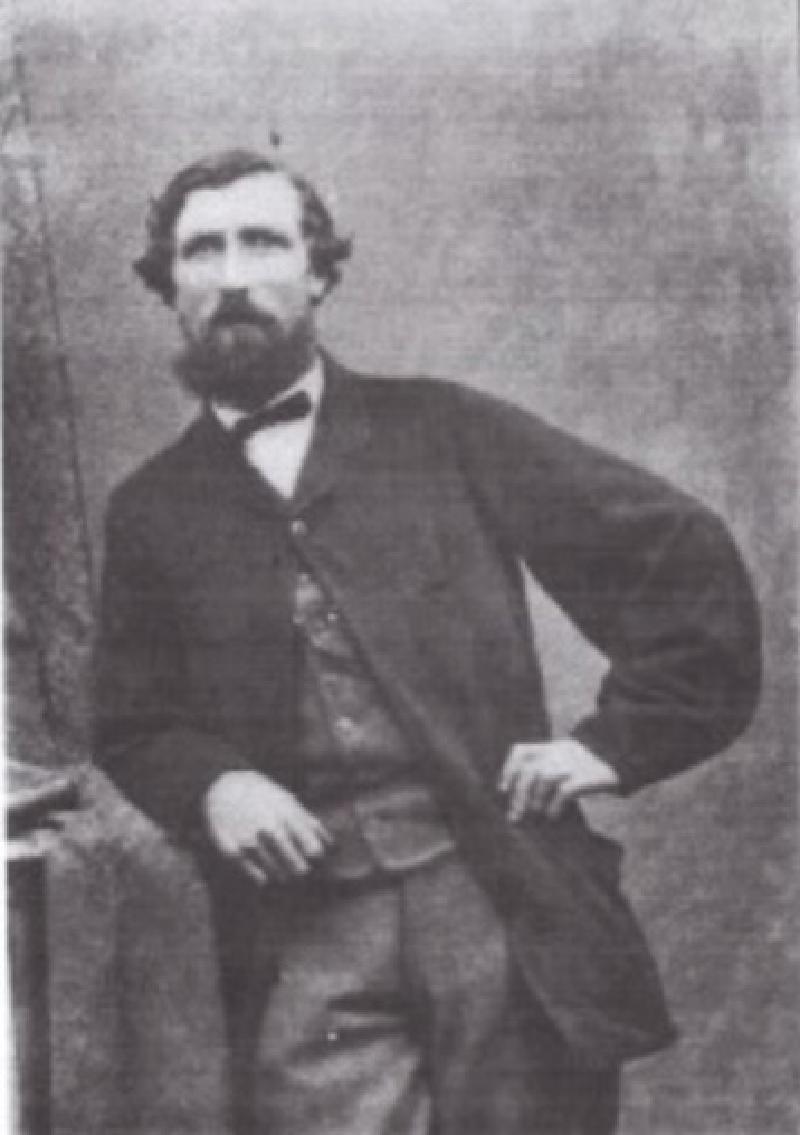
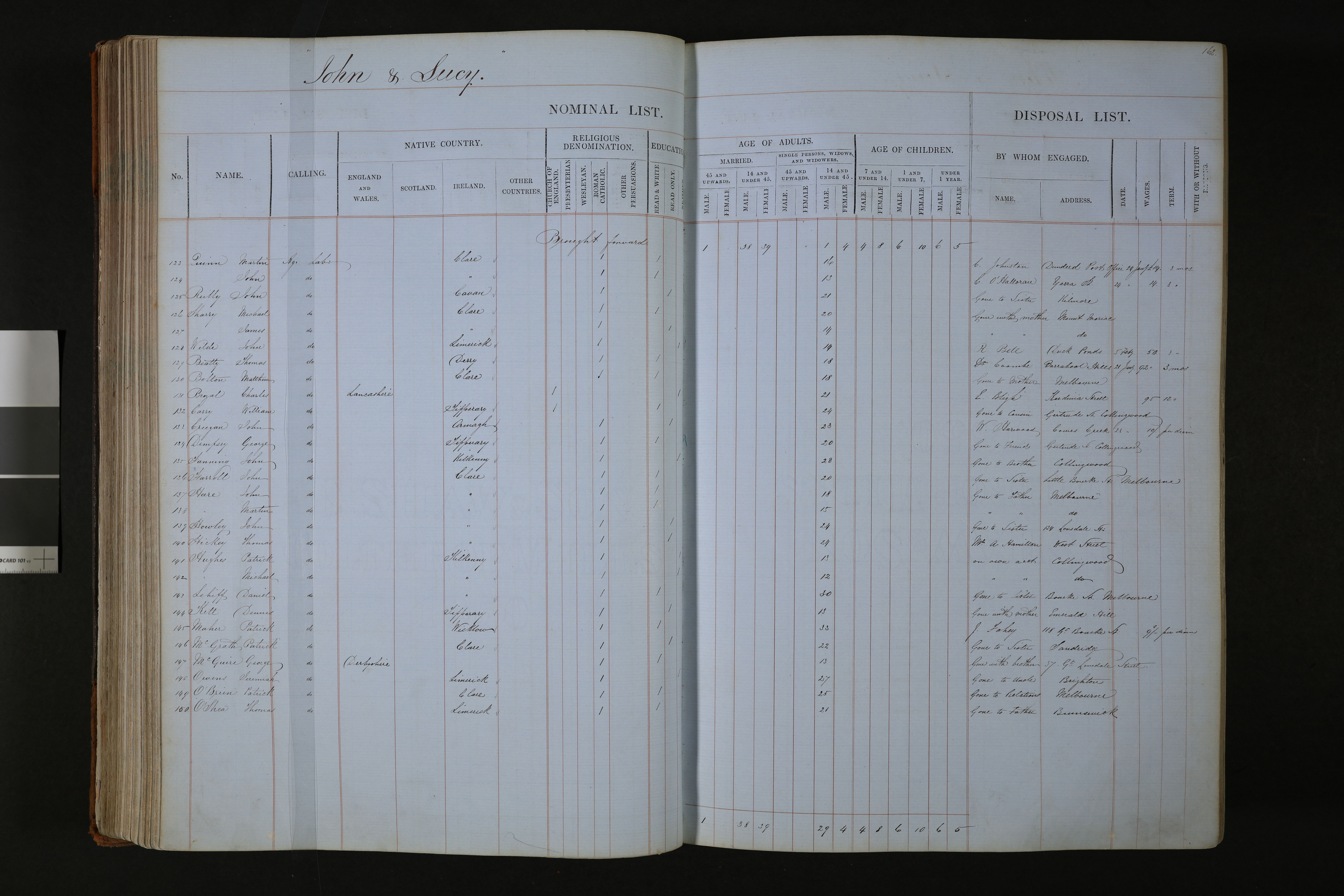
John and Martin arrived in Geelong on the ship John and Lucy on 16 January 1856, along with a cousin Catherine (who will be discussed separately). We have a copy of the relevant page of the passenger list. They are number 137 and 138. They are agricultural labourers, from County Clare. They can both read and write. They gave their ages as 18 and 15 (their actual ages were 22 and 18). They could both read and write, and under Disposal they both “went to Father, Melbourne”.
It had been a long trip. The trip from Ennis, County Clare to Liverpool would have been tedious, as it was just before the first railways. The 75 km trip from Geelong to Melbourne would have involved horse-drawn transport, as the railway (the first in Australia) was not opened until 1860. Indeed, the John and Lucy brought 300 tons of iron rails for the project.
Contemporary articles in the Geelong press give some context of the world they arrived into.
The Geelong Advertiser and Intelligencer of Monday 14 January 1856 published a report from “their own correspondent” in London, saying in part:
Our Emigration returns for the month of September show a great falling off, which would seem to indicate that the lower classes are in better circumstances, and less inclined to remove. The total number for the month was only 15,873: of these 4,787 went to the Australian colonies, and 10,258 to the United States. The Calliance has sailed for Melbourne with Government emigrants since my last letter, and conveys 285 statute adults, of these more than 150 were single women and mostly from Ireland. The ship John and Lucy is embarking emigrants at Birkenhead, and is expected to sail to-day for Geelong, and I am told two-thirds of her complement are also Irish. In short, it is said that the Emigration Commissioners cannot obtain parties under the present regulations, although there are still numbers of good people out of employ.
The same paper of 17 January 1856 reported:
The John and Lucy anchored at Point Henry about noon, and was boarded by Mr Ford, Assistant Emigration Officer; the vessel is in a most creditable state of cleanliness; the immigrants are in good health and no deaths have occurred during the voyage. The Surgeon Superintendent, Mr S. J. Jolly, has made several voyages to these colonies, in the immigration service. No doubt that the immigrants by the John and Lucy will meet with immediate employment if they are not too greedy in their demands.
Elsewhere
THE JOHN AND LUCY. This noble ship, now at Point Henry, is the first vessel fitted up with Watson’s patent ventilator which has visited this port, and the result, as exemplified in the high degree of health and comfort enjoyed by the Immigrants during her last voyage, has been most successful.
On 21 January:
The arrival of the John and Lucy is opportune, if the majority of the 317 emigrants recently in her are of the right sort; for the enormous sum of two pounds per acre is now in some instances being paid for reaping strong corn, and wages it is not easy to over estimate the power of absorption in Victoria of real workmen. or the advantages which will accrue to them as well as to the colony at large from their presence here; and we cannot account for the apathy shewn by the laborer “at home,” whose wages there for the week are rarely above the sum they would be paid here for a day’s work, to the certainty of bettering their position in such a land as this, where intelligent industry and perseverance alone are required to secure ultimate (and often times early) independence.
On 23 January:
JOHN AND LUCY. Thomas Diaper, Samuel Treveylor, and John Rodcliffe, three articled seamen belonging to the ship John and Lucy were brought up by Captain McKay, and charged by the chief officer, Mr Millar, with insubordinate and refractory conduct on board ship. Diaper and Rodeliffe were sent to gaol for one month, and Treveylor being found too useful to dispense with, he being the ship’s carpenter, and expressing some contrition for his misbehaviour, was discharged with a caution.
On 7 February:
FRIGHTFUL ACCIDENT PROM A SHARK. One of the crew of the John and Lucy, ship, at Point Henry, while bathing near the ship’s bow, was dragged under water by a shark which was seen prowling about shortly before. The alarm was immediately given, and Captain McKay, who was in a boat a little way off, pulled quickly to the spot and rescued the young man literally from the monster’s jaws, but in such a mutilated state that recovery is despaired of, the flesh on his thigh being much lacerated and torn. The sufferer is now in the hospital. Well attested cases of attacks by sharks are not common, and we shall solicit from Captain McKay and the unfortunate young man himself, if he recovers, a few further particulars of the case.
A subsequent report indicated that the unfortunate sailor had survived and was about to be discharged.
On 13 February:
STEALING BLANKETS. James and Lelitia Gahey, emigrants by the John and Lucy, were charged with stealing blankets from the stores of the Immigration Depot, Geelong. Mr Upston, the overseer of the Government Immigration Depot of this place, deposed to the stores having been entered in a burglarious manner, and to several pairs of blankets being missing. Suspicion falling upon the prisoners, their boxes were searched, and the pair of blankets now produced, which are government property, and had not been distributed for use, were found in their possession. They were severally sent to gaol for one month, the Mayor remarking that the pair of them had made a bad business in a new colony.
The John and Lucy sailed through the Heads on 2 March, for Bombay. It took a while to unload the iron rails by lighter. There was no wharf for ships of that size.
The John and Lucy is listed as being owned by the famous Black Ball Line. It was built in 1850, and wrecked in 1859. Perhaps an average life for a wooden ship of the time.
The licence for their selection apparently dates from 1874. The family moved to the farm in 1876 (as noted in his wife’s obituary), after the brothers had constructed a house and farm buildings, in part using timber from the block. The Riverine Herald, Monday 5 May 1879, reported (among others) that
GAZETTE NOTICES
It is notified that the following licensees under section J9 of The Land Act, 1869, have surrendered their licenses, and have obtained new ones under section 8 of the Land Act, 1878 :
John O’Hare, Barwo ;
This must have been a technicality.
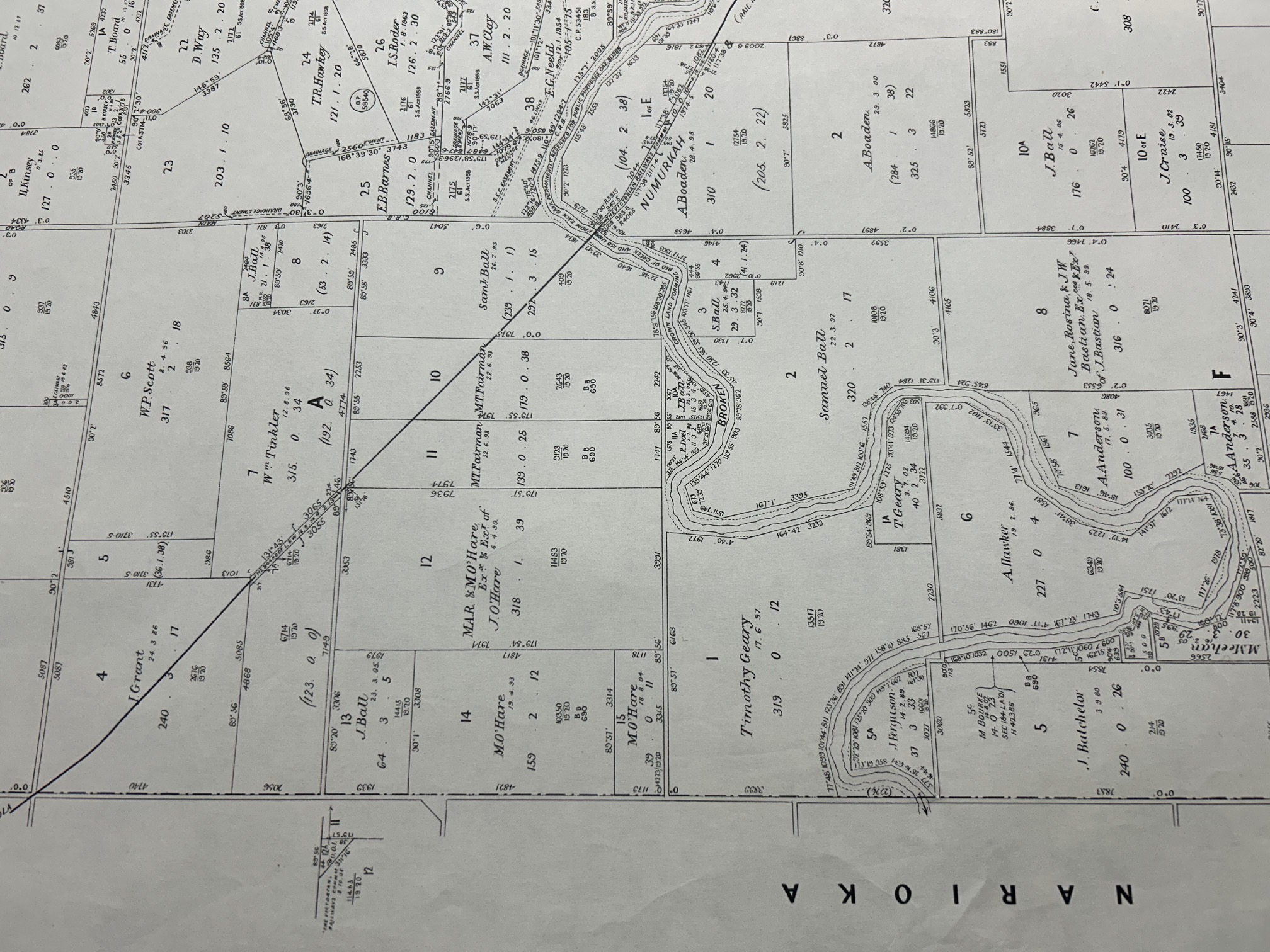
The O’Hare land is “Crown allotment 12, Section A, Parish of Barwo, County of Moira”. We have a 1884 Moira map showing the land allotments in the county. The farms are nominally 320 acres (there are 640 acres to the square mile). This was deemed to be the area that could be cultivated by a single-family farmer using the technology of the time. The parish of Barwo is in the top left-hand corner. We have a Barwo map of the detailed allotments, showing the original licence holders. Allotment 12 (labelled J O’Hare) is second from the left edge, just above Broken Creek. Just nearby, allotments 13 and 9 are held by P. Commons and J. Commons who are John O’Hares in-laws. They clearly selected the land at the same time. We have a later map (provided by the Nathalia Historical Society) that shows land ownership up to about 1965. The O’Hares acquired two neighbouring blocks (allotments 14 and 15) in 1893 and 1904, that gave them a total holding of 516 acres.
The Numurkah Leader of 13 January 1898 tells us:
OBITUARY.
The oppressive hot weather of the past few weeks has been the primary cause of many cases of illness in the town and district, more deaths having occurred hereabouts during the last month or six weeks than ever took place in the same space of time in the history of the township of Nathalia.
The last victim that the grim harvester—Death—has claimed is Mr. John O’Haire, a well-known and respected farmer of Barwo, whose death took place at his residence early on Saturday morning last. The deceased gentleman was suffering from heat apoplexy since Christmas week, and paralysis setting in, eventuated as stated above. Although deceased did not take an active part in public matters, he was well-known and highly respected, and was always regarded as a person of shrewd, common sense, whose opinion was worth considering in any matter referred to him. He was one of the early pioneers of the district, being a resident of upwards of twenty-one years, a good neighbour and hospitable man. The funeral cortege, was one of the largest witnessed here, over sixty vehicles and several horsemen following his remains on Sunday to their last resting-place — the Nathalia General Cemetery. Universal regret is expressed on all sides at his decease at the age of sixty-three years, and much sympathy is felt for his sorrowing family. The Rev. Father McCarthy conducted the burial service, and the mortuary arrangements were assiduously attended to by Mr. A. B. Binger.
It is with regret that I have to record the death of Mrs. Hilet, wife of Lawrence Hilet, of this town, whose death took place at her residence on Thursday last. The deceased lady was recovering from an attack of typhoid, when congestion of the lungs set in and brought about her demise. Although everything that medical skill could advise was done, the unfortunate lady passed peacefully away to her last home, leaving behind a large family of children to lament their beloved mother’s death and deplore their father’s loss. The Rev. R. W. Rock conducted the burial service in a very impressive manner. The burial, which took place on Friday last, was attended by a large circle of sorrowing friends.
The infant child of Richard Smith, Nathalia, and the youngest child of J. Connelly, Narioka, were interred in the Nathalia cemetery on last Friday — death in each case resulting from exhaustion, brought about by the oppressive heat.
We also have a notice in the Australasian of 22 January 1898:
O’HARE. —On the 8th January, at his residence, Snugborough, Nathalia, John, the dearly be-loved husband of Mary O’Hare, and beloved brother of Martin and Sarah O’Hare, late of Edward-street, Brunswick, aged 63 years. Requiescat in pace.
Finally, we have his will, his statement of Probate, and his assessment of estate duty. A great deal can be extracted from these documents (see separately), but in the end a princely sum of £7/1/10 was paid in duty.
Martin was John Joseph’s bachelor brother. He presumably worked in the family cartage business in Brunswick, and clearly moved to the farm at Barwo.
We have a direct family memory of him. Honor Pusenjak lived at Snugborough for much of the period 1915 to 1925. She says in her memoir:
I remember “Old Uncle” as being immensely aged, a tall old man with a white beard smelling faintly of whiskey, who walked with a stick, tap, tap, across the landing, and who seemed to spend most of his days in a rocking chair - “Uncle’s chair” - in the dining room, sighing deeply about the black and tans and the woes of his native land.
We have a photograph of “Old Uncle”, aged about 81, at Snugborough.
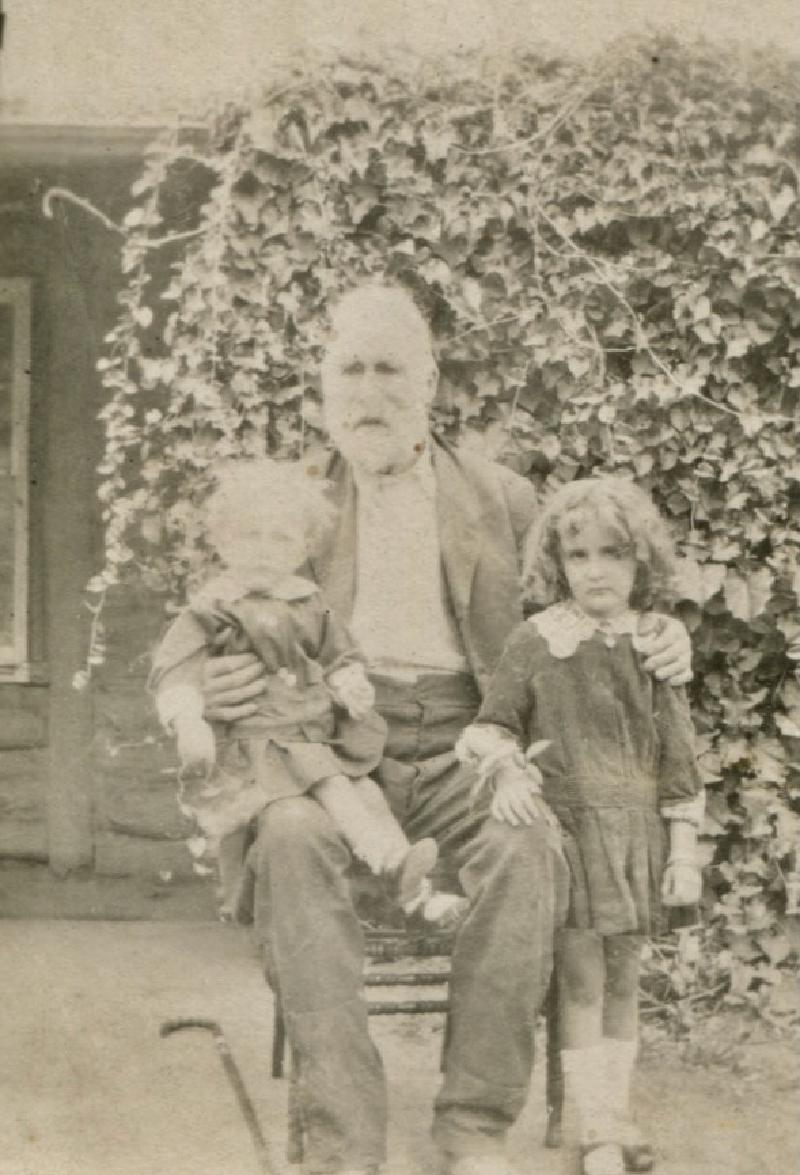
The Numurkah Leader of Wednesday 12 January 1927 tells us:
The death occurred at Barwo on Monday of Mr Martin O’Hare, at the great age of 90 years.
Honor Pusenjak says of Sarah:
Sarah, “Old Aunt”, was the typical maiden aunt of Victorian times, taking her full share of family life and sharing with the growing children of her sister-in-law. She was said to be a very good maker of cakes, lamingtons, napoleons and sponges, but I remember her best as being continually in the kitchen standing up washing dishes, and what amount of dishes there were! Family legend has it that there was once somebody, but she never married.
The Argus of 7 October 1933 tells us:
O’HARE-On the 2nd October, at her residence, Snugborough, Nathalia, Sarah, dearly loved sister of the late John and Martin O’Hare, aged 87 years. - Requiescat in pace.
To show the Commons in this generation, it is convenient to show a family tree of the descendants of William Commons.
Family tree: William Commons (fullscreen)
Honor Pusenjak gives us some details, which she got from Michael Doherty (her Aunt Lal’s husband):
John O’Hare and Mary Ann Rose Commons were married at Kyneton by Dean Geoghegan on 12 August 1868. In 1968 Lal and I had a 100th anniversary mass celebrated in the Kyneton Church by a Father Connors. He showed us a volume containing the original marriage certificate. The witnesses who signed it were (Old Uncle) Martin O’Hare and (Old Aunt) Sarah O’Hare, and for good measure, indicating that he approved of his daughter’s choice, old William Commons also added his signature. Father Connors remarked on the particular educated handwriting of all of them.
Mary Ann’s family had a property in Woodend, only 12 km from Kyneton. Maybe Woodend didn’t have a Catholic Church (or a resident priest) in 1868.
We have a photograph (from the web) of Mary Ann at about the time of her wedding.
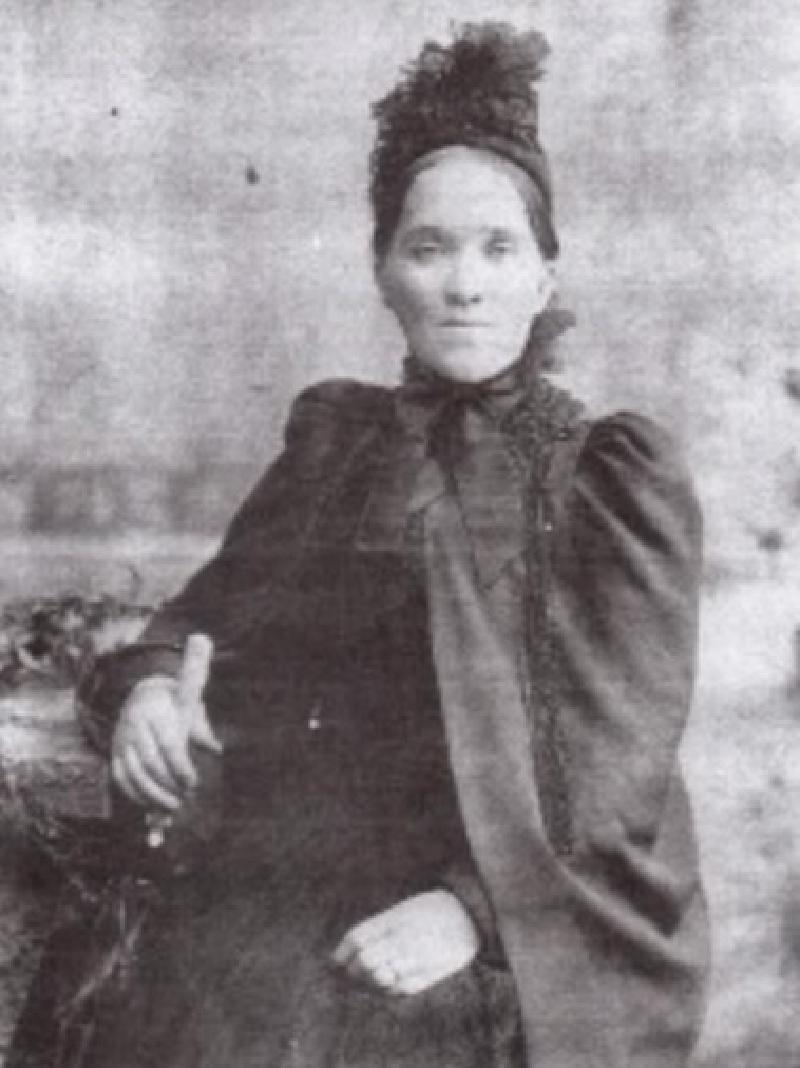
Honor has direct memories of her grandmother Mary Ann:
Grandma was blind. She lost her sight through cataracts but she could knit and always seemed to have a sock on her needles waiting for someone to “turn the heel” for her. I sometimes sat and spelled out words from the newspapers to her and thus I learned to read long before I went to school. Usually for an hour or so each day one of the aunts would read to her from a novel, and how delighted she was with the poems in John O’Brien’s “Around The Boree Log” depicting such Australian-Irish scenes she knew so well herself.
The Nathalia Herald of Tuesday 6 March 1928 tells us:
A very old colonist and resident of the Nathalia district for over 50 years, in the person of Mrs Mary O’Hare, relict of the late Mr J O’Hare, died at her residence, Barwo, yesterday morning at the great age of 82 years. The late Mr O’Hare was one of the first to take up land at Barwo and with Mrs O’Hare settled there in 1876. Those whose memory can carry them lack to the pioneering days of the district relate innumerable instances of the large heartedness and kindly disposition of the deceased lady, who even when conditions became better and settlers were not so isolated, never wearied of her well-doing among the sick and the needy. Though in latter years her eye-sight failed that did not prevent her from taking a keen interest in all things around her.
A family of five daughters and four sons, the members of which are Mrs Doherty (Canberra), Catherine (Melbourne), Josephine, Sarah, Maggie (Barwo), Martin (W.A.), William and Phil (N.S.W.), and Jack (Barwo) are left to mourn the loss of a devoted mother. For them and her sister (Mrs J. Ball) and sister-in-law (Miss Sarah O’Hare) much sympathy is expressed.
The funeral took place yesterday afternoon when, despite the short notice, a number of mourners followed the remains to the Nathalia cemetery, where the Rev. Father Murphy officiated at the graveside.
Honor Pusenjak tells us:
Aunt Sarah’s two brothers (Grandfather John) and Martin (Old Uncle) came to Australia later, as young men bringing with them a cousin Margaret McCormick who married John Brown, the father of Cissy, Rose and Maggie who became my mother’s best friends.
It turns out that family story Honor was relating somehow got the details wrong. There was a cousin, but her name was Catherine O’Malley.
The appropriate details are demonstrated in the following family tree, for the descendants of John Hassett (Margaret Hassett’s father).
Family tree: John Hassett (fullscreen)
There is a Catherine Hare on the passenger list for the John and Lucy, along with John and Martin O’Hare. She gives her age as 17 (which is correct) , is a Domestic Servant, can read (but not write), and is listed as “Gone to Father, Melbourne” (exactly as for the boys). It is surely her. It was probably simply and slightly safer to travel as a sister to the boys rather than a cousin. It seems that Irish immigrants were somewhat flexible with details when it suited them.
Catherine OMeally married John Brown in Melbourne in 1864. John Brown arrived in Melbourne on the ship Sultana on 1 March 1858. The passenger list shows him in a list of 9 Irish policemen, obviously explicitly recruited and brought out directly into the Victoria Police Force.
The Age of Wednesday 27 May 1896 tells us:
BROWN. On the 26th May, at his late residence, Dandridge, 154 Gatehouse-street, Parkville, John, the dearly beloved husband of Katherine Brown, and brother of Mr. P. Brown, Sunbury, (Iate of Victorian police force), in his 68th year. May his soul rest in peace.
The Age of Monday 21 February 1916 tells us:
BROWN. — On the 19th February, suddenly, at her residence, “Dandridge,” 154 Gatehouse-street, Parkville, Catherine, relict of the late John Brown, of Victorian police force, aged 76 years. By request, no flowers. Rest in peace.
Her death certificate (as transcribed by Ancestry.com) gives her mother as Cath Hassett. This is the explicit cousin link. Several on-line family trees explicitly identify Bridget Catherine Hassett as a sister to Margaret Hassett. They don’t, however, provide explicit evidence.
John and Catherine had six children, including the three girls, Cissie (Cecilia), Rose and Maggie (Margaret) mentioned by Honor Pusenjak. The youngest daughter, Katherine, married into Nathalia society. The Nathalia Herald and Picola, Narioka, Kotupna and Moira Advertiser of Tuesday 1 November 1910 reported (in part) that
Miss Katie Brown, youngest daughter of the late Mr. Jno. Brown and Mrs. Brown, of “Danbridge,” Parkville, was married on October 12th to Mr. James Bourke, third son of Mr. M. Bourke, of Wattle Park, Barwo. The ceremony took place at St. Mary’s Parish Church, West Melbourne, the Rev. Father Keenan officiating. The bride entered the church on the arm of her uncle, Mr. Martin O’Hare, and was attired m a pretty gown of ivory lace over an under dress of white liberty satin.
This was “Old Uncle” Martin. Strictly, Katie was not his niece, but his great-niece. The relationship between the families clearly remained very close.
This is the generation of Kerry’s paternal grandfather and his nine siblings. Of the ten, only three married.
It is informative to look at the 1925 Electoral Roll. There are eight O’Hares registered at Nathalia (presumably living at Snugborough). There are three left of the older generation: John Joseph’s widow Mary (aged 80), Old Uncle Martin (aged 88) and Old Aunt Sarah (aged 79). There are five of the next generation, all single: Joanna, John Joseph, Margaret, Sarah and William. Mary has died, some thirty years before. Martin Patrick has married, and is living in Queensland. Philip has married and is living in NSW. Eliza has married, and is living in Melbourne. Catherine is still single, and is in fact living with Eliza and her husband in Melbourne. When she retired in 1949, she moved back to Snugborough.
At this remove, the ownership and the finances of the farm are not clear. Somehow the farm duties were shared, and the farm income was shared.
As well as being a home for the eight unmarried adults, it was also a family foster home. As explained here the first two children of Martin and Angela also lived at Snugborough during the period 1913 to 1926, being mothered by the Aunts. See the photograph of Old Uncle above.
The Pioneers of Nathalia and District tells us:
After the deaths of Billy and Jack within a few weeks of each other early in 1931, Margaret, Sarah and Johanna continued the running of the farm with hired help until the harvest of 1939 when John, Phillip’s eldest son was sent for “to help take off the crop”. He has been there ever since and is now the owner of the property.
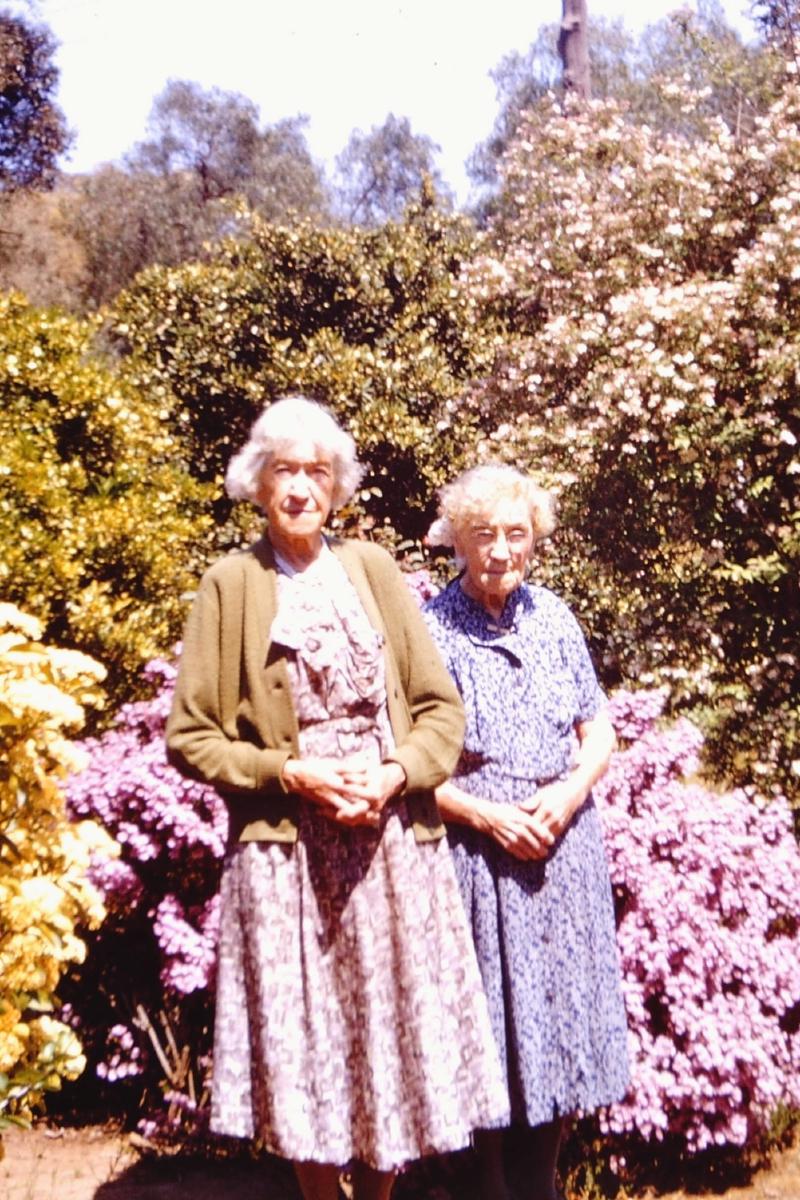
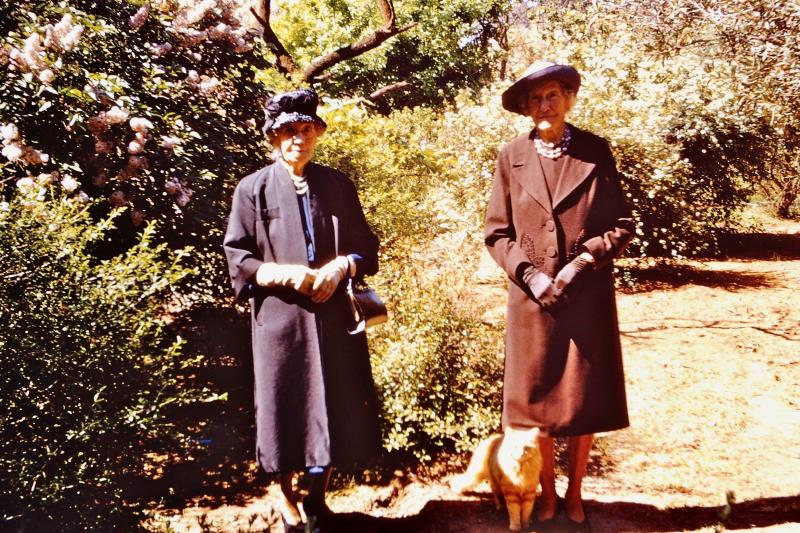
By 1962 there were just three of “The Aunts” left at Snugborough. We have a photograph, taken during a visit by Frank and Sheila O’Hare (Kerry’s parents).
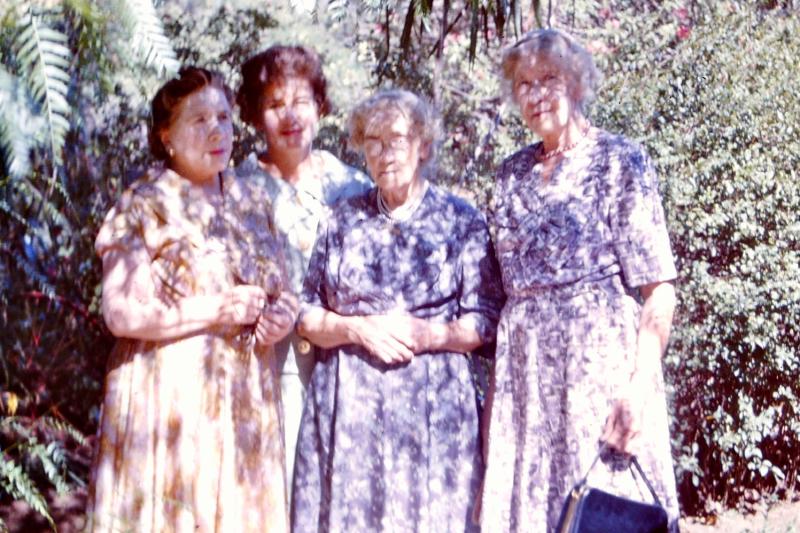
They made another visit in 1966. Sarah died in 1965. We have two photographs of Johanna (aged 91) and Catherine (aged 85).
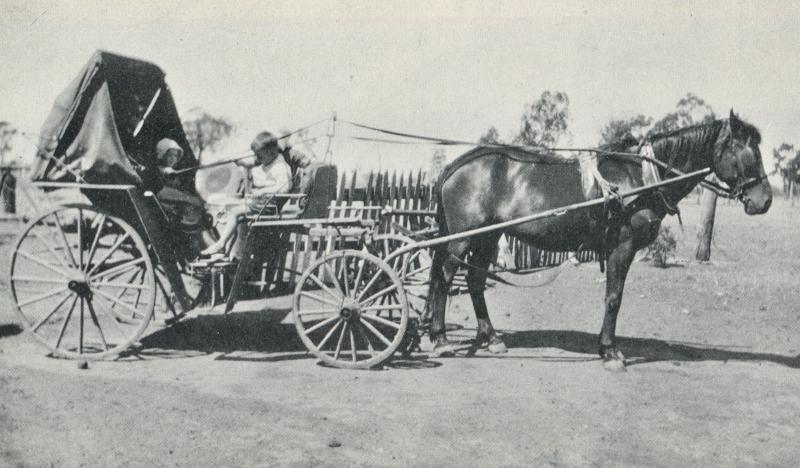
Although he was the oldest son, there seemed to be no room for him at Snugborough. Honor Pusenjak tells us:
There was not enough room to support four sons on 500 acres, so my father went to work for the Gormans who owned Nangunyah station near Berrigan in the NSW Riverina. Here he remained for many years, eventually becoming farm manager.
He worked at Nangunyah Station owned by one Mr Emanuel Gorman.
A report in the Numurkah Leader of 21 August 1908 relates (in full detail) a farewell for Martin as he left Nathalia to start a farm near Kin Kin, in Queensland.
The Gympie Times and Mary River Mining Gazette of 8 September 1908 tells us:
Mr. M. O’Hare, of Kembla Heights, N.S. Wales, who recently purchased a large area of country north of Kin Kin, arrived at Gympie last week, and intends settling on his property right away; he has had about fifty acres felled.
The Gympie Times and Mary River Mining Gazette of Thursday 20 February 1913 tells us:
KIN KIN (From Our Correspondent.)
The rainfall for January was 1614 points and there were 22 days on which rain fell. Up to to-day (13th February) rain has fallen every day this month giving 517 points, which is a total since January 1 of 2131 points.
The district is looking beautiful and probably never looked better. The new burns are quickly assuming a green appearance as the regular rains have hastened the germination of the grass seed. There is very little grass seed being saved here this season as holders of last year’s seed have not been enabled to dispose of it at a satisfactory price. Nine months ago Rhodes grass was fetching 2/3 per lb., and now it can be bought here for 4d.
The cream supply at present is very heavy and Mr. Chapman"s three carts are kept very busy ; the most pessimistic must admit that there is now quite sufficient cream to warrant the factory being erected. Mr. Graham the Government Dairy Expert spent a couple of days going through the farms here. It is the wish of the directors to obtain expert advice as to what class of machinery to use and the capacity of same to suit the requirements of the district. The idea is an excellent one and pleasing to the shareholders. The directors are all dairymen and as such are not expected to know much about factory building, but when in possession of the information from Mr. Graham they will be in a much stronger position to deal with the contractor or the firm supplying the machinery.
Quite a number of houses have of late been erected, which is a good reflex of the prosperity of the district. Mr. E. C. Tomkinson, of Upper Kin Kin, has just had substantial additions made to his house and it is now quite a commodious build-ing. Mr. Tomkinson is one of the pioneers of the district, coming here from Ipswich some eight years ago. Mr. Martin O’Hare of Kauri Hills in December had a nice residence erected containing seven rooms and wide verandahs all round. It is built mainly of hardwood as he does not approve of soft timbers for building purposes and when it is known that his native land is a district in Victoria on the banks of the Murray, Australia’s greatest river, whose long course from source to estuary is marked out by park like forests of great red gums, the timber of which is almost indestructible and is used in those districts for all purposes, then one can understand why Mr. O’Hare pins his faith to the hardwoods. On the 16th of December Mr. O’Hare was married in Melbourne where the honeymoon was spent and with his good wife is now home and quietly settled down in the Kauri Hills house.
The Gympie Times and Mary River Mining Gazette 19 February 1916 tells us:
BIRTHS. O’HARE. February 17th, at “Kotoro”, Nurse Hillcoat’s Private Nursing Home, the wife of Mr. M. P. O’Hare, of Kauri Hills, Wolvi, a son.
“Kotoro” was a facility in Gympie that provided midwife services. These were common before public hospitals were better developed and trusted. The place-name Wolvi lets us locate the farm a little more accurately. It is about 10km north of Kin Kin, on the road to Gympie.
At the moment, I have only one photograph of Martin, taken at about this time.
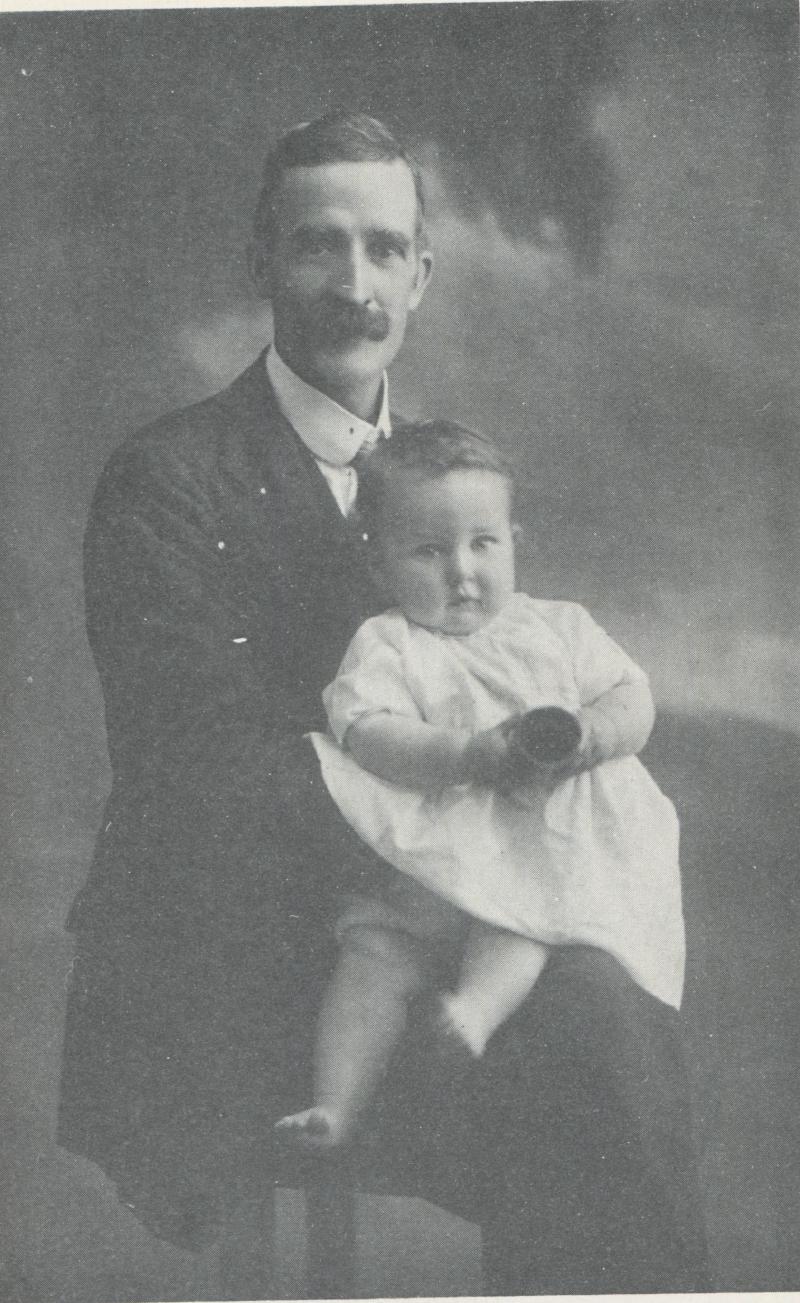
In late 1925 (or perhaps early 1926) Martin fell seriously ill. Honor tells us:
We were told that he had developed the dreaded T.B.. His lungs were effected. He must be moved as soon as he could travel to a climate less damp and humid than the Queensland coast.
Events now moved with dramatic speed. The Aunts immediately rallied to give their loving support, Jo and Kath coming as fast as trains could carry them. When he was well enough my father travelled back to Victoria with Auntie Kath. We remained behind till the sale of the farm was negotiated. The contents of the house were auctioned, my mother’s wedding presents, all our furniture, there was little that could be salvaged.
They travelled from Brisbane to Melbourne on a coastal steamer, the Levuka, and the family was reunited at Snugborough. Martin slowly recovered, and it was thought that he was not suffering with T.B. but with a complication of dengue fever. In any event, Martin lived to the good age of 79 years.
Honor relates that the family was there for nearly twelve months
while my father tried to find a suitable property at a price that he could afford in Nathalia and surrounding areas. It was a vain search, land was everywhere too expensive and nothing was ever found.
The momentous decision was taken to move to Western Australia, where farms could be had for less money. Again they travelled by sea, on the Hobson’s Bay. This was one of a small fleet of steamers owned by the Australian Government that plied from Australian ports to Britain and return. What with all the stops the round trip was about four months. The Hobson’s Bay arrived in Fremantle from the Eastern states on 18 November 1926 and next on 06 April 1927. The November sailing seems the most likely.
In Perth the family stayed with Angela’s sister Annie while Martin went looking for a farm.
My father at last managed to purchase a farm in the Corrigin district, not far from his old friends the Keays and the Dillons. The local siding was Bilbarin which consisted of nothing more than a general store, a school with a house for the resident master, a hall, and the usual wheat-handling near the siding.
We can date this quite precisely. The West Australian of 17 May 1927 tells us:
Corrigin
Within the last few days, Mr Joseph Tuia (one of the early settlers here) sold his farm to Mrs Lithgo of Mt. Lawley, and Mr A H Henderson’s farm at Bilbarin was sold to Mr O’Hare of Victoria, at satisfactory prices.
If this is not the actual farm, the following advertisement from the Sunday Times of 4 July 1926 gives a good idea of what it might have cost:
1000 Acres, 3 miles from Bilbarin Siding and School, 830 acres first-class land; timbered with gimlet, yorkgum and jam; 830 acres cleared, 300 acres fallow; boundary fenced and subdivided into 4 paddocks; watered by dam and well: 5-roomed House, stables, chaffhouse, etc; carrying capacity 300 sheep; 3 horses and full working plant.
PRICE, £4 15s. per acre. Including crop, stock and plant; £1000 cash, balance arranged.
A meeting with his old friend Jack Dillon was reported later in the Corrigin Chronicle and Kunjin-Bullaring Representative of 10 March 1938:
You Never Know!
That this world of ours is but a small place, was instanced to the representative of this journal, one day this week. Conversation with a local resident and farmer in Mr. J. F. Dillon was in progress — various topics — until discussion arose on coincidences or peculiar incidents in life. Mr. Dillon told the best naturally—being an old head— and as it concerns that gentleman and Mr. M. P. O’Hare, formerly of Bilbarin, but now of Cunderdin, the incident bears repeating in a condensed form:
Mr. O’Hare was best man at Mr. Dillon’s wedding in 1901, in Goulburn Valley, Victoria. Mr. Dillon came straight back to the Goldfields and several years later came to Brookton, and secured a property at Corrigin. Mr. O’Hare in the meantime, was situated in N.S.W., later moved to Queensland, ill-health in turn causing him to move to Victoria. Owing to circumstances not being favourable, he headed for the West in 1927 and selected a farm at Bilbarin. Soon after his arrival, Mr. Dillon, working the Corrigin farm from Brookton, used to travel from that centre, plant the crop and return to Brookton until harvest time. It was on one of these trips that the two friends met on the roadside near Lomos, to the surprise of both, after a period of some 27 years. After that — well we leave it to you.
We have two reports of the family’s time at Bilbarin. The Toowoomba Chronicle and Darling Downs Gazette tells us on 1 August 1927:
TWO STATES COMPARED.
Mr. M. P. O’Hare, writing to “Gympie Times,” from Bilbarin in West Australia, in which place he has recently settled, says: “The country here is in marked contrast with Gympie and Kin Kin districts. We miss the wonderful greenery and rich verdure of those places. The tropical growth and lovely little rivulets are absent in the West. Still it’s going to be a wonderful wheat-growing State and when in order will carry a fair number of sheep. It will never be the equal of the wheat-growing areas of Victoria or the Riverina. The Government here, though Labour, are keen on land settlement. They give every encouragement and assistance to anyone willing to take up new country. Their Land Acts are good and very liberal. I trust your Premier does not call in on his way back from London and put them wise or otherwise to the Queensland method.”
In early 1928 the Nathalia Herald printed a series of five articles by one J. O’Hagan, entitled Across Australia from West to East. Article number 2, printed 24 January 1928, included a detailed description of Martin’s farm:
When in West Australia I had the pleasure of calling on Mr. Martin O’Hare, a former resident of the Nathalia district, and stayed with him for a few days. He has a splendid farm, and I heard from outsiders that it is the best farm for many miles around. It comprises 918 acres, and is termed a very handy one-man farm. He only bought it at the beginning of April last.
The ground he grew his crop on was fallowed by the sundercut. Mr. O’Hare worked it again previous to sowing with the sundercut, and then sowed the wheat with the combine at the rate of 60lbs of wheat and 90lbs of super per acre. His crop when I was there was averaging over 21 bushels per acre, some parts of it going much more. With improved farming methods I am sure the farmers in Western Australia would do still better than already is the case, although the fallows are fair. The farmers in Mr O’Hare’s district are getting good results with the sundercut, and they say the mouldboard plough is too slow. However, their fallows do not appeal to me, and in my opinion extra workings of the fallows would produce three to four bags more per acre.
Mr O’Hare’s property is mostly of a sandy loamy nature, and is equal to the best land in the Nathalia district. It is gently undulating, and on all sides is surrounded by hills, which look picturesque in the distance. Beautiful little trees, with dense foliage and rounded tops, are growing here and there over the farm, and as well as being nice to look upon, act as shelter for the stock. The manna gum (a species of the wattle family), which has a beautiful yellow blossom in the spring time, is also a pretty round-topped tree with dense foliage, the gum of which has a comnicrcial value, and sells readily at 4d per lb, This tree has a long narrow leaf full of moisture. I also noticed other trees on the property, the leaves of which were glistening in the sun, and when I pulled them they were full of sap, which is altogether different to the dull green looking leaf of the grey box tree, deficient in moisture content, that is to be seen about the Nathalia district. This all made me think that there must be a great deal of moisture not far beneath the surface, and upon enquiry I elicited the information that good fresh water could be obtained from six to eight feet from the surface in several places on the farm. In fact, I believe water could be got at not too great a depth all over the farm, and this no doubt accounts for the glistening of the healthy trees in the sunshine. Although the annual rainfall in that locality is only 16 inches it is quite sufficient for all requirements. It is not at all improbable that the rain that falls on the hills which surround this and neighbouring farms finds its way by soakage to the lower levels, so I do not wonder at all the farmers who I came in contact with over there saying that the land of Western Australia is a puzzle to them and that it is really far better than it looks.
The temperature in Mr O’Hare’s locality is not so oppressive that a white man could not work in the harvest field. The hottest day for the year, and which 1 believe was a record, occurred on December 12, the thermometer rising to 106, but one great advantage there is that a sea breeze comes along regularly in the evening from the Southern Ocean and there are always cool nights. The breeze in that locality is called the “Albany Doctor.” You can hear it whistling through the trees from the south some time before it arrives, and it sometimes stays on till the morning of the following day. It was ideal harvesting weather when I was at Mr O’Hare’s place, only a little cool in the morning and there were days when you could not see a collar mark on the horses. The crops there ripen about a fortnight earlier than at Nathalia or Numurkah.
Mr O’Hare’s property is three miles from Bilbarin railway siding, where there is a large shed which will hold about 13,000 bags of wheat, which is controlled by the Westralian Farmers Limited, acquiring agents for the trustees of the Co-operative Wheat Pool of Western Australia. There is also a store, blacksmith’s shop, hall, State school, and a branch of the National Bank there. The pool received 45,000 bags of wheat at the siding last year, and Dalgety holding 33,000, or 81,000 bags altogether. When I was at Bilbarin on December 16 there were only 25,000 bags of this season’s wheat at both the cooperative shed and stacked at the siding, but farmers estimated that when carting was completed the total for the season would be about 80,000 bags. On the date mentioned the market price of wheat at Bilbarin was 4s per bushel, and at the beginning of the season the price there was 4s 4d.
Of course the Bilbarin district has its troubles as well as other parts of the State, as there are three pests there, viz., rabbits, poisonous plants, and wild dogs. The rabbits are the chief menace at present, and a little damage has been done by them to the crops this year, and the pest is not decreasing by any means. Mr O’Hare is making preparation to wire-net the whole of his property, and others in the district are doing the same. As regards the poisonous plant which 1 believe exists more or less in most of the settled portions of the State, cultivating and grazing are the main means of coping with the trouble. There was none of this plant to he seen on Mr O’Hare’s property, but some of it was pointed out to me near the railway siding at Bilbarin. The wild dog will be the next danger, and a very serious one, too, where sheep are concerned.
If the farm itself was judged to be “splendid”, the farmhouse itself did not attract any such praise. Honor tells us:
The house on the property fell below our previous standards, but it “was there” and we must endure it. It was jarrah weather-board, hot in summer, cold in winter. It was so designed that all who entered had to arrive at the back door and walk through the kitchen to reach the front room. When all were at home it was too small for us. With visitors, the verandah was always cluttered with extra beds.
In the summer, water became a most precious commodity. It had to be carted from a few soaks for washing and bathing, while we had to rely on our rainwater tanks to supply drinking and cooking needs. Consequently during the summers, there could be no garden; a lawn was unheard of.
We have several photographs, taken years later. The house is unchanged, but had long since been abandoned.
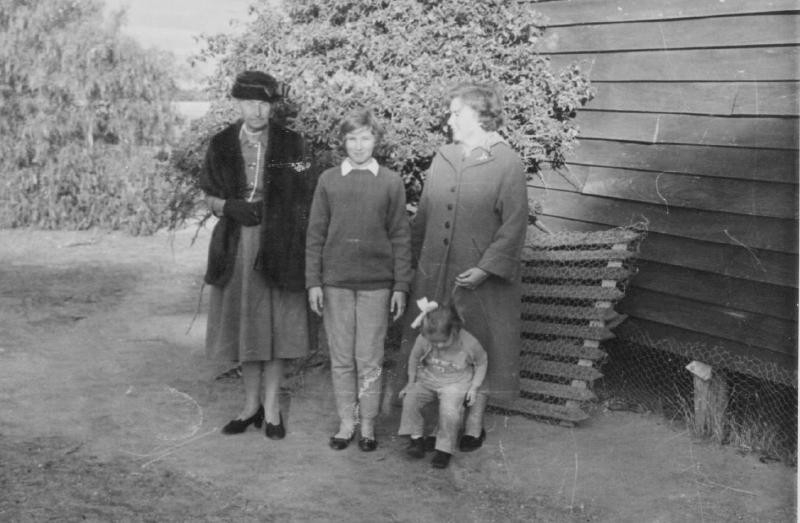
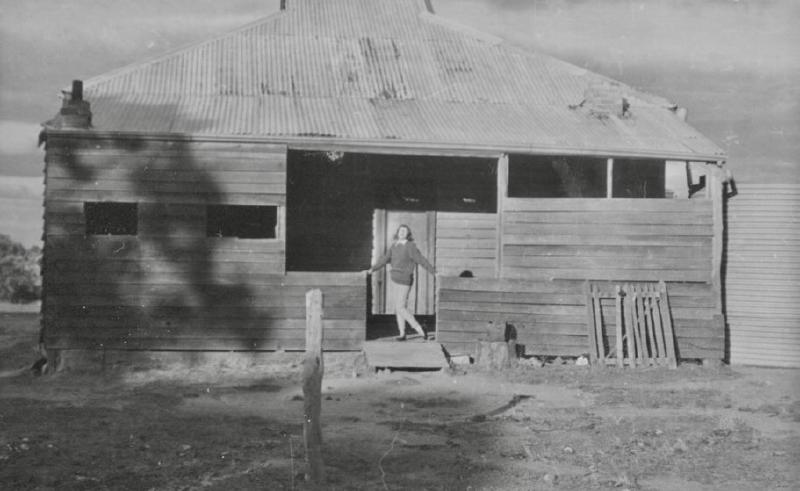
In 1938 a better financial situation allowed them to move to a property called Yenelin, south of Cunderdin. The Corrigin Chronicle and Kunjin-Bullaring Representative of 3 March 1938 reported a sendoff.
Bilbarin Valedictory.
A social evening and dance was held in the Memorial Hall, Corrigin, on Saturday, 26th February, the occasion being in the nature of a sendoff for Mr. and Mrs. M. P. O’Hare and family, who are leaving the Bilbarin farm for a larger one at Cunderdin.
A most enjoyable evening was spent under the Chairmanship of Mr. Dillon. The speakers were Mr. Childe on behalf of the W.G. Union of which Mr. O’Hare has been Chairman of the Bilbarin Branch for the past 3 or 4 years.
Mr. Martin on behalf of the P.P.A., of which Mr. O’Hare was a loyal member until the Branch ceased to function.
Mr. W. Marshall on behalf of sporting bodies, principally cricket of which he and his family have always been keen supporters and players.
Mr- Brankstone, on behalf of the Corrigin and district residents and Mr. Gasser on behalf of the Bilbarin and district residents. Each speaker stressed the point to show in what high esteem the family were held by all with whom they came into contact.
Mr. O’Hare replied, thanking everyone for the good things said and the good feeling he had always found to exist amongst all with whom he came into contact while living in the district and extolling the district, his only reason for leaving being that having now a grown-up family, he had to get a larger farm to keep those who remained at home employed.
During the evening, presentations were made to Mrs. O’Hare (a Pyrex Casserole), and to Mr. O’Hare (Case of Pipes), by the Chairman as a small token of esteem. The Cricket Club also made a presentation to one of their stalwarts, Mr. Frank O’Hare.
Music was supplied by Miss Parsons, assisted by Mr. O’Connor and others. A sumptuous supper was served in the usual fine style by the ladies and a most enjoyable evening was brought to a close by the singing of “Auld Lang Syne.”
Manna Gums was initially leased. The Corrigin Chronicle and Kunjin-Bullaring Representative of 3 March 1938, tells us:
We must bid “goodbye” to Mr. and Mrs. O’Hare, of Bilbarin, who have leased. their farm to Mr. Tullock. They are settling in Cunderdin, where they have taken a farm of 3,000 acres.
Paul O’Hare thinks that it was finally sold around 1948. Soon after that Martin and Angela retired to Perth, to 30 Comer St, Como. Their son Ned took over “Yenellin”.
Martin died in 1953. The West Australian of 23 July 1953 reported
O’HARE: On July 21, at his residence, 30 Comer street, Como, Martin Patrick, dearly beloved husband of Angela, loving father of Honora (Mrs. Pusenjack), Francis, Martin, Edmund and Elizabeth, father-in-law of Sheila, Patricia and Margaret, grandfather of eight grandchildren; aged 79 years. Requiescat in pace.
Lived at Snugborough. One of “the girls”.
The Advocate of 7 October 1937 tells us:
O’HARE.—On 3rd October, at private hospital, Melbourne, Margaret, loved eldest daughter of the late John and Mary O’Hare, of “Snugborough,” Nathalia. Requiescat in pace.
Her death certificate, at least as transcribed by Ancestry.com, shows her dying in Barwo in 1892, aged 19.
Honor Pusenjak tells us:
Uncle Billy was a man of immense charm but had occasional lapses into alcoholism. I remember a night when late at night he appeared at the house demanding I suppose, drink or money. None was forthcoming and hotels in Nathalia had been forbidden to serve him. “Then I’ll ride to Waaia” he cried and rushed into the night. “The poor horse”, said Old Uncle with a huge sigh. “Ho! Ho!, the poor horse”.
The Age of 25 February 1931 tells us
REMARKABLE COINCIDENCE.
Deaths of Bachelor Brothers.
NATHALIA, Tuesday. Mr. William O’Hare died yesterday after an illness of some months’ duration, at the age of 53. His brother, Mr. John O’Hare, died suddenly, three weeks ago. Both were unmarried.
Honor Pusenjak tells us:
Jack O’Hare was somewhat eccentric. Today perhaps if his eccentricities were channelled correctly, he could have been brilliant. He used to invent things, had many guns, bringing down ducks and hares with great ease. He was also a great fisherman and many a fine Murray Cod did he bring home from the creek. He it was who put in the crop and did the harvesting.
He had it in for rabbits. The Numurkah Leader of 31 January 1908 tells us:
An Improved Rabbit Destroyer. Patents are being applied for by Mr John Joseph O’Hare, of Nathalia, for an invention described as an “Improved apparatus for destroying rabbits by noxious fumes.” Mr O’Hare found that two things had to be overcome to effect absolute certainty of death in the burrow. There was first something needed in a fumigator to prevent the return of the carbonised air, and secondly a provision that when poisoned the air would reach to the full length of the burrow. He set about to overcome these defects and if the evidence tendered by his neighbours and himself is to be believed, and we have every reason to believe them, he has succeeded. The machine was used at several very large burrows on warrens and when these were afterwards dug out not a live rabbit remained. Shortly described the machine consists of a small reservoir or tank in which is placed a small quantity of bi-sulphide of carbon. Through the bottom of this a piece of piping is run with holes on the inside to take in the carbon. On the one side is attached an air pump fitted with a valve after the style of a bicycle pump so that when the carbon is forced into the burrows there is no return of the carbonised air. The carbon is forced into the burrow direct through a long galvanised pipe and the air by a separate pipe is let in above the carbon and distributed all over the burrow to its furthest extremity. The chief point of difference, the maker claims, is that in other fumigators the air and carbon are mixed in the machine and there is no mechanism to prevent a return. So far only a few of the machines have been made and these have found a ready sale and orders have been given in.
Eagles weren’t safe either. The Nathalia Herald and Picola, Narioka, Kotupna and Moira Advertiser of Tuesday 9 August 1921 tells us:
Periodically, and particularly during the lambing season, eagles visit the district, and several of these large birds may be seen within few miles of the town. A week or so ago Mr J. O’Hare shot one measuring 8 feet from tip to tip — one of the largest of its kind. The bird was viewed by many people at the office of Mr A. E. Heighway, and its picture is being placed on canvas by Miss Scott, an artiste visiting the district, and who is a niece of the last-named gentleman.
The Numurkah Leader of 10 February 1931 tells us:
A well-known resident of the Nathalia district, Mr John O Hare, died suddenly at his farm on Tuesday last. The late Mr O’Hare who was 51 years of age, was born at Nathalia, his parents being amongst the very first settlers in that district. He was a fine athlete and won a reputation for himself as one of the best pigeon shots in the State. Personally he was very popular, and his sudden death caused deep regret among his many friends. Surviving members of his family are Misses M., J., K., and S. O’Hare (Nathalia), Mrs M. Doherty (Melbourne) and Messrs Martin (West Australia), William (Nathalia), and Phil. O’Hare (West Wyalong).
The funeral on Wednesday was largely attended. The interment took place in the Nathalia Cemetery, where the Rev. Father Heffernan read the burial service.
Honor Pusenjak tells us:
Auntie Kath worked all her life in the Lands Department (in Melbourne) until she retired back to Snugborough, while Auntie Sara sometimes got called to Melbourne for a temporary office position.
By 1918, Cath and Eliza were both working in Melbourne. Honor Pusenjak tells us they boarded with a cousin Ellen Commons (one of Maurice Commons’ children) who was married to one Patrick Collins. They lived at 27 Grattan St, Carlton, and had no children, so chose to take in boarders. Honor relates that in about 1919 it was decided that the government school at Barwo West would not do, and that Cath and Eliza should look after her in Melbourne while she attended the rather posh Catholic Ladies College. She speaks of Cath having the main caring responsibility, particularly after Eliza married in 1921. The arrangement came to an end in about 1923, when Honor was taken back to her parents in Kin Kin. (Frank remained at Snugborough, looked after by Sarah in particular).
Cath seems to have lived with her sister and brother-in-law. The Electoral Rolls certainly record the same address in Deepdene. Pat Collins died in 1925, and maybe the boarding arrangements in Carlton came to an end. At some stage Ellen moved back to Woodend where her Commons family lived (she died there in 1942).
Honor Pusenjak tells us:
Apart from my father, the only other male member of the O’Hare family to marry was Uncle Phil. He was a rather dashing young man and started to pay his attentions to a charming girl, Flo Reardon, who was an accountant in the office of “Brown and Corks”. Phil’s attentions were frowned on by the Aunts, especially Aunt Margaret, because terrible to relate Flo was not a Catholic. Many diatribes were hurled at Uncle Phil for his breach of “The Faith”. He persisted, however, and they were eventually married in Flo’s home state, Queensland.
I do not believe any of the Aunts attended the wedding, in spite of which the couple lived happily. They eventually settled on a farm in Wyalong, NSW, where they raised a family of six children. When Mary, the only daughter, was a little girl Flo died tragically after being burnt by the explosion of a petrol lamp.
Uncle Phil, with the help of the Aunts, managed somehow. He was lucky enough to win £10,000 in Tatts. Later he married again. Dot Leach was a widow and a friend of the Aunts.
The West Wyalong Advocate of 24 April 1947 tells us:
Mrs. O’Hare’s Death From Burns
Following a tragic burning accident on Sunday evening, the death of Mrs. Florence Elizabeth O’Hare, wife of Mr. Philip O’Hare, of Buddigower, occurred in the District Hospital, West Wyalong on Tuesday morning.
In trying to extinguish the flames Mr. O’Hare suffered severe burns, and he is a patient in the hospital.
The accident occurred shortly after sundown, when Mrs. O’Hare was lighting a petrol lamp. It was stated that some difficulty was experienced in lighting the lamp, and when releasing air from it the benzine ignited, enveloping Mrs. O’Hare in flames.
The only other member of the family at home was their young daughter, Mary, who rode a bicycle to the tennis courts, over two miles away, where some of her brothers had been playing. The Bland Shire Ambulance was summoned, and Mr. and Mrs. O’Hare were given first aid and brought to the District Hospital.
The late Mrs. O’Hare was 52 years of age.
Mr. and Mrs. O’Hare came to Buddigower in 1924 from Nathalia, in Victoria. They have endeared themselves to all in that district by their kindliness and their good neighbourly qualities, and the whole community was shocked and deeply grieved by the tragedy. In rearing her children she lived up to all the ideals of motherhood and set them a fine example. They gained their preliminary education at their own district school, and in their higher education three of them Martin, Patrick and William, have secured bursaries. All social and community activities in their district have been given good support by Mr. and Mrs. O’Hare.
In addition to her husband the late Mrs. O’Hare leaves five sons and one daughter. They are Philip and Patrick (Buddigower), John (Nathalia), Martin (ex-RAAF, Melbourne), William (a student at St. Patrick’s College, Goulburn) and Mary (Buddigower).
Her mother lives in Queensland.
The funeral at West Wyalong on Wednesday afternoon, which left St. Mary’s Church, was a large and representative one, and there was a wealth of floral tributes. The service at the graveside was read by Father Lynch, and the interment was made in the Roman Catholic portion of the Wyalong Cemetery.
A nephew, Giffard O’Hare, provides the following memories of Snugborough and his aunt around 1960.
When we were young we stayed at the Snugborough Farm at Natalia on a number of occasions. The old aunts, Aunty Sarah, Aunty Joe and Aunty Kath lived in the original homestead that was an extension of the original log cabin. This original cabin is all that remains and we were told by Mary Barry that it was to be heritage listed. There was another building at the back that served as an extra living area - all gone. There was a beautiful orchard of mainly orange trees behind this and the drive from the access road was lined with these magnificent peppermint trees. John O’Hare, built his house nearby and worked with the aunts in running the property. Dad had 80 acres there that he inherited and John eventually bought Dad out.
Aunty Sarah was my favourite aunt. She was an accomplished pianist and we had these great singalongs around the piano. She was very attractive when young and I remember seeing a photo of her and Aunty Lal who married Uncle Mick on the wall and thinking she would have made a wonderful wife and mother. Interesting that I have only just learnt that she and I share the same birthday, 24th of January. This would explain why Aunty Sar used to spoil me with big servings of lemon meringue pie and she even gave me a beautiful big green one pound note for helping herd the sheep to the shearing sheds up at the Thorpe’s nearby property. It was a lot of money for a 10 year old kid in those days.
Called Auntie Lal, she worked (like Catherine) in government offices in Melbourne. She married Michael Doherty in 1921, and they had three children.
Honor Pusenjak tells us:
It was about this time that Auntie Lal and Uncle Michael Doherty got married. As she was the only O’Hare daughter to achieve this state, the wedding was a large affair. It took place in Nathalia with all of the family friends present to wish them well. Father Murphy performed the ceremony and the reception was held in the Court House Hotel. Uncle Michael had a brilliant legal mind, eventually becoming Registrar of the High Court, a position which makes us very proud of him.
The wedding and reception was reported in full detail in that journal of record the Nathalia Herald and Picola, Narioka, Kotupna and Moira Advertiser.
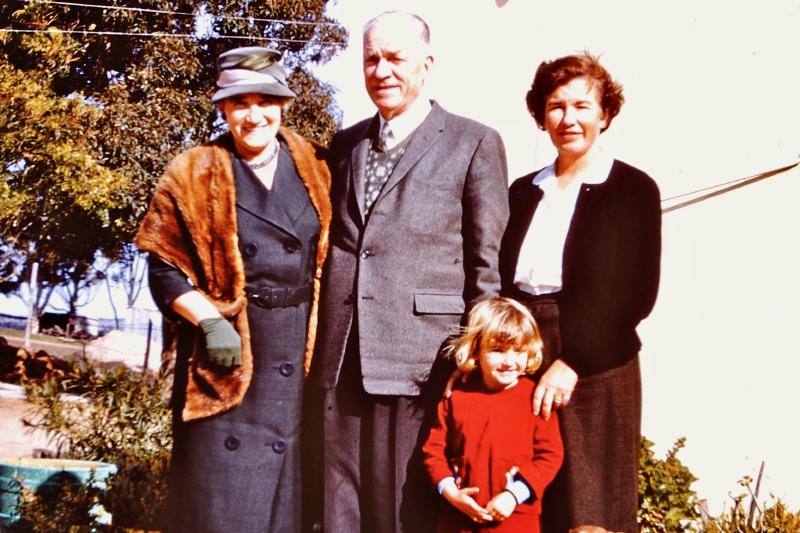
I remember meeting them once, in about 1971. Kerry and I were living in a small house in Maroubra Junction in Sydney, and they kindly visited us. They regaled us, non-stop for what seemed to be three hours, with stories about priests and nuns that they knew, and convents and presbyteries they had visited. They seemed to have the knack of staying at convents when travelling overseas. They had travelled on the same ship as Cardinal Gilroy, a significant anecdote in itself. They were what I would irreverently call, religious groupies. They never once asked about our experiences. I have never forgotten it.
Francis John, known as Frankie as a child, had an unusual childhood. He was born in 1916 in Gympie, Queensland. In 1917 his mother Angela travelled to “Snugborough” in Nathalia to give birth to her next child, Martin, and obviously brought the one-year old Frank with her. When she returned to Kin Kin, she left Frank with the maiden aunts in Nathalia. Honor reports:
So now we were two. As I was the special concern of Aunt Joe, Frankie was taken over by Aunt Sarah. She adored him, and the feeling was mutual. She was “Doonie”, and he was “Poss” or “Little Possum”. He loved her all his life and when she was dying in Victoria at the age of 78 or so, he flew over to be with her. I don’t think he ever got over the fact that she left him nothing in her will, as my mother said, “Not even some rosary beads”.
We have a photograph of Frankie at this time.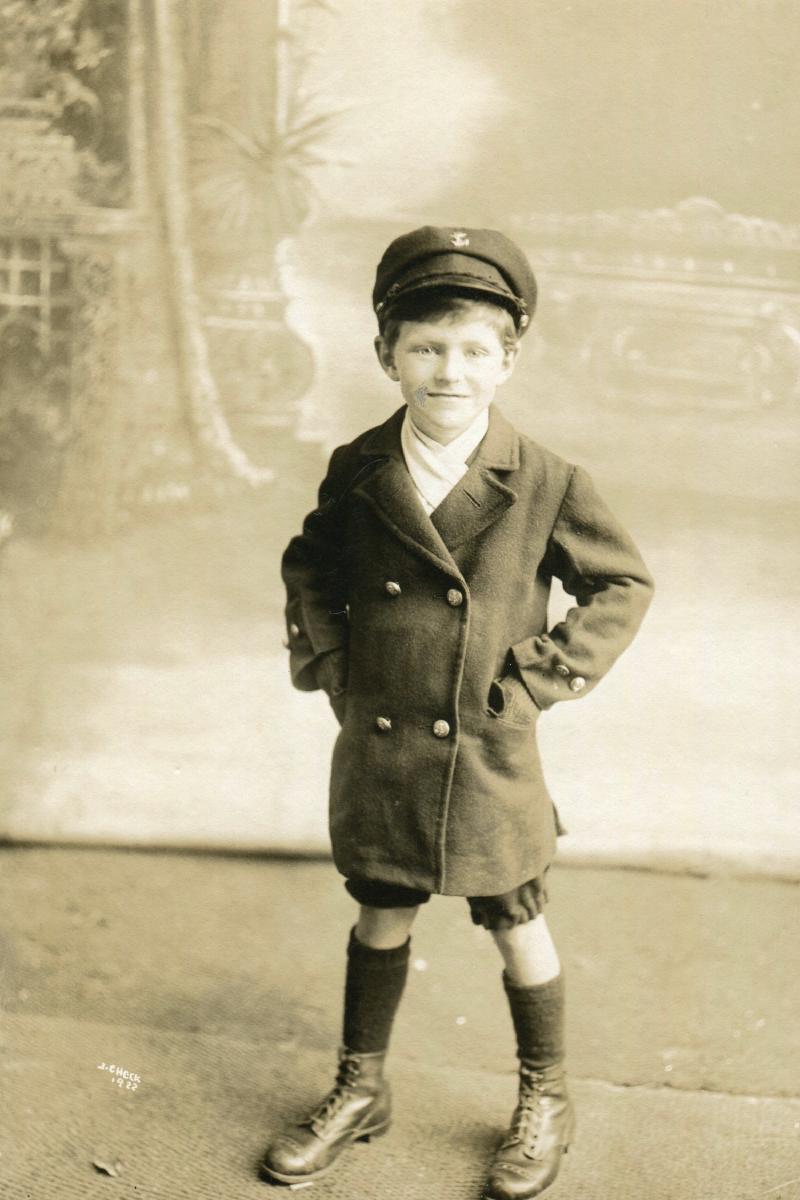
It is not clear that he saw his parents again until 1926, when the family retreated from Kin Kin back to Nathalia. Honor reports of this time:
It seemed that on school mornings Frankie developed what the Aunts termed “his old pain”. No-one seemed to know quite what it was or where it was. “He’s got his old pain”, Aunt Sarah would say, so school must be abandoned for the day. About ten o’clock the pain would be somewhat easier, so that he might partake of some hot milk or perhaps venture cautiously out to play. My mother soon saw through this subterfuge which, of course, was having an adverse effect on his education. She was appalled at his lack of knowledge.
“Sarah”, mother was reported to have said, “Sarah, Frankie doesn’t know his twice times tables, why is this?”
“Don’t ask me”, came the crushing reply, “ask his teacher”.
After nearly twelve months in Nathalia, the family set out for Western Australia. Family legend has it that Frankie was given the choice: to stay with the Aunts or to come with the family. He is reported to have said, “I want to go with Matt” (his brother).
We have two impressive photographs, taken about 1936. Sheila comments:
These photos were regularly displayed at the Perth Royal Show, in the Co-Operative Bulk Handling pavilion.
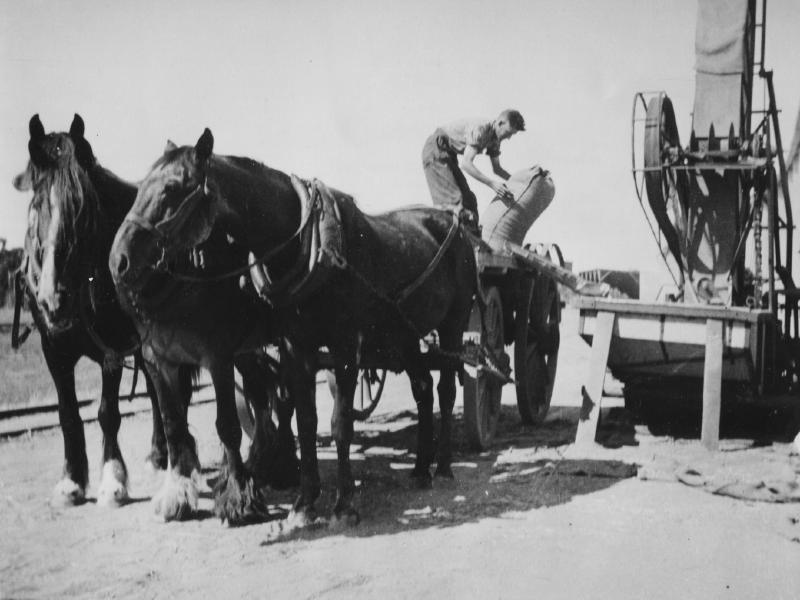
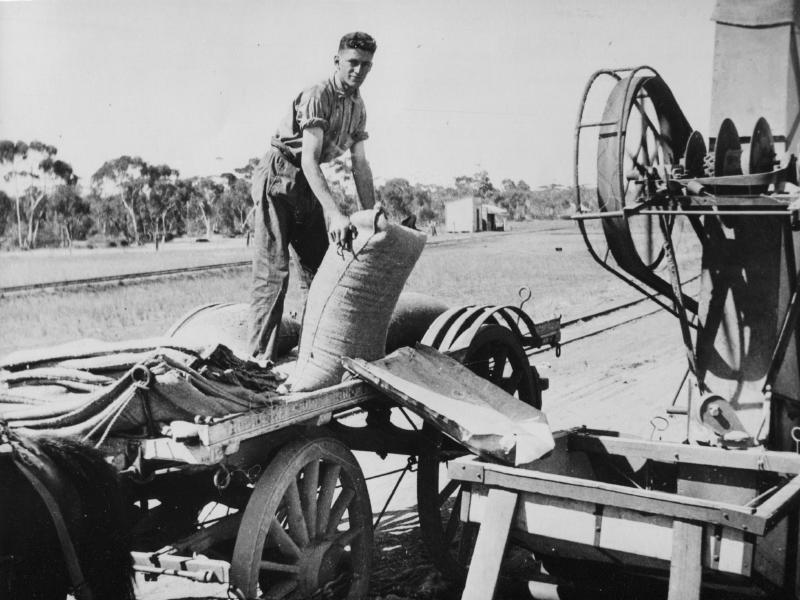
At this point Frank was 21, the eldest of the three boys. Hr had left school at 14 and had been working on the family farm ever since. Martin, aged 20, had completed his secondary education, and was now enrolled at RMC, Duntroon. Ned, the youngest boy (aged 16) had also left school and was working on the farm. Sheila tells us that Frank never received a regular wage. Nor, presumably, did Ned. The farm, like the earlier O’Hare and O’Hanlon farms at Nathalia, was some sort of unspoken family collective.
In 1938 the O’Hare family moved to a somewhat larger farm called Yenelin, south of Cunderdin.
Sheila O’Hare commented:
Frank was in the Australian Light Horse Regiment, but my father who was trying to manage “Spring Dallah” on his own in his late sixties, man-powered Frank out to help him. Frank and I lived with my parents until we were allocated “Nangunia” (a war-service farm) at Quairading in 1948.
Between the wars the 10th Light Horse Regiment was part of the Australian Army Reserve. Indeed
For the first half of the 20th century, due to a widespread distrust of permanent military forces in Australia, the reserve military forces were the primary focus of Australian military planning.
The Western Mail of 22 September 1938 tells us
Light Horse Troop.
CUNDERDIN possesses its troop of “C” Squadron, 10th Light Horse Regiment, which is under the direction of Lieut. D. C. Macpherson, secretary of the local road board, who recently attained commissioned rank. The troop sergeant ls Mr. N. B. Pascoe. There are some 20 local men in the troop, and, apart from local training activities, they annually compete in military events at district shows, including Meckering and Tammin. The troop has had some difficulty in securing suitable remounts. During last month Lieut. Macpherson, the N.C.O.’s, and two selected troopers attended a cavalry training school held at Northam.
For example, the Northam Advertiser of 19 November 1938 tells us:
10th LIGHT HORSE REGIMENT. C squadron.
To-morrow a competition shoot has been arranged with the Cunderdin troop on the Northam rifle range at 11 o’clock. Troops are requested to assemble at the drill hall at 10 a.m. A picnic luncheon will be held on the range, lunch to be provided by each man, and later tea at the Shamrock Hotel, The Commanding Officer of the regiment (Lieut.-Colonel Sweet apple), Captain McLean and Warrant Officers have kindly consented to be present at the function. Every effort has been made to en-sure the success of the shoot, and it hoped that all members of the Northam troop will endeavour to be present.
Things got a little more serious by the end of 1939. The Avon Argus and Cunderdin-Meckering-Tammin Mail of 11 November 1939 tells us:
The 10th. Light Horse Regiment will enter camp at Naval Base next Tuesday for one month continuous training. All members of the Cunderdin troop have received definite instructions regarding loading of mounts and gear. The members travelling by train will leave Cunderdin at 3.10 a.m. and are due to arrive a Spear wood at 10.45 a.m. No doubt a whole month away from the district during the harvest will seriously inconvenience a number of the men, but it is learned that arrangements have been made to minimise this difficulty where possible.
In the end, it all went swimmingly.
Frank’s military record takes a little deciphering. Page 17 shows he voluntarily enlisted at Cunderdin on 3 August 1940, in the 10th Light Horse Regiment. He declares that he willing to serve for three years, within the limits of the Commonwealth of Australia. A medical examination on the same day says he is 5ft 9in tall, weighs 140lb, has good eyesight and is
Fit - apart from having no teeth - recently extracted and no plate yet available.
He then goes home, and waits to be called up.
This process is shown in the main Mobilisation Attestation Form (pages 1-2). Part A is filled out at the initial enlistment (3 August 1940). Part B is a medical examination, done at Bunbury on 24 April 1941 (Frank is fully fit). Part C is the oath of enlistment, done at the same place and date. Finally there is an annotation “Called up FTD 18 Dec 1941”. Presumably FTD means “full-time duties”.
Finally, there is an Attestation Form (page 12), dated 27 July 1942, where Frank agrees to “serve in the Australian Military Forces within or beyond the limits of the Commonwealth”. (Apparently the great majority of the Regiment made this commitment to be potentially sent overseas.)
Finally (page 14) he is discharged on 11 November 1943, with the reason for discharge being “Essential Supply - Farming”.
In the event the 10th Light Horse was not moved from W.A. It was committed to coastal patrol through to 1944, when it was disbanded. We have a photograph of the Cunderdin troop at this time.
We also have two identity photographs for Frank from this time:
here and
here.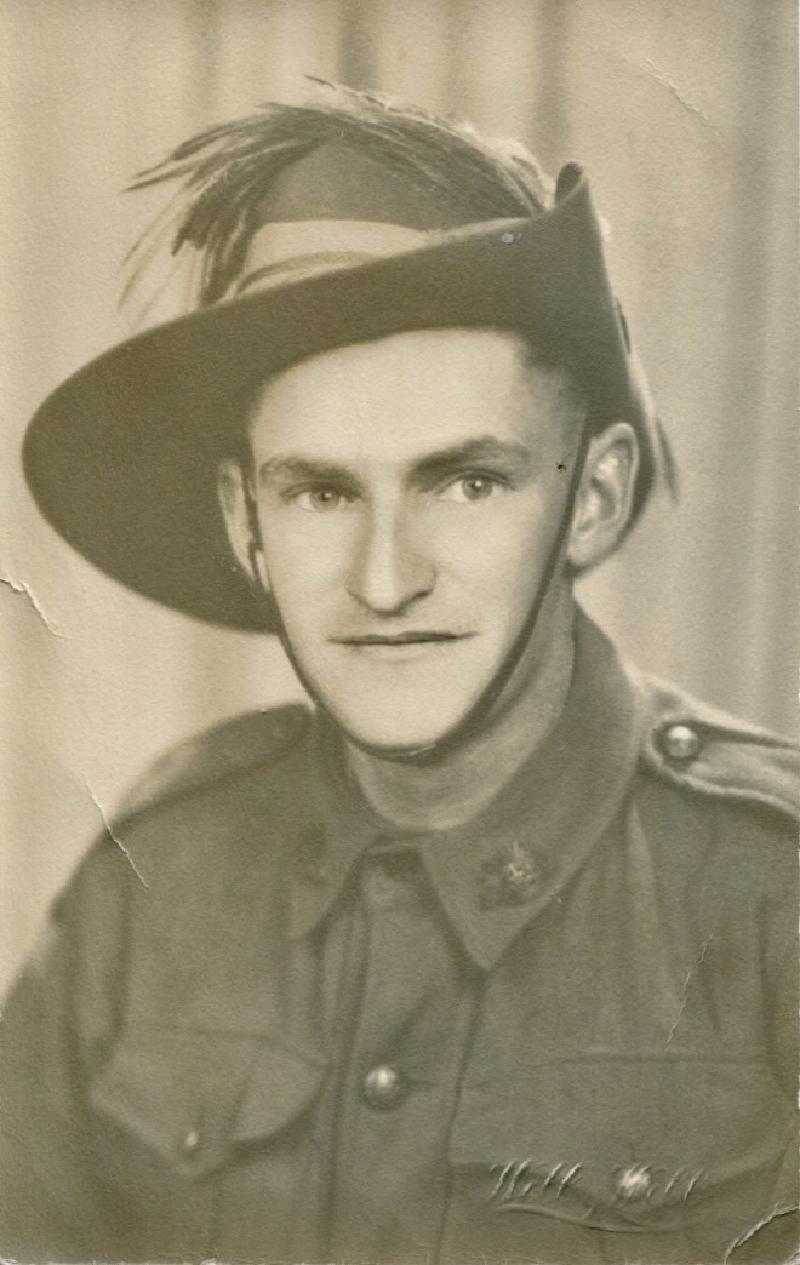
For nearly five years (early 1944 to late 1948), Frank and Sheila lived on “Spring Dallah”, sharing the farmhouse with Sheila’s parents. Sheila tells us that Frank worked under some sort of share-cropping arrangement, receiving the value of the wheat crop. Presumably he helped work the farm right through the year, but did not otherwise receive a weekly wage. As the crops were generally poor, they had a low income through this time. For example, the Sunday Times of 20 October 1946 reports:
Latest reports on the crops from the Rural Bank yesterday were:
Northam, Toodyay, York, Cunderdin, Quairading and Pingelly: A few crops on high country but generally crops here disappointing and show effects of excessive moisture. Yield under normal average.
When Michael O"Hanlon got rid of his horses in 1937 he purchased a Deutz diesel tractor. Apparently it was a dud, and it was forever breaking down, particularly during seeding and cropping. As well, Frank wasn’t the district’s greatest mechanic.
When the O’Hare family moved to Yenelin in 1937, apparently they kept the old farm at Bilbarin. Family legend has it that Frank was “offered the farm” at about this time. However, he did not take up the offer. Or perhaps Sheila was unenthusiastic. It was 100 km away from “Spring Dallah”, and Honor relates that the farmhouse was awful. In the end, Sheila relates that Frank received £2000 “from Bilbarin”, in £500 instalments.
Somewhat in desperation Frank managed to acquire another tractor, a second-hand International, using a war service loan.
And then, Frank and Sheila had a big stroke of fortune. The West Australian of 29 September 1948 tells us:
SIX FARMS ALLOTTED
Allotment of an additional four wheat and sheep farms and two dairy farms under the war service land settlement scheme has been approved by the Minister for Lands (Mr. Thorn). All the properties, with the exception of one indicated, will be occupied on a caretaker basis until the Commonwealth approves the granting of a perpetual lease. Mr. Thorn said yesterday that the successful applicants recommended by the allotment board were: Wheat and Sheep Farms: A423a (Gnowangerup). Ira James Thornton, Gnowangerup: A272b (Quairading). Francis John O’Hare. Balkuling: A453 (Kulin), Thomas Ashley Randall, Jitarning: A558 (Borden). Leslie Albert Geoffrey Black. Gnowangerup. Dalry Farms: A239 (Pemberton). Harold William Daniels. 17 Battle Street. Mosman Park (perpetual allottee):’ A145 (Narrikup). Benjamin Randolph Thomason. Narrikup.
For a history of Quairading, one can do no better than to note the history of the Quairading Farmers Co-Operative Company.
The property itself warrants a heritage listing. This includes:
Statement of Significance
The place is a fine representative example of a farm of its era. The pioneer associations are significant.
Physical Description
Red brick home with a corrugated iron roof.
History
TC Hodgeson took up 25000 acres on a pastoral lease, and later conditional purchase, and called the property “Whitehaven”. Robert Barr took over part of the property from Charles Baxter who retained the homestead portion of the original Whitehaven property. In c1927 Barr built the existing homestead. An old stone dwelling on the property is used as a seed storage area. Together with Whitehaven, Nungunia was purchased by the Government after World War Two, and the property with the original dwelling was allocated to Francis J O’Hare in 1948, under the Soldier Settlement Scheme. The farm is currently farmed by his son Paul O’Hare.
A history of the war service land settlement scheme is available. This particular post-WWII scheme first purchased farms on the open market. However, when values rose it became too difficult to obtain sufficient farms, and the scheme resorted to developing virgin Crown land. Frank and Sheila acquired a farm close to Balkuling, with an attractive farmhouse, in this first phase.
From the history:
The Scheme was based on perpetual leasehold with the right to acquire the freehold after ten years of leasehold occupation. From the inception of the Scheme the basis of valuation was cost and the lessee was to be charged a rental of 2.5 per cent. of cost, thus giving him a great advantage over farmers outside the Scheme, who generally pay between 5 per cent. and 7 per cent. for money borrowed for development.
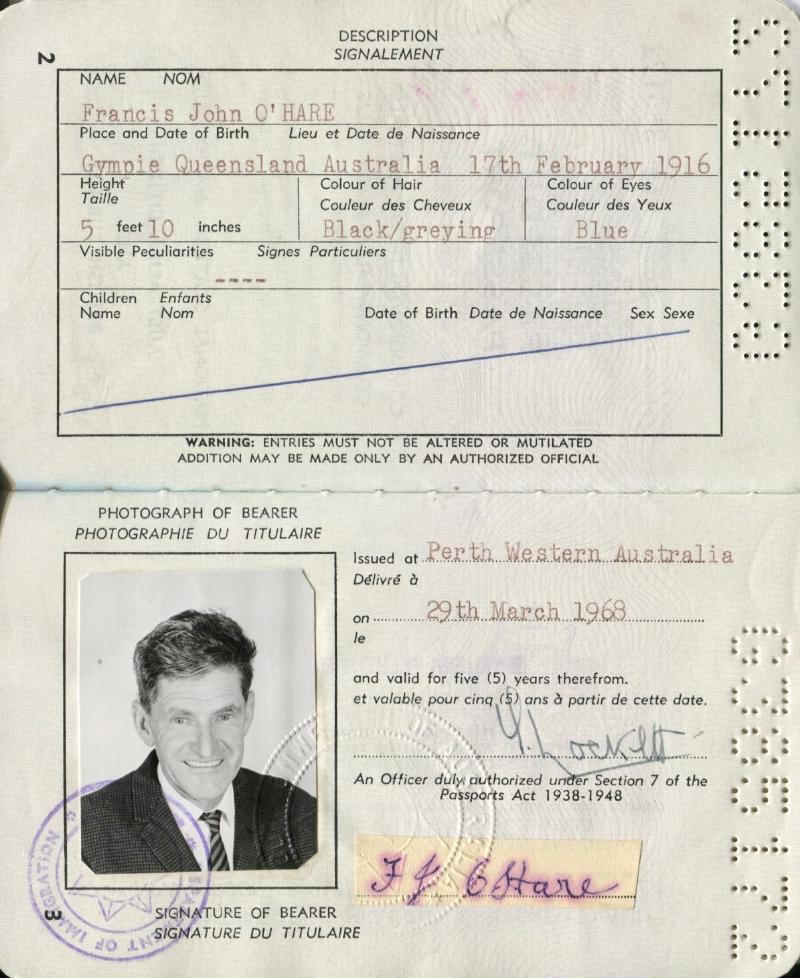
Tragically, Frank was killed on 27 December 1971, on the farm. A newspaper report of the time:
FARM DEATH. A farmer, Francis John O’Hare (54), was killed when he was run over by a tractor while harvesting on his property near Quairading. Police believe that Mr O’Hare was emptying a harvester when he noticed that the tractor was moving. He slipped while trying to pull on its handbrake and was crushed beneath a rear wheel.
The Avon Argus and Cunderdin-Meckering-Tammin Mail of 3 February 1945 tells us:
Miss Honor O’Hare of Cunderdin will commence duties at the Quelagetting school on Tuesday.