Raselli
Table of Contents
Introduction#
Kerry’s maternal grandmother is Catherine Angeline Raselli, known as Angela. Her father was born in the small town of Poschiavo, in the canton of Grisons, in Switzerland. He emigrated to Victoria in 1858. Her mother was born in Ardrahan, County Galway, Ireland and emigrated to Victoria in 1861.
Family tree: Angela Raselli (fullscreen)
We have two family memoirs to help us.
Honor Pusenjak, As It Seemed To Me, Apollo Press, 1982.
Betty Stokes, Brains in Neutral, Tongues in Top Gear, 2000 (privately published).
For the context of Poschiavo and associated emigration we have a Marchesi family website. Indeed, there was Marchesi family member of the same ship to Melbourne as Angela’s father.
Great-Grandparent Generation#
Francis Raselli (1832-1886)#
Pietro Francesco Celeste Raselli (known in Australia as Francis or Frank) was born in Poschiavo in the canton of Grisons in Switzerland. Here Grisons is the name of the canton in English. The official language of the canton is German, and in German it is known as Graubunden.
The births, deaths and marriages records for Poschiavo go back to 1600. They have been microfilmed but don’t seem to be readily accessible from the web.
Poschiavo (in Switzerland) is but 15km from Tirano (in Italy) where my forebears came from. Poschiavo is simply up the valley from Tirano, and to get to the rest of Switzerland you have to go over the Bernina Pass. Hence Poschiavo is culturally tied to Tirano (it is Italian speaking) and the motivations that drove the Tiranese to emigrate in the nineteenth century must have been the same as drove the Poschiavini.
The surname spelling in records is not standardised. Variations are Roselli and Rosella. The birth record for Angela has her as “Catherine Angeline Rosella”, and her father as “Francis Rosella”.
Frank Raselli’s parent and siblings are shown in the following family tree. All this information has been taken from secondary sources. While I have reason to doubt the details, it would be nice to be able to check things.
Family tree: Giovanni Bernardo Raselli (fullscreen)
We have Frank’s parents, their date of birth and the date of their marriage in Poschiavo, but not their date of death. Frank was the oldest of seven siblings, and was born in 1832. The secondary records indicate a marriage in Poschiavo and a child. If this is correct, maybe his wife and their child died of birth complications.
He arrived on the Scottish Chief in Port Melbourne on 8 May 1858, from Liverpool. The news from Liverpool was
Messrs. James Baines and Co. loaded for Melbourne, as their packet for the 5th February, the magnificent clipper Scottish Chief, a beautiful new vessel which has only made one voyage previously, and we understand that her passenger accommodation cannot be surpassed for comfort and ventilation.
Getting from Poschiavo to Liverpool in 1858 was a nontrivial exercise, as the railway network was just starting to be put together. One wonders if coach to Genoa and then steamship to England might have been an option.
On the relevant page of the passenger list he is fourth on the left-hand page. He is listed as age 21, and a “labourer”. As far as I can tell, he was more like 26. One did not have to carry attested documents, and the ship simply accepted your statements of details.
The Mount Alexander Mail of Wednesday 12 May 1858 reported
SHIPPING INTELLIGENCE.
Arrived.
May 8. Scottish Chief, Black Ball ship, 1052 tons, Buchan, from Liverpool, 8th February. 7 cabin and 205 second cabin and steerage passengers.
It sailed from Melbourne on 1 June, for Callao, in ballast.
On arrival, he would seem to have been a gold-seeker, pure and simple. Honor Pusenjak tells us:
When he first arrived he joined the rush to Charters Towers. This failed, and he and hundreds of other who nearly starved had to be brought back to Melbourne at Government expense.
Charters Towers is not correct (gold wasn’t discovered there until 1871) but rushes did fail spectacularly, and many miners on the failed goldfield did not have the resources to extricate themselves.
In the Victoria Government Gazette of 19 July 1860 there is a very long list of ship’s letters lying unclaimed in Post Offices. At New Inglewood there is a letter for
Francesco Raselli
Inglewood was the site of a gold rush in 1859, with an estimated population of over 40,000 in mid 1860. If it wasn’t our Francesco, it is typical of where he might have been.
He finished up on the Caledonian Goldfield, in the Yarra valley only 35km from downtown Melbourne. For a description, see this document pages 12-14. The document refers to mining at Oram’s Reef, at Kingstown. Kingstown was renamed to Panton Hill in 1874.
Honor Pusenjak tells us:
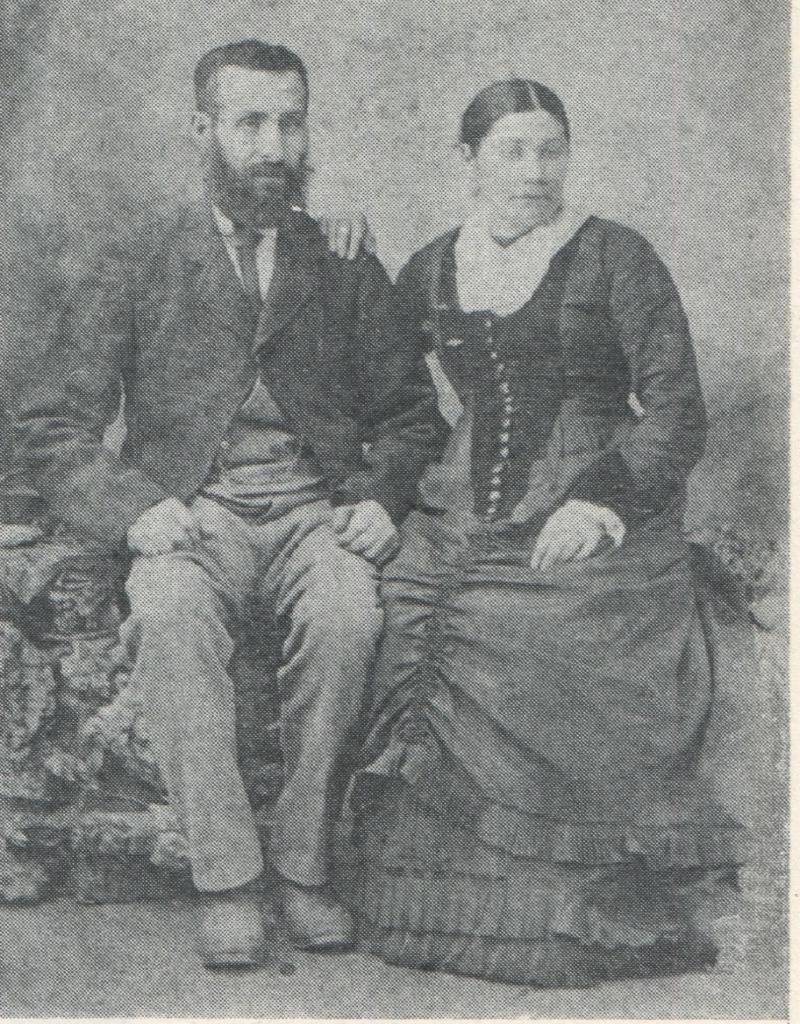
It was in Panton Hill that Honora Quinn met and married Frank Raselli who was employed on the mine. They were married in 1865 at St. Francis Church in Melbourne, she aged nineteen, occupation domestic, and he twenty-eight, occupation digger.
Their real ages would seem to be 25 and 32, respectively. St Francis Church was the first Catholic church in Victoria, and predated the gold rush of 1851.
He was extremely skilled in many ways; he built the house they lived in and made much of the furniture. He had a large orchard, a vegetable garden and kept a herd of goats. Poor they might have been but there was always plenty of good wholesome food.
The Evelyn Observer, and South and East Bourke Record of Friday 7 August 1885 tells us
PANTON HILL, DEBATING SOCIETY. The above society held its usual fortnightly meeting in the schoolhouse, Panton Hill, on Saturday, August 1st. In the absence of the President, Mr. J. B. Borelli, Mr. F. Raselli, sen., occupied the chair. According to notice previously given Mr. R. J. Harris opened the subject, “Which does the most good to mankind, the miser or the spendthrift”.
Honor Pusenjak again:
Alas, this good and interesting and died when my mother was only eight years old after he contracted pneumonia, his lungs being weakened by underground work. He is buried at Panton Hill.
It seems that his younger brother Carlo Antonio also came to Melbourne, two years later than Frank. The passenger list for the P. C. Kinch show an entry for xx. It arrived from Hamburg on 6 November.
Antonio Raselli seems to have married in Melbourne in 1867. I have been unable to track his death record. The family legends do not make mention of this brother.
As well, the family does not have any record of keeping in touch with the Poschiavo relatives. Even with a brother in Victoria, Frank still had five siblings back in Poschiavo.
Honora Quinn (1847-1915)#
Honora Quinn was born in county Galway, Ireland in about 1840. Her parents had a small farm (of some 59 acres) in the townland of Srah, in the civil parish of Ardrahan in the Poor Law Union of Gort. The latter was centred on (and named after) the town of Gort. There are some 4550 townlands in the county of Galway.
Honora’s parents and siblings (and their descendants) are shown in the following family tree.
Family tree: Malachy Quinn (fullscreen)
Honora was the oldest of three siblings. She and her younger brother Patrick Joseph emigrated to Victoria in 1861, while the youngest brother Malachy stayed on the farm. She married Frank Raselli in 1865, and they had seven children. She died in 1915 in Gympie, Queensland, while visiting her youngest daughter Angela.
She and her brother arrived in Port Melbourne on King of Algeria on 18 July 1861, from Liverpool. They are on the passenger list, half-way down the right-hand page. She is a spinster, aged 20, and Patrick is a labourer, aged 18. The ages seem about right.
The Age of 19 July 1861 tells us
HOBSON’S BAY. ARRIVED.—July 18.
King of Algeria, Black Ball ship, 1707 tons, Geo. Brown, from Liverpool, 25th March. Passengers - cabin : Mrs Stone, Mrs Despard, Mrs Brevit and child, Miss West, Miss Smithson, Miss M’Kay, Messrs Downing, Brown ; and 190 in the second cabin, intermediate, and steerage.
A week later, the Age tells us that poor Mrs. Despard didn’t make it off the ship:
DESPARD.—On the 22nd inst., in Hobson’s Bay, on board the King of Algeria, from Liverpool, Mrs. Despard, relict of the late Lieut. Despard, H.M. 17th Regiment, aged sixty-four years.
Mr. Donaldson didn’t last much longer.
DONALDSON.—On 17 August, of the Exford Hotel, Mr. William Russell Donaldson, late of Scotland, aged twenty-three years, arrived by the ship King of Algeria. Funeral this day, at half past two o’clock. Friends respectfully invited.
Honor Pusenjak tells us:
Honor Quinn found work with some French people, Huedes, who kept the Hotel de la France in the small mining town of Panton Hill. She was perhaps more fortunate than some. Her employers were extremely kind to her, they became firm friends and she was given her wedding breakfast at the hotel.
We have a photograph of the Hotel de France taken about 1890. It was built about 1864, and the hotel, store and post office were all under the same roof. A report in the Evelyn Observer and Bourke East Record of 16 September 1904 tells us that the entire building was burned to the ground. It was rebuilt.
It was initially did not have a publican’s licence. The Argus of 8 January 1870 tells us:
Publicans Licences
TO the BENCH of MAGISTRATES at HEIDELBERG
I, JEANNE HUDE, widow, now residing at Panton Hill, in the colony of Victoria, do hereby give notice that it is my intention to apply to the justices sitting at the Court of Petty Sessions to be holden at Heidelberg on the 17th day of January, 1870 for a CERTIFICATE authorising tho issuing of a PUBLICAN’S LICENCE for a house situated at Panton Hill, constructed of wood, etc; contains two sittingrooms and five bedrooms, exclusive of those required for the use of the family. The house is my own, and at present licensed under the name of the Hotel de France. JEANNE HUDE. Jan. 5,1870.
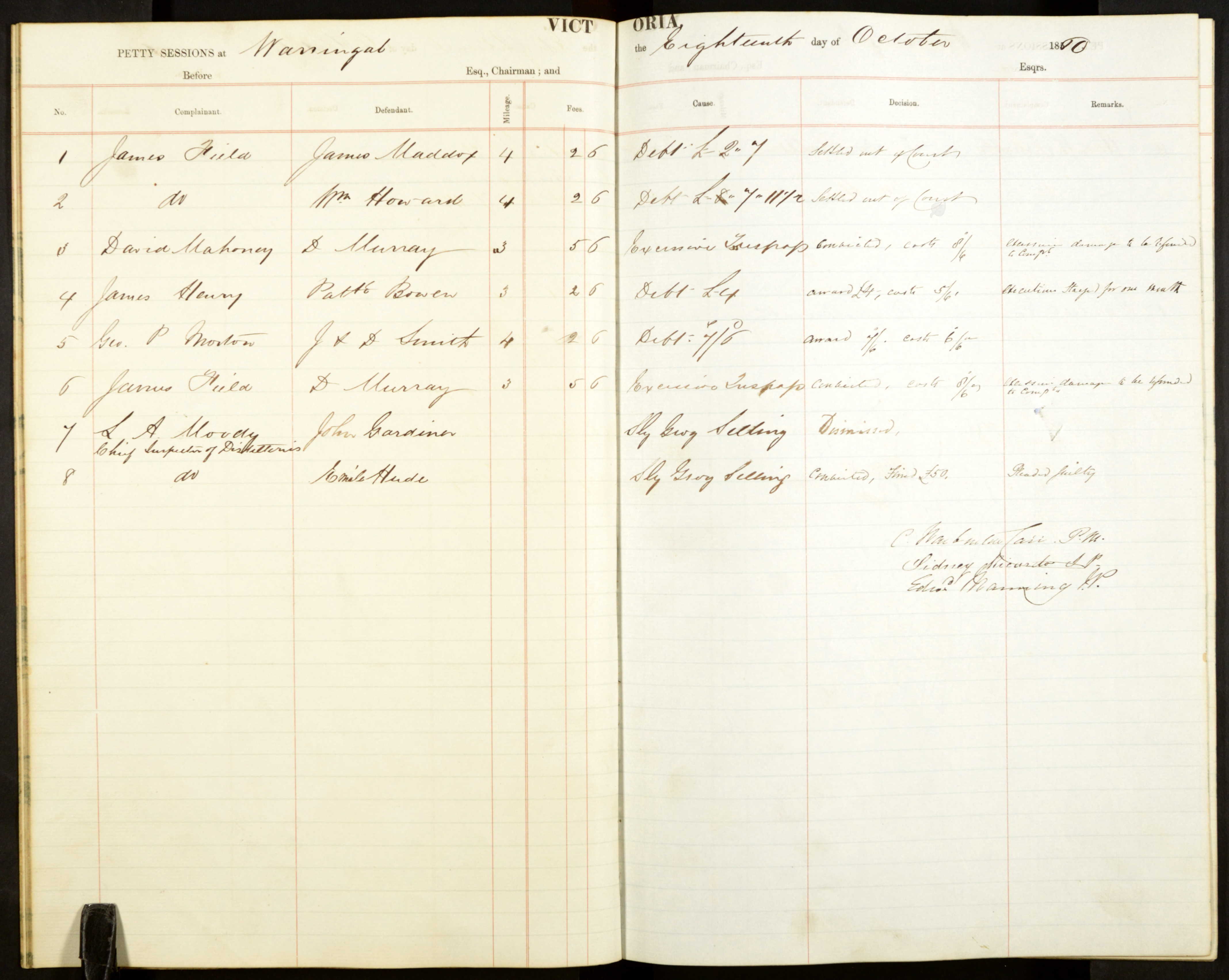
Emile Hude (Jeanne’s husband) was convicted of “Sly Grog Selling” at the Warringal Petty Sessions of 18 October 1860. Here Warringal was later named Heidelberg and would have been the nearest court. He was fined £50, a serious amount.
The Yarra Valley was awash with hotels. This report (pages 3,4) gives an overview, and provides a photograph of the new Hotel de France (1912).
An indication of the Hotel de France in its heyday is provided by the Evelyn Observer, and South and East Bourke Record of Friday 11 December 1885.
CHAMPAGNE DINNER TO J. H. MILLER, ESQ. A very pleasant re-union took place at Mrs Hude’s Hotel De France, Panton Hill, last Saturday evening. According to previous arrangement some 13 or 14 gentlemen drove up in a well appointed 4-horse-drag, and after enjoying the pleasures of a most enjoyable and picturesque drive through Heidelberg, Eltham, and Kangaroo Ground, arrived at Panton Hill shortly after 7 o’clock, perfectly enchanted with the country they had driven through and with the stretch of view and magnificent scenery to be seen from the Hill; all of them acknowledging that when the locality became more known to the inhabitants of the city it must become a favourite place of summer resort.
As some 7 or 8 local inhabitants had been invited, at 8 o’clock some 20 gentlemen sat down to dinner. The dinner, which consisted of five or six courses, was of a most recherche description, and had been prepared by a Frenchman cook, and the guests were waited on by lady waitresses, which added zest to the enjoyment. “Bass,” “Pale,” and " French" wine was plentiful during the repast, and after the toasts and speechifying began, the popping of champagne corks was both sonorous and continuous.
(Many speeches omitted.)
The next toast on the list was one well deserved, “The Hostess, Mrs. Hude,” for it was acknowledged on all sides that a better spread, better got up, and better served could not have been got even in Melbourne. Mr. J. B. Borelli responded at length on behalf of Mrs. Hude.
The time was now fast approaching 12 o’clock. Mr. J. H. Miller proposed in a stirring speech, " The Chairman and Vice Chairman," to which was given the usual musical honors, and was responded to by the gentlemen themselves. After which the party broke up, well pleased with themselves and all the World.
After a good night’s rest the Melbourne party left Panton Hill at 4 o’clock the next day. Each of them resolved that it should not be the last time they visited that picturesque locality.
The following would seem to be a different Hotel de Paris, but is worth including anyway.
A PIG ADVENTURE. — Rather more than three weeks ago Mr Peter Luyckx, of the Hotel de Paris, Chiltern, missed one of his pigs. The animal was sought for in vain, and it was at length concluded that it had been stolen. Yesterday a fowl which had been scratching on a heap of rubbish lying at the top of an abandoned, and partially filled up shaft at the back of Mr Worthington’s shop, was observed to fall down the hole. Mr Berg, the tentmaker, volunteered to descend the shaft, which is now between sixty and seventy feet in depth, and recover the fowl. A rope was procured, and Mr Berg was lowered down the shaft. His exertions were crowned with complete success, for he not only recovered the fowl which had been seen to fall down, but two others which appeared to have been in the hole for several weeks. But the strangest part of the adventure was that Mr Luyckx’s pig was also found, alive, quite uninjured, and apparently in the enjoyment of the most robust health. He was fastened to the rope and hoisted up. When he was landed on terra firma, and liberated from the rope, he trotted off in the most unconcerned manner possible. — Murray Gazette, 2nd July 1861.
Back to the main story. Honor Pusenjak tells us:
With the death of my grandfather, there was nothing for the family in Panton Hill. They moved to Melbourne, taking the first of a series of rented houses in North Melbourne. The boys got work, Frank with an engineering firm. Annie the eldest daughter became a dressmaker and a very good one she was.
Betty Stokes tells us that they later moved to Ascot Vale.
Honora had nearly 30 years as a widow. The Leader of 6 February 1915 tells us simply:
RASELLI. On the 19th January, at Kotoro private hospital, Gympie, Queensland, Honora, relict of the late Francis Raselli, late of Ascot Vale.
Patrick Joseph Quinn (1842-1920)#
Honor Pusenjak tells us:
My grandmother (Honora Quinn) came to Australia because of a brother, Patrick Joseph, who began studying for the priesthood and then decided the religious life was unacceptable and left the seminary. Such was the disgrace of a failed priest for the Irish family, who had probably sent him there at great expense, that he was sent off to seek his fortune in the colonies. My grandmother was chosen to accompany him. “They were not migrants”, my mother used to say with some pride, “They paid their way”.
Having left for the seminary, it probably didn’t suit anyone for him to come back to the family farm. It is not clear why his slightly older sister needed to accompany him. Honora must have wanted to emigrate.
Honor continues:
In his early years he taught in some country schools, but eventually had his own business travelling with a type of hawker’s cart selling articles to shearers and stations in the western outback of NSW.
He never married and always remains a rather shadowy figure, but he kept in touch with his sister from time to time. My mother remembers him calling sometimes and leaving a much-needed £5 note. When he died he left £150 to his nephew Malachy.
Honor places him in Nyngan in NSW, in 1909. He seems to have died in 1920. All I have managed to find is the following which may be him:
THE SUPREME COURT OF NEW SOUTH WALES. – Probate Jurisdiction.
In the Will of PATRICK JOSEPH QUINN, late of Rookwood State Hospital, Lidcombe, in the State of New South Wales, Retired Miner, deceased. Application will be made after fourteen days from the publication hereof that Probate of the last Will and Testament of the above named deceased may be granted to THOMAS RICHARD BOEHME, of Wellington, in the said State, Engine-driver, one of the executors named in the said Will leave being reserved to ERIC MAXWELL, the other Executor named in the said Will to come in and provide the same. And all notices may be served at and all claims against the said Estate must be rendered to the undersigned within the said period of fourteen days. Dated this second day of November 1920. WILLIAM PATRICK KELLY Proctor for the Executor Wellington By COLLINS and MULHOLLAND 77 Castlereagh street Sydney.
The Quinn Relatives in Galway#
According to our family tree, Honora and Patrick left a brother in Ardrahan. Honor tells us:
There seems to have been little subsequent contact with the family in Galway but when Uncle Michael and Auntie Lal visited Ireland in the 1960s they rediscovered long-lost relations still living in Ardrahan. My mother’s first cousin, his wife and family were still living at the farm in Srah at that time.
My wife’s cousin visited in 2025, and took notes of an updated headstone:
In loving memory of Malachy Quinn
Shragh
Died 7th August 1874 aged 72 years
His wife Mary Ann nee Ward
Died 28th January 1901 Aged 87 years
Their son Malachy died 25th January 1908 Aged 55 years
His wife Bridget nee Hallinan
Died 24th July 1944 Aged 76 years
Their sons John died 6th August 1913 Aged 10 years
Thomas died 13th June 1966 Aged 78 years
His wife Mary Kate nee Killeen
Died 7th March 1994 Aged 80 years
Their sons Tommie died 4th December 1961 Aged 12 years
Malachy died 12th July 2014 Aged 74 years
Rest in Peace
We have the relevant entry from the 1901 census of Ireland. When Malachy died in 1908, the six children were aged from 21 to 9. We also have the entry from the 1911 census of Ireland, showing the widow Bridget with five children still at home. We have a notice of his will, but not the details.
Honor Pusenjak tells us:
One of grandmother’s cousins was shot by the Black and Tans as she sat nursing her baby in front of her house during that period of Ireland’s long troubled history.
This is surely Eileen Quinn and the event happened in November 1920. Reference 9 of that Wikipedia article says that she lived in the townland of Corker, which is about 1km away from Srah. Her husband was (yet another) Malachy Quinn. I have not been able to determine the exact relationship to Honora.
Her death was commemorated in 2020. A grandson (a Professor of Law) published this article and a grand-niece provided a podcast.
Grand-Parent Generation#
This generation of the Raselli’s is a story of fascinating family dynamics. Assuming the family moved to Melbourne in 1887 (just after the father Frank died), the children were aged 21, 19, 17, 14, 11 and 9. They lived as a family unit, with them all working as they left school. Presumably they had a workable way of contributing to the household expenses. Honor tells us:
Annie was an excellent dressmaker and the girls were always well dressed, thanks to her nimble fingers.
There was a major depression in Australia in the 1890s, second only to the Great Depression in the 1930s. It was particularly felt in Melbourne. A little more detail is provided here. In particular
The metropolitan population declined for some years after many unemployed left for the new goldfields in Coolgardie and Kalgoorlie.
Jack and Malachi left for WA about 1897, as did Annie after she married John Young the same year. That left Frank and the two youngest girls Teresa and Angela, with Honora, and the single household continued. About 1903, Teresa went to WA, to help sister Annie run the family store and hotel in Vettersburg. The 1903 Electoral Roll has Annie and her husband, Malachi and Teresa all in Vettersburg. From about 1905, Annie started placing her children back at the family home in Melbourne, for schooling. About that time, John Young seemed to have bought a “large house in Ascot Vale” for them all to live in. Nonetheless, grannie Honora and Angela presumably had to wrangle the kids. Angela left in 1912 to marry, and Annie fetched the kids back to Perth.
That left the bachelor Frank at home with Honora. She died in 1915, while visiting Angela in Gympie. Frank seemed to have lived in Melbourne until retirement in 1930. Presumably John Young sold the house and bought one in Perth. On retirement, Frank moved to Perth and lived with his sister Annie.
Francis John Raselli (1866-1944)#
The West Australian of Thursday 18 May 1944 had three notices:
RASELLI. On May 17, 1944, Francis dearly loved brother of Annie (Mrs J. Young), John (deceased), Malachi, Theresa (Mrs P. J. Leyden), and Angela (Mrs O’Hare, Cunderdin) aged 77 years. RIP.
RASELLI. The Friends of the late Mr Francis Raselli of 73 Woolwich-street. West Leederville, are respectfully invited to follow his remains to the place of interment, the Roman Catholic Cemetery. Karrakatta. The Funeral is appointed to leave Messrs Bowra and O’Dea’s Private Mortuary. 195 Pier street. Perth. at 2 o’clock THIS (Thurs day) AFTERNOON. arriving at the Cemetery at 2.20 o’clock.
RASELLI. Amalgamated Engineering Union (Perth Branch). Members of the above are respectfully invited to attend the Funeral of their late Member, Mr F. Raselli, which will take place in the Roman Catholic Cemetery, Karrakatta at 2.20 o’clock THIS (Thursday) AFTERNOON.
He was obviously a good union man.
Mary Ann (Annie) Raselli (1868-1977)#
Honor Pusenjak tells us:
Auntie Annie was the first to marry. Her husband was John Young whose people were from Panton Hill. Annie and her husband came to the goldfields where he had a hotel in Vettersburg and interests in sandalwood cutting. They prospered but unfortunately the premises and most of the contents, including a grand piano, were destroyed by fire. They then moved to Comet Vale and supplied wood for the mine.
Annie married John Young in Melbourne in 1897. He was a widower, with one surviving child (Doris Emily), who was 12 years old when he remarried. He was a “timber carter”. Directly after their marriage they moved to Vetters Find, later called Vettersburg, in WA. Where is Vettersburg, I hear you cry. About 8km north of Bardoc, itself 48km north of Kalgoorlie. Vettersburg was never a proclaimed town, but was a stop on the Kalgoorlie to Menzies railway, which opened in 1899. About as far from the urban living of Melbourne as you can get.
The www.outbackfamilyhistory.com.au website entry for Bardoc makes interesting reading. The Bardoc Postal Directory for 1899 shows John Young as proprietor of the Vettersburg Hotel.
Vettersburg only existed because of the Slug Hill Gold Mine. This article provides a history of the mine, which operated from 1898 to 1908. The hotel and store serviced what passing trade there was, and the mine community, which was said to number about 60.
The opening of the mine triggered a speculative flurry. In the Broad Arrow Standard of 19 February 1898 John Young advertised that he was applying for a publican’s general licence for a premises he was about to build. In the 23 February 1898 edition of the same paper there were another two such advertisements. They were all taking a punt on the mine being successful, and wanted to get in early.
The Broad Arrow Standard of 12 March 1898 reported progress:
Licensing Court. BROAD ARROW, MARCH 7TH, 1898.
Bridget Leyden applied for an eating house for premises at Vettersburg. Mr. Brown appeared for applicant. Granted.
John Young applied for a provisional certificate for premises about to be erected at Vettersburg, near Bardoc. Mr. McIntyre for applicant. The applicant stated that he had complied with the provisions of the Act. The house is in course of construction, and the main part will be finished in a few days. The framework is up and half the roof on, and 3 1/2 in walls are erected ; will be finished by end of the week. Present population of Vettersburg is about 60. There is no licenced house at present, the nearest being at Bardoc, about 5 miles away. Have not held licence before. Have means to complete the house, and will give a bond to finish within one month. Adjourned till March 16.
W. G. Cross applied for a provisional certificate for a house to be erected at Vettersburg, near Bardoc. Refused.
The affairs of the Vettersburg Hotel seem to be a moving feast. In Aug 1901 one Henry William Brown advertises that he is applying for a Wayside House Licence for premises at Vettersburg that “he is renting from John Young, and containing two sittingrooms and two bedrooms”. It is not clear if this application proceeded. In Aug 1904 Malachi Patrick Raselli advertises that he is applying for a Wayside House Licence for
house and appurtenances thereunto belonging, situated at Vettersburg. and now liccnced under the sign of the Vettersburg Hotel, and which license I now hold under transfer from John Young.
Again, it is not clear if the application proceeded.
On the same page, John Young advertises that
I intend to apply at the next Licensing Meeting to be holden for this district for a Provisional Certificate for the premises belonging to me, and situated at a point on the Kalgoorlie to Menzies railway, about six chains south of the- 400-mile peg, and being Business area No 54W, within the said district. The premises are now about to be erected, and will, when finished, be in all respects in accordance with the requirements of “The Wines, Beer and Spirit Sale Act, 1880” and the Acts amending the same.
The 400-mile peg reference places the proposed new hotel in the metropolis of Broad Arrow.
In any event John Young had long since unloaded the Hotel by 1908. The Kookynie Press of 6 June 1908 tells us:
COMET VALE APPLICATION REFUSED.
Isaac Joseph applied for a provisional certificate for premises at Comet Vale. Mr Ackland appeared for the applicant. Mr Maxwell appeared to object on behalf of the present licensee, whilst Sergeant Stokes objected on behalf of the police.
Isaac Joseph deposed he held a license at Vettersburg, and had held license on the goldfields for nearly 11 years. The place cost him £800. When he took it over there were about one hundred men there. He owned a block of land at Comet Vale. If his license were granted he intended to use as much of the Vettersburg building as possible. The population of Comet Vale was about 115 all told. He had been asked by Comet Vale residents to make an application on the ground that they did not go to Fitzpatrick as he was not liked. In his opinion further hotel accommodation was required. He guaranteed to carry out the building in accordance with the plans and specifications. The mining prospects at Comet Vale were good. There were three batteries there and another about to be erected. There were two good mines there. All necessary notices had been posted. Witness (cross-examined), deposed he inquired about the population. He knew there was a travelling public. One of the batteries was idle.
Sergeant Stokes deposed the population at Comet Vale was 75 males, 10 females and 15 children.
James Patrick Fitzpatrick deposed he was licensee of the only hotel at Comet Vale. He had three bedrooms available for the public. He was able to supply all the requirements of the place. He estimated the population at 79. Witness (cross-examined), stated he had one boarder and lodger at his hotel. There was no truth in the statement that there was fighting at his hotel. He never threatened anyone with a gun.
Sergeant Stokes objected on the ground that the place was not required.
The Bench refused the application as the evidence showed that another license was unnecessary.
Honor Pusenjak continues:
They prospered (in Vettersburg) but unfortunately the premises and most of the contents, including a grand piano, were destroyed by fire. They then moved to Comet Vale and supplied wood for the mine.
There was a disastrous fire at Broad Arrow on 11 February 1904 involving five buildings. Maybe that was the fire Honor refers to.
John Young was in Comet Vale in 1913, according to a report:
Escape from Death. An almost miraculous escape from death (our Comet Vale correspondent wrote) occurred to a boy named Willie Bain yesterday afternoon. It appears that the boy was riding in a wood-dray owned by Mr. J. Young. By some means he fell from the dray unnoticed by the driver. The first intimation of the boy’s absence was a cry. The driver at once pulled up, but not before one of the wheels had passed over the boy’s body. The lad was picked up in a semi-conscious condition and it was feared that he was injured internally. Fortunately, however, after receiving attention, he was found to be little the worse for his unpleasant mishap.
The 1917 Electoral Roll has Annie, John (“contractor”) and Malachi (“horse driver”) in Comet Vale.
He was still in Comet Vale in 1921, according to the Comet Vale Post Office Directory 1921, listed as a contractor.
The 1925 Electoral Roll has him in Mundaring Weir, again as a “contractor”. Malachi is there too, as a “woodcutter”. They seemed to have a house in Leederville, where Annie lived with the children.
He died in 1925. The West Australian of 1 July 1925 had two reports:
YOUNG. On June 30, at Northam, suddenly, John Young, beloved husband of Annie, fond father of Mrs. W. Vance (Doris), Evelyn, Kathleen, Jack, Maggie, Frank, aged 64 years. R.I.P
YOUNG.The Friends of Mr. John Young, of Mundaring, are respectfully invited to follow his remains to the place of interment, the Roman Catholic portion of the Karrakatta Cemetery. The Funeral is appointed to leave his late residence, 73 Woolwich-street, West Leederville, THIS (Wednesday) AFTERNOON, at 3 o’clock, arriving at the Cemetery at 3.30 p.m. Friends wishing to attend the Funeral may proceed by the 3 p.m. train from Perth.
But back to Annie. Honor Pusenjak tells us:
Annie had five children, Evelyn, Kitty, Jack, Maggie and Ned. At the age of about five or six, Kitty and Evelyn and later Jack were sent to Melbourne to live with Grandma Raselli and my mother because the goldfields climate was said to be too hot and their education was a problem. Jack Young bought them big house in Ascot Vale where my mother lived until she married. The other children later returned to WA and attended boarding schools.
The West Australian of 7 April 1951 reported
YOUNG: On April 5, 1951, at her daughter’s residence (Dumbleyung), Annie, dearly beloved wife of the late John Young, loving mother of Evelyn, Kathleen (Mrs. S. West), John, Maggie (Mrs. E. Dart), Ned, loving step-mother of Doris (Mrs. D. Vance), fond mother-in-law of Stan, Mary, Eric, also Alma and Bill (deceased). Requiescat in pace.
Giovanni Bernard Raselli (1870-1898)#
Honor tells us:
Jack died young, a victim of the scourge of the goldfields, typhoid fever, and is buried in Kalgoorlie. He was rarely mentioned afterwards by the family. He was the only son to marry, somewhat hastily it seems, and he had a son whom my cousin Kitty West remembers visiting them in Melbourne and little notice being taken of him. He, along with his mother, appear to have been assigned to oblivion by the family, probably because of the hurried marriage.
The Kalgoorlie Miner of 13 October 1897 has the following advertisement:
ENGINEER wants position as Winding Engine-Driver or Engineer in charge of mining plant ; first-class W.A. certificate ; 11 years’ experience; good papers. Apply, stating wages, to J. B. Raselli, Norseman, W.A.
It is clear that he was a skilled tradesman, pursuing his trade, rather than a gold-seeker as such.
He died in May 1898, and is buried in the Kalgoorlie cemetery, along with his brother Malachi.
Malachi Patrick Raselli (1873-1944)#
Perhaps Malachi went to the goldfields with his brother Jack, perhaps about 1895. In any event he is in Bardoc and Vettersburg with his sister Annie and brother-in-law John Young. We indicated above that he may have been persuaded to get involved with the Vettersburg Hotel, if only until a suitable buyer was found.
Honor tells us:
Mal lived for many years at Bardoc, fossicking but never making his fortune. I remember him as a rather small gentle man who would come once a year and spend his holiday with his sister Annie in Perth. He would play the violin, which he probably taught himself. Poor Uncle Mal, he would never leave the Goldfields and died there in tragic circumstances.
We can track him through his entries in Electoral Rolls. In 1903, 1906 and 1910, he is in Bardoc as a"miner". In 1917 he is in Comet Vale (a “horse driver”), and in 1925 he is in Mundaring Weir (a “wood cutter”), working with, or for, his brother in law. After John Young died in 1925, he must have gone back to the goldfields. In 1931 he is in Larkinville, as a “prospector”. This is perhaps the last of the WA gold-rushes, triggered by the find of the largest nugget ever found in WA (some 1135 oz. or 32.1 kg). By 1937 he is back in Bardoc, as a “prospector”.
The Kalgoorlie Miner of 26 December 1944 tells us
LOST IN THE BUSH
Old Man’s Death PROSPECTOR FOUND BY NATIVE TRACKERS
On Saturday the post mistress at Bardoc notified the Kalgoorlie police that Malachi Patrick Raselli (71) was missing from his camp, but might have gone to Perth to see his sister. He had not left Bardoc by train, but might have got a lift with a passing motorist and joined the train at Kalgoorlie. Inquiries at the Kalgoorlie railway station showed that no one answering the description of the old man had left by the express that day.
As Raselli had not returned to his camp, Constables Blackman and Rosich were detailed to make a search and left late on Saturday night for Bardoc. About 7 o’clock on Sunday morning, assisted by native trackers, Tommy and Nora, they picked up tracks and followed them from the camp. After travelling some miles the tracks led over very rough country and the police were forced to leave their car. In the rough, hard going Nora proved very much superior to her man in the art of tracking and unerringly led the party on. About 10 miles from the camp the old man had abandoned the suitcase he was carrying. At 1.40 p.m. yesterday Raselli was found near the old Broad Arrow-Ora Banda track, some 10 miles from Broad Arrow. He was in a very advanced stage of exhaustion, but appeared to revive when given a drink of water.
Mr. W. Chisholm, of the Bulletin Group, lent his utility truck, in which the wanderer was brought to Broad Arrow, where he was met by the St. John ambulance and conveyed to the Kalgoorlie District Hospital, where he died about 8 o’clock on .Sunday night, from exposure and starvation. In all he had walked approximately 25 miles after leaving his camp.
This account raises more questions than it answers. How far out of Bardoc was his camp? Why was he walking to the railway station? How on earth did he get lost, in country with sparse vegetation, essentially flat, that he obviously knew like the back of his hand? Why weren’t the trackers afforded the courtesy of a surname. After all, it was Constable Blackman, not Constable Bill.
Malachi became that standard goldfields character, the solitary prospector. Life somehow passed them by, and they continued a solitary existence, forever fossicking for the next find. On average, they must have “made wages” with their small finds. Heavens knows, their cash needs must have been low. Accustomed to their own company, they slowly let their life ebb away.
Virginia Theresa Raselli (1876-1951)#
After Malachi, Jack and Annie had left for the West, there was Frank, Teresa and Angela at home with Honora.
Honor tells us:
Aunt Teresa also went to the goldfields to assist auntie Annie in the store and hotel.
There is a “Miss T. Raselli” on the passenger list of the Kanowna, which arrived in Fremantle on the 9 March 1904.
At Vettersburg she met Pat Leyden, a relieving officer in the Post Office whose parents and sister Mary had come to Vettersburg from Camperdown (in Sydney) and ran a boarding house.
Pat Leyden must have been at the Post Office in Bardoc - there was no Post Office in Vettersburg. They were married in Melbourne, in 1910.
The Mirror of 18 November 1910 reported:
The “Australasian” of last week contained the following wedding notice :—
On September 7, at St. Brendan’s, Flemington, by Rev. Father Rohan, Patrick, second son of the late Patrick Leyden, of Camperdown, to Theresa, second daughter of the late Francis Raselli, of Panton Hill. Present address, Lawlers, W.A.
Patrick and Teresa had three children. Teresa died in 1951. The West Australian of 17 November 1951 reported:
LEYDEN: On Nov. 16. at her residence, 70 Gardner-street, of Como, Therese Virginia. beloved wife of Patrick Joseph Leyden, loving mother of Gerald (Melbourne), Margaret (Mrs. Lee) and Grace. fond mother-in-law of Patricia and Peter, grand-mother of Margaret, Richard and Johanne.
Angela Raselli (1878-1973)#
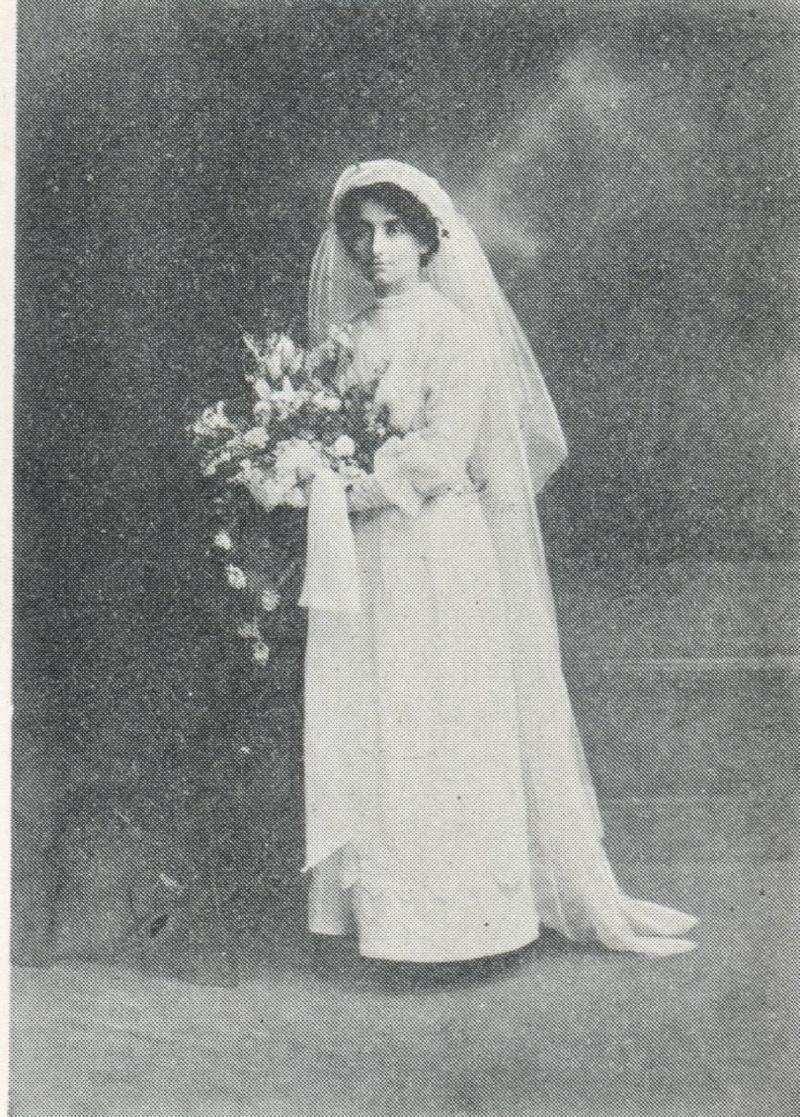
She seemed to have a slightly ambivalent relationship with her children. When Honor was born in Gympie, in 1913, Aunts Joe and Kath (her sisters-in-law) came to help and when they returned they took Honor back to Snugborough. Angela came to Snugborough for the birth of her third child Martin (in 1917) and she left her second child Frank (born in 1916) there as well when she returned. So she had two children in Nathalia and one, the baby, in Kin Kin. Around 1921 a cousin from WA, Kathleen Young, came through Melbourne on her way to Kin Kin, and delivered Honor (but not Frank) back to her parents. In 1926 they were forced to leave Kin Kin, and the family retreated to Snugborough. Frank, aged 10, would not have known his parents and met his brothers for the first time.
Honor tells us of two Angelas.
The first involved her time in the collective Raselli household in Melbourne. She was first a dressmaker (perhaps not a very enthusiastic one) and then a teacher in a catholic school. After contributing to the household she must have had some discretionary spending, because she attended a wide range of opera and musical theatre. She had a wide range of friends, including school friends Cissie, Rose and Maggie Brown who were cousins of the Nathalia O’Hares. Through them she must have met her future husband Martin.
Honor tells us:
My mother made many friends. She was possessed of a strong and vivacious personality, was a good conversationalist, and was always ready for fun and outings. She saw practically every grand opera and worthwhile stage play that came to Melbourne. She also remembered being taken to art exhibitions by her elder brother Frank. Their lack of secondary education did not prevent them from appreciating what was good in literature and art. My mother knew many operatic arias, Rigoletto was a particular favourite, while Uncle Frank was practically a self-educated botanist.
The second involved her life as a farmer’s wife.
Honor again:
She seems to have suffered a complete sea-change or, in this case, a land-change. Gone was the gay young woman who laughed with the Browns and went to operas. Instead there emerged a being full of grim determination to “get on”, to save, be thrifty, to pay off the overdraft; goals she ruthlessly pursued for many years to come.
She had a strong dominant personality and her wishes were seldom disobeyed. Only by thrift and austerity could her goals be achieved, especially to escape the clutches of “The Bank”. The Bank loomed over us like some actual monster, ready to pounce. Allied to the bank was “The Mortgage”, equally to be feared, which appeared to swallow all the hard-earned money.
She was a widow for twenty years. After her husband Martin died in 1953, she moved to Comer Street in South Perth. There a collective family household was created in miniature. Her eldest daughter Honor moved back around 1951 with her young son, and three generations lived there for many years.
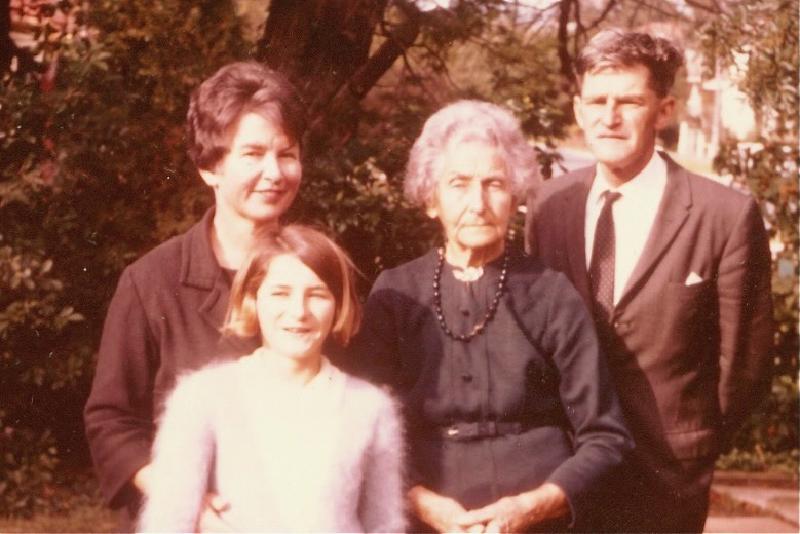
I met her but once, in 1966. She did not have a twinkle in her eye, nor a smile on her face. She looked at me rather darkly, as I had designs on her eldest granddaughter.
Second Cousins#
The lack of marriage of the Raselli males has resulted in this surname disappearing from the family. The marriage of the Raselli females has led to relatives with the surnames: Young, Leyden, West and Lee.
When I first joined the O’Hare family these relatives were invariably described as “cousins”. I was unable to work out how the relationships fitted. I trust that the family trees in this section have made it clear. Most of them are second cousins.
Misc#
There are no articles to list here yet.